A Brief History of Thai-Japanese Art Exchanges

Given our recent focus on Thai-Japanese relations, I thought I would share some excerpts from a translation I did about a year ago on the topic. The essay was written by a Japanese scholar as part of the catalog for the Show Me Thai museum exhibit at the Museum of Contemporary Art Tokyo.

Art Exchanges Between Thailand and Japan in the Modern Era

by Masahiro Ushiroshoji

Thailand and Japan in the Early Modern Era

Thailand is the only Southeast Asian nation to have escaped Western colonization. Squeezed between the balance of power between the British Empire, which merged Burma into British India and brought the Malay Peninsula under its control, and France, which controlled the Indochina peninsula, King Mongkut (made famous in the movie “The King and I”) and King Chulalonkorn succeeded in their modernization policies and in keeping the country independent. The turning point in modern Thai history came in 1932 with a coup d’etat, whereupon the nation of Thailand started on the road modernity as it became a constitutional monarchy similar to Japan under the Meiji emperor.

Thailand’s modern art, distinct from its neighbors in Southeast Asia that became colonies of the Western powers, developed under the art policies of the government, which aimed to create a nation state. In this sense Thailand’s experience mirrors Japan’s modern art. More specifically, Thailand invited a foreign expert from Italy named Corrado Feroci, among others, to build a national school of fine arts (Rongrien Praneetsilpakam) in 1933 (which in 1943 became Silpakorn University). As a modern nation, there was a need to quickly train Thai artists, especially sculptors, to build the Democracy Monument to commemorate the democratic coup, and the “Victory Monument” intended to celebrate Thailand’s victory in a war with France, as well as monuments to the king. Since then, many Thai artists have emerged from this art school.

What is crucial to note when considering Japan’s role in Thai art history is the presence of Japanese artists in Thailand before and during the Pacific War. The Thai government invited not only Western advisors but also Japanese advisors in various fields. Accordingly, records remain of gakou (artisans specialized in painting) and choukokushi (artisans specialized in sculpting) dispatched by the Ministry of Education to Thailand.

There were three Japanese artisans/ artists who taught at Rongrian Poh-Chang — lacquerware artisan Sakae Miki, Western-style painter Niro Yokota, who joined Rongrian Poh-Chang as a teacher in 1930 and opened the school’s bamboo craftwork course.

Thai Students in Wartime Japan

It was rare for Thai students to study in Japan before the war, but Jitr Buabusaya stands out as an early pioneer.
In November 1941, Jitr, who had hoped to study in Europe, ended up in Japan since Europe was in the middle of the World War II. Ironically, Japan entered the Pacific War a mere two or three weeks after Jitr arrived in the country, and his five years in Japan coincided with the war he tried to avoid.
jitr-pic03.jpgJitr was born in Bangkok in 1911. He studied at the teacher training course at Rongrian Poh-Chang, and after more than a decade of teaching experience went to Japan on a Thai education ministry a scholarship. In Japan, he studied oil painting and sculpture at Tokyo Fine Arts School. It is often noted as historical fact that he studied oil painting under Kunzo Minami and sculpture under Fumio Asakura, but Jitr himself professes that he did not study under any one specific master.

As one of the few foreign students to come to Japan from Southeast Asia, Jitr was invited to events held throughout the country, such as the opening ceremony of the Kanmon undersea locomotive tunnel. He painted gorgeous scenes of Japan, rich with seasonal beauty, using his travels as inspiration. In 1942, Jitr held a solo exhibition at the Nichido Gallery and planned an exhibition in his home country as well. But tragically, most of his works, which would have served as important artifacts in the history of Thai-Japanese relations, were burned in bombing raids, and Jitr was only able to bring a few small pieces back to Thailand. Still, it is possible to glean from his remaining body of work that he had mastered portrayal of external light in the impressionist style as seen in his brilliant paintings of Japan’s vistas. Impressionism was not yet known in Thailand at the time, and Jitr is credited as the painter that brought the impressionist style to his homeland.

Jitr’s Artistic Contributions and Japan

Jitr returned to Thailand in 1946 to find the Poh-Chang school building destroyed in a bomb attack. He worked to rebuild the school and served as its headmaster. Jitr modeled the school after the Tokyo Fine Arts School where he himself had studied. He was impressed by Japan’s teaching methods, which struck a balance between Western influence and Japanese tradition, and used them to structure the school’s curriculum. He added new courses, including anatomy, composition, color theory, and art history.

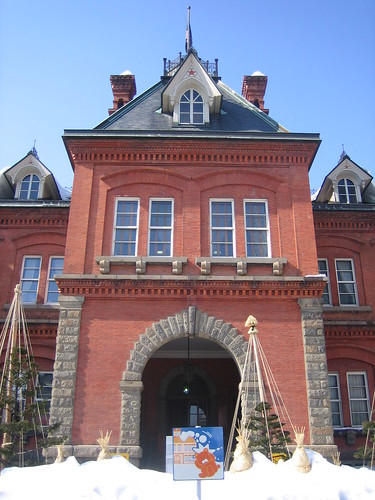
Outdoor nature sketching also came into practice under his leadership. Moreover, Jitr designed the school building by himself — it was erected in Japanese-style mix of Japanese and Western convention known as the “Imperial Crown style,” only with a twist: he added a Thai-style roof to a Western structure.

Jitr’s art studies in Japan were in line with the Thai government’s goal of establishing an art system, and took place within the framework of public art administration and the training of art teachers. But Jitr the painter brought the impressionist style that took root in Japan after the establishment of the Hakubakai in 1895 which was the first Western style painters’ group in Tokyo, and from the mid-1940s to the early 1950s, Jitr provided the opportunity for French impressionism, imported via Japan, to take the Thai art scene by storm. In the late 1950s, Fua Hariphitak’s cubism made an impact among Thai painters, quickly pushing impressionism into the annals of history, but Jitr’s role in the history of Thai-Japanese art exchange will not be forgotten.

Postwar Exchanges: From Prints to Modern Art

On Jitr’s heels came many postwar artists who went to Japan to study, mainly printmakers. This group returned home after learning Japan’s advanced woodblock techniques and played a key role in the development of printmaking in Thailand. The pioneer artist who studied abroad was woodblock printmaker Praphan Srisouta. Srisouta was more interested in Japanese traditions, not in the latest printmaking techniques. Born in Lamphun in the Northern region of Thailand, he went to Japan in 1964 after studying at Silpakorn University. He reportedly spent most of his time studying Ukiyo-e woodblock prints by famed masters such as Hiroshige.

He journeyed from Japan to Germany before returning home in 1967 and went on to gain notoriety for his first solo show,
which showcased 90 of his original woodblock prints. These prints, which were dually influenced by Thai temple mural paintings and Ukiyo-e, portray the daily lives of children and feature vibrant depictions of people and beautiful black and white contrasts, and are considered some of the most precious masterpieces in all of Southeast Asia.

In recent years, Thailand’s modern art has received increased exposure in Japan, ushering in a new era of art exchanges between the two countries. Notable among these artists is Montien Boonma, who is often exhibited in Japan. His installations, which reflect an almost meditative Buddhist mindset, have remained popular even after his sudden death.

One artist of the younger generation has set in motion yet another new turning point in Thai-Japanese art exchange. That artist is Navin Rawanchaikul, who is married to a Japanese woman and works out of Fukuoka, Japan and Chiang Mai. Navin is not content to simply work out of this regional Japanese city. He closely examines the Fukuoka community where he lives and creates pieces that deal with issues within it.

These works have in turn allowed him to become involved in the Fukuoka community. He will continue to be watched as a new harbinger of Thai-Japanese interchange whether from the perspective of a teacher, learning as a foreign student, or showcasing his art.
Nifty finds 40% of Japanese blogs are SPAM

One of the key doubts about Japanese blogging activity that I expressed in my last real post almost four months ago was that it seemed that an inordinate number of accounts on major blogging sites were nothing but spam generators:

Basically, [a Technorati report claiming that Japanese was the most prevalent blogging language] counted the number of submissions, so dead blogs don’t count, and since it is Technorati, I am sure lots of spam blogs ended up being counted (seriously, go try a blog search on Technorati Japan right now!).

Now it appears I have been vindicated in my claim. CNet Japan reports that Japanese web portal Nifty has announced findings that a full 40% of Japanese blogs are set up as nothing but ad platforms to suck up clicks and affiliate bonuses. The announcement coincides with the release of an auto-filter developed for Nifty’s proprietary blog hosting service.

A Nifty-affiliated research body randomly sampled 100,000 blog entries per month using the filter between October 2007 and February 2008. Over the five-month period it was determined that “40% of domestic blogs are spam blogs.”

While the definition of “domestic blog” is unclear, the sheer volume (and any time spent surfing the Japanese net) should tell you that spam blogs are a major problem. And considering that the original Technorati figure put Japanese-language blogs ahead of English by a mere 1%, I am content to conclude that Japan is most certainly not the world’s top blogging nation, putting the statistics more in line with reality.

Who knew Bhutan could be so kinky?

While reading about Asia’s newest self-proclaimed democracy I did a double-take at the following factoid:

Bhutan’s first democratically elected prime minister will be Jigmi Thinlay, a charismatic politician who has portrayed the DPT as the party of ordinary Bhutanese. His rival, Sangay Ngedup, leader of the rival People’s Democratic Party (PDP), is the brother of the previous king’s four wives, all sisters.

(Note to readers: I know my last couple of posts have been frivolous. Many apologies. This stuff is just too amusing not to blog.)

Another Seattle anecdote from my notebook

March 10

Stop in a local cafe across from the Pike Street Market. Need some cash. As I use the exorbitantly overpriced transaction fee laden ATM a man sitting at a table located directly between the dor and the counter begins speaking. He is somewhat indistinct, but he is saying something like:

“I used to get three hundred dollars a day out of these cash machines. [[something about buying or selling cocaine, unclear]] and you could get out $300 a day without a transaction fee. You got a transaction fee on that one?”

Long white hair and beard, flannel shirt and jeans. 55-65 years age, long slightly pointed nails, with visible dirt underneath. From California originally, he has been in Seattle for 7 years. No matter how one responds, he continues his stream of consciousness elocutions, your own contribution affecting the flow of monologue barely more than a pebble tossed into an actual stream.

“Are you a local?”

“No, I’m visiting some friends here. From New Jersey.’

“Oh,  year Jersey- interesting state. My dad was from outside Toronto, little place near a farm seven miles outside of town.”

“Uh-huh…”

During the 3-5 minutes I am in the cafe, he tells me his favorite pie is key lime blackberry but recommends against carbanero-the hot pepper. I am unclear if this is somehow pie related, but if so I must admit it sounds like a terrible recipe. His favorite restaurant had some sort of meal platter involving a rosemary chicken breast for only $7.50, he sometimes eats two for 13 dollars. He offers to treat me to this lunch as I am already trying to pleasantly say goodbye and head out the door, which I am slowly inching towards. There is no recognition whatsoever of my attempts to politely break off conversation, so I walk out the door, words at my back.

The coconut chai is delicious.

Later, I meet my friend Brian for lunch as he takes his break from work a couple of blocks away. We eat at an Ethiopian/African restaurant which I notice has a dish involving rosemary chicken for $7.50, but I am more in a fish mood. For $8 is it excellent, with some sort of green sauce which looks like, but does not taste like pesto.

Raelians in unexpected places

You may remember I posted a few months ago about the highly curious billboard by Nagoya’s central train station sponsored by the alien/free-love Raelian movement. They do pop up in odd places. I was looking through Wired magazine’s gallery of photos from Japan’s “Adult Treasure Expo” and noticed this somewhat curious photograph, accompanied by rather more curious text.

Clitoraid is an non-profit organization set up by the Raelian Movement to help women around the world who have suffered genital mutilation. The Raelians promote an “adopt a clitoris” campaign and claim to facilitate surgical clitoris reconstruction. The woman on the right of the photo is wearing a clitoris costume.

Genital mutilation doesn’t seem to be a big issue in Japan, and the Realians’ adoption of the issue is a mystery. There are several serious nonprofits around the world trying to stop genital mutilation. The Raelians are best known for claiming to have cloned the first human baby, without offering proof.

If you look at Clitoraid’s web site, you can find the following text:

 Following the announcement made by Dr Foldes, OBGYN in France, stating that women and children of all ages who have suffered the atrocities of clitoral excision, or female genital mutilation the equivalent of male castration in its barbarity, now have the possibility to regain sexual pleasure and be whole once again, thanks to medical advances and scientific progress. Rael, the spiritual leader of the Raelian Movement decided to help as many women as possible to regain their sense of pleasure and founded Clitoraid, a private non-profit organization with the aim to sponsor those women who want to have their clitoris rebuilt.

Considering the huge number of Burkinabe women who are candidates to be operated on and as Clitoraid received offer from a few doctors to travel to Bobo Dioulasso and help rebuild the clitoris of all the circumcised women, the Prophet Rael declared: “Instead of using Clitoraid’s collected money to operate on just a few women, we should create the first Raelian Hospital, the “Pleasure Hospital”, and operate on all African women, for free, with the help of Raelian or non-Raelian benevolent doctor”.

While offering medical aid to victims of genital mutilation is certainly a laudable goal, I am slightly disturbed that the motivation is because their space alien-inspired prophet told them to. Then again, how is this really different from any other religion?

Fun economic indicator: Women’s hair styles

Following up my post on the stock market’s effects on Sazae-san viewership, I wanted to show you something fun I saw in the Nikkei:

Friday, February 15, 2008
Women’s Locks Hold Key To Forecasting Economic Outlook

TOKYO (Nikkei)–Women tend to wear their hair long when the nation’s economy is up and short when it is down, a survey conducted over the past two decades by consumer goods manufacturer Kao Corp. shows. As concern grows about a possible economic downturn, will this hairstyle trend repeat itself, or will something new happen?

Kao has been regularly surveying the hairstyles of 1,000 women on the streets of Tokyo’s Ginza and Osaka’s Umeda districts since 1987. In 1991, the firm defined “short” hair as above the chin, “medium” as above the collarbone, “semi-long” as above the armpit and “long” as below the armpit.

Taking the “short” and “medium” categories together as “short” and the “semi-long” and “long” categories as “long,” the long-short ratio for women in their 20s turned in favor of “short” in Ginza for the first time in 1997. The diffusion index of coincident economic indicators, published by the Economic Planning Agency (now the Cabinet Office), reached zero in November and December of that year, the first two-month streak of that kind in five and a half years. The economy is thought to be deteriorating when the index drops below 50%. That year also saw a boost in the consumption tax and a series of major bankruptcies, including that of Yamaichi Securities Co., and in 1998 the economy contracted.

Until 1990, over 60% of women in their 20s kept their hair long. But since 1997, the percentage of women wearing long hair has remained under 10%. That figure has been rising again lately, but without the briskness that would signal a return to past levels.

How has the length of women’s hair, assuming a linkage with the health of the economy, influenced related businesses? The market for hairstyling products, such as hairsprays and gels, are estimated to have peaked in 1994 at 102.5 billion yen in terms of shipments. Then it showed year-on-year decreases for a while, along with falling per capita spending on styling products. Although about 80% of women continued to use those products, they used them less frequently, switching sometimes to products like waxes for the tips of the hair. The market hit bottom in 2004 at 59 billion yen, ending a “lost decade” for hairstyling products.

Though the longest economic expansion since the end of World War II has continued, the consumer confidence index fell for 10 months running to hit a record low for six years and one month in January, according to the Cabinet Office’s Economy Watchers survey released on Feb. 8. With many observers talking about a downturn, Kao’s data suggest that women’s hair will likely get shorter again.

“Women’s hair may get shorter, but shorter hairstyles will not dominate,” said Kotaro Nuriya, brand manager at Kao’s Premium Hair Care/Hair Make Group. He bases his view on the fact that a growing number of women are pulling their hair together in the back or up, as in the chignon style. Kao began including the chignon in its survey in November 2002, and its use has risen 10% to about 30% among women in their 20s recently.

hairnni20080215d15hh90301.gif

While it might not be surprising to see that women are forced to make choices on which cosmetics to use when they are low on disposable income, it’s funny how predictable this survey makes it seem. Also, this so-called boom time has still been one of low economic growth and has occurred at a time when wages remained stagnant for Japanese overall and growing economic disparity has been an overarching theme, especially in the past two years. With prices rising now during a period of economic slowdown, I’ll have to be on the watch for more faux-expensive hairstyles. They will go great with the cheap clothes/expensive bag look that’s so popular these days.

PS: I wonder if the beehive was the product of a booming economy?

Fishing with poison

Upon seeing the photo Joe posted of a sign prohibiting kinds of fishing that no one should ever engage in, I was somewhat skeptical at the prospect that anyone might actually try and catch fish using poison. Well, I was wrong. The NYT today has a rather distressing account of Jamaicans catching shrimp in just this manner.

And in the Blue Mountains and John Crow Mountains here, people go fishing by dumping poison in the Rio Grande.

Any toxin will do. Some favor the pesticide used to keep insects off the coffee plants. Others use the potent solution used to rid cows of ticks. When subjected to the poison, the shrimp — large and small — float right to the top. So do the fish. Catching them is as easy as scooping them up before the river washes them and the poison away.

“You have to put all morals and conscience aside, and then you throw a toxic pesticide in the river,” said Kimberly John of the Nature Conservancy, which is leading an effort to stop what it considers the principal threat to the ecosystem. “It’s a very cold, hard reality to put poison in the river, and whatever jumps out, you catch.”

If I read many more articles like this, I may have to start reconsidering eating food at all.

Falun Gong theatre in New York

The NYT has a rather funny article about New Yorkers who attended what they thought would be a traditional Chinese New Year theatrical spectacle at the Radio City Music Hall, but ended up seeing a very different kind of show.

Then the lyrics to some of the songs, sung in Chinese but translated into English in the program, began referring to “persecution” and “oppression.” Each time, almost at the moment a vocalist hit these words, a few audience members collected their belongings and trudged up an aisle toward the exit.

Before long came a ballet piece in which three women were imprisoned by a group of officers, and one was killed. At the end of the number, more members of the audience, in twos and fours and larger groups, began to walk out. At intermission, dozens of people, perhaps a few hundred, were leaving.

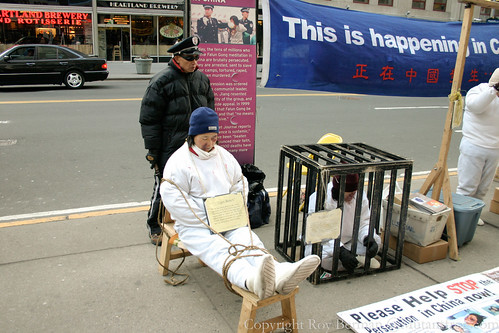
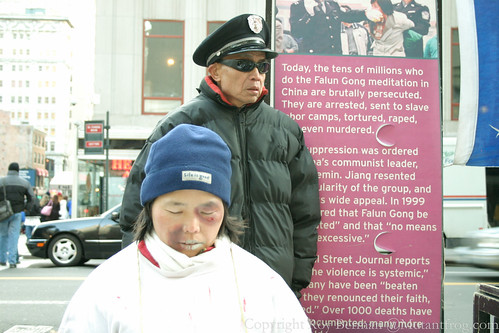
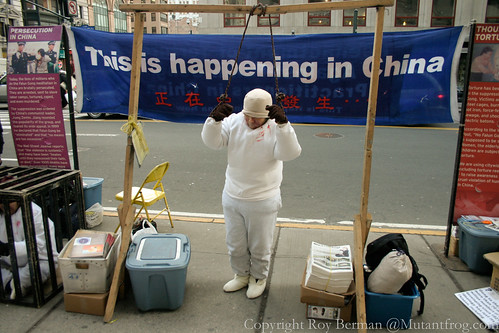
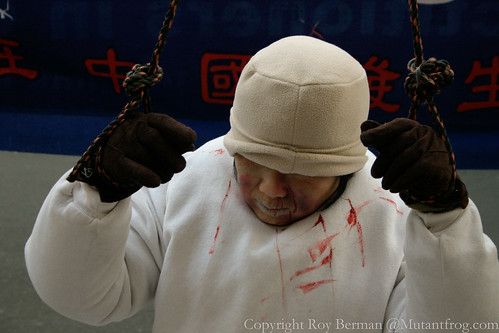
They had realized that the show was not simply a celebration of the Chinese New Year, but an outreach of Falun Gong, a spiritual practice of calisthenics and meditation that is banned in China. More than three years after flooding city corners and subway stations to spread the word about the Chinese government’s repression, Falun Gong practitioners are again trying to publicize their cause. Only this time, it involves costumed dancers and paying audiences in that most storied of New York concert halls, Radio City.

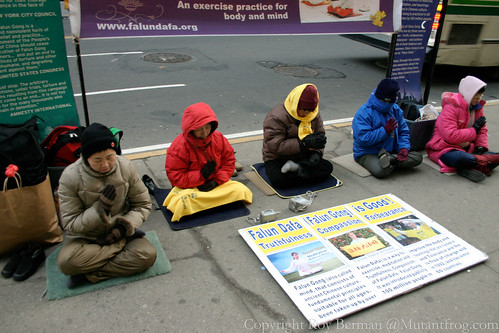
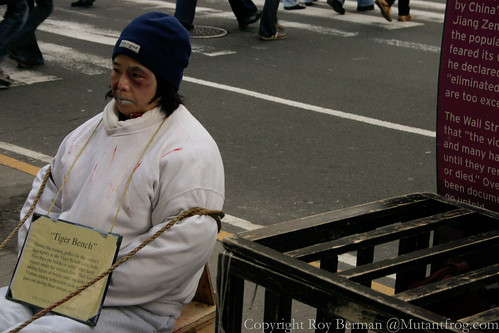
The article then goes on to mention that Faul Gong is well known for their elaborate street theatre protests around the city, in which they use props and stage makeup to dramatize the torture their compatriots are undergoing in China, as they hand out literature on the subject. Here are some photos I took of one such protest back in May of 2005.

IMG_9400

IMG_9401

IMG_9403

IMG_9404

IMG_9405

IMG_9406

Has anyone ever seen something like this anywhere besides New York? I saw Falun Gong protesters in Hong Kong, by Victoria Bay, and handing out flyers and DVDs outside of Taipei’s National Palace Museum (prime location to find tourists from the mainland) but never anything like this sort of dramatic reenactment.