
This is what life at Mrs. Adamu’s house is all about: a tiny dog, sitting on a low couch, and two newspaper subscriptions. Life is good.

This is what life at Mrs. Adamu’s house is all about: a tiny dog, sitting on a low couch, and two newspaper subscriptions. Life is good.
Quiz time! What percentage of Tokyo is non-Japanese?
Answer: 2.93% – that’s the percentage of registered foreigners in Tokyo as of January 1, 2007 (an increase of 1.8% over last year), says Shukan Toyo Keizai. That means that 3 out of every 100 people you see in Tokyo are foreign (one of whom could be a white dude staring at the Daily Yomiuri [picture courtesy STK]). There are 371,000 registered foreigners among Tokyo’s overall population of 12.69 million. The information comes from a “population movement survey” conducted by the Tokyo Metropolitan Government.
 Top nationalities:
Chinese – 126,000
Korean – 109,000
Filipino – 31,000
Most foreign districts:
Shinjuku-ku (where Tokyo’s Koreatown is located): 30,000
Adachi-ku: 21,000
Edogawa-ku (home to Indiatown in Nishikasai): 21,000
Tokyo’s foreign population has surged 2.5-fold over the past 20 years, going from a mere 150,000 in 1987 to the present 371,000 (18.5% of the estimated 2 million registered foreigners, or about 1.5% of the total population).
These numbers may just be the tip of the iceberg. The ‘registered’ foreigners are merely the people in the country legally for purposes other than tourism, some of whom are temporary visitors who have no intention of making a life here. But many do plan to (there were 349,804 permanent residents that are not zainichi Koreans/Chinese as of 2005). According to Immigration Bureau statistics, there were approximately 190,000 people illegally residing in Japan (presumably concentrated mainly around Tokyo) as of 2006. Though the number of illegal immigrants has decreased as controls have gotten stricter over the years, Japanese manufacturers have no intention of turning back from their use of cheap, often illegal, foreign labor to stay competitive as the numbers of Japanese workers decrease and fewer people are willing to take such jobs. On top of that, other industries, including the medical, restaurant, and agricultural industry are eager to expand their use of foreign labor.
While many of the legal immigrants were educated at least partly in Japan (and in the cases of Chinese and Koreans, their families may have been in the country for 3 generations or more) and lead normal, middle class lives, the conditions for illegal workers in Japan can be downright dreary. A recent government-produced documentary depicting the daily activities of immigration officials features a scene in which the “Immigration G-Men” break up a textile operation in a small Tokyo apartment that was making handbags for local consumption. The workers are Korean, speak poor Japanese, and look like they rarely leave their work stations. Even among legal residents of Japan, many are “trainees” at manufacturing companies whose “training” consists of full time work on an assembly line for low pay.
The regular publication of statistics like these, and the regular, adversarial reporting of developments in this issue, should remind the public as well as the authorities that real “internationalization” based on economic interests, rather than the abstract concept of peace, cooperation, and English study that is usually associated with that term, has already arrived in parts of Japan, making it necessary to adjust and respond. Recently publicized cases of some issues facing foreign laborers, such as abuse in the “trainee” system the difficulty that children of foreign residents face in getting an education, have resulted in increased attention by the authorties, and even some incremental reform. Justice Minister Nagase is heading efforts at the ministry to provide a legal framework to tap unskilled workers, a move that would give legal credibility to the current practice but at the same time would give the foreign workers rights and proper status. The Ministry of Education has begun requiring children of permanent residents to attend school.
These are necessary steps forward, but I feel like the current developments facing foreign residents in Japan have yet to receive the top spot on the agenda that they deserve. Back in 1990, Japan began a program to accept Brazilians of Japanese descent as temporary guest workers. I wasn’t around at the time, but it’s clear that the issue received very wide coverage that I think helped prepare people mentally for the small-scale but significant change in policy. Today, with the foreign population exploding (by Japanese standards), where are the public opinion polls, dramas featuring foreign laborers, rants by unqualified political commentators, etc etc?
Corporate-led Social Revolution
Generally, Japan’s immigration policies are much more liberal than the US – in the rare case that you speak Japanese fluently and have connections within the country. For the rest of the world, Japan’s immigration policies focus on attracting skilled foreign workers in areas such as computer programming where Japanese skills aren’t enough to meet demand. Some industries, meanwhile, are calling for an addition to that policy of allowing more low-skilled workers in to either fill shortages or drive wages down. The most recent victories for advocates of such policies were the “free trade agreements” signed with the Philippines and Thailand, which will allow foreign nurses and chefs, respectively, to work in Japan. However, the Japanese side insisted on language requirements that guarantee virtually no significant numbers will be let in.
This is a radical change for Japan, which has traditionally coddled its low-skilled workers with decent wages and living standards and kept out large numbers of non-Japanese foreigners. Like the US, Japan has a valuable currency and lots of industry, making it an attractive destination for low-skilled workers. Bringing in lots of foreign unskilled labor would make Japan’s immigration structure more like the US, which imports millions of unskilled laborers with poorly enforced immigration laws while making highly skilled jobs very difficult through unofficial barriers such as difficult licensing requirements and tight visa quotas. From the perspective of an average citizen who wants to see the best people in the right jobs, I would advocate opening up the books for all levels of jobs. The US situation is a nightmare for both the illegal immigrants from Mexico who have no prospects back home but must leave their families and live as an outlaw to support their families in the US, and the Americans who have seen low-skilled jobs with decent pay evaporate as a result of the immigration and outsourced manufacturing.
Japan, meanwhile, has relied almost exclusively on what the Japanese government coyly calls “international division of labor” and less on importing labor. Large Japanese corporations are major investors around the world, particularly in China and SE Asia, and employ hundreds of thousands if not millions throughout the region. This decision by the Japanese companies no doubt increases the supply of labor for the companies and allows them to save on wages. But Japan managed to avoid the US situation by maintaining stable employment in domestic industries such as service and construction, sometimes at the expense of efficiency or economic rationality.
But the business community has changed its tone over the years, and now the two top business lobbies, the Keidanren (made up of manufacturers) and Keizai Doyukai (a more brazenly neo-liberal group of top executives), are calling for massive importation of labor to avoid a drop in GDP due to the shrinking native work force that will accompany Japan’s population drop to 100 million by 2050.
No more – Economic analysts have been pointing out for years that Japanese consumer consumption is low relative to other developed countries, and that poor consumption is holding back Japan’s GDP growth. The low consumption is blamed on two factors – deflation that makes people delay large purchases, and stagnant wage growth – the latter of which Morgan Stanley economist Stephen Roach argues stems from the “powerful global labor arbitrage that continues to put unrelenting pressure on the labor-income generating capacity of high-wage industrial economies.” In other words, Japanese labor is in competition from foreigners, a prospect that means money for the global corporations but hardship for the domestic workers.
Japan’s media has been sensitive to this issue, if a bit reluctant to blame it on globalization. Economic disparity between the rich and poor (known succinctly as “kakusa” in Japanese) has been a persistent buzzword over the past 2 years. A host of phenomena – growing income disparity, the collapse of stable employment and the rise of fluid ‘temporary’ employment, a jump in the welfare rolls, the rise in prominence of a new wealthy class, the bankrupt finances of local governments, the near-collapge of the social insurance system, low economic growth for more than a decade, a shrinking/aging population, and on and on – have given average Japanese people the sense that the future looks rather dim.
Now the manufacturing interests, among others, are calling for more foreign labor to come to Japan, and as we’ve seen above it is on its way, putting perhaps more pressure on the average worker. But in my opinion this is only a problem if only labor is allowed to be fluid while corporations with stable management and shareholders reap the profits. Highly skilled laborers such as lawyers, doctors, professors, journalists, and especially corporate managers/investors should be allowed into Japan. Allowing a full spectrum of business opportunities into Japan, which with a highly educated population, peaceful society, and hyper-developed infrastructure, would allow for a wealth of more business and labor opportunities.
But of course that’s a silly proposition. The stewards of Japanese society will continue to hoard the top positions and continue making hypocritical appeals to racial harmony out of one side of their mouths when it comes to reform of corporate boardrooms while pushing for internationalization of cheap labor from the other side. Like it or not, the choice average citizens have is how to deal with the situation that’s been thrust upon us.
Where East and West meet
It’s easy to see a disconnect between, say, the interests of English teachers, IT workers, and businessmen that make up the bulk of Japan’s semi-permanent Western population, and those of the “low-skilled” world of immigrants from Asia.
But that would be wrong. Apart from entry requirements and visa stipulations, Japanese law treats all foreigners basically the same. And while perceptions of foreigners is different based on skin color and culture, the rights of foreigners and the level of their acceptance in Japan will depend on the experiences of other populations. There are already many examples of this connection. The question of whether zainichi Koreans will be accepted as a distinct “Japanese-Korean” identity or whether they will end up mostly assimilated and forgotten will decide how future populations will be dealt with. And if human rights activist Arudo Debito is successful in his campaign to get a national law passed banning racial discrimination, that legal framework will be enforceable for the entire foreign population.
At the same time, the bad deeds of a small group of people can ruin things for everyone else, fairly or not. Crimes committed by foreign nationals are often highly publicized thanks to a xenophobic police force that I suspect is in search of a scapegoat to help market security equipment and grab bigger budgets. Whatever the case, the anti-foreign crime campaign has resulted in bothersome ID checks and humiliating signs warning citizens to watch out for suspicious foreigners. And as limited as its impact was (thanks mainly to successful protests that cut its shelf life to mere months), the “Foreign Crime File” book, a despicable, short-lived multimedia diatribe against the foreign population in Japan, did not distinguish between Asians, Africans, or Westerners in its cheap attempts to cast foreigners in a negative light.
My biggest worry is that without proactive efforts to make this immigration smooth and easy, Japan will start to experience something like the US illegal immigration problem, with all the poverty, crime, and mistrust that goes with it. Occasional statements from high-level politicians, like Education Minister Bunmei Ibuki’s statement that Japan is a “homogeneous nation,” should remind people that race consciousness and nativism are not dead and work as appeals to a conservative voter base. The time to lay the groundwork is now to prevent a backlash against foreigners that would prove a major headache for the entire foreign population, and a loss of the culture of tranquil co-existence with neighbors that has defined Japanese society.
I’ve finally arrived in Japan to live after spending almost 4 years away, save for some brief visits. My blogging up to now has been a way for me to keep up on Japanese current events from the outside. But now that I’m here and have easy access to TV, ads, products, marketing campaigns, convenience stores, books, etc, I’m going to have to make it about something else. I’m still kind of thinking about that.
But first, some good things about coming to Japan:
Lame things about being in Japan:
All in all, I’m excited to be here and start my married life (filed the papers on Monday) and get back in the game with my career after almost a year of translating at home in a situation my wife calls “house arrest.” I’m not sure what I’ll be blogging about from now on, but expect more translations and my occasional thoughts and pictures.
Translated from the museum’s official site (edited as needed):
The First Exhibit to Offer an Expansive Look at Thailand’s Modern Art History
 From April 18-May 20, the Museum of Contemporary Art Tokyo will hold Show Me Thai, an exhibit jointly produced by the Kingdom of Thailand’s Office of Contemporary Arts and Culture, to commemorate the 120th anniversary of Thai-Japanese friendship.
This is the first attempt to take an expansive look at Thailand’s contemporary art history. The exhibit will take visitors from the country’s early contacts with Japanese culture, which started before World War II and progressed through Japan’s era of high economic growth (1955-1975), to the time of high GDP growth in Thailand (1986-1996), when the Buddhist kingdom absorbed massive amounts of Japanese pop culture, including manga, music, and fashion, all the way to the present day.
A diverse array of pieces, including paintings, sculptures, mixed media, video, installations, cinema, animation, and music will be displayed throughout the museums’s exhibition space. And that’s not all – the artists themselves will be there to participate in performances and panel discussions.
Among the 60 artists and groups participating (Links lead to samples, mostly, or at least a picture of the artist):
Pinaree Sanpitak (painter)
Rirkrit Tiravanija (installations/mixed media)
Nobuyoshi Araki (photographer)
Sutee Kunavichayanont
Navin Rawanchikul (mixed media, lives in Fukuoka)
Wisut Ponnimit
Yasumasa Morimura
Ichi Ikeda
Apichatpong Weerasethakul (filmmaker whose filmography includes “Blissfully Yours,” a romance that was showcased in a non-competing section of the 2002 Cannes Film Festival, as well as the more interestingly titled “The Adventure of Iron Pussy”)
Yoshitomo Nara (pop artist who has done Shonen Knife album art and is the subject of a recent documentary)
The museum is open from 10AM-6PM, and will be closed on all Mondays save for April 30. The museum is easily accessible by Tokyo Metro, Kiyosumi-Shirakawa (清澄白河) Station on the Hanzaemon and Oedo Lines.
Disclaimer/self-promotion – I learned of this event because a translation I did about Thai-Japanese contemporary art exchange will be featured in the exhibit’s ‘art catalogue,’ with full ‘translator’ credit! This doesn’t exactly mean a whole lot, but I’m pretty excited to go see this, not least because this is my first time being published but also because I just might get to take in more Thai culture in Tokyo than I did when I lived in Bangkok.
‘Swamp Donkey’ Richards’ boxing career rising with help from Holyfield
By DAVID BOCLAIR
Boxing has had a pair of Sugar Rays, an Iron Mike and a Raging Bull, among others.
Now there’s Swamp Donkey. That’s right — Swamp Donkey.
No, Adam Richards is not from Louisiana or Florida or anyplace else generally associated with swamps. The 26-year-old Riverdale High School graduate and former MTSU student does pack a mule-like wallop, though, which makes him an attraction in the world of professional boxing. An original nickname, even if it is a bit unusual, does not hurt either.
“More people (in boxing circles) know me by ‘Swamp’ or ‘Swamp Donkey’ than my own name,” he said. “It’s really taken off. It’s catchy. If you look up on the Internet, I get a little grief. There’s a lot of people who make fun of it and a lot of people who like it. You’re going to have either way.”
For the better part of the last three years, though, Richards’ career has been headed in one direction — up.
Earlier this month he moved into the top 100 heavyweights in the world, according to at least one ranking source. For the past two years he has worked with one of the sport’s leading trainers, Ronnie Shields, in the same Houston camp as former world champion Evander Holyfield.
What this article doesn’t tell you is that he took the name “Swamp Donkey” because his boxing buddies kept getting him confused with a certain blogger…
(I’ve noted Swamp before)
For some reason ads have popped up into Japan’s news agenda lately (Second Life is coming to Japan, local newspapers got in trouble in their flailing attempts to use government contracts to make up for lost ad revenue) and on the Western side as well (Google is offering a new pricing structure for its ads). So as an armchair observer I want to bring up (and translate) some interesting articles I’ve seen on the subject that take a closer look.
Last month, Dentsu announced that Internet ad spending surged in 2006. It beat out radio spending in 2004 and is poised to overtake spending on magazine ads in 2007. The numbers came out with great fanfare, but not much context. Thankfully, Shukan Toyo Keizai has stepped up to fill in the details with a free online article on the subject (translated in full below):
At the Front Lines in the “Hard Fight” of Internet Advertising
March 16, 2007
In 2006, Japan’s Internet ad spending jumped 30% from the year before to 363 billion yen. Yet, we don’t hear Internet companies heralding that “Internet ads are booming.” What’s going on in the field?
“Companies have been leaving ad budgets unspent these past 4 quarters. They have money leftover but aren’t using it. We’ve been hoping that they’ll finally use it each quarter, but that time has yet to come” (Masahiro Inoue, President of Yahoo! Japan). “The Internet ad market overall is stagnating, with industry-wide price-drops in advertising having an effect on regular ads including banner, text, and search-sensitive ads” (Tetsuya Ebata, President of AllAbout Japan).
net-ads-140_2.jpgIn Februray, Dentsu announced in its “Advertising Spending in Japan, 2006” (PDF in Japanese)that as ad spending for the 4 mass media of TV, newspapers, magazines, and radio slumped, Internet ads jump 30% on a year-on-year basis to 363 billion yen. Net ads already surpassed radio in 2004, and it seems certain that they will beat out magazines in 2007.
Despite this, most top executives at Internet companies complained of a “sense of stagnation in Internet ads” in earnings announcements for the Oct-Dec 2006 quarter.
Internet businesses get their main source of revenue from advertising. Slow growth in that market could lead to slower growth for Internet companies as well.
Some Smaller Companies Reporting Negative Growth
So what’s going on here? Take Yahoo! Japan, for example. It ad revenue grew 40% in 2006 to 84.7 billion yen. Looking at this figure alone makes things look like an ideal situation. But one’s impression changes drastically when looking at per-quarter numbers. Though Yahoo’s ad revenue grew 13% from 18 billion yen in Oct-Dec 2005 to 20.5 billion yen in the same quarter in 2006, growth clearly slowed in the following quarters: 21.2 billion, 21.2 billion, 21.7 billion.
Examples of negative growth are far from rare. Excite Japan, a mid-market portal site, has continued to see its ad revenue shrink since the Apr-Jun 2006 quarter. AllAbout, a company offering specialized guides and articles from experts in their respective fields, has been unable to exceed its peak in the Oct-Dec 2005 quarter. Ad revenue for Cyber Agent’s media operations saw their growth come to a halt in 2006.
The cause of this slowdown in Net ads, as everyone in the industry points out, is the drop in ad placements from major consumer credit firms. These companies were a major advertiser in all Internet media from banner ads to search-sensitive ads. But they took a turn for the worse business-wise when scandals led to a rise in maximum interest rates. The companies’ major scaling back of ad budgets has taken its toll.
“The exodus of consumer finance has collapsed ad demand” (Osamu Ishikawa, Finance and Accounting Director, Excite Japan); “Revenues from consumer finance companies have been dropping each quarter since the first. Revenues from many other industries are growing, but they have not made up for the drop” (Akira Kashigawa, CFO at Yahoo! Japan)
Over the past few years, year-on-year growth rates of 50 or 60 percent were taken for granted, and quite a few companies had boosted hiring and investment based on this surge, moves that are at the root of the doom and gloom attitudes that have prevailed from mid-2006.
But if you think that the industry will return to its former health after riding out the shock of consumer finance, think again. That’s because a huge structural change is underway in the Internet ad market.
A Growing Oligopoly: A Battle for the Top Spot between the 2 Big Search Engines
Recently, you have probably noticed quite a few TV, newspaper, and outdoor ads that feature search boxes.
Cross-media marketing, a practice that combines existing advertising techniques and search engines, is experiencing a surge in popularity. “Dentsu and Hakuhodo, who want to sell existing ad space (which is more profitable than Internet ads), are pitching this method as a way to meet the needs of companies that want to take advantage of the Internet,” explains a source connected to the industry. Companies both large and small have been getting into the cross-media game.
Search-sensitive ads refer to ads that are displayed above or to the right of results when a user searches on Yahoo! or Google. They are very effective since the ads displayed are tailored to the users’ interests and ad fees are only paid when the ads are actually clicked on, giving them a high level of cost effectiveness. Users and advertisers have both accepted the ads and they have exploded recently.
The above-mentioned Dentsu survey shows that search-sensitive ads grew 57% in 2006 to 93 billion yen, making up 25% of all net ads. However, asd President Akira Shinta of Aun Consulting notes, “30% of the American market is search-sensitive ads. Their share is going to grow in Japan as well.”
Japan’s net ad market is currently dominated by one player, Yahoo! Japan, which has 25% of the market. But the more search-sensitive ads grow, the more Google is sure to make its presence felt.
Unlike in the US, where Google reigns supreme in search engine market share, Yahoo has held onto the top spot in Japan. Even still, Shinta argues that “Google is gradually becoming a threat.” While Yahoo Japan relies on Yahoo! USA subsidiary Overture for its search ad system, Google has its own. If search-sensitive ad revenue were set at 100, Yahoo’s takehome would be 55, while Google takes home 85-100. Moreover, Google, which has teamed up with KDDI, is in a better position in the mobile search market than Yahoo is in its partnership with Softbank.
What’s happening right now is a fight for the top spot in the Japanese market between Yahoo and Google. It’s gone from a market dominated by a single company to one dominated by 2 companies, and as a result an oligopoly has taken shape. Unless they can sell their uniqueness, the “3rd place and under” Internet companies may get weeded out as they suffer a structural lull.
(by Masao Yamada)
UPDATE: Excite Japan’s Web Ad Times has a good graph depicting the slowdown. You shouldn’t even need to read Japanese to see that growth is way down.
The unified local elections began their official campaign periods today, with the Tokyo Gubernatorial election emerging as the most interesting to watch, as incumbent Ishihara under fire for a number of scandals and main challenger Shiro Asano looking like a real contender (though an underdog) in early polls.
Still, I can’t say I’m that interested because the elections probably won’t have much direct effect on national politics. I mean, I guess I’m keen to see if localities continue to elect fewer ex-national bureaucrats and “elect representatives who will end the traditional dependence on subsidies and reshape their communities into strong entities through wisdom and innovative ideas” as the Asahi suggests.
But unless the LDP-backed candidates somehow fare absolutely miserably, I can’t really see them having a huge effect on, say, whether Abe will stay in office. So let’s focus on the latest juicy political speculation from Shukan Bunshun:
Signs of “Certain Political Reorganization” after the Upper House Election – Both LDP and DPJ may break up if ruling coalition loses majority
March 20
Political maneuvering with an eye toward what happens after the July upper house elections have begun within the LDP. The scenario is “If the ruling coalition loses its majority, the LDP and DPJ will break up and cause a major political reorganization.” Nagata-cho is squirming this Spring.
On the evening of March 12, 4 influential Diet members gathered at a Tokyo restaurant. They are former LDP Vice President Taku Yamasaki, Koichi Kato, Makoto Koga (the last two both former LDP Secretaries General), and present LDP Policy Council Chief Toshihiro Nikai. Except for Nikai, a member of the LDP senior leadership, the men have all kept their distance from Prime Minister Abe. Their are called the “New YKK,” a name taken from their initials, and also held a top-secret meeting on February 19. This meeting, on the surface, reported concluded with “unanimous support for the Abe cabinet leading up to the Upper House election,” but the content of the meeting had to be different considering who was in attendance.
When the conversation got to the point, Kato brought up the upper house election:
“This won’t be an ordinary election (since unaffiliated votes are moving away from the LDP). It’s going to be a tough election.”
After Kato offered his analysis, Koga and Yamasaki nodded, and revealed their opinions:
“If we lose the majority, then both the Diet and the administration will be very tough to manage.” However, Nikai, his position in the party being what it is, listened intently.
This summer’s upper house election (voting will be held July 22) has been billed as “a battle for supremacy,” but people have started making political maneuvers behind the scenes aimed at after the election. This New YKK meeting is just one example. The key words in meetings like these are “the ruling coalition losing the majority in the upper house” and “political reorganization.” These words were actually used in the above-mentioned meeting. Koga: “If, for instance, the ruling coalition loses its majority in the upper house, there is no need to dissolve the lower house. In that case, we should keep a political reorganization within our field of vision.” (to a group of reporters in Saga Prefecture, March 11)
Yamasaki joined in, saying “If, heaven forbid, the LDP loses in the upper house election, it will be very difficult to manage the political landscape in the 3 years until the next upper house election. In that case, there are people who would call for dissolution of the lower house and a general election, but that would be meaningless since it’s the upper house that would be paralyzed… In order to restore governing ability, there would be no choice but reorganization. (March 9, in an interview with Asahi Shimbun)
An LDP official close to Kato reveals more detail, but prefaced his explanation by saying “This is only if the LDP loses its majority in the upper house.” He went on:
“This is probably an idea thought up by the New YKK, led by Kato. They are aiming to rope in some DPJ members and form a ‘non-Abe, non-Aso’ liberal administration. They have no other options if the LDP loses the upper house election.”
In November, Kato met with Yohei Kono, speaker of the lower house, possibly to test the waters. Kono is well known, along with Kato, as representatives of the LDP’s doves, but the two had a “bad breakup” when the former Miyazawa faction split up. After patching things up, they reportedly agreed at the meeting to “stop the right-leaning rampage and cooperate from here on out.”
Of course, there is a potential partner for this “political reorganization.” The target is the DPJ, Japan’s top opposition party. Party president Ichiro Ozawa, who leads the party, is infamous for shaking things up. Even recently, Ozawa has sounded positive about a shakeup: “The opposition should take a majority (in the upper house election) and if possible realize a political reorganization and a healthy 2-party system… The LDP cannot exist in its present form if the opposition takes a majority in the upper house election. They will split into groups along ideological lines.” (in Tottori city on Feb 10) He has expressed a desire for political reorganization that takes in the LDP as well.
Atsuo Ito, a political analyst with experience working for both the LDP and the DPJ, had this to say:
“In Ozawa’s book, the only shortcut to taking control of the government is political reorganization. Ozawa’s political stance has shifted from right to left and back again, but he has been consistent in seeking reorganization and a 2-party system. The now-defunct Shinshinto and Liberal Party were nothing but tool to achieve that reorganization.”
And the rumors in Nagata-cho speculate: “If the opposition takes a majority in the upper house, Ozawa will most certainly try to split the LDP.”
In fact, in the “June Transformation” in 1994 over who would succeed Tsutomu Hata as PM, Ozawa (then president/sec gen of the Shinseito) got former Prime Minister Toshiki Kaifu to leave the LDP and make a run at the premiership. He also made overtures toward former PM Yasuhiro Nakasone and former Foreign Minister Michio Watanabe (now deceased) and set up a split in the LDP. People are wondering if he’ll try the same trick again.
Still, Kato, Yamasaki and the rest are reportedly unlikely to team up with Ozawa. The above-mentioned LDP official remarks: “[Teaming with Ozawa] might be an option, but that would bring with it a lot of halation. They are probably actually prioritizing the “non-Ozawa” conservative elements of the DPJ.”
The Kato-Yamasaki group is probably eyeing the mid-career and younger conservative DPJ Diet members, such as the Maehara Group. There is some dissatisfaction among the conservative DPJ Diet members with Ozawa, who gives consideration to former Socialist Party factions including Takahiro Yokomichi. Also, one mid-career member from the DPJ explains, “They are tired of being in the opposition and are more and more seeking to join the ruling parties.” If both the LDP and DPJ have potential to split up, there’s a good possibility that the two groups could come together.
Kamei Shizuka of Kokumin Shinto may also prove to be a key player. And since the epicenter of any potential reorganization will be “the ruling coalition losing their majority in the upper house” one mustn’t ignore the actions of Mikio Aoki, chairman of the LDP’s upper house caucus, and Toranosuke Katayama, Secretary General of the upper house LDP caucus. Both men are high-ranking members of the LDP’s Tsushima faction, which is brimming with dissatisfaction with the Abe administration. A political reorganization won’t have much traction only with this New YKK, and it goes without saying that the actions of the Tsushima faction, which is not a leading faction and boasts strong numbers in the upper house.
I’d state the obvious and say that Lonely Girl is the lamest bunch of crap that ever existed, but then I might hurt my own chances of a sweet product placement deal with Pocky.
Lonelygirl15 Breaks Ice With Hershey’s
MARCH 20, 2007 –
Lonelygirl15, the pseudo-video diary that became a YouTube phenomenon last year, has signed its first major product placement deal with Hershey’s for its Icebreakers Sours Gum brand.
In a video posted on March 20 on the official Lonelygirl site, Lg15.com, the show’s main character Bree is seen offering her friends a piece of Icebreaker’s gum, and a closeup of the product is shown. The sponsored episode of scripted teen drama is slated to eventually be featured on YouTube and other video-sharing sites in the near future, said officials.
This level of product integration marks one of the more sophisticated examples of branded entertainment to emerge from the rapidly-evolving world of amateur-created online video. The deal was initiated by the Dallas, Texas-based agency TracyLocke. Ad sales were handled directly by the agents from Creative Artists Agency who represent the Lonelygirl creators. “It’s empowering for us to have major international brand like Hershey’s treat us like they would any other major entertainment property,” says Greg Goodfried, Lonelygirl15co-creator. “Deals like this are good for the community – they help us pay our operating expenses, which has been an ongoing struggle.”
(from MediaWeek)
English-only Ghibli fans might be interested to know how people are reacting to the recently announced new Ghibli film “Ponyo of the Cliff top”. J-Cast has the story:
Hayao Miyazaki to Re-educate Son with New Film
Mar. 20
Director Hayao Miyazaki’s latest project, “Ponyo of the Cliff Top” was announced yesterday for a summer 2008 release. The main character, a 5-year-old boy named “Sosuke” was modeled after Miyazaki’s son Goro. Goro directed the Ghibli project “Tales of Earthsea” in 2006, and while the film was a major hit, many slammed how the film turned out. As a result, Hayao is attempting to re-educate his eldest son, and has included a message in the film of how he wants his eldest to turn out. Or at least that’s what everyone is saying.
The 5-year-old Lead Resembles Hayao’s Son
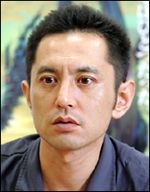 This will be the first film from Hayao Miyazaki ever since Howl’s Moving Castle achieved huge box office totals of 19.6 billion yen when it was released 4 years ago (November 2004). The new film is a story of Ponyo, a goldfish princess who wants to become human, and the five-year-old Sosuke. Producer Toshio Suzuki explains, “This is kind of like Miyazaki’s version of ‘The Little Mermaid.'” Tales of Earthsea, which came out last year, was supposed to have been directed by Hayao himself — he negotiated the film rights with the original author 20 years ago — but the director changed to his eldest son, Goro (pictured). As J-Cast reported earlier:
“Ghibli’s Suzuki said in an interview ‘(Hayao) said that “it would be inconceivable for Goro to take the helm.” In other words, he was totally against Goro directing it.'”
Afterward, Suzuki convinced Hayao to go along, but while the production ended up being a hit, the movie received less than favorable reviews from viewers and the original author.
The father-son feud was reported as follows in a March 20, 2007 article in Sports Nippon:
“Sosuke was modeled after Goro Miyazaki, Hayao’s 40-year-old eldest son. Goro made his directorial debut with Tales of Earthsea last year, and Hayao interpreted his son’s actions as a rebellion against his father, reportedly expressing remorse: “Things turned out this way because I was working all the time and didn’t spend time with Goro when he was 5 years old. [I’m making this] so there won’t be any more children like Goro.”
It looks like this will be a film about regrets over raising an eldest son.
“Thank goodness it’s Hayao!”
Since Hayao Miyazaki has made several statements indicating he’s retiring from directing, rumors had been circulating on the Internet wondering if there would be another Hayao-directed film. Perhaps influenced by such concerns, there are lots of blog entries from Yahoo, Livedoor, and Excite-hosted blogs placing their hopes in Hayao:
“Thank goodness it’s Hayao!!! But it looks like the kid is modeled after Goro…”
“Yes!!! YES!!!! I LOOOOOOOVEEEE Miyazaki’s movies!! Goro’s movie was just so poorly received I still haven’t watched it [Translator: Same here!], but I wonder how Earthsea turned out? Hayao’s movies almost never fail to please, so I am simply looking forward to it.”
“I am looking forward to this. Since this is coming after Goro Miyazaki seems to have misjudged the public, I am interested to see how people react to this one.”
Will this new film feature the father’s overwhelming dignity and serve to re-educate Goro?
Comment: This looks like a continuation of the human drama initiated and encouraged by Ghibli (who printed Goro’s blog that detailed the feud and an interview with Suzuki that explained more about it) since it was learned that Earthsea would be directed by the inexperienced Goro. Since, as J-Cast notes, Earthsea ended up being a hit despite bad reviews, perhaps the promoters and investors (which include notorious hit-generators Hakuhodo and Dentsu) see this reality-show spectacle as an effective way to generate hype. The personal stories probably resonate with fans of Studio Ghibli, which was voted Japan’s top-ranking brand name in a 2006 poll of consumers conducted by Nikkei BP:
Miyazaki magic
Studio Ghibli stepped up from second place in the 2005 survey, receiving fairly high marks in two of the four categories the survey conductors determined to be key factors in creating brand power. The two categories were friendly and outstanding.
The animation studio has spawned an array of popular films, such as “Howl’s Moving Castle”, released in 2004, successfully connecting with consumers on an emotional basis.
Resonating with consumers is the ultimate goal of corporate marketing.
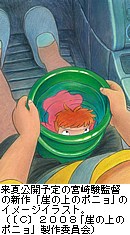 Jiji Press reports that Hayao Miyazaki announced that he is directing a new long-form animated film called “Ponyo on the Cliffs” (崖の上のポニョ), a story of a boy’s friendship with a “goldfish princess” who wants to become human.
The production, the first directed by Hayao Miyazaki since 2003’s Howl’s Moving Castle, began last October and will be completely hand-drawn, with no computers used whatsoever. The animation style is simple and childlike (see picture). The scenery is based on the Seto Inland Sea, an area of Japan where Miyazaki stayed in 2005. The 5-year-old hero is based on his son Goro, who directed the poorly-received Earthsea adaptation. The music will be done by Ghibli regular Jo Hisaishi. The final production is scheduled to be released in summer 2008.
An official press release confirms the recent reports and promises more information moving forward.