Profile of Ryoichi Sasakawa in Irrawaddy

Some recommended light reading: Burma democracy movement news site The Irrawaddy has published a profile of Ryoichi Sasakawa, the enigmatic right-wing figure who went from war profiteering in Manchukwo to development state profiteering as the yacht racing (kyotei) mogul/ostentatious philanthropist.

Some excerpts:

A report prepared in June 1947 by US army intelligence described Sasakawa as “a man potentially dangerous to Japan’s political future…He has been squarely behind Japanese military policies of aggression and anti-foreignism for more than 20 years. He is a man of wealth and not too scrupulous about using it. He chafes for continued power. He is not above wearing any new cloak that opportunism may offer.”

Twenty years later, Sasakawa was the head of a multinational foundation, named after himself, which funded health and educational programs mainly in Asia. He claimed to be a man of peace, and one branch of his philanthropical empire was even named “The Sasakawa Peace Foundation.” When he died in 1995, his deepest regret was said to have been that he never got the Nobel Peace Prize.

From the very beginning, Burma was one of the countries where the Sasakawa Foundation and its sister organization, the Nippon Foundation, were especially active. Apart from being an associate of Kodama, Sasakawa was also close to Nobusuke Kishi, the Japanese prime minister from 1957 to 1960—and, in the late 1940s, also a prisoner in Sugamo. Kishi led the once influential Burma Lobby in Japan, and the Japan-Burma Association counted among its members 11 trading companies allowed to operate in various aid projects in Burma prior to 1988.

A native of Osaka, he was born in 1899 into a family of wealthy sake brewers. In the 1930s, he led an ultranationalist group called Kokusui Taishuto, or the “Patriotic People’s Mass Party,” which grew to 15,000 members. Each one of them wore a dark uniform fashioned after Benito Mussolini’s Italian Blackshirts. He also had his own airplanes, which transported supplies for the Japanese army. In 1939, Sasakawa used one of them to fly to Rome, where he met Mussolini. Years later, he expressed regret about not meeting another European leader at that time: “Hitler sent me a cable asking me to wait for him, but unfortunately I didn’t have time.”

The problem after the war was that the American occupiers in Japan badly needed the extreme right to counter the leftist movement, which was growing strong in the late 1940s. So, in 1948, Sasakawa, Kodama and Kishi were all released and allowed to rebuild their former organizations.
Continue reading Profile of Ryoichi Sasakawa in Irrawaddy

Adam Richardses of the world update

I guess in Japan a post like this violates the personal information protection law, but you know what – damn the man:

  • With the budget cut for the only part-time officer position in town, for all intents and purposes police chief Adam Richards now is the law in Somerset, PA, and according to the council, “he’s doing a great job”:
  • No salary has been allotted for a part-time police officer. The borough’s part-time officer resigned several months ago, leaving Chief Adam Richards to cover the borough alone.

    “I don’t want to knock him, because he’s doing a great job,” said council member John Mull. “I just think scheduling is the issue, and we can get by with one officer.”

    Council will consider hiring another officer in the future if the need becomes apparent, members said.

    Back when he and his part-time partner were keeping order, Chief Richards was getting all Dirty Harry on bored teenage house vandals by “meeting with residents to lay the groundwork for starting a Community Watch.” There has yet to be a follow-up story, but we’ll be watching this closely to see if these rascals can’t somehow live up to their potential to be good citizens.


  • British financial regulator spokesman Adam Richards-Gray
    does not think that 6-figure fees are too much for his FSA to charge mortgage advisors (which may be true depending on what kind of “surgeries” they offer the mortgage firms in exchange*)
  • * (I believe that surgery may be a British real estate industry term for some kind of credit check that the FSA performs with the fees it collects)

  • The story is no longer available, but one Adam Richards in NZ is apparently a king of drift in his refurbished Nissan Cifero. I can’t tell if this is cooler than the UK stuntman Adam Richards.
  • Another dead link story (I’ll never forgive myself for not posting sooner) – A “children in need fever” inspired hotel manager Adam Richards in the UK to offer a “sponsored leg wax” which I can only assume is a competition among people who get their legs waxed for a living.
  • Congratulations to Cincinnati Adam Richards for making the 8th Grade Honor Roll. We expect many good things to come of this up and coming AR.
  • I thought I saw something recently about the boxer Adam “Swamp Donkey” Richards but not I can’t find it. Here’s hoping he is still kicking some serious ass somewhere.

  • Chinese, Korean workers gaining full-time positions at convenience stores: Nikkei

    Any self-respecting Kanji reader will have noticed that Japanese convenience store workers have been less and less Japanese in the Tokyo area starting some time around 2004 or so (or even earlier?). Now, according to the Nikkei, the convenience store corporate headquarters are bringing in Chinese workers in “full time” positions:

    Monday, November 19, 2007

    Convenience Stores Boost Foreign Hires To Aid Expansion, Fight Labor Squeeze

    TOKYO (Nikkei)–The falling birthrate and overseas expansion plans are spurring major convenience stores to increasingly hire foreigners for full- and part-time positions.

    Lawson Inc. (2651) has already accepted nine Chinese and one Vietnamese for full-time positions starting in April next year. It is the first time for the company to hire foreign workers on a full-time basis.

    The foreign hires will account for about 10% of all new employees accepted for full-time positions starting in April. The company plans to increase the number to 30, or about 30% of the total new workforce to be hired for jobs starting in April 2009.

    This fall, Lawson created a work manual for Chinese part-timers as part of its efforts to increase its ratio of foreign employees amid the falling birthrate. With the number of foreign customers at its outlets also growing, Lawson felt it necessary to hire foreign staff on a regular basis to supervise non-Japanese part-timers. The presence of these employees in supervisory positions will also help the company in its future efforts to open overseas outlets.

    So apparently the chains need to hire Chinese managers to help manage their increasingly foreign workforce.

    I am tempted to say the Nikkei is really late in covering this (and as usual they don’t really dig very deep), but I haven’t reviewed the whole archives and at least I think I remember them making the point that there are lots of foreign convenience store workers in some New Years series of “make Japan more internationally competitive” editorials.

    Some questions come to mind:

    1. I would love to see how they train the Chinese workers because they do an amazing job. I’ve only very rarely had communication difficulties with Korean/Chinese convenience store workers.

    2. Why no non-Japanese franchise owners? I wouldn’t expect there to be a copy of America’s population of Indian and Korean convenience store owners, but these convenience stores are pretty profitable and you’d think that they’d be tempting for an ambitious foreigner. Wouldn’t at least some of these student-workers feel like going into business for themselves?

    3. Since I have come to Tokyo, I have seen a lot of South Asian people working at a lot of different chains, particularly McDonald’s. Is there any reason why the hiring patterns are different?

    All about the PM’s trip abroad

    I have waited far too long for this:

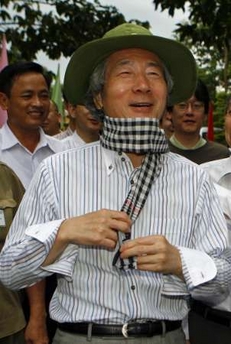
    koizumi-r4211326578.jpg

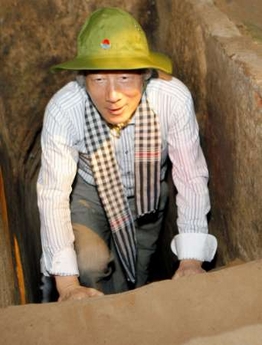
    koizumi-r729074569.jpg

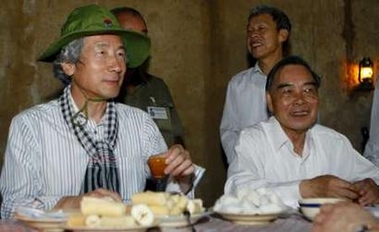
    koizumi-r339873611.jpg

    Japan’s former Prime Minister Junichiro Koizumi wears a Vietnamese soldier’s ‘Viet Cong’ hat and shawl during his visit to Cu Chi tunnel system in southern Ho Chi Minh city November 14, 2007. Koizumi is in Vietnam on a three-day visit.

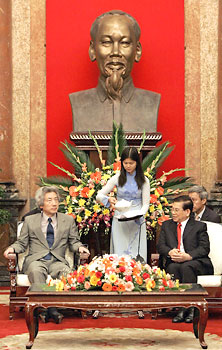
    koizumi-fr0711162.jpg

    November 16: Former Prime Minister Junichiro Koizumi, left, speaks to Vietnamese President Nguyen Minh Triet in Hanoi on Friday. (AP)

    In other news, some wormy-looking guy named Fukuda is visiting with President Bush. God I hope there’s an election soon.

    Gaijin in the spotlight

    I could have sworn that the “Westerner’s Fear of Neonsigns” blog was written by Marxy on a gaijin-baiting stint, but apparently that’s not the case. Whoever writes it, however, is amazing and I especially love his post “How’s your Japan blog?

    1. Japan is unintentionally hilarious – in particular, misuse of English – or Engrish – is so funny that I devote considerable time to documenting and disseminating it. To avoid a similar fate, I will not be blogging in Japanese.
    2. Japan is barbaric – it fails to treat sacred Western food with due decorum (bread in a can) and celebrates Christian festivals all wrong (Kentucky Fried Chicken on Christmas Eve). Check my blog for further examples.
    3. Japan is sexually deviant – society operates in the tacit knowledge that Japanese men are paedophiles by default. Look at all the photographic evidence I have amassed to prove it. They just don’t know how to treat a woman properly. That I do is the underlying message I want you to receive from my blog.
    4. Japan is a visual paradise (1) – all Japanese have a heightened visual sensibility; they spend their coffee breaks contemplating tiny design modifications to plastic cups and bathe in the juice of fonts come evening. Not actually living in Japan, I can safely say that they never drive ugly white minivans or fill their tatami rooms with tat.
    5. Japan is a visual paradise (2) – the thing I love about Japan is how it allows me to me indulge in the objectification of women without guilt or reproach. The pornography here is just fantastic. Oh, of course, this will be known as The Great Unmentioned in my blog.
    6. Japan is spineless and work-addicted – people will do any job rather than lose esteem by not working. Look at this old man waving past cars with a pair of red wands – you wouldn’t catch me stooping to do such a demeaning and unnecessary job. Oh, excuse me, I’m late for my English conversation school class.
    7. Japan is childish – public announcements are only heeded when they are delivered by curtseying cartoon characters. To prove it, I will photograph them all. Even though the large incidence of such messages is obvious, I will continue to treat each one as a fantastic novelty.
    8. I am childish – only in Japan can I indulge my secret love of toys and games while presenting it as sociological research. I never miss an opportunity to make the sweeping observation that Japan is populated by inadequate geeks. I visit Akihabara every weekend in search of corroborating evidence, but it’s purely research you understand.
    9. Japan loves me – it’s always saying how tall I am, how handsome I am, how intelligent I am (admit it, I am pretty hot at producing those L/R sounds), how good I am at sports, how amazing it is that I am a man and yet I cook for myself. Nobody said anything in my home country except: “So, are you finally going to get laid in Japan?” Deeper awareness of Japanese social etiquette would have saved me the trouble of believing any of this.
    10. Japan is mine – I am the Alpha Gaijin. If Japan can be said to exist at all, it is only because I have brought it to life with my intellectual efforts. Other foreigners intruding on my turf better be able to withstand the fire of my comments. Japan will thank me for everything I have accomplished once it knows who I am. Until then, I have an immersion experience more impressive than yours to attend to.

    I feel like I was the opposite of other Japan bloggers, at least by this person’s definition – I was more into blogging about Japan when I wasn’t here. Now that I live here it is all so uninspiring.

    This analysis of Japan blogs is as spot-on as it has been curiously absent in unfiltered form. Still, in defense of Japan blogs I will say that it is often a lot of fun to post and discuss the interesting and weird stuff in a foreign land, whether that’s Japan or elsewhere. It is definitely shrill-sounding when people make their experiences out to be more than they are (god, there are thousands of expats just in Asia, you’re not that special), but really the antidote to Japan blog fatigue is to just tune them out.

    The truth is I am sad we weren’t even mentioned (though in a separate post he calls translation one of the “brilliant arts” so maybe I don’t get called on my own cultural imperialism. Or maybe I just didn’t get noticed by not posting when the blog launched…)

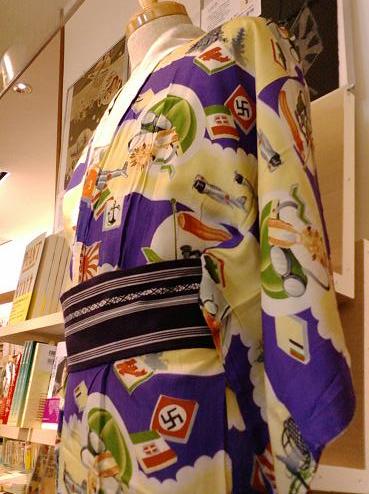
    Speaking of cautionary tales and immersion experiences, I took no less than 4 friends on a wild goose chase the other day to see what was supposedly an exhibit of Nazified kimonos celebrating the tripartite alliance in the WW2 era. This is all we found next to a display of books on wartime Japan:

    nazi-kimono.JPG

    Meanwhile, today’s Asahi (I read the print edition now, screw the crap online version!) ran a feature on a sweet sounding historical fiction “Tokyo Year Zero” about a double murder in early postwar Japan. The author, David Peace, grew interested in postwar Japan after teaching English here in the early 90s and reading Seidenstecker’s Tokyo Rising. He later returned to his native England and became an award-winning mystery writer on non-Japan related subject matter. His new book is enjoying a simultaneous bilingual release and a major PR push from the Japanese publisher Bungei Shunju.

    Just goes to show, if you’re willing to shed a little baggage and be friendly to the like-minded (most of the research for his new book was apparently provided by the in-house Bungei Shunju translator after the two hit it off during negotiations for translation rights to an earlier Peace book), you too can have success and avoid the stench of “slow-burning underachievement” that apparently afflicts the expat population in Japan.

    A Bathing Shoko

    A few days ago I spotted the following sticker just outside Tokyo’s Roppongi Hills:

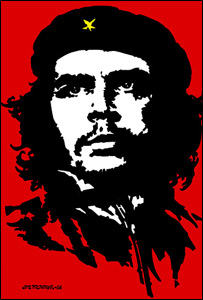
    It’s an ironic tribute to former Aum Supreme Truth Cult leader* Shoko Asahara that combines his ugly mug with the iconic BAPE clothing logo (see below). I absolutely loved the image for my own reasons (I am a BAPE fan and an avid consumer of Aum-related developments), but it has taken on new relevance now that the BBC informs me that this year marks the 40th anniversary of Che Guevara’s death. The article discusses the enduring popularity of that one image of him glancing out somewhere with the utmost intensity:

    Combined with the mystique and allure of Che and the spirit of revolution, another key to the spread of the image was the complete and intentional lack of intellectual property management on the part of the original photographer and designer, and it has certainly been effective for better or worse. Anyone with a pair of eyes who has visited US college campuses will know how pervasive this image is. And more importantly, the BBC article notes that in Latin America he remains an inspiration for his life and what he stood for, rather than just being a part of the trustafarian poster collection.

    However, in Japan the story is a little different. A far more recognizable but similar image is the logo for hip clothing brand A Bathing Ape (aka BAPE) which derives its flagship logo from a combination of the Che image with the Planet of the Apes movies (stunning in their own right). While Che’s logo may stand for the combination of “capitalism and commerce, religion and revolution,” notwithstanding some recent dilution of the brand BAPE’s message is more along the lines of “wear this if you are young and listen to Cornelius”:


    I should point out, however, that BAPE has none of the revolutionary hype nor is it even close to the level of pervasiveness of the Che image. It is just a hip clothing brand with a slightly creepy but somehow irresistible logo.

    (*Asahara is apparently still revered in one sect of former Aum followers according to recent reports. He will be headed for the gallows for orchestrating the deadly 1995 sarin gas attack on the Tokyo subways whenever the Justice Minister gets around to it.)

    Burma: Will Japan show its teeth next week?

    The junta in Burma has “successfully” put down much of the protesting in the country, according to NYT, with unconfirmed reports from diplomats of dozens of deaths in the crackdown. The junta is divided as to how to move forward, while a UN inspector has arrived in the country to observe conditions there. This leaves the rest of the “international community” to figure out just how to successfully exert influence and whether stumbling blocks China and Russia can be brought along. One of the many open questions in the crisis in Burma is how Japan will act.

    Amazingly, the debate in Japan has been transformed this week as a result of the apparently intentional point-blank shooting of Kenji Nagai, a photographer for a Japanese production company.

    The Japanese government has gone from a basically hands-off approach to demanding full explanations at the highest level. Still, new prime minister Yasuo Fukuda has not gone ahead with sanctions and has decided only to demand an explanation and lodge an official protest over the incident. However, most significant is that major commentators have begun calling for Japan to initiate sanctions against the junta, which has so far not been a popular position as Japan has had a policy of so-called dual engagement, giving aid to the country while trying to maintain relations with democracy leaders as well.

    Fueling the change in the government’s stance is the fact that Nagai’s death has put a face on the ugliness of tyranny for the Japanese public and the blunt shove and rapid-fire of bullets that felled him symbolize the almost casual brutality that Burma has faced for decades.

    The protests’ coverage in the media was transformed overnight at the news of his death and intensified when it was learned that he was killed so brutally, going from the usual “instability in a foreign country that doesn’t affect us” sort of coverage to much more involved reports of the protests that more closely resembled the BBC’s intense up-to-the-minute reporting.

    In addition to an increased volume of media coverage, the tone of commentary has changed dramatically. Just this morning, the host of a news talk show noted something to the effect of “the only reason the junta wants to stay in power is to protect their vast financial interests” backing up the biggest justification for targeted sanctions.

    Newspaper editorials the morning after Nagai’s death made limited calls for escalated Japanese involvement. From Asahi: “Why not have Japan take the initiative? We must not allow the robes of monks to get tainted with blood.” Yomiuri noted: “As Japan has maintained ties with both the military regime and pro-democracy forces in Myanmar, it should explore ways to contribute to the settlement of that country’s difficult situation.”

    However, once the news of Nagai’s apparent cold-blooded killing came out, Asahi’s latest editorial (Title: “Cooperate with Asia to Put Pressure on Myanmar”) dramatized the fact that Nagai continued filming even after being fatally wounded as a symbol of the junta’s fear of free expression of the public’s will. Asahi then called for Japan to initiate unilateral sanctions and wonders why the initial government reaction has been so tepid. “The power of Japan’s diplomacy is being called into question,” it claimed.

    Sankei, Japan’s most conservative national newspaper, had a more concrete proposal while sounding the similar tone but did not call for sanctions (title “Time has come for democratization in Myanmar): “Japan, as the largest provider of economic assistance, has a major role to play. We must go further in explaining that if democratization comes to pass, aid from Japan and the West will begin again in earnest.”

    Nikkei (Title: “Initiate Sanctions and Put International Pressure on Myanmar’s Military Regime”) goes the furthest of all and calls for unilateral sanctions and full participation in the international pressure on the Burmese government.

    While all recognize the key role that other countries, especially China, must play in exerting pressure on the military government, it is heartening that Japanese commentators can see Japan as having an interest in democratization and will not (in some cases at least) merely toe the government line.

    Expect the debate in Japan next week to center on whether Japan’s government will announce some form of sanction proposal, either unilaterally or in some kind of international proposal. While the Fukuda cabinet would like to focus on domestic concerns as it must face a tough Diet session, the pressure is on for the government to show it can protect its citizens and “play a responsible role” in the international arena. The Voice of America has described the situation in Burma as Fukuda’s “first crisis” (so we can see what the US would like Japan to do, but it would be smart for US Japan hands like Michael Green to stay out of the debate this time) and the Burma issue will remain at the top of the agenda for a while to come.

    Sympathy protests have been going on in Japan (primarily in Nagoya and outside the Burmese consulate in Shinagawa). These protests are critically important to show that the message is being heard in Japan as well and its citizens are keenly aware of the situation. I will be out in Shinagawa this Sunday to show support and I hope some of the MF readers will come out as well!

    BTW, Mrs. Adamu has been doing her part to get the message out to the Japanese audience. She has a translation up at BurmaInfo.net, a Japanese-language site for Burma news. The article she has translated is an account of the famous brief encounter the protesters had with democracy leader Aung San Suu Kyi in front of her home in Yangon/Rangoon. You can read the original article in English here.

    The video can be seen here.

    Some good news for sumo wrestling, for once

    While the Japan Sumo Association has been rocked by (a) The Asashoryu fiasco; and now (b) A bizarre and tragic lynching of a 17 year old boy (learn more of the gruesome details here), at least one wrestler is enjoying the sweet spoils of success:

    Wrestler awarded horses and sheep to mark victory

    Fri Sep 28, 6:59 AM ET

    TOKYO (Reuters) – “Yokozuna” Hakuho was given more than 100 horses and sheep in his native Mongolia to celebrate his latest major sumo tournament victory.
    ADVERTISEMENT
    click here

    The 22-year-old was feted by 1,000 people from his father’s home village where he was presented with the livestock as a gift, Japanese newspapers reported on Thursday.

    Hakuho, whose real name is Munkhbat Davaajargal (awesome name!), won his fourth major title at the weekend, his first since being promoted to sumo’s highest rank of yokozuna four months ago.

    “It gives me great power to know that everyone back in Mongolia is watching me on TV,” he was quoted in Japan’s Nikkan Sports. “It makes me want to keep improving my sumo.”

    Any plan to revive Japanese sumo wrestling will have to include: (a) transparent judging and anti-rigging rules; (b) thorough drug testing; and most of all (c) big fat livestock kitties for the winners.

    Short update: Two upcoming changes in Japan that will rock your world

    1. The end of eikaiwa: Along with some of the minor players in the industry, former industry leader NOVA seems to be in its death throes (more info here). While the details of just how many people are getting screwed over are interesting and all, I just want to take a minute to ponder the implications of what is going on: massive change in the ESL market and, perhaps more importantly, the death of NOVA. It is hard to underestimate the presence that those four letters have become in the mind of the expat, especially those not involved directly in teaching English. Basically, in the gaijin hierarchy, NOVA teachers have been regarded with just a little less disdain than the African club promoters in Kabuki-cho. NOVA finds the most gullible young partiers eager for an easy first job out of college (or increasingly a fun place to work during a working-holiday) who then proceed to come to Japan and live as if they were still in college. It’s one thing for students and professionals to look down on NOVA teachers, but even other eikaiwa teachers hated on NOVA. There is really no better way to sound mature and like you are really interested in Japan than to cluck your tongue at a faceless mass that stays in a gaijin bubble and terrorizes the local population.

    But without NOVA, who will the uppity gaijin have to kick around? None of the other schools have the nationwide presence or annoying mascot (though NOVA had the status way before the rabbit came around), so just what will the shorthand be to let other gaijin know you’re not ‘one of them’? And what will it mean if the eikaiwa industry (which was long supported by lax regulation of shady sales practices) can no longer maintain its appeal, especially now that the honeymoon is over and headlines of school closings and unfulfilled class contracts, not to mention successful lawsuits by unhappy customers, are constantly weakening the appeal of the product to the customers? The demand for English is unlikely to go away, but the shrinking of this private market (along with the decline of the JET program) is likely to erode the situation of ‘one foreigner in every village’ or (assuming that actual schools continue to hire foreigners for their English curricula) will more likely lessen it from 3 foreigners in each village to just one or two. And with the opportunities for easy employment cut off, what will become of the ‘Japanese dream’ of easy employment and Charisma Man status for young adventurous Westerners? Has this not been a major factor fueling the interest in Japan in recent decades? And will this loss constitute a truly missed opportunity for Japanese educators who feel that the best way for Japanese people to learn English is to be around native English voices?

    2. Japanese mobile advancement to hit a wall in favor of better prices? Cell phone regulations are going to change in a big way – the Nikkei recently ran a story (Sept 19) detailing the report of a Ministry of Internal Affairs and Communication study group that recommends ending the practice by cell phone carriers of providing “free” cell phones to customers as early as next spring. These offers of free phones are deceptive because the phone companies reimburse their distributors for the phones and then charge customers a higher rate for their plans (hence the ridiculous 20 yen per minute talking fees). But with little upfront costs, the provision of the phones has been a major (perhaps deciding) factor in attracting customers to one company or another, which has spurred the insanely high technological levels of Japanese mobiles. Perhaps in a few years Japanese phones will more closely resemble those in other countries, where users get a minimum level of features but enough of what they need for a reasonable price. I mean really, do we need to watch TV on the train?