A hard bargain

In a 2ch thread reacting to news of a high-end speed-dating bar catering to older “marriage hunting” women and men (this year’s manufactured social phenomenon), commenters have excoriated a 39-year-old single female flight attendant (an apparent lookalike of former Takarazuka Revue actress Yuki Amami) for her quote, “I am no longer in a position to be choosy. My conditions are that [my future husband] does not smoke, can communicate, and makes at least 10 million yen per year.”

Such high standards reminded me of a recent episode of NPR’s This American Life, in which the hosts discussed just how limited dating options can be once you start getting choosy. I suggest you give it a listen, but suffice to say the prospects for Boston-area chemistry grad students were whittled down to the dozens, if I recall correctly.

So what about this woman’s scenario? Does she stand a chance? Let’s try whittling down the population of Tokyo until we find out how many men would pass muster:

  • Population of Tokyo: 12.79 million people (also see Stat Bureau)
  • Number male: 6.354 million (49.6%)
  • In Amami’s age bracket (25-49): 2.536 million (more generous than 2ch would allow for – see below)
  • College grads: 1,038,492 (assuming college grads are more likely to have communication skills than non-grads. The number was reached by estimating from the facts that 45.5% of high school students moved on to four-year universities in 2006, of which around 90% eventually get their degree (OECD Fact Sheet PDF))
  •  Salary of at least 10 million yen: 103,849 (10%: Though 7.5% of men in the private sector earned at least 10 million yen per year as of 2006 nationwide, I will be generous and say 10% given the age and education group’s above-average earnings and the probably higher wages of the Tokyo area) (PDF page 18)
  • Single: 51,924 (about half?)
  • Non-smokers: 31,414  (39.5% of Japanese men smoke)
  • Attractive to her: 6,282 (1 in 5? This assumes that even if she can’t be choosy, she will still remain superficial enough to avoid lazy eyes, missing teeth, limps, moth ball smell, etc.).

Then what if you divide by between 3 and 5 for other possible dealbreakers, such as religion, politics, sense of humor, blood type, and all that? Not exactly raining men! And this exercise doesn’t even address the issue of her age, which was the biggest bone of contention among the 2-channel posters (specifically, many found the entire premise farcical – a woman entering middle age is delusional enough to think well-off men would consider her marriage material, to the point that 10 million a year becomes the bare minimum, and she thinks they will show up at a speed-dating bar in Roppongi). 

While this is a rough guess and the general bias toward richer and more educated people in Tokyo would no doubt push the number somewhat higher (and she is lucky to be in Tokyo and not comparatively tiny Boston), it is still kind of sobering to see how closely this woman’s search for love (or at least stability) in Tokyo resembles the quest to find the missing Dragonballs.

Women flee Japan, as the men evolve into a different species

Of course, the female population could simply be falling more or less in line with the overall population, but let’s not let that get in the way of an anonymous ministry official’s speculation (thank you Kyodo and Nikkei):

Population Of Women In Japan Sees 1st Decline On Record
TOKYO (Kyodo)–The number of females in Japan fell for the first time on record as of October last year, the Internal Affairs and Communications Ministry said Monday.

The female population was estimated to be 65.44 million as of Oct. 1, down 20,000 from a year earlier to mark the first decrease since 1950, when comparable data were first recorded.

”More Japanese women are going abroad for extended periods, and this is thought to be one of the reasons,” a ministry official said.

This might be a good time to tell you that I very much enjoyed attending Patrick Macias’ lecture on otaku culture held a couple weeks ago at Temple University Japan. You can listen to it in full on his website. The lecture is a broad overview of the development of Japan’s otaku culture and the American obsession with it. Within, he notes:

  • Densha Otoko, the dubiously true story of an 2-Channeler otaku who falls in love with a normal woman, follows the storyline of an “interracial romance,” and
  • The ubiquity of erotic elements in anime and gaming indicate that otaku are leaving normal female companionship behind, in a phenomenon he compares to the “post-humans” of sci-fi anime such as the Gundam series.

It’s an interesting listen!

Congressional Research Service on Japanese political turmoil, circa September 2008

I have been very excited to discover the website Open CRS, an unofficial repository of Congressional Research Service reports. Normally, the reports are only available to Congress members and their aides, but a surprising number of them do see the light of day. This site could serve as a helpful source until Joe Lieberman’s initiative to open up the CRS becomes law.

For a taste of what the CRS has to offer, here is a report (PDF) on the state of Japanese politics around the time when former PM Fukuda stepped down:

Factors Behind Japan’s Political Paralysis


A number of factors impeded Fukuda’s ability to govern and will challenge
whomever the LDP chooses as his successor.
Parliamentary Gridlock. In July 2007, the DPJ won a majority in nationwide
elections for the Upper House of the Diet. As a result, for the first time in Japanese
history, Japan’s two parliamentary chambers are controlled by different parties. Shortly
after the DPJ’s victory, then-prime minister Shinzo Abe resigned, leading the LDP to
select Fukuda as premier. Concerned by Ozawa’s threats to veto major legislation,
Fukuda attempted to form a “Grand Coalition” with the DPJ. After the talks broke down,
the DPJ adopted an aggressive policy of using its control of the Upper House to block or
delay several of the Fukuda government’s legislative initiatives.
The LDP’s Increased Dependence on Coalition Partners. For more than
a decade, the LDP generally has not been able to secure independent majorities in both
Diet chambers, forcing it to rely upon coalitions with smaller parties. Since 1999, the
LDP has formed a governing coalition with the New Komeito party, a pacifist-leaning
party with strong ties to the Buddhist Soka Gakkai religious group. Komeito’s clout in
the coalition has increased over time, for at least two reasons. First, the LDP is reliant
upon Komeito to obtain the 2/3 majority in the Lower House to override the DPJ-led
vetoes in the Upper House. Second, LDP candidates in many electoral districts have
become reliant upon support from Soka Gakkai followers.4 Although traditionally the
LDP has dominated the coalition, during the summer of 2008, New Komeito became
more assertive, for instance by resisting Fukuda’s push to renew the authorization to
provide fuel to coalition forces in Afghanistan (see later section for details).
The LDP’s Weakened Decision-Making Structure. Former Prime Minister
Junichiro Koizumi significantly weakened the LDP’s old, opaque system, in which the
leaders of the party’s internal factions made major budgetary, policy, and personnel
decisions (including deciding who would serve as prime minister). This system, although
widely criticized as lacking transparency, helped the LDP to overcome significant internal
divisions over policy. While he was breaking the faction-based system, Koizumi used his
personal popularity and aggressiveness to enforce party discipline. However, his
successors, Abe and Fukuda, often were unable to duplicate this feat. As a result,
decision-making became increasingly difficult on contentious matters, such as the battles between the LDP’s economic reformers and those favoring a return to the status quo of
channeling government funds toward key interest groups.5
The DPJ’s Discipline. The DPJ was formed in 1998 as a merger of four smaller
parties and was later joined by a fifth grouping. The amalgamated nature of the DPJ has
led to considerable internal contradictions, primarily between the party’s
hawkish/conservative and passivist/liberal wings. In particular, the issues of deploying
Japanese troops abroad and revising the war-renouncing Article 9 of the Japanese
constitution have generated considerable internal debate in the DPJ. As a result, for much
of its history, the DPJ has a reputation of not being able to formulate coherent alternative
policies to the LDP. Additionally, battles between various party leaders have weakened
the party. Since winning the Upper House, however, the party has appeared much more
unified, at least on the strategy of using its veto power to try to force the LDP to hold
early elections. This discipline is remarkable considering that, privately and publicly,
many DPJ members chafe at Ozawa’s top-down leadership style. If the DPJ does worse
than expected in the next election, it is likely that he will be forced to step down.


No retrial for Asahara – clock ticking

Tokyo Court Rejects Aum Cult Leader’s Retrial Plea, Kyodo Says


By Stuart Biggs

March 19 (Bloomberg) — The Tokyo District Court turned down a request for a retrial for Shoko Asahara, the leader of the Aum Shinrikyo cult who was sentenced to death for the murder of 19 people in sarin gas attacks in Japan, Kyodo News reported.

The retrial plea, filed in November by Asahara’s second daughter, was turned down because what it claims is new evidence wouldn’t be sufficient to overturn his sentence, Kyodo said, citing unidentified people familiar with the case. The report didn’t provide further details of the contents of the plea.

Asahara, whose real name is Chizuo Matsumoto, was sentenced to death in February 2004 for the attack on the Tokyo subway in 1995 that killed 12 people and another attack in the city of Matsumoto a year earlier that left seven people dead. The group is alleged to have killed 27 people in total.

Asahara, 54, lost a final appeal against the death sentence in September 2006, Kyodo said.

14 years later, Asahara might face the gallows this year…

Michelle Malkin – Kabuki, stage left

(Updated below)

Wow, politics as theater. What a deep and insightful insight!

The Kabuki Theater of AIG Outrage

Michelle Malkin – Wed Mar 18, 3:00 am ET

All the world’s a stage, wrote Shakespeare, and in the world of Washington, the curtains have opened on the most elaborate farce of the year. Welcome, taxpayers, to the Kabuki Theater of AIG Outrage — where D.C.’s histrionic enablers of taxpayer-funded corporate bailouts compete for Best Performance of Hypocritical Indignation.

Democratic Sen. Chris Dodd, the corporate crony who is the largest recipient of AIG donations, is now leading the charge to tax the retention payments in order to recoup the $450 million the company is paying to employees in its financial products unit.

But Dodd, it turns out, was for protecting AIG’s bonuses before he was against them.

Fox Business reporter Rich Edson pointed out that during the Senate porkulus negotiations last month, Dodd successfully inserted a teeny-tiny amendment that provided for an “‘exception for contractually obligated bonuses agreed on before Feb. 11, 2009,’ which exempts the very AIG bonuses Dodd and others are seeking to tax.” Pay no attention to what his left hand was doing. Dodd’s right fist is pounding mightily, mightily for the sake of the taxpayers.

If Washington’s newfound opponents of rewarding failure want to do taxpayers a favor, how about giving back their automatic pay raises? How about returning all their AIG donations? How about taking back all the bailout money to all the failed enterprises, from Fannie Mae and Freddie Mac to AIG, the automakers and the big banks? Barry? Harry? Nancy? John? Chris? Bueller? Bueller?

Exit stage left. The curtain falls.

Are there even curtains at kabuki performances?

BTW, as Glenn Greenwald notes, one of the central themes of this piece – that Chris Dodd was key to ensuring that these bonuses could be paid – is part of a falsehood-based smear campaign (UPDATE: Apparently not baseless after all…) (UPDATED AGAIN: Dodd “accepted responsibility” for agreeing to the Obama-Geithner plan to pay the existing bonuses… whatever!):

…here is a February 14 article from the Wall St. Journal on the debate over executive compensation limits:

The most stringent pay restriction bars any company receiving funds from paying top earners bonuses equal to more than one-third of their total annual compensation.  That could severely crimp pay packages at big banks, where top officials commonly get relatively modest salaries but often huge bonuses.

As word spread Friday about the new and retroactive limit — inserted by Democratic Sen. Christopher Dodd of Connecticut — so did consternation on Wall Street and in the Obama administration, which opposed it.

Can that be any clearer?  It was Obama officials, not Dodd, who demanded that already-vested bonus payments be exempted. And it was Dodd, not Obama officials, who wanted the prohibition applied to all compensation agreements, past and future.

Ironically enough, Malkin’s own eagerness to repeat wingnut talking points is about as staged and scripted as anything on Capitol Hill, not unlike a certain traditional Japanese dramatic form. But I guess since she uses blogging software instead of the Senate floor, no  appropriate cliches have arisen to describe the right-wing noise machine.

(Thx to M-Bone for pointing this out)

UPDATE: So Dodd did push to pay the committed AIG bonuses?

UPDATE AGAIN: Dodd “accepted responsibility” for agreeing to the Obama-Geithner plan to pay the existing bonuses… whatever!

Who has more “construction workers”?

In my previous post, an investment analyst suggested the following:

Japan should focus more on creating jobs in the construction industry, to which 10 pct of its workforce belongs, he said.

To which my gut reaction was, MORE construction workers? Come on. As with the general worry that massive stimulus could create crippling levels of dependency on government largesse, a large permanent construction workforce could prove an end in itself, spurring fruitless construction projects like so many Towers of Babel.
 
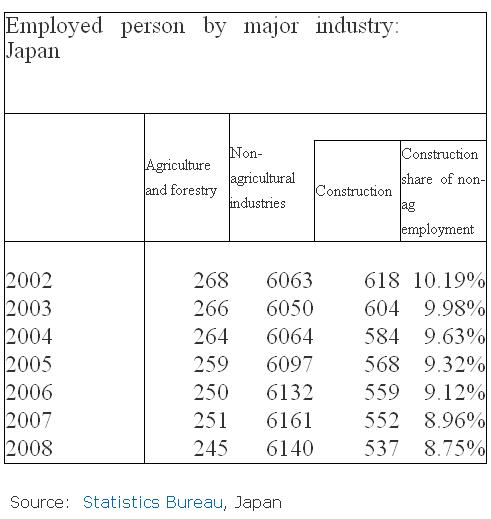
So today I want to take a look at just what Japan’s workforce looks like and whether this guy has a point. Japan’s level of construction employment currently comes in at around 8.75%, having steadily declined since 2002:
 
 percentage-of-construction-workers

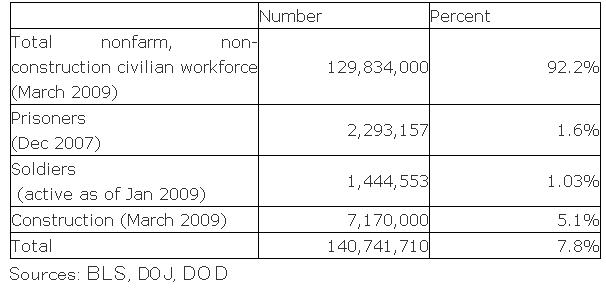
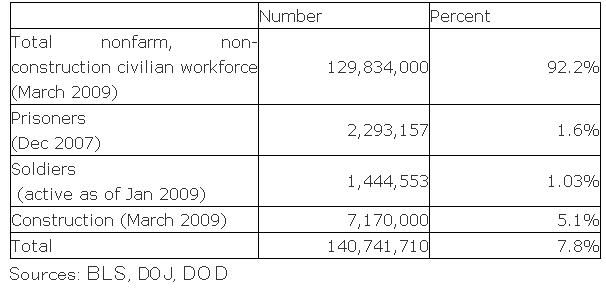
Construction workers make up just 5% of the US non-farm civilian labor force. But then again, if you add prisoners and soldiers into the mix, you find the breakdown is  5.1% of the core workforce does construction, around 1.6% is in prison and another 1.03% is in the armed forces.

construction-workers-in-the-us1
At that point the level of workers taken in by the “employment creation industries” (a term of my own creation) adds up to 7.8%. Given the comparatively miniscule incarceration and military service rates for Japan and the chronically higher unemployment rate in the US, the picture doesn’t end up looking so different from Japan.

I still don’t know whether Japan really needs more construction workers, but at least I know that there’s a somewhat equivalent population of workers in the US that makes Japan a less of an outlier.

It’s all about the Benjamin

There are times when I want to just quit my job, lock myself in an Internet-connected bomb shelter, and spend all my waking hours reading updates from the troubled mind of Benjamin Fulford:

The exposure of Satan worshippers accelerates as the Federal Reserve Board heads for collapse.

The confessions of child sacrifice and cannibalism by a Satan worshipper on prime time US television is a sure sign Satan worship is coming to an end:

This confession confirms other sporadic confessions and a few rare historical court cases describing human sacrifice among Satan worshippers pretending to be Jews or Christians. As the Federal Reserve Board heads for collapse many more of the Satan worshippers who are often found amongst the super rich are sure to be exposed.

An aristocratic Satan worshipper contacted me to say that “Satan has gone to heaven,” and ask “what are we to do now?” My answer is they should abandon the Western concept of an eternal clash between Good and Evil and replace with the Asian concept of Yin and Yang or harmonious opposites. They can then also start worshipping life instead of fooling themselves about some sort of war between Satan and God.

We are likely to see many more horrendous confessions over the coming months and years. In order to have a fresh start for the planet I think we need to forgive those who confess.

This guy David Icke, a promoter of the idea that “reptile people” are in secret control of the world order, called Benjamin Fulford a “disinformation artist” because Fulford says he needs proof before he’ll believe the Illuminati are actually reptilian Here Icke feverishly denying that money really exists:

More Benjamin…

About the Bush-China connection

The Skull and Bones drug dealing syndicate was a major player in the opium trade so they have been dealing with Chinese mobsters for over 150 years. However, while the two sides did business, they were also enemies who did not fully trust each other. The Bush family were heavily involved with China and the Chinese mob. They were also blackmailing top Chinese power brokers over illegal slush funds they had. Papa Bush’s brother Jonathan Bush lived in Beijing and had high level contacts. However, the Bush, China connection has since been severed because the Chinese figured out it was the Bush faction that was trying to depopulate China with Sars and Bird Flu etc. The Chinese were planning all-out warfare against the US because the US elite were planning to kill 80% of the world’s population. That plan has been stopped and there are now negotiations on to build a win-win permanent world peace.

On the DPJ Ozawa scandal:

Japan’s prosecutors ordered by US to trump up charges against opposition leader Ozawa’s secretary

The US criminal regime ordered the current Japanese puppet/slave colonial government to trump up charges against the secretary of opposition Democratic Party of Japan’s leader Ichiro Ozawa, according to senior sources in the Japanese secret government. The reason was that Ozawa said “the only US forces we need here are the 7th fleet.”

As the US secret government comes to an end it is using every dirty trick in its book both in Japan and the US in a desperate but doomed effort to stay in power. No matter what they do they will not be able to con the Japanese people like they did during the last lower house election that was held on September 11 4 years ago. For one thing they no longer have any money so they will not be able to bribe the TV stations to run their propaganda. Furthermore, if members of the current slave regime continue to betray their people with dirty tricks like this they will surely end up in jail.

The Japanese Democratic Party promises to renegotiate the US/Japan security treaty once they come into power. If the US carries out any more dirty tricks it will hurt them in the negotiations. The Japanese opposition would like to retain a US presence as a counter-balance to China but they might change their mind if the US continues to abuse this country.

Shining Path is back… what about Fujimori?

According to the NYT, Shining Path, the Peruvian Maoist rebel group, has made a comeback:

The war against the Shining Path rebels, which took nearly 70,000 lives, supposedly ended in 2000.

But here in one of the most remote corners of the Andes, the military, in a renewed campaign, is battling a resurgent rebel faction. And the Shining Path, taking a page from Colombia’s rebels, has reinvented itself as an illicit drug enterprise, rebuilding on the profits of Peru’s thriving cocaine trade.

The front lines lie in the drizzle-shrouded jungle of Vizcatán, a 250-square-mile region in the Apurímac and Ene River Valley. The region is Peru’s largest producer of coca, the raw ingredient for cocaine.

… Coca, the mildly stimulating leaf chewed raw here since before the Spanish conquest, is largely legal; cocaine is not.

Coca, a hallowed symbol of indigenous pride, is ubiquitous here. Qatun Tarpuy, a pro-coca political party, paints images of it on mud huts. Women harvest coca in clearings along the winding dirt road, and children dry the leaves in the sun.

It is also nearly impossible to find a coca farmer here who admits that his crops are sold for anything other than traditional use, but somehow, studies have found, as much as 90 percent of the coca goes to produce cocaine.

In 2007, the latest year for which data is available, coca cultivation in Peru increased by 4 percent, reaching the highest level in a decade, according to the United Nations. At the same time, Peru’s estimated cocaine production rose to a 10-year high of about 290 tons, second only to that of Colombia.

Since the Shining Path retreated here after the capture of its messianic leader, Abimael Guzmán, in 1992, it has followed the much larger Colombian rebel group, the FARC, in melding a leftist insurgency with drug running and production.

While the Shining Path was involved in coca before, now it is a major focus. According to military and anti-drug analysts, the faction here, while still professing to be a Maoist insurgency at heart, is now in the business of protecting drug smugglers, extorting taxes from farmers and operating its own cocaine laboratories.

Coca farmers here describe today’s Maoists as a disciplined, well-armed force, entering villages in groups of 20 in crisp black uniforms. Little is known about their leaders, aside from the belief that two brothers, Victor Quispe Palomino, known as José, and Jorge Quispe Palomino, alias Raúl, are at the helm.

Soldiers speak respectfully of the rebels’ command of the jungle terrain and of their ability to harass with gunfire more than a dozen forward operating bases that have been established in recent months. “Their columns seem to melt into the jungle,” said Maj. Julio Delgado, an officer at a base in Pichari, one of the largest towns in the valley.

The rebels contend that they no longer assassinate local officials or sow terror with tactics like planting bombs on donkeys in crowded markets, atrocities the group was infamous for in the 1980s. This metamorphosis was confirmed by testimony from villagers who had come in contact with them, interviews with imprisoned rebels and a 45-page analysis written by the rebels, tracing the group’s evolution from its origins under Mr. Guzmán, that was captured by military intelligence here in December.

Meanwhile, the last we had heard of former Peruvian president and Shining Path nemesis Alberto Fujimori was in 2007 when he made Japanese political history as perhaps the first person to run for parliamentary election while under house arrest in a foreign country (he lost). Today, he remains in a Peruvian jail after the country’s Supreme Court upheld his 2007 convictions for abuses of power during his time as president. His trial for human rights violations is apparently still ongoing. This BBC profile provides a pretty much up to date record of Fujimori’s status, in addition to an overview of his background (I never knew he was an agricultural engineer before becoming president!).

Fighting fire with fire – ominous divine eye silently watches, condemns Saitama litterers

Here is the image that will be in my nightmares from now on:

tky200903170154

If you think you can toss your waste in the Minuma Rice Fields nature preserve, think again – the red torii are watching you. Judging you.

A citizens’ group in Saitama prefecture has set up dozens of these unsettling warnings to try and stop litterers from ruining their greenery and historical farmland. A member of the group commented that they would prefer not to set these things up since they understand the negative effect on the scenery, but the move was taken out of frustration after signs and cameras didn’t work. The group claims it has been effective in reducing the amount of trash. I mean, what’s worse – hellish, gazing torii or mountains of construction waste in one of Japan’s precious nature preserves?

Torii (often translated as “traditional Japanese gates”) are traditionally placed at the entrance to Shinto shrines and symbolize that you are venturing into sacred space. In recent years, the practice of using torii (or mock torii with distorted proportions) to ward off potential litterers has grown as word of mouth has spread with the help of positive TV coverage. The added eye was an original innovation of the Saitama group. According to Wikipedia, this custom is predated by the use of tiny torii to keep public urinators in check.

Ideas to save Japan’s economy

There has been no shortage of ideas to shore up Japan’s economy in the face of the global economic slowdown and the general collapse of exports, Japan’s main engine of growth over the past few years. Let’s look at some of them.

Today’s Nikkei (p. 3) featured a government-convened expert panel featuring the elite leaders of top corporate think tanks, gathered to provide ideas on how to approach additional fiscal economic recovery spending. Their suggestions ranged from the mundane to the borderline extreme to Andy Rooney-ish whining:
  • Motoshige Ito, Tokyo University Professor: Temporarily waive gift taxes to encourage the elderly to hand their financial assets to their children and grandchildren. Then the money will be used for consumption and help spur domestic demand.
  • Yuri Okina, Research Director, Chief Senior Economist at Japan Research Institute: Push domestic demand by creating jobs in child care, medicine, and elderly care. Specifically, improve day care services and digitize medical records.
  • Ryutaro Kono, Chief Economist of BNP Pariba – 1.2 million yen in handouts to each unemployed person. Build health care, elderly care, and education into growth industries through deregulation.
  • Akihiko Tanaka, Tokyo University Professor:  Revamp scholarship systems to attract the best foreign students. Expand slots open to students with recommendations and speed up the application and selection process for foreign students.
  • Iwao Nakatani, Director of Research at Mitsubishi UFJ Research & Consulting (“one of the leading opinion leaders of Japan”) – Raise the consumption tax to 20% and issue a refund of 200,000 yen per person. Eliminate the system of 47 prefectures and reorganize the country into 300 “han” domains, while shrinking central government functions.
  • Mitsuhiro Fukao (PDF), President of Japan Center for Economic Research: Institute a negative interest rate policy, by which a 2% tax would be levied on government-guaranteed financial assets. Focus any fiscal efforts on employment policy. Encourage a shift in employment toward medical and elderly care sectors.
  • Richard Khoo, Chief Economist of Nomura Research Institute: Continue fiscal support until “balance sheets are improved.” Encourage supply of sturdy, long-lasting housing to expand consumption and maintain household assets.
  • Robert Feldman, managing director of economic research at Morgan Stanley Japan – Increase productivity and build up demand in agriculture, medical, and financial sectors. Aggressively promote preventive medicine. The national health insurance program should charge extra to smokers.
In terms of short-term means to ensure a smooth transition during the dip in the business cycle, the Nikkei has called for increased funding of employment training, not to mention using the fiscal stimulus money to fund priority infrastructure projects, and avoid a repeat of the white elephants of the 1990s. Here is what the Nikkei thinks should happen in terms of constructions projects:
  • PROJECT: Enhance earthquake protection of schools and other public institutions. BENEFIT: They’ll be the last buildings standing when the big one hits Tokyo. 
  • PROJECT: Examine and fix the nation’s 140,000 road bridges. BENEFIT:  Many bridges are aging and need it, and we don’t want a Minneapolis on our hands.
  • PROJECT: Bury power lines, giving priority to tourist areas. BENEFIT: Prettier streets, plus this would prevent accidents somehow.
  • PROJECT: Complete the beltway around Tokyo, starting with the Nerima-Setagaya area that feeds into the Tomei. BENEFIT: This would “almost totally resolve” inner city congestion and increase the average speed of Tokyo roads by 30%.
  • PROJECT: Expand both Haneda and Narita airports, and improve rail services to them. BENEFIT: 30% more landing/takeoff capacity, better access.

Whether this would actually raise the level of construction employment as opposed to merely keeping it steady, it is unclear.


But I do like the Nikkei approach to avoid building castles in the sky. They have also called for massive government support of solar and other “green” technologies.

Here’s what one analyst had to say:

Japan Economy May Have Bottomed Out in Feb.: Economist
Thursday, March 12, 2009 5:59 PM

(Source: Jiji Press English News Service)Tokyo, March 12 (Jiji Press)–The Japanese economy appears to have hit bottom in February as a result of inventory adjustments by automakers, Yuji Shimanaka of Mitsubishi UFJ Securities Co. said in an interview with Jiji Press.

Noting that a key point for production is when vehicle output cuts end, Shimanaka said production cuts will be smaller from now on. Production and the economy, therefore, are both likely to have hit bottom in February, he said.
The Japanese economy is expected to recover because the ruling Liberal Democratic Party and the major opposition Democratic Party of Japan are both expected to call for economic stimulus measures totaling some 10 trillion yen, he said.
He said he believes that the Bank of Japan will take further monetary easing measures and that the Chinese economy will show clear signs of recovery.
But Japan needs measures to boost its economy as the recovery is likely to be weak, he said, adding that the country needs a stimulus package worth 10 trillion yen on a fiscal spending basis.
Japan should use 4 trillion yen for public projects and 6 trillion yen for tax cuts and other measures, he said.
Japan should focus more on creating jobs in the construction industry, to which 10 pct of its workforce belongs, he said.

In the Nikkei’s New Year editorial series they noted that crises are times when the ideas that fuel future prosperity are often born. This might not happen by the decree of senior economists but from spontaneous invention by someone somewhere in the world.