But one thing the current prime minister will never apologize for is noting that people in the stock industry “shady” to rural residents and “not trusted.”
In a written formal response to a Diet member’s question (質問主意書), Aso’s government staff declined to retract the comments made during a public appearance. The question came from Muneo Suzuki, an ex-LDP Diet member from Hokkaido who was ousted from his party and the Diet for accepting bribes only to win re-election under his own one-man political party. Since then, his life mission has been to slow down the ship of state with a nonstop flurry of formal written parliamentary inquiries, each of which by law must be answered thoughtfully by staffers with the official government stance.
While I am totally on board with Tobias’ points and am annoyed by the ultra-detailed and glowing NHK coverage, I almost feel like he wrote this post specifically to taunt me. I cannot bear to look, so I will leave it to readers to fill in the blanks:
Japan’s security (censored)
The Taepodong-2 missile North Korea claims will deliver a satellite into orbit is on the launch site, awaiting a launch that will reportedly occur between 6 and 8 April, and Japan is in a state of alarm.
…
The Japanese government’s very public preparations are akin to the post-9/11 rituals of airport security (derisively referred to as “security theater”), the repetitive, cosmetic measures implemented by the federal government that many have argued provide the illusion of aviation security rather than actual security. Even as senior officials, including a cabinet minister, questioned Japan’s ability to shoot down ballistic missiles, let alone unguided missile debris, the Aso government has made a public show of acting as if it is only natural that Japan’s relatively untested missile defenses will be up to the task, all the while assuring the public that they have nothing to fear. Arguably the government’s response has only heightened the sense of alarm, especially among residents of the prefectures now hosting JSDF PAC3s. More importantly, the Aso government’s security (censored) — to coin a phrase — may undermine Japan’s security over the long term. What will the public response be should debris fall on Japan and the JSDF spectacularly fail to intercept it, especially if the falling debris is the source of casualties or property damage? Japanese might — unfairly given that the system isn’t designed to shoot down debris — come to question the government’s substantial outlays on missile defense.
The Yomiuri reports that Ibaraki Prefecture police announced 2008 figures on reported incidents of lost and found items. The results for cash? 600 million yen reported lost, 200 million yen reported found.
Maybe some of the lost money could have been found later by the original owner who neglected to update the police. It could also have been somehow destroyed or neglected without human contact (and sometimes it takes a while to return a wallet). And on the other side, people surely could lie about losing cash in hope of an easy payday. But obviously the lion’s share must have been pocketed by the finders.
A typical praise one hears from visiting Americans about Japanese society conters on the people’s reflexive, almost unthinking sense of honesty, as if the nation were the world’s largest and most disciplined Boy Scout troop. A typical anecdote goes something like “I dropped a one yen coin only to have it returned to me immediately by a kindly but unnecessarily concerned bystander,” often including a lament that this could never happen back home.
But in the case of Ibaraki Prefecture (located in the northern Kanto region and increasingly serving as a commuter base for Tokyo), the record gives a more complicated image of reality.
Ibaraki residents are outperformed by a more than 2:1 margin by the results of wallettest.com, a “social experiment” in which 100 people are observed finding “lost” wallets that were planted for them in Belleville, Illinois, a mid-sized American city. The test showed that 74% of people returned the wallet unharmed, while only 26% kept the money or the entire wallet. While it might not be fair to make a direct comparison since there is no guarantee that all or even most of the Ibaraki money was found in similar circumstances (the wallets in the Test only contained around $2 plus a fake $50 gift certificate), it does make me wonder whether common stereotypes of Japanese good citizenship are really grounded in reality, or whether foreign visitors are just more likely to a) lose things; and b) receive special treatment when they do, owing to the Japanese perception of them as guests in their country (not that that’s a bad thing – the typical tendency is for foreign tourists to be victimized rather than helped).
Also noted in the report:
Wallets were the most commonly lost item, followed by mobile phones. Cash was the most commonly found item.
People are concerned about retrieving some lost items more than others: Compared to almost 16,000 umbrellas reported found, only 49 bothered to report them missing.
In addition to cash, items reported found included a chameleon, a goat, and 33 chickens (the chameleon and goat were either returned or given to new owners, but the chickens had to be put down).
Ibaraki police started putting lost and found information on their website starting in December 2007. And Facebook has made the police potentially irrelevant in this regard as people can easily find and contact just about anyone with an account, as long as their wallets contain ID. Still, this doesn’t solve the problem of greedy or lazy people from deciding “finders keepers.”
Japan’s Pachinko Parlors Beat Vegas as Gamblers Defy Recession
…
As Japan’s economy shrank at an annual 12.1 percent pace in the last quarter and revenue slumped at Las Vegas casino companies like MGM Mirage and Las Vegas Sands Corp., the 23 trillion-yen pachinko industry is on a roll. Sales from the machines, which resemble upright pinball games, rebounded 0.5 percent in last quarter, reversing a six-year decline, and rose 0.9 percent in January, according to government statistics.
…
Kyoto-based Maruhan Corp., the biggest pachinko-hall operator by sales, forecast net income will rise 11 percent to 20 billion yen in the fiscal year ending today, according to a statement on its Web site. Operators aren’t publicly traded and typically don’t provide financial information.
Casino gambling revenue in Las Vegas fell the most on record last year and dropped 15 percent in January as the U.S. recession curbed spending on travel and betting. Shares of MGM Mirage and Las Vegas Sands fell more than 95 percent in the 12 months through March 27.
Introduced in the 1920s, pachinko is played by about 13 percent of Japan’s population, who fed 23 trillion yen into the machines in 2007, according to the Japan Productivity Center for Socio-Economic Development.
Numbers are down from 16 percent of the population and 29.6 trillion yen in 2003, a drop that was caused by a regulatory crackdown on types of machines that encouraged heavy gambling, according to a February 2007 report by CLSA Asia-Pacific Markets.
13,000 Parlors
Japan’s 13,000 pachinko halls — more than one for every 10,000 residents — are located throughout the country around train stations, along highways and in entertainment areas.
Pachinko players seek to amass piles of small steel balls that can be exchanged for prizes. Because casinos are illegal in Japan, cash can’t be paid out on the premises. Prizes can usually be exchanged for money at a nearby booth. When playing online casino games, check for 먹튀사이트 warnings and ensure that the platform is licensed and regulated.
Operators are luring customers with new high-stakes machines that yield bigger profit margins, while lowering fees for others to 1 yen per ball from 4 yen.
“Parlors are thinking more carefully about which machines customers like, which machines are the most profitable,” S&P analyst Miyuki Onchi said. “Sales have come up bit by bit.”
Lower-fee machines have widened the customer base at Maruhan, the company said in an e-mail. Founded in 1957, Maruhan said it has 242 parlors, up from 225 a year ago, and about 12,000 workers.
…
Spending by Japanese households dropped 5.9 percent in January from a year earlier, the most in more than two years, the government said last month.
…
“It’s an industry that in the past, when the economy has slumped, it has improved,” Kobayashi said. “But this time we don’t know how bad the recession will be.”
…
If pachinko parlors were a convenience store chain, it would be the biggest (7-11 Japan is the biggest with 12,071 stores, with more than 50,000 convenience stores nationwide)
For some reason the article doesn’t mention that part of the new attraction of these “new high stakes machines” is the aggressive advertising and licensing deals. Recent titles have included Evangelion, Space Battle Ship Yamato, Korean drama Winter Sonata, and even Tensai Bakabon. There is also a difference between pure pachinko and pachinko-slots (“pachi-slo”) that I still don’t really understand.
Here’s the theory behind the magazine cover indicator. By the time a company’s success or failure reaches the cover page of a major publication, the company is so well known that it is reflected fully in the stock price. Once all the good news is out, the stock is destined to underperform. The reverse holds for negative stories.
A recent academic study by three finance professors at the University of Richmond put the magazine cover story indicator to the test — specifically as it focuses on coverage of individual companies.
The professors culled headlines from stories in Business Week, Fortune, and Forbes for a 20-year period to examine whether positive cover stories are associated with superior future performance and negative stories are associated with inferior future performance. “Superior” and “inferior” were determined in comparison with an index or another company in the same industry and of the same size.
…
The study confirms that it is better to bet against journalists than alongside them. It would be easy to jump to the self-congratulatory conclusion that journalists are incompetent. But that conclusion misses the point. Journalists aren’t writing cover stories to make investors money. They are writing cover stories to sell magazines. And “hot topics” sell. But it also means that when a company or financial trend is featured on a magazine cover, the chances are that the trend is already widely known, and universally accepted.
Krugman brought up the effect in part because he’s on the cover of the latest issue of Newsweek, in which they profile his role as sharp critic of the Obama economic policies. More interesting than the actual article, though, was Glenn Greenwald’s reaction:
Newsweek’s unintentionally revealed, central truth
In his just-released cover story on Paul Krugman’s status as Obama critic, Newsweek‘s Evan Thomas includes these observations:
By definition, establishments believe in propping up the existing order. Members of the ruling class have a vested interest in keeping things pretty much the way they are. Safeguarding the status quo, protecting traditional institutions, can be healthy and useful, stabilizing and reassuring.
Thomas then acknowledges what is glaringly obvious not only about himself but also most of his media-star colleagues: “If you are of the establishment persuasion (and I am) . . .”
One day in the near future, Thomas should have a luncheon or perhaps a nice Sunday brunch at his home, invite over all of his journalist friends who work in the media divisions of our largest corporations, and they should spend 15 minutes or so assembling these sentences together, and then examine what these facts mean for the actual role played by establishment journalists, the functions they fulfill, whose interests they serve, and the vast, vast disparities between (a) those answers and (b) the pretenses about their profession and themselves which they continue, ludicrously, to maintain.
While I’m at it, I cannot recommend highly enough Greenwald’s recent, impassioned argument against political cynicism — whether it come from policymakers, opinion-makers, or the average citizens themselves — in reaction to Jim Webb’s call for prison reform:
Webb’s actions here underscore a broader point. Our political class has trained so many citizens not only to tolerate, but to endorse, cowardly behavior on the part of their political leaders. When politicians take bad positions, ones that are opposed by large numbers of their supporters, it is not only the politicians, but also huge numbers of their supporters, who step forward to offer excuses and justifications: well, they have to take that position because it’s too politically risky not to; they have no choice and it’s the smart thing to do. That’s the excuse one heard for years as Democrats meekly acquiesced to or actively supported virtually every extremist Bush policy from the attack on Iraq to torture and warrantless eavesdropping; it’s the excuse which even progressives offer for why their political leaders won’t advocate for marriage equality or defense spending cuts; and it’s the same excuse one hears now to justify virtually every Obama “disappointment.”
Webb’s commitment to this unpopular project demonstrates how false that excuse-making is — just as it was proven false by Russ Feingold’s singular, lonely, October, 2001 vote against the Patriot Act and Feingold’s subsequent, early opposition to the then-popular Bush’s assault on civil liberties, despite his representing the purple state of Wisconsin. Political leaders have the ability to change public opinion by engaging in leadership and persuasive advocacy. Any cowardly politician can take only those positions that reside safely within the majoritiarian consensus. Actual leaders, by definition, confront majoritarian views when they are misguided and seek to change them, and politicians have far more ability to affect and change public opinion than they want the public to believe they have.
…
We’ve been trained how we talk about our political leaders primarily by a media that worships political cynicism and can only understand the world through political game-playing. Thus, so many Americans have been taught to believe not only that politicians shouldn’t have the obligation of leadership imposed on them — i.e., to persuade the public of what is right — but that it’s actually smart and wise of them to avoid positions they believe in when doing so is politically risky.
People love now to assume the role of super-sophisticated political consultant rather than a citizen demanding actions from their representatives. Due to the prism of gamesmanship through which political pundits understand and discuss politics, many citizens have learned to talk about their political leaders as though they’re political strategists advising their clients as to the politically shrewd steps that should be taken (“this law is awful and unjust and he was being craven by voting for it, but he was absolutely right to vote for it because the public wouldn’t understand if he opposed it”), rather than as citizens demanding that their public servants do the right thing (“this law is awful and unjust and, for that reason alone, he should oppose it and show leadership by making the case to the public as to why it’s awful and unjust”).
It may be unrealistic to expect most politicians in most circumstances to do what Jim Webb is doing here (or what Russ Feingold did during Bush’s first term). My guess is that Webb, having succeeded in numerous other endeavors outside of politics, is not desperate to cling to his political office, and he has thus calculated that he’d rather have six years in the Senate doing things he thinks are meaningful than stay there forever on the condition that he cowardly renounce any actual beliefs. It’s probably true that most career politicians, possessed of few other talents or interests, are highly unlikely to think that way.
But the fact that cowardly actions from political leaders are inevitable is no reason to excuse or, worse, justify and even advocate that cowardice. In fact, the more citizens are willing to excuse and even urge political cowardice in the name of “realism” or “pragmatism” (“he was smart to take this bad, unjust position because Americans are too stupid or primitive for him to do otherwise and he needs to be re-elected”), the more common that behavior will be. Politicians and their various advisers, consultants and enablers will make all the excuses they can for why politicians do what they do and insist that public opinion constrains them to do otherwise. That excuse-making is their role, not the role of citizens. What ought to be demanded of political officials by citizens is precisely the type of leadership Webb is exhibiting here.
In Japan as well, I think it goes without saying that both the average Japanese citizen and outside observers have been screaming for some political courage from their political class, both in the bureaucracy and in the Diet. But the line emphasized above might be equally applied to just about every member of Japan’s policymaking elites.
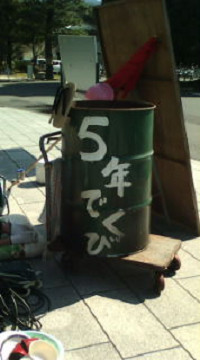
According to the Asahi, Kyoto University has issued a final warning demanding the dispersion of two men who have been camping out on the university main campus for a month. The pair formed their own union, called Union Extasy in English, to demand that their employment contracts be extended past their five year maximum. Thirty supporters, presumably members of the regular Kyoto University workers’ unions who have taken a position supporting improved conditions for campus part-timers, stood with them in solidarity.
The crowd scene could be a sign that the moment when the university forcibly removes the two from campus could end up becoming a publicized confrontation, similar to the one seen at the Shinagawa Keihin Hotel earlier this year, when police forced the staff of the bankrupt hotel from keeping the business open against the wishes of the owners. The event was apparently crowded with both protesters and journalists, making for an enormous spectacle, itself something of a replay of the “temporary employee village” set up in Hibiya Park over the new year holiday.
The two men, both in their late 30s, were doing data entry work for the agricultural faculty for monthly wages of around 120,000 yen, according to an earlier report. I find it just amazing that they were both able to live on that much (20,000 yen/month apartments, probably a very meager diet).
A JANJAN citizen reporter who interviewed the strikers notes that of Kyoto University’s 5,400-strong staff, 2,600 are part-timers, 85% of them female.
The employment rules for university part-timers are on paper intended to promote full-time, indefinite employment. Universities are basically required to prioritize permanent hires and can only hire contract employees on a provisional basis. However, in typical lukewarm fashion, when the Kyoto U and other national universities were officially branches of the education ministry, Kyoto University signed non-permanent employees to 364-day contracts, theoretically terminated employment on March 31, “re-hired” the same people the next day for another term, and repeated this process for years. Exploiting this loophole had the added benefit that none of the “new employees” needed to be given raises from the previous year.
But when the national universities were corporatized in 2004, the rules changed. The ministry decided to close this loophole and instead, for employees hired on or after fiscal 2005, limited contract employment to a maximum five years, after which universities were barred from hiring the same person as a contract worker. In other words, the schools must now choose to either take them on as a full-time employee (and provide all the job security and regular pay raises that entails) or hire someone else on a contract basis. Kyoto University apparently decided to go with the cheaper option at the time, and now five years later they have this protest on their hands along with all the creative artwork that’s come with it:
The decision for these older men to protest may have been in part due to their stated desire to raise the wage levels for this type of work. The assumption for years has been that this so-called “part-time” work is the province of housewives in need of extra cash, so the fact that they are men and not basically dependents of their spouses breaks with this stereotype. And of course, this also implies the question, what difference does it make whether men or women are expected to fill the position?
The university Director involved in the labor negotiations has argued that non-permanent employees have no “operational responsibility” — in other words, they are not expected to become Company Men and accept forced transfers or other duties that would come with permanent status. But in an era of decreased job opportunities to the point that men are competing for jobs that were traditionally seen as women’s work, these old divisions seem pretty irrelevant.
Despite the clearly brazen and confrontational tactics taken by the union, asking to change this arbitrary rule seems pretty reasonable. Saga University has apparently already done so. They apparently are not asking to be taken on as full timers, just for a raise and the chance to stay on.
As often happens when observing events in Japan, I get the feeling that viewed from the outside this issue seems simple – just allow indefinite part-time employment, and leave the decision of who to promote to full-time status up to the university managers. I can understand the university’s reluctance to take on indefinite staff – in these uncertain economic times and an era of declining population, I wouldn’t want to promise someone a job for the next 30 years either. But there is strong resistance in Japan to a system of at-will employment, and the US model that I am used to is certainly not an obvious path to prosperity.
In addition, the various parties have widely divergent agendas. I would imagine the politics of a university employees union must be quite intense indeed, and they along with the bureaucrats have a vested interest in maintaining the seishain system of stable employment and regular pay increases, at the expense of everyone else. In addition, other actors such as the Japan Communist Party have a somewhat extreme vision of maintaining employment, as seen in their platform of forcing companies to use their “internal reserves” to maintain employment.
This time we have a first-ever video kabuki alert – toward the end of this clip you’ll find that Republicans’ submitting a budget proposal that has no hope of getting passed resembles the “highly stylised classical Japanese dance-drama” known as kabuki:
It has been a while since I highlighted an Adam Richards of the world, but I couldn’t ignore this fashion triumph. An Adam Richards in Montana has apparently joined a campus trend of rolling up one pant leg to protect against bicycle chains:
Adam Richards, a communications studies graduate student, said that although he sports the bike leg when it’s warm, he uses a rafting strap to cinch his pants to prevent wind from drafting up his leg during the cold months.
“It works fine,” Richards said, adding that the cold may be too much with rolled up pant legs.
“Maybe I’m just a wuss,” he said.
Even with this alternate approach to keeping pant legs intact, Richard still admits that sometimes the strap isn’t enough.
“I’ve ruined a couple pairs of pants,” he said.
Two things:
This article features something I have had to deal with all my life – people thinking my name is “Richard” instead of “Richards.” Either they think my first name is Richard, or they forget my last name ends in “s.” This is something I am sure all Adam Richardses of the world can agree on.
I sometimes see people in Tokyo with the “bike leg”, but it’s generally unnecessary since most bikes here come with metal guards over the chains.
This CNN report documents that much as in Japan, there is apparently a sizable number of Africans engaged in international trade and retailing in shops in Guanghzhou and some other areas of China. The report attributes the increase to increased trade ties between China and nations like Nigeria.
For a more detailed look at the situation of Africans in China, take a look at this translated article from Southern Metropolis Daily entitled “‘Chocolate City’ – Africans seek their dreams in China”:
In distant Africa, nearly 50 countries exploding with demand have opened their arms wide, and are rapidly digesting all of these consumer products not produced locally. Based on Chinese official statistics, during this period of China-Africa trade fever that started in 2003, the number of Africans headed to Guangzhou has been growing at annual rates of 30-40%.
…
About five years ago, Chinese petrolem companies and businessmen poured into Africa. This led many locals to feel that China was grabbing their resources and rice bowls (jobs). And yet from tractors to toothpaste, everything was “Made in China”; this stimulated many of them into looking in China’s direction. Many of Clem’s friends encouraged him, “Go to China! Nigeria’s using petroleum to trade for foreign currency, and the Chinese are buying it to build heaven!”
…
In September of 2007, Clem’s father, working at a Nigerian embassy in Europe, was able to arrange a Chinese visa for him. His friends were envious. More and more Africans are patiently lining up in front of Chinese embassies in Africa, fighting for visas permitted under a limited quota. A guy who received his visa at the same time as Clem had paid a fee to a visa application service nine months ago. When he finally received the visa he had been waiting for, the guy who had been muttering and cursing under his breath finally calmed down; he fiercely kissed his passport.
…
Many taxi drivers aren’t willing to take on “chocolate” customers. They don’t like the nose-irritating perfume, nor the constant bargaining on every trip. Some drivers will use excuses that “you’re too big, the car won’t fit you”, or “I don’t understand your foreign language”; but some don’t care, “driving anybody is just business.”
Based on official statistics, since 2003, the number of Africans in Guangzhou has been growing at 30-40% annually. Based on a report in the Guangzhou Daily, there might already be 100,000 in the community. They come from Nigeria, Guinea, Cameroon, Liberia, and Mali. Amongst these, Africa’s most populous country Nigeria claims first place.
They primarily live in village-districts in the city of Guangdong (like Dongpu, Dengfeng Jie, Yongping Jie). They do their business in a few large-scale China-Africa commerce malls.
The stalls in these commerce malls don’t have much in terms of decoration; at most, there will be a black plastic model at the front door. Samples are piled up the ground, and hung up on the walls and placed in display cases. In one building, the warehouse and sales offices are one and the same. Stall owners pile their blue jeans on the walk-way itself. When it gets busy, you have to step over the piles of pants.
These centers have accumulated basically all of the world’s top brands — Dolce and Gabbana blue jeans, Adidas shoes, Gucci high-heels, Louis Vuitton purses, Chanel purses, Armani underwear. Their prices are ridiculous: Dolce and Gabbana jeans are 20 RMB (3 USD), Gucci high-heels and purse together for 100 RMB (15 USD)…
…
While picking through clothes, Cote claimed that he had many Chinese friends here. To prove his point, he walked up, and pats the store-owner on his head. Or, he playfully kicks at the store-owner’s leg. He’ll loudly greet them, “Friend, how are you recently?” His “friends” don’t respond. Some pull out a cell phone and intentionally ignore him. Others impatiently wave at him, and say in a combination of Chinese and English: “if you’re not buying anything, then go… quickly GO!”
…
Guangzhou has the densest concentration of African businessmen in China. Areas and cities surrounding the area has thousands of factories that take tens of thousands of African orders, originating from Chocolate City, every day.
…
… On Yongping Street, many black illegal immigrants live together in homes that rent for 100-200 RMB per month. They come out only at night, either selling physical labor by offering to carry goods, or sell drugs and other illegal activities. According to police in the area, starting in November of 2007, they had searched out a group of Africans in the country illegally. They were sent to Yunnan and deported.
Africans in Tokyo
On the continental level, Africans make up the least significant group of foreigners in Japan, far outstripped by just about every other group that counts (Vietnam alone has more registered foreigners in Tokyo than the entire continent). According to a Mainichi article from 2006 Africans in the Tokyo area number in the “tens of thousands,” though this is far above the 2,987 registered foreigners of African nationality within Tokyo Prefecture (Excel). It is also far smaller than the “as many as 100,000” in Guangzhou – that would mean African residents make up 1.31% of Guanghzhou’s population vs. 0.16% of Tokyo’s (assuming that Mainichi is right and there are at least 20,000 African residents in the Tokyo area). I should also mention that they are apparently overwhelmingly male and in prime working years.
Many are apparently in the country under similar terms as in China – most come from Nigeria and Ghana, and they are in the country on work/business visa quotas, and sometimes as illegal overstayers. In addition, many are in the country on spouse visas, both genuine and fraudulent (or somewhere in between). Some teach English, while others operate or work for clothing stores, import shops, or restaurants. Their numbers extend beyond Tokyo – I have heard reports of African-run hip-hop clothing stores as far-flung as Shikoku.
While almost all of the African residents in both Japan and China surely make their livings legitimately, it is worth mentioning that Africans in Japan have been notably involved in counterfeiting, drug muling, money laundering, and other illicit activities, apparently in line with the situation in Guangzhou. These crimes may receive extra scrutiny because of how Africans stand out. Anecdotal reports indicate that the police generally view Africans with suspicion, and apparently when they are arrested they can expect little mercy from the Japanese justice system (though the reaction in Japan must certainly be tamer than the brazen racism seen in that piece on China).
One key difference between the Sino-African and Japanese-African relationships is that while the Japanese interests have centered around resource investment projects (in his youth, Prime Minister Aso helped run a diamond mining operation in Sierra Leone) and meeting diplomatic goals (UN Security Council reform, whaling), China under Mao developed ideological ties with leaders in Africa as it sought to support socialist revolution abroad. These efforts included a priority student visa program for African students to study at Chinese universities. On an only tangentially related not, this was the historical background of some pretty scary 1988 protests in Nanjing:
On December 24, 1988 two male African students were entering their campus at Hehai University in Nanjing with two Chinese women. The occasion was a Christmas Eve party. A quarrel about correct identification between one of the Africans and a Chinese security guard, who had ordered the Africans to register their guests, led to a brawl between the African and Chinese students on the campus which lasted till the morning, leaving 13 students injured. 300 Chinese students, spurred by false rumors that a Chinese man had been killed by the Africans, broke into and set about destroying the Africans’ dormitories, shouting slogans such as “Kill the black devils!” After the police had dispersed the Chinese students, many Africans fled to the railway station in order to gain safety at various African embassies in Beijing. The authorities prevented the Africans from boarding the trains so as to question those involved in the brawl. Soon their numbers increased to 140, as other African and non-African foreign students, fearing violence, arrived at the station asking to be allowed to go to Beijing.
By this time, Chinese students from Hehai University had joined up with students from other Nanjing universities to make up a 3000 strong demonstration which called on government officials to prosecute the African students and reform the system which gave foreigners more rights than the Chinese. On the evening of 26 December, the marchers converged on the railway station while holding banners calling for human rights and political reform. Chinese police managed to isolate the non-Chinese students from the marchers and moved them to a military guest house outside Nanjing. The demonstrations were declared illegal, and riot police were brought in from surrounding provinces to pacify the demonstrations which lasted several more days.
The African population depicted in the video is clearly of a much different character from these earlier students. Reflecting the increasing resource investment of China itself, this group of Africans in China are strictly business-oriented (many never even attended college), apparently hoping to cash in on the Chinese economic boom.
UPDATE: Could have been “a special WBC page set up on the Asahi shimbun’s web site”. Thanks to commenter ST
In an otherwise vividly descriptive article on Japan’s World Baseball Classic victory, it seems like the Wall Street Journal reporters may have made a slight error (emphasis mine):
Even workers who couldn’t watch the game live on television kept an eye on the contest. In Tokyo, three Japanese businessmen who were waiting for the subway huddled together staring at a mobile phone screen, tracking every pitch from a Web site.
I am pretty sure they must have been watching “1seg,” a mobile TV signal that’s become fairly common in Japan over the past three years or so. Scenes of strangers watching mobile TV together have become somewhat common in Japan, a sort of modern-day version of businessmen stopping to watch the sample TVs at the Sakuraya in front of Shimbashi Station. During pivotal sports games (Asia Cup soccer, Red Sox in the World Series, etc.), people seem willing to share their mobile TVs with onlookers. Maybe they don’t have much choice unless they want to be a jerk and turn it off, but all the same it’s a new and somewhat rare expression of community with strangers in this city.
(DISCLAIMER: This is not an essentialist statement about Japanese culture! I found Washington DC to be full of similarly detached and unfriendly strangers, as perhaps it should be to a certain extent).