
Note Howard Dean’s statement toward the end of this video:
BTW, the Talking Points Memo blog’s “Day in 100 Seconds” and “Sunday Show Roundup” are great. This way I don’t have to actually watch those painful news shows.
Note Howard Dean’s statement toward the end of this video:
BTW, the Talking Points Memo blog’s “Day in 100 Seconds” and “Sunday Show Roundup” are great. This way I don’t have to actually watch those painful news shows.
On Tuesday, parts of Japan’s political net-osphere will go dark as the official campaigning period begins for the August 30 general election to select members of the nation’s lower house of parliament. Considering that this election has the potential to take government control away from the ruling Liberal Democratic Party for the first time in 13 years, national and international attention on this race is high.
So what can I add to the conversation? My interest in Japanese politics and other current events is fairly intense, so I plan to follow this story with the same rigor I apply to my other favorite topics.
Mainly, I plan to profile the candidates up for election in my district (Tokyo’s 13th) to give a worm’s-eye-view of the election from my perch in Adachi-ku, Tokyo. Some readers will recall my series of candidate profiles leading up to last month’s Tokyo prefectural assembly elections.
But first, some opening remarks:
What will this election decide?
On Sunday, August 30, Japanese voters will go to the polls to elect all 480 members of the House of Representatives, the more powerful house of the country’s bicameral legislative branch of government. After the election, the Diet (Japan’s word for its parliament) will be convened to choose a prime minister, who will then form a cabinet. The upper and lower house will each conduct a vote, but if the upper house vote differs from the lower house’s, the lower house’s choice will prevail. If one party has won an outright majority of seats in the lower house, it can elect a prime minister without the aid of any other party, but if not various parties will have to negotiate and form a coalition government.
The lower house is where most substantive legislative business is done. It controls the passage of the national budget, can override an upper house veto with a two-thirds vote, and most importantly decides the appointment of the prime minister. The DPJ currently controls the upper house, which is a less powerful but still significant part of the legislative process.
The party (or coalition of parties) that wins this election will ostensibly gain control over essentially the entire country — if the DPJ gains control it will preside over the executive branch, dominate both houses of the legislature, and possess the power to appoint Supreme Court and lower court justices.
In practice, however, the prime minister and cabinet’s power has been limited – to give a very broad outline, powerful ministries set the agenda on most important national issues, the legislature exists mainly to ratify that agenda and distract the public with loud but ineffectual drama and scandal (in exchange for funneling money back to their districts), and the judicial nominees are almost never decided by the elected officials themselves.
The opposition Democratic Party of Japan are on track to make significant gains in this election, though it will be a tall order to increase their current standings (110) to exceed the LDP’s total of 303. The DPJ are campaigning on many issues, but perhaps first and foremost on a revolutionary vision of administrative reform. They believe that the bureaucrats in the country maintain power based on, in Secretary General Acting President Naoto Kan’s words, a “mistaken interpretation of the Constitution” that bureaucracy has the inherent right to control government administration, while it’s the job of the cabinet and legislature concentrate on passing laws. The DPJ would like to wrest control away from the “iron triangle” of unelected bureaucrats, powerful business interests, and their cronies in the Diet and place power squarely in the politicians’ hands. But more on that later.
How are members selected?
Since the law was changed in 1993 following a major LDP electoral defeat, members of Japan’s lower house have been chosen using two parallel systems – 300 are selected through single-member districts nationwide similar to the US House of Representatives, while the remaining 180 seats are allotted through a proportional representation system (or PR for short).
Under Japan’s PR system, the parties running in the election field candidates in each of 11 regions. On election day, voters write down two votes for the lower house – one for their preferred individual in their district, and the other to choose a party they’d like to receive the PR seats in their region. In the interest of counting as many votes as possible, votes will still count if a voter writes in the name of an individual running in the region or the party leader’s name instead of the party name.
For example of how this works, in 2005 the Tokyo PR district had 17 available seats. To win a seat, a party would have had to earn at least 5.88% of the vote, or 389,682 votes. Only one party that ran (Shinto Nippon with 290,027 votes) failed to gain a seat in this district.
The fact that relatively fewer votes are needed to win a PR seat has convinced smaller parties to try their luck. Most recently, the Happiness Realization Party, a newly formed political wing of new religion Happy Science, has decided to field more than 300 candidates in all single-member and PR districts (though as of this writing it is unclear whether they will actually go through with it). The religion’s leader Ryuho Okawa has announced his intention to run in the Kinki PR district with the top position. To do so he will need 3.45% of the vote, which would have been around 375,000 votes in 2005. His party would have to seriously improve its performance after winning a dismal 0.682% (13,401 votes in 10 districts) of votes in the Tokyo prefectural elections. Okawa had originally planned to run in Tokyo, but Tokyo has a higher 5.88% hurdle to overcome.
How does voting work in practice?
After entering the polling station, voters will be handed a paper ballot and a pencil (yes, a pencil, not a pen). They will be directed to a table with a list of candidates and instructions on how to vote. There they will write in the name of their preferred candidate along with their PR vote. To make it easier for voters to remember, many candidates spell their names using phonetic hiragana instead of kanji, which can be harder to write and have many different readings.
Since this election will also include a people’s review of nine of Japan’s 15 Supreme Court justices, voters will be required to mark an X next to the names of justices they would like to see dismissed. Blank votes will be counted as in favor of keeping them on.
In my next post, I’ll talk about the issues and outlook for this specific election before getting into the more provincial task of profiling my local candidates.
(Updated with correction, thanks to Curzon)
Everyone knows that Japan’s lower house of parliament is up for re-election on Sunday, August 30.
But what you may not have heard is that some Supreme Court justices are also up for a “people’s review” (国民審査) at the same time.
Thanks to a banner on the sidebar of Yahoo Japan’s politics site, I now know how this works:
On paper, Supreme Court justices are “appointed by the emperor” based on the cabinet’s nomination and thus the Chief Justice serves as a minister of the emperor on the same level as the prime minister. However, the Japanese emperor has no real power, so in fact this means the justices are appointed by cabinet decision.
As a means of providing a democratic check over the judicial process, each justice is subject under the constitution to a people’s review at the general election immediately following their appointment, and then again every decade thereafter. In the upcoming election nine of the fifteen justices are up for review, including Chief Justice Hironobu Takesaki who was appointed by the Aso cabinet in November 2008.
At the polls, voters will be presented with a ballot listing the name of each justice with a box next to each name. The voter must place an X in the box to affirmatively vote to dismiss each judge. Blank votes are counted as votes in favor.
As far as I can tell, this system is all but window-dressing. So far, no judge has ever been dismissed in this manner, and among current justices who have undergone review, the justice with the highest ratio of votes against him is Yuki Furuta at 8.2%.
This appears to be the only way for the electorate (or their representatives) to dismiss Supreme Court justices, though there is The other ways that justices can be dismissed are the age requirement (they must retire by their 70th birthday) and a law that judges can be tried for dereliction of duties or other misconduct in the Court of Impeachment, consisting of 14 lower and upper house MPs (no Supreme Court justice has ever been impeached).
The Supreme Court‘s English-language page has a very brief mention of this system toward the bottom:
The appointment of Justices of the Supreme Court is reviewed by the people at the first general election of members of the House of Representatives following their appointment. The review continues to be held every ten years at general elections.
A Justice will be dismissed if the majority of the voters favors his/her dismissal. So far, however, no Justice has ever been dismissed by the review.
Justices of the Supreme Court must retire at the age of 70.
The Japan Times had a good Q&A about the Supreme Court back in September 2008.
Spotted during a recent trip to the IKEA in Shinmisato, Saitama:
Thanks to Gen Kanai for passing on this landmark lecture on Youtube culture and how it’s turning all Americans into attention whores who can only find validation through media exposure:
This appears to be on the same page as J Smooth’s observations about how even as the Youtube generation mourns Michael Jackson’s death, now that everyone is a media star they must deal with the same pressures of public exposure that Jackson faced:
I direct all MFT readers to read this amazing, detailed expose from The Smoking Gun identifying and incriminating the the denizens of “Pranknet” an online community of highly destructive and juvenile practical jokers, whose exploits include the following:
Late on the evening of February 10, a call to Room 306 at the Best Western in Shillington, Pennsylvania roused a sleeping traveler. Jonathan Davis at the front desk was calling with scary news: A ruptured gas line was threatening hotel guests, some of whom were already feeling lightheaded and dizzy.
Noting that he was following a “protocol sheet,” Davis instructed the male guest that he needed to quickly unplug all electrical devices and place wet towels at the base of the room’s door to keep carbon monoxide from entering the space. After the guest took those precautions, Davis then directed him to bust out a 5′ x 5′ section of window. The man, who happened to be a glazier, asked, “Are you serious?” When Davis urgently assured him that the drastic measure was required for his safety, the guest replied that he would put on clothes and “bust this fucker.”
Using a chair, the guest then smashed a window. As broken glass cascaded into the room, Davis then advised that the television screen would need to broken since the tube contained an electrical charge that could spark an explosion. Davis suggested the use of the toilet tank cover to disable the television. But when the guest threw the porcelain lid at the TV, it broke. So Davis directed the man to toss the set out the window. Stepping gingerly around glass shards, the guest complied.
At this point, Davis’s supervisor, Jeff Anderson, joined the call and determined that the guests in 306 had co-workers in the adjoining room. Anderson then called Room 304 and advised the man answering the phone to “remain calm.” He told the guest of the gas leak and advised him of the safety measures that had already been followed next door. The man in 304 also unplugged electrical devices, placed wet towels at the door, smashed a window, and tossed the television to the sidewalk below. Anderson then directed the guest to pull the fire alarm. As a siren wailed, the guest asked Anderson, “Can we get out of this motel? Why can’t we just leave the building?” He had previously remarked, “I hope this ain’t some kind of joke.”
This is a really impressive investigation. The author writes with a well-deserved satisfied tone and seems to almost taunt the Pranknet members with his ability to expose them. Do yourself a favor and spend the next half hour reading through it and listening to some of the calls. You’ll see what a public service it is to hopefully stop these people.
I am currently reading Discrimination and Power (差別と権力), Akira Uozumi’s fascinating biography of Hiromu Nonaka, a former LDP heavyweight and cabinet minister known as a member of the burakumin, a minority outcast group who have suffered discrimination due to their historical role in feudal Japan as leather tanners and undertakers, vocations considered unclean. MFT readers will remember him as the man a New York Times article characterized as Japan’s version of Obama, as he too was a minority politician who rose to become a powerful politician.
I will post more on the book later, but for now I just want to share the following episode:
Just four months after Nonaka’s first successful bid* for the Diet’s lower house in 1983, the Kyoto Prefectural Police arrested the head of his koenkai (support association, kind of like a political action committee) for violating election laws. But Nonaka and associates were mostly able to beat the charges. Here is why:
You see, when Nonaka was first elected to the lower house he was already 57, a very late start for an LDP politician. But before that he had already made a very large name for himself in Kyoto prefectural politics as an anti-Communist conservative at a time when Kyoto had a Communist governor for more than two decades.
Part of the secret of Nonaka’s success was a questionable election tactic – when election season came around, construction executives friendly with Nonaka would mobilize housewives associations and other support groups to visit houses and run “get out the vote” campaigns in Nonaka’s home district of Sonobe and surrounding areas of Kyoto. Under Japanese election laws it was (and remains) illegal for politicians or their staff to visit people’s homes to ask for support, as it’s (correctly) assumed bribes will be forthcoming during such visits. However, Nonaka was able to get away with this for years as the construction executives ostensibly acted independently.
Eventually, police found evidence that during Nonaka’s first bid for the Diet, the voter mobilization efforts were in fact illegally run directly by the campaign. That’s when they moved to raid Nonaka’s offices, arrest the head of the koenkai, and question two leaders of the koenkai‘s youth bureau.
However, the charges never stuck due to a lack of evidence or confessions (subordinates were prosecuted for minor offenses but the investigation never spread) thanks to a flurry of expert moves by Nonaka’s people to undermine the investigation before, during, and after the fact. They included:
From the beginning, the top brass in the police were hesitant to rock the boat since the politicians have a hand in deciding the police force’s budget. I can’t help but think they were a little prescient.
*from Kyoto’s 2nd district; he ran with (or more appropriately, against) Sadakazu Tanigaki and they each won a seat in the two-member district.
(Updated)
A few weeks ago NYT ran this great article about the difficulties of raising a son in both Japanese and American cultures:
My Un-American Son
By KUMIKO MAKIHARA
Getting Yataro ready for his first sleep-away camp overseas is turning out to be much more than counting T-shirts and towels. I’m having to review the way children interact here to see which behaviors would go against American codes of conduct. American parents have higher standards than Japanese when it comes to acceptable behavior among children.
Take “kancho” for instance, a popular prank where kids creep up on and poke each other with pointed finger in the behind, shouting “kancho!” or enema. That would likely have the camp counselors in America alleging sexual abuse.
Kancho certainly isn’t encouraged in Japan — a friend of mine is convinced her daughter failed a preschool entrance exam because she playfully jabbed her mother in the rear during the interview. But Japanese parents usually bestow only a mild rebuke.
Please head on over to NYT to read the original article!
Other differences mentioned:
All these observations ring very true, though obviously your mileage may vary. I thank my lucky stars every day that I’ve never been kancho’d.
What I like best about this piece is that she resists the temptation to theorize or lecture about which society has the better practices. That’s the right approach because proclaiming one country’s education/child-rearing regime to be superior to the other’s does nothing to help Yataro navigate his new summer camp. By talking from her own experiences as someone who has had to navigate both societies (and offering some speculation about how Americans at the summer camp will react), she is able to shed light on cultural differences without getting into ultimately unhelpful broad conclusions. And in the process she has given us an entertaining and enlightening case study in the form of her own son. I look forward to the follow up article to hear how Yataro fared.
(A Google search for “Maki Katahira” “Kumiko Makihara” reveals several other articles about her son and life in Japan, along with this right-wing conspiracy theorist who implies she must be a CIA agent and part of the Trilateral Commission‘s plot to control Japan because she was married to former Newsweek Japan bureau chief William Powell (though apparently they divorced) and once worked as an executive assistant for a firm partially owned by private equity group Ripplewood. I don’t want to lend any credibility to this crackpot, but even if she is working for the man, this is still a pretty great article)
(Today’s post about how my chance to observe the lay judge trial was stolen is in Japanese only. For an overview of my experience in English, please check my photo album here. Feel free to leave comments in English!)
8月4日(火曜日)、全国で初めての裁判員裁判を傍聴しようと、朝早くから東京地方裁判所へと出かけた。ニュースで聞いていたとおり、傍聴希望者が数百人来ていて、大きな行列ができていた。報道陣も大勢来ていて、目の前の人にも「なぜ傍聴に来た」と取材していた。

基本的に、裁判の傍聴はアポなしでもできるが、注目が集まるような事件となると希望者が傍聴席の約60席を上回るため、抽選で傍聴券が配布される。当日は並んでいる人に整理券をくばり、9時になると当せん番号をホワイトボードに掲載し、整理券の番号と一致した場合は当せんとなる。
残念ながら、私は外れた。裁判所の前で「惜しい」と悔やんでいたところ、不思議な光景を目撃した。それは次に述べるように「報道機関による裁判傍聴制度の乗っ取り」である。
まず、裁判所の前は報道陣のカメラマンなどであふれている。それに、報道陣から当選者らしき人に対し指示を出し、一つの場所に集めようとしている。

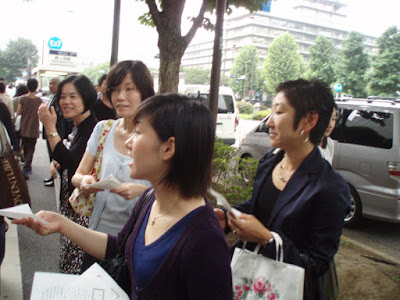
そして、道を渡って警察庁本部の前に行くと、また別の行列ができている。並んでいる人全員が整理券を手に、誰かに渡し、マニラ封筒を受け取る。


封筒を受け取る様子を見てやっとわかった。この人たちはおそらくアルバイトで応募して、当選した場合は報道関係者に傍聴券を譲渡する。当たりでも外れでもお金がもらえるので、抽選の後で封筒入りの現金を渡していたようである。
これを見て、本気で憤りを覚えた。動員されたアルバイトがいればいるほど、その分まじめに傍聴しに来た人が当たる確率が低くなり、その機会が報道機関の動員によって奪われたからだ。
改善策
裁判には報道関係者の立ち入りが禁止されているらしい(利害関係者などは別の傍聴席があるようだ)。その状況下で、なんらかの方法で取材しようとすることが、ジャーナリストとして当然の行動である。しかし、傍聴制度は国民のために設けられ、その権利を奪ってはいけない。
もちろん、バイトの人たちが悪いと思わない。
一番責任があるのは、こんな非効率なルールを作って裁判所の関係者たちである。この状況を改善するには、裁判所に対していくつかの提言を述べてみたい。
1.傍聴券を譲渡不可にする。お金目当てでの傍聴券の入手を防ぐために、傍聴券を第三者への譲渡を禁止すべきである。これによって、「報道機関の乗っ取り」による不公平をなくし、一般人が傍聴しやすくなる。
2.一定の傍聴席を報道機関に優先的に枠を作る。報道陣はどうしても取材したいし、国民の関心のある事件の場合、その社会的価値も高い。法廷のスペースに制限があるので、一般人の傍聴席を少し減らして10席ほど設ければいい。事情により報道機関の立ち入りを一時的に禁止する必要も考えられるので、その場合は枠を作らないで、一般人の傍聴も禁止すべき。
この慣行が何年も続いているので、提言したところで改善すると思わないが、裁判員制度が始まった今、国民の司法に対する関心は高まるに違いない。
以上の二つを実現すれば、傍聴制度は利用しやすくなり、本来の目的を果たすことを期待している。
Are Japanese couples spending more or less on their weddings during the current recession? For the answer the J-media have unsurprisingly turned to their corporate overlords, but this time it looks like they have been given mixed signals:
So does that mean the recession pushes people to spend more or less (or the same) on their weddings? J-Cast seems to think data like this reflect Japan’s growing economic disparity. The key to explaining this disparity, they argue, lies in whether a couple’s parents helped pay for the wedding. Recruit’s data shows that 78% of couples did have parental support, so perhaps the other 22% had no choice but to settle for less.
I have no data to back me up (not the first time), but I suspect that weddings can be somewhat recession-resilient. Though weddings can be expensive, if you invite enough people they will bring more than enough ご祝儀 (cash gifts) to make up for the cost. Some couples even profit from the exchange (though that means they will have to attend many of the guests’ own weddings later on).
Obviously, that could still mean the poorer sections of society have to settle for less, for a lot of reasons. Without parental support, a young couple is unlikely to have the cash that’s needed up front to make deposits or pay bills ahead of time. Also, poorer couples have poorer friends, limiting the amount of financial support they can ask for. And at any rate there is a recent trend of a rising number of shotgun marriages (estimates range from 26.8%-40% of new marriages), which can make it socially difficult to hold a big celebration due to the shame involved.