I generally agree with all of Roy’s comments about the device itself. It has a few drawbacks, but it’s a great machine overall, and probably the best solution for someone who wants a multilingual smartphone that doesn’t suck.
I first tried ordering my phone directly from Softbank, in order to take advantage of a corporate discount which my employer has through its relationship with Softbank. The contact at Softbank corporate replied that he would send over the documents, with one caveat:
I apologize for asking, but do you have Japanese nationality and a Japanese [driver’s] license? If you have a nationality other than Japan, an alien registration card and passport (within its term of validity) are required. They must be within their term of validity and you must have a duration of residence of more than 27 months. There must be a photo, address, name and date of birth, and they must match the address, name and date of birth on your application. If your status of residence is “Temporary Visitor” or “No Status,” you cannot apply. You must also pay by credit card.
If applying by using an alien registration card and passport as personal identification, please be aware of the following.
(1) If your duration of residence is less than 90 days, you cannot apply.
(2) If your duration of residence is 15 months or less from the date of your application, you may not enter a discounted purchase contract. (You may pay by lump sum at the store.)
(3) If your duration of residence is more than 15 months but 27 months or less from the date of your application, you may only enter a discounted purchase contract divided into twelve payments. (You may also pay by lump sum at the store.)
(4) If your duration of residence is more than 27 months from the date of your application, you may enter a discounted purchase contract.
Note that, by the language of those requirements, they only apply if you are using a gaijin card as ID. Softbank has not publicized any documents which say that a foreigner has to use their gaijin card, or that they have to pay with a credit card.
I would recommend a couple of strategic points for others who want an iPhone, don’t have enough time left on their permit and don’t want to lose a lot of money:
Don’t go directly through Softbank or a Softbank store. Go through a third party, like an electronics store. They are less likely to care about Softbank rules and more likely to care about getting you out the door with a new phone.
Don’t use a gaijin card as ID if you don’t have the necessary period of residence left. Use another form of ID, and be sure to point out that the 27-month rule only applies if you are using your gaijin card as ID.
If you still can’t get the right deal, go to another store. If you ask to talk to a manager, they will probably waste your time calling Softbank corporate and getting a stone-wall answer.
The really odd thing about these requirement is that other acceptable forms of ID do not prove Japanese citizenship or lack thereof (e.g. health insurance card or chipped driver’s license), so if you say you are a citizen, Softbank really has no way to prove you wrong (unless they can bribe their way into government databases).
But that’s enough about Softbank. Let me complain a bit about eMobile before signing off.
Why I switched from eMobile
Readers may recall that I adopted an eMobile phone about a year ago, mainly because I was moving to a new apartment with no existing internet connection. I didn’t want to wait a month to wire the place for high-speed internet, so I decided to get an eMobile phone that would tether to my PC for free.
This turned out to be pretty good for most purposes–fast enough for web browsing and even for BitTorrent. The biggest drawback was ping time. Since the connection had to go through my phone, through the air and through a bunch of 3G routing equipment, it often had crappy latency, which made it hard to use Skype, online games and other connection-intensive software. Even YouTube gave me problems at times.
After a few months of that, I had optical fiber installed, and then the drawbacks of my eMobile phone became more and more apparent. The Windows Mobile OS was buggy and often locked up, requiring a restart in order to use the phone. Some third-party software kept activating my 3G connection even when I didn’t want it activated, which severely ran up my phone bill on a trip to Taiwan.
Then came the proverbial straw that broke the camel’s back. One night last week, my phone just stopped working. Internet use gave me a “modem connection error,” and calling out gave me a message saying my phone wasn’t activated.
I emailed customer service, and got a reply the next day which said that my phone had, indeed, been deactivated. This was because the contact phone number I gave at sign-up was no longer active. This, in turn, was because it was my old deactivated Docomo phone, which the eMobile store said I could use as my conact number.
Rather than help fix the problem, the online customer service agent told me I had to call eMobile. I called, got an annoying voice prompt, and eventually found my way to an agent, who took down all my personal information and then immediately told me I had to call someone else (at a local Tokyo number, no less). I called the new number, was placed on hold again, and got another agent, who told me that the one person who could help was assisting someone else and would call me back “in a few minutes.” A few hours passed without a call-back, and that was enough for me to put in my MNP application online. My new iPhone was up and running on the same number just a couple of hours later.
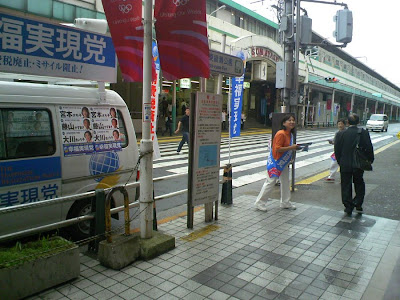
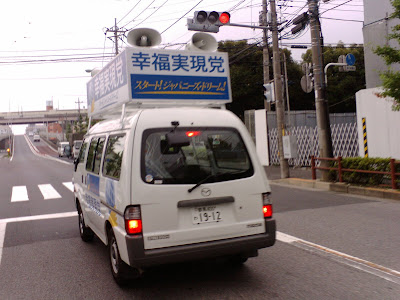
I am wrapping up this profile series on the final night of campaigning. All ten candidates have had their vans drive by my apartment at least once. Since the average time someone can listen to a passing van is about 3 seconds, the candidates’ strategy seems to be “forget about policy, just repeat your name again and again.”
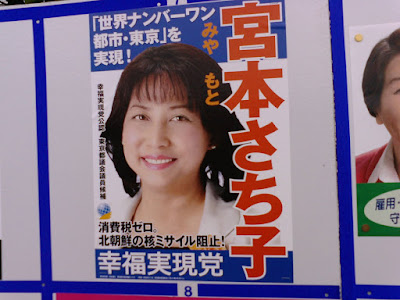
Last but not least is Sachiko Miyamoto, the candidate sponsored by the infamous Happiness Realization Party:
The Happiness Realization Party was formed in May of this year as the political wing of Buddhism-based new religion Happy Science, which claims to have somewhere around 10 million followers (compared to between 12-20 million for Soka Gakkai), an enormous rate of growth for a faith that only started in 1986. I am not sure exactly why Happy Science decided now is the time to enter politics, but they seem to be very well-funded and serious about trying to get elected (their resources quite obviously outstrip someone like Osato Ichikawa).I have probably gotten more literature from HRP than anyone else during this election cycle. Also, they make no attempt to hide their affiliation with Happy Science – it says so right there on the literature.
Whatever else the HRP might have wrong with it (and there’s a lot), you cannot accuse them of thinking small. Every proposal they have is radical and sweeping. This video from their official Youtube channel makes it look like they are prepared to conquer the earth just to install a high-speed rail network:
As you can see from the video, the HRP is promising to build nothing less than a utopia in Japan – prosperous, safe, and above all happy. Unfortunately they are light on details on how they could bring this about.
Among their chief policy proposals:
Revise the constitution to allow a pre-emptive strike on North Korea if necessary.
Eliminate inheritance taxes and consumption taxes.
In the cities, “bring work and home closer together” by building offices and residences in the same building.
Build an enormous monorail around the entire city of Tokyo.
Allow massive immigration and promote reproduction to increase Japan’s population to 300 million by 2050
Some of their most radical proposals can be found in their draft constitution:
Make a directly elected president the head of state. The president would have the right to issue presidential orders apart from parliamentary legislation. If an order and legislation contradict each other, the chief justice of the supreme court would decide which to follow. But if there is no decision in two weeks, the presidential order will take precedence.
The emperor “and other traditions” would be kept on but with their power limited by law.
The chief justice of the supreme court would be directly elected.
Payment for public bureaucrats would be based on performance (this would be in their constitution!)
“Equal opportunity” and total freedom within the law.
The state must always aim to have a small government with low taxes.
“The mass media must not abuse their power and must act responsibly to the people.”
I am not sure how exactly this is related to the Happy Science teachings, and frankly I don’t care. Their mythology is complicated to the point that it’s just about impenetrable. All anyone needs to remember is that Happy Science is that it is a personality cult above all else. They believe that the founder Ryuho Okawa had a vision in the 80s that he is essentially the savior of mankind. If you’re interested in learning more I am sure they’d be happy to talk to you.
Career: Miyamoto’s website offers precious little information. She apparently moved around a lot as a kid – born in Itabashi-ku, then moved to Wako-shi in Saitama through middle school followed by Koshigaya for high school. After studying French in college, she worked for the Palace Hotel company for two years until she got married in 1981. From then until deciding to run for office, she has apparently held no job or responsibility besides raising her two boys to adulthood.
Policy: The main point of her candidacy is to spread the message of the national HRP. To do that, in her speeches she constantly repeats that the HRP is “the party of zero consumption taxes.”
In her more detailed campaign literature, she says Tokyo needs a “transportation revolution” with the following main policies: build another highway on top of the most crowded sections of the Shuto Expressway; make intersections and rail crossings “three-dimensional”; and install double-decker train cars for use at rush hour.
Something interesting: Miyamoto is a mysterious blank slate, so I don’t know what to say here.
And so ends my attempt to humanize these people! Once the election is over I will be back with some reflections on voting and analysis of the results. Just for the record, here is my projection of the winners, in descending order of votes:
That’s right, I am predicting the LDP will walk away with just one seat. One anonymous Adachi-ku assembly member put the chances of this happening at “around 70-80%” and I am inclined to agree.
Today we profile Japan Communist Party candidate Yoshie Oshima (age 59):
Taken during this morning’s commute.
Career: Oshima has spent her entire career working in the Adachi-ku government, first as a bureaucrat and later as a politician. After graduating from high school in 1968, she became a bureaucrat in the Adachi city hall. In a biographical video, Oshima recalls her daily tasks included cleaning the senior workers’ desks and serving them tea, tasks that she didn’t hate but considered fairly useless to her goal of helping the people of Adachi-ku. At that point, she decided to start looking for a job that would give her the same status as the men and allow her to realize her objectives.
She found her niche in 1973 when she became a case worker at the city’s welfare office. At this time she got involved with the Communists, which no doubt played a role in inspiring her to become a consistent political agitator. She joined movements to oppose price hikes to and push for improvements to pre-school services, in part because she herself had trouble finding ways to balance child-raising and a career. She also served as head of the city workers’ labor union.
Oshima left the city hall in 1982 to run as the chosen successor to a retiring Communist politician and won her first election in 1983. She’s been a fixture of the Adachi assembly ever since. As a city assemblywoman, her achievements have focused on very specific local issues, such as fixing water buildup in a Kitasenju walkway. She’s also been highly critical of the LDP mayor’s policies, such as the elimination of detailed garbage separation requirements and price hikes to pre-schools (a pet issue for Oshima).
Policy: While she has joined the other candidates in offering a program of beefed up welfare benefits, her campaign is unique for her particularly blistering criticisms of the Ishihara administration, echoing the general JCP line. The party’s efforts to uncover scandalous spending and potential corruption have formed the only credible opposition force in prefectural politics, a foundation the DPJ has sought to expoit by belatedly coming out strongly against Ishihara’s policies.
Despite the JCP’s commendable record in that regard, the main reason Mrs. Adamu and I cannot support any JCP candidate is their program of radical social change. The party may have softened its line in recent years, but the JCP’s policy remains essentially unchanged – they are working to build up their political support in preparation for eventually realizing communism.
Chances of winning: Hoping to repeat history, Oshima is once again running as the chosen successor to a retiring JCP veteran. This time she seeks to replace Yasunobu Watanabe who is retiring for health reasons after a long political career. Both Tokyo Shimbun and Nikkei Shimbun expect her to win a seat by inheriting the support of her predecessor.
Tell me something interesting: Not much in this department. Oshima is the only candidate so far to prominently feature her personal life in her campaign. This makes sense since it was no small achievement for her to lead a political career while married and raising three kids. The kids are grown up and Oshima now has two grandchildren. Her hobbies are photography and flower arrangement.
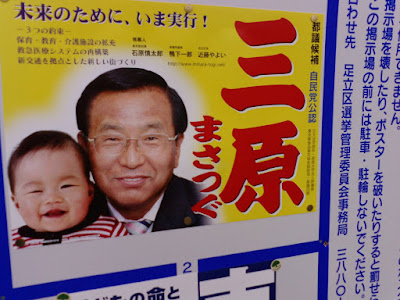
Like rival DPJ candidate Satoru Onishi, Mihara was a political secretary for a national MP before becoming a politician himself. Since then, Mihara appears to have split duties between serving time and giving full-throated support to Governor Ishihara.
Judging from his website, this guy is not trying very hard to get re-elected. Nothing about it even suggests there’s an election coming up. It’s almost an insult to someone like Katsuhiro Suzuki who has yet to taste electoral victory and spends every waking moment campaigning. Sure, Mihara is on top of a bus giving speeches, but even then he didn’t seem as passionate as the other candidates. Then again, as a connected guy he may not need to work all that hard, at least not in public.
But while you get the impression that Mihara feels entitled to his assembly seat, his political career hasn’t been all peaches and cream. Though he served three consecutive terms starting in 1993, Mihara was voted out in 2005 and then back in 2007, when he easily won a by-election to replace LDP assemblywoman Yayoi Kondo after she ran successfully to become the mayor of Adachi-ku. (Mihara’s own profile fudges this fact but it’s backed up by election data)
Born in Yamaguchi Prefecture on the western tip of Honshu, Mihara joined the Ground Self Defense Force straight out of middle school. After leaving the force, he earned his college degree and in 1970 became a secretary to the late Lower House MP Ryosuke Kujiraoka. Kujiraoka, who grew up in and was elected from Adachi-ku, was known as a conservative pacifist and member of former Prime Minister Takeo Miki‘s faction. Like Miki, Kujiraoka gained respect as a squeaky clean politician. Presumably, the Kujiraoka connection (he served the man for 22 years) is why Mihara is running from Adachi-ku.
Policy: Like everyone else, Mihara trots out a series of enhanced welfare initiatives to help kids and foster development. Interestingly, he places “small and medium size corporations” first on his list of groups he wants to help.Contrast this with the consistent “people’s lives first” campaign of the DPJ.
Chances of winning: Mihara won the 2007 by-election by a substantial margin, so as the successor to popular mayor Yayoi Kondo, Mihara will likely land within the top six despite the anti-LDP sentiment.
Tell me something interesting about this guy: On his list of accomplishments, Mihara claims to have led the fight to ban “legal drugs” in Tokyo which I assume refers in part to magic mushrooms, which were legal in Japan until around 2001. According to his site, his efforts led to “Japan’s first anti-drug ordinances” (which in Japan is kind of like banning werewolves) though he doesn’t say when.He is also a big supporter of Governor Ishihara’s efforts to install security cameras around the city.
If you spend most of your adult life serving under a loyal factionist LDP Diet member, that apparently means you get to earn extra money by serving on various boards and committees. That’s at least true for Mihara, who sits on the board of an organization that runs group retirement homes and as a “councillor” (member of the management council) at a Buddhist-run school. He also heads the Adachi Gateball Association (had to look that one up).
Mihara Easter Egg
If you load just the top-level domain of Mihara’s site it opens what appears to be an older version. It contains some of the typical profile info, but toward the bottom of the page he links to a bunch of fad diet websites and then this dude:
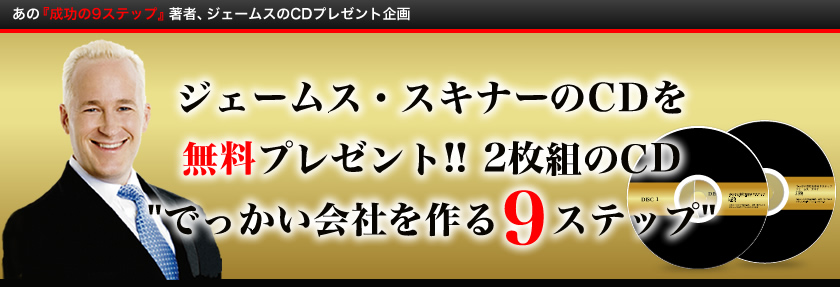
This is James Skinner, a US-born motivational speaker for upwardly mobile Japanese. He speaks native Japanese and gives high-energy talks encouraging the audience to focus and make their companies more profitable:
His audience apparently consists primarily of corporate managers. I don’t know what this says about Mihara’s qualifications, but considering all he’s accomplished in his career maybe paying for these life coaching services was worth it.
I am flying to the US next Friday for a two-week trip around the East Coast, stopping in New York, Philadelphia, Washington and Myrtle Beach. One of my biggest helpers in planning this trip has been a website called TripIt.
I generally use Google Calendar for planning my schedule, and as long as I stay in Japan, it works just fine. My Windows Mobile phone automatically syncs to Google and displays upcoming Google Calendar events on its Today screen. But there is a serious drawback to Google Calendar: its assumption that the user will always stay in the same time zone.
Let’s take my flight from Narita to JFK, ANA flight 10. It leaves Narita at 11:00 AM JST, and arrives at JFK at 10:45 AM EST on the same day (thanks to the International Date Line). If I stick to local time on my calendar, it’s impossible to input this flight unless I create two separate events for arrival and departure. Even if I do that, my calendar will still assume that I am on Japan time no matter where I go, so it will assume that I have already arrived even when I am hours away from arriving.
Enter TripIt. It was designed as a socially-networked travel tool; you put your upcoming trips online and it tells you who else will be in your destination with you. I find this particular function to be pretty worthless, but the real beauty of TripIt is in calendaring trips that go across multiple time zones. Here’s why:
The TripIt web page always shows the itinerary in local time. You can specify departure and arrival time zones for each mode of transportation you take. This is perfect for planning each step of the itinerary.
Each account has an iCal feed which you can use to automatically reflect your travel plans in Google Calendar, iCal or any other modern calendar app.
The feed shows up in whichever time zone your calendar reader is set to. While I am planning my trip in Tokyo, all the times show up in Google Calendar in Tokyo time, which comes in handy for figuring out when to sleep so I can minimize jet lag. Once I am on the plane to the US, I can switch my phone to Eastern Time and all the events will convert to Eastern Time.
Automated input keeps this from being a pain in the butt to set up. All you have to do is forward your airline, Amtrak and hotel confirmations to a special e-mail address, and TripIt parses your travel plans into your calendar automatically.
Thanks to the authors of this web site for solving my problems–now I’m ready to enjoy sweltering weather, greasy food and panhandlers again!
I recently joined keireki.jp, a Japanese social networking service (SNS) launched earlier this month. It’s a neat concept which may interest many in the English blogosphere.
(Disclosure: In a past life I helped the site’s coder-in-chief, Kristopher Tate, get set up in Japan, but I currently have no business relations with his company.)
Keireki is essentially a Japanese version of LinkedIn–a service aimed at professionals who want to expand their network. Unlike the big Japanese SNSs, GREE and Mixi, it is designed to be non-anonymous and (more or less) entirely public. Users are expected to use their real names and employers, although some choose to redact their employers’ names.
There are four components to a Keireki profile:
Keireki (“work history”): Takes up the front page of each user’s profile and lists the user’s current and past jobs and schools in chronological order, just like a Japanese-style CV. Doesn’t have any space for qualifications, hobbies, etc., although those can be included in the “hitokoto” tab (below).
Iitoko (“good points”): The most unique feature of the service. These are short tags added by other users to describe the person’s strong points: “good designer,” “bilingual,” “super hacker,” and the like. Each new iitoko has to be approved by the recipient, and if users agree with an iitoko they can click a link which says “Tashika ni!” (“Certainly!”) to signal their agreement. Clicking on an iitoko produces a list of all users nominated for that particular iitoko. The concept is generally somewhere between a LinkedIn recommendation and a Flickr tag.
Kikkake (“opportunities”/”springboards”): A personal feed very similar to Facebook status updates. Each one-line post can be the basis of a comment thread below it. This appears as a separate tab on each user’s profile, while the main landing page for the site shows the collective kikkake of your connections (again, very similar to Facebook).
Hitokoto (“a word”): The third tab on each profile is a free writing space which the user can fill as they prefer. It supports basic rich text formatting, hyperlinks and images, which puts it several steps ahead of even Facebook and LinkedIn. In practice, users seem to treat this like they treat their “personal introduction” space on Mixi: some write a sentence, while others fill the space with gobs and gobs of personal information, interests and links.
The site is still in alpha and has some minor annoyances: for instance, while it can handle foreign names (in katakana and romaji simultaneously), the order of foreign names often comes out differently in the input field and the final profile, which requires some fiddling. The sign-up process is also unnecessarily clunky and requires a Japanese mobile phone to complete (you have to send yourself an e-mail, then click on a link in your phone to get an access code). Some features are also conspicuously missing: there is no private user-to-user messaging, no RSS, no direct interface to other websites and fairly limited search functionality, but I expect that all of these features will be strengthened in future updates.
With some further development and good marketing, this could make SNS a useful business tool in Japan. I deleted my Mixi and GREE accounts a while ago because both sites seemed to be optimized for frivolity and little else. Keireki has the potential to be a serious platform for businesspeople and creative types to get together.
Keireki is currently invite-only, although several MFT bloggers and commenters have accounts already. It’s also only available in Japanese for the moment.
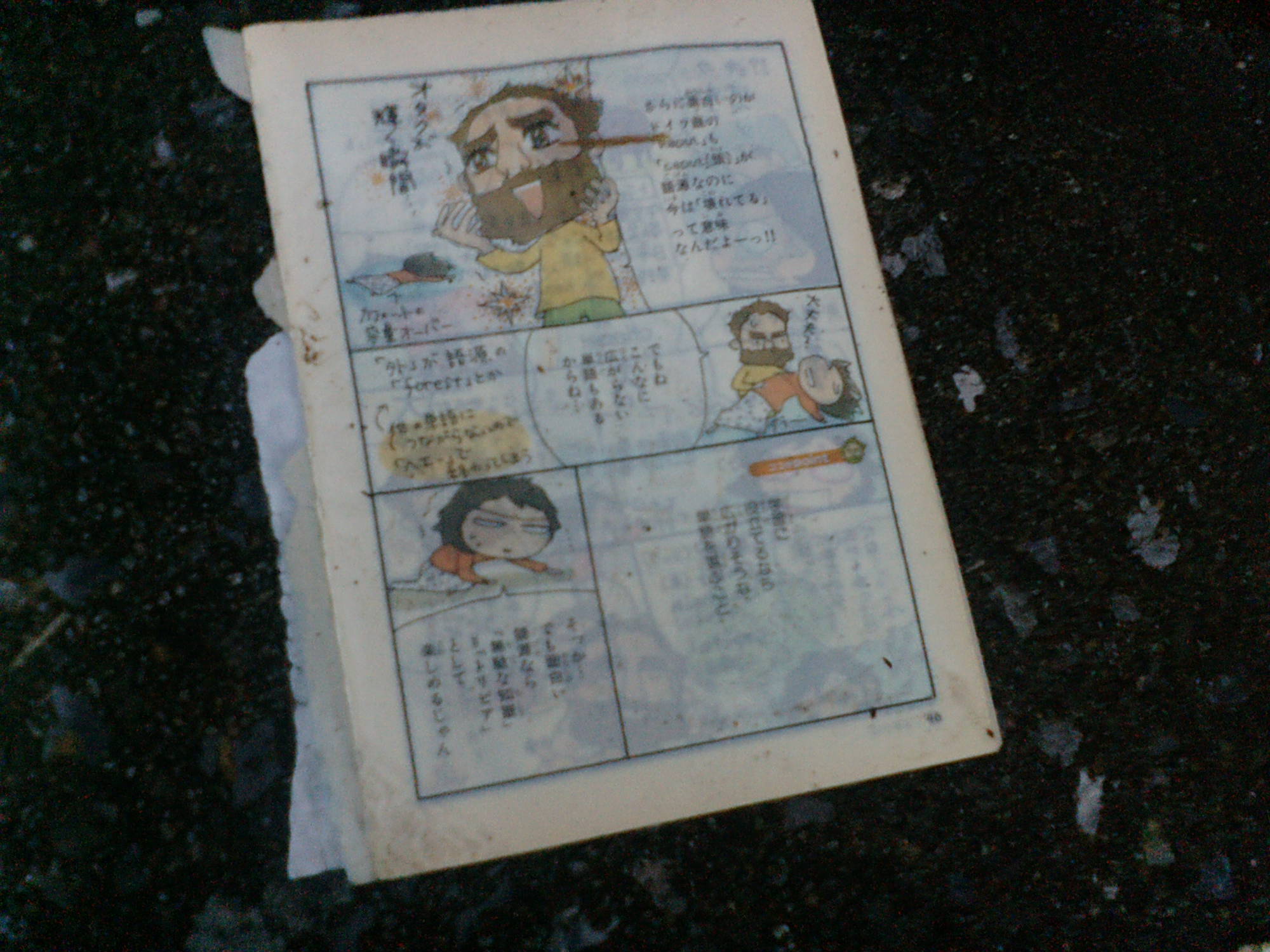
I came across this depressingly soggy ex-manga on the road near my apartment:
This was a volume in the ダーリンは外国人 series (Literally translates as My Darling is a Foreigner but has been sold in English translation under the godawful title Is He Turning Japanese? Out of basic respect for human dignity I will use the literal translation in this post).
Whoever left this must really have not liked what they read since it looks like they took the effort of tearing the the binding apart into three pieces before leaving it to rot. I’ve read the first two volumes (one of Mrs. Adamu’s friends gave them to us as a gift appropriate for our situation), and while they weren’t my favorite they don’t deserve this level of disrespect.
But I always believe that when life gives you soggy manga on the street, you use that opportunity to write a review of that manga in the hope that something constructive can come out of such a senseless waste:
Adamu’s thoughts on My Darling is Foreigner
The series, a semi-autobiographical episodic story of the daily life of the author, a Japanese woman with no international experience or English ability, and her quirky, multilingual American husband, was a surprise hit in Japan. According to an undated article at the Hiragana Times, the first volume has had at least 28 print runs since the first edition hit bookshelves in 2002.
I might expect too much from a manga that wears its light-heartedness on its sleeve, but this title was a letdown when I read it a few years back. As a manga it is very well-drawn (I was especially impressed with the detailed closeups of Tony’s face), but the depiction of main character Tony (pictured above) leans too heavily toward a two-dimensional “Hello Kitty” caricature, someone who hasn’t got a personality so much as a list of quirky but endearing distinguishing traits (extremely obsessed with learning languages, generally kind-hearted but won’t change his mind once he’s settled on a decision, doesn’t like to be told how to wash the dishes out of a sense of respect for individuality, has deep-set eyes).
While Darling was basically very well-received by a public that’s used to being entertained by exotic-looking foreigners who love Japan and can speak their language, the manga was not without its detractors. Critical Amazon commenters, many of whom claimed to be in international relationships and to have received the manga from well-meaning friends, seemed turned off by the superficial observations and general dullness of confusing the routine aspects of married life with a deep commentary on international marriage just because the husband has a white face and commutes to Starbucks. Some speculated that the author’s lack of English ability and experience abroad led her to concentrate on the superficial aspects of Tony and fall short of all but the most amateurish insights. Interestingly, some pointed out that Tony seems far more integrated with Japanese society than your typical foreigner, while others got the impression that he’s just a miser who couldn’t fit in back home.
I felt a little disappointed to see a person reduced to such simplicity in the name of keepin’ it honobono, especially since the title implies he represents “foreigners.” And I want to emphasize that Tony is in no way typical of the American population here. Some of Tony’s quirks – as seen in episodes where he badgers a pizza place into letting him use expired coupons and demands a waiter give them wine free of charge since he didn’t like how it tasted – are downright abrasive and share more in common with the stereotypical obatarianthan an American man, let alone “foreigners,” which as a term is far too broad (though it fits in with the Japanese connotation of gaikokujin to mean a white Westerner first and foremost). More than any of that, however, I found it hard to stay interested in want of any compelling characters or really any story elements more complicated than your typical episode of Sazae-san.
Still I don’t see any reason to disrespect a perfectly good manga, especially when there is a used book store just a few hundred meters away.
Just came across a very cool blog from Fumi Yamazaki, who works at Digital Garage (an IT company perhaps best known for its promotion of Creative Commons licensing and Joi Ito’s involvement). She’s interested in how Japan is using the internet, so reading through her posts will give you some idea of “what’s going on in Japan right now” as the title suggests.
I wish I had found her blog sooner because I have been working on gathering together data on how Japan uses the Internet for a while now, but haven’t been sure how to present the information. But now with the development of some interesting discussion on “the state of the Japanese web” now might be appropriate for me to just dump what I have.
Connections and usage patterns
Perhaps the most authoritative survey of Japanese Internet usage is the annual Communications Usage Trend Survey from the Ministry of Internal Affairs and Communications (MIC). Much of the information below was taken from this source. It covers a truly broad range, so I encourage people to read the English summary edition (PDF) for more details (on topics such as IP telephone usage, business Internet adoption, etc.).
PC and Internet penetration
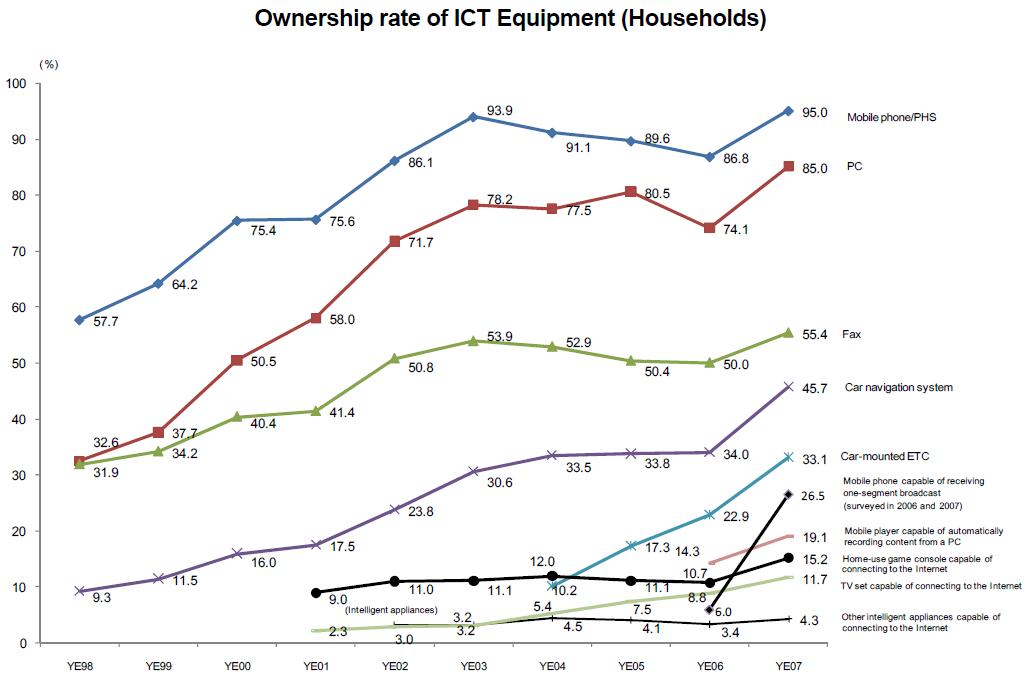
For an overall idea of what hardware is in use, the MIC has this handy breakdown of ownership rates over time (in this report, all charts were prepared by the source unless otherwise noted):
Meanwhile, the MIC survey (covering both PC and mobile usage) shows that 91.3% of households reported using the Internet at least once over the past year, while 50.7% used it for personal reasons in the past month as of March 2008. However, there is reason to believe the MIC data may be overstating the real situation somewhat, as the 52.4% rate of valid responses is significantly lower than the near 100% level for Cabinet Office data. This means that the data could be biased toward people with an active interest in technology.
Number of users
Recent stats from MIC (also covered by Fumi) show that measured against the population, MIC data shows that overall 75.5%, or 90.9 million people, had used the Internet at least once over the past year, either on mobile or PC. The total is up from just 9.2% in 1997, a simple linear growth rate of about 7 million per year.
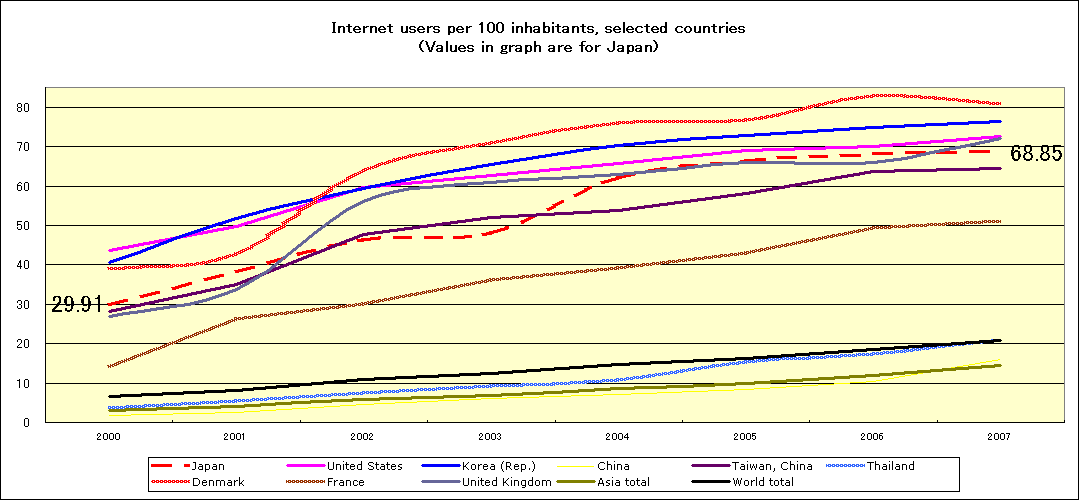
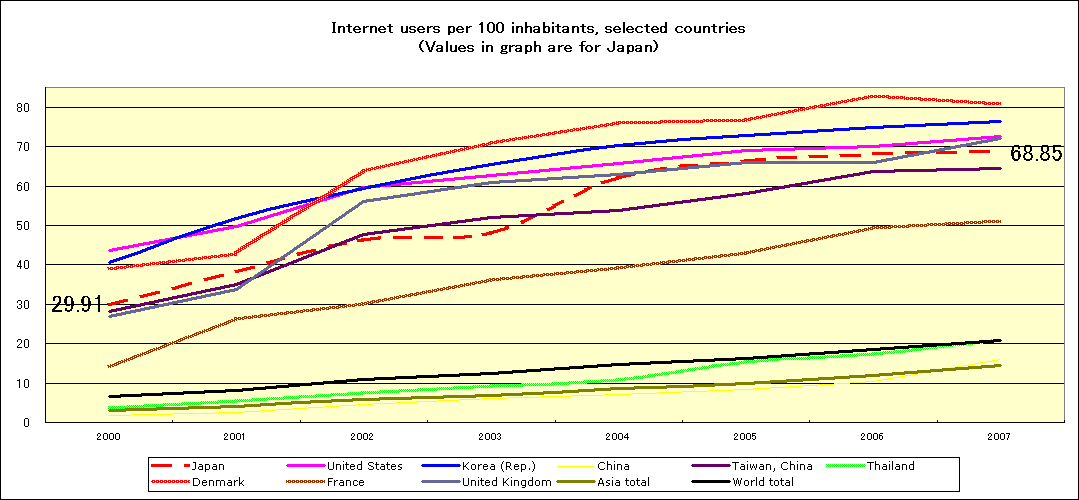
International statistics from UN body International Telecommunications Union of the number of Internet users per 100 residents show that Japan ranks in the top tier of wired nations – the 2nd highest in Asia after S. Korea, exactly even with Australia, but slightly under the US figure of 72% and well under some European nations (and I don’t think anyone can hope to approach Greenland’s 90% – that means even old people must be checking their e-mail!). I put this chart together to see how the pace of growth stacks up with some of the world’s other Internet powerhouses:
* See my Google Document for comprehensive global data from the UN-sponsored International Telecommunications Union (2000-2007).
Broadband penetration
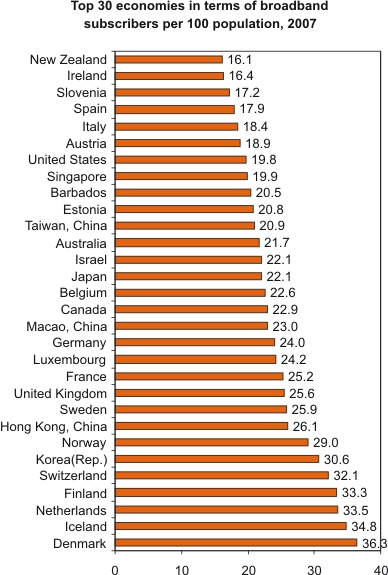
Aside from the widely debunked idea that Japanese is the language with the most blogs, one of the more famous statistics about the Japanese internet is the country’s high level of broadband penetration. Once again, this number comes from ITU, current as of 2007:
Japan comes in 17th, behind Canada and Korea but way ahead of the United States, as was true when New York Times columnist Thomas Friedman noticed in 2005, quoting from an article in Foreign Affairs, baseless claims of “top-notch political leadership” aside:
[T]he United States is the only industrialized state without an explicit national policy for promoting broadband….
[W]hen America “dropped the Internet leadership baton, Japan picked it up. In 2001, Japan was well behind the United States in the broadband race. But thanks to top-level political leadership and ambitious goals, it soon began to move ahead.
“By May 2003, a higher percentage of homes in Japan than the United States had broadband. …
“Today, nearly all Japanese have access to ‘high-speed’ broadband, with an average connection time 16 times faster than in the United States – for only about $22 a month. … And that is to say nothing of Internet access through mobile phones, an area in which Japan is even further ahead of the United States. It is now clear that Japan and its neighbors will lead the charge in high-speed broadband over the next several years.”
Interestingly, a recent study showed that 2/3 of US dial-up users (“9% of all adults”) have no intention to switch over to broadband, while in Japan it seems like there almost is no other option.
Speed and price
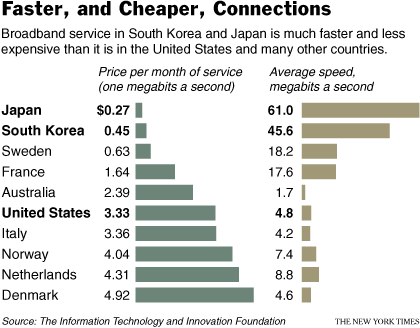
Data on Japan’s Internet speed and price also comes from the New York Times:
I use NTT East’s B-Flet’s service and pay somewhere around 4000 yen per month for the 100Mbps connection, something that as far as I know still isn’t available in the US except perhaps in select areas and certainly not for these prices. As far as I know, this is the common service package for most households with Internet connections.
Much of the attached 2007 article is more distracting than informative, but I’ve taken the liberty of Mad-libbing a key section for enhanced accuracy:
[T]he stock price of Nippon Telegraph and Telephone, which has two-thirds of the fiber-to-the-home market, has sunk because of concerns about heavy investments and the deep discounts it has showered on customers. Other carriers have gotten out of the business entirely, even though it is supported by government tax breaks and other incentives.
The heavy spending on fiber networks, analysts say, is typical in Japan, where big companies [are forced to] disregard short-term profit and plow billions into projects [out of deference to their regulator’s] belief that something good will necessarily follow.
Matteo Bortesi, a technology consultant at Accenture in Tokyo, compared the fiber efforts to the push for the Shinkansen bullet-train network in the 1960s, when profit was secondary to the need for faster travel. “[The internal affairs and communications ministry wants] to be the first country to have a full national fiber network, not unlike the Shinkansen years ago, even though the return on investment is unclear.”
“The Japanese [bureaucrats] think long-term,” Mr. Bortesi added. “If [the ministry thinks it can secure funding for a project they can hype as something that] will benefit in 100 years, they will [go forward with deficit spending that will be repaid by] their grandkids. There’s a bit of national pride we don’t see in the West.”
Now, I don’t want to be too cynical – the very success of this push for superior broadband access speaks well of those that promoted it, and regardless of pure intentions or what have you, this has had enormous ramifications for Japanese society and has produced an excellent technical Internet infrastructure.
Age distribution
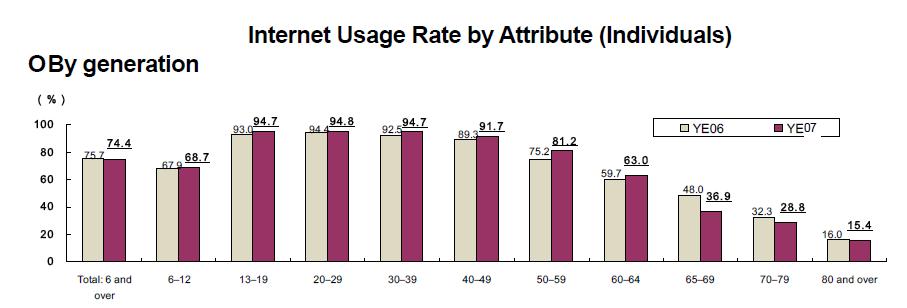
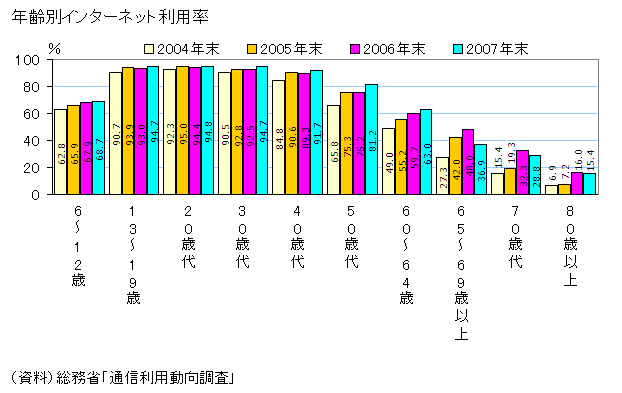
MIC data show 90% or greater Internet usage among all age groups from teens to people in their 40s, with a sharp drop to about 2/3 of people in their early 60s, 1/3 of those in their late 60s, 1/4 of 70-somethings, and 15% of people in their 80s. You’ll see that there is steady growth among the 50s and 60s age groups.
Frequency/intensity of usage
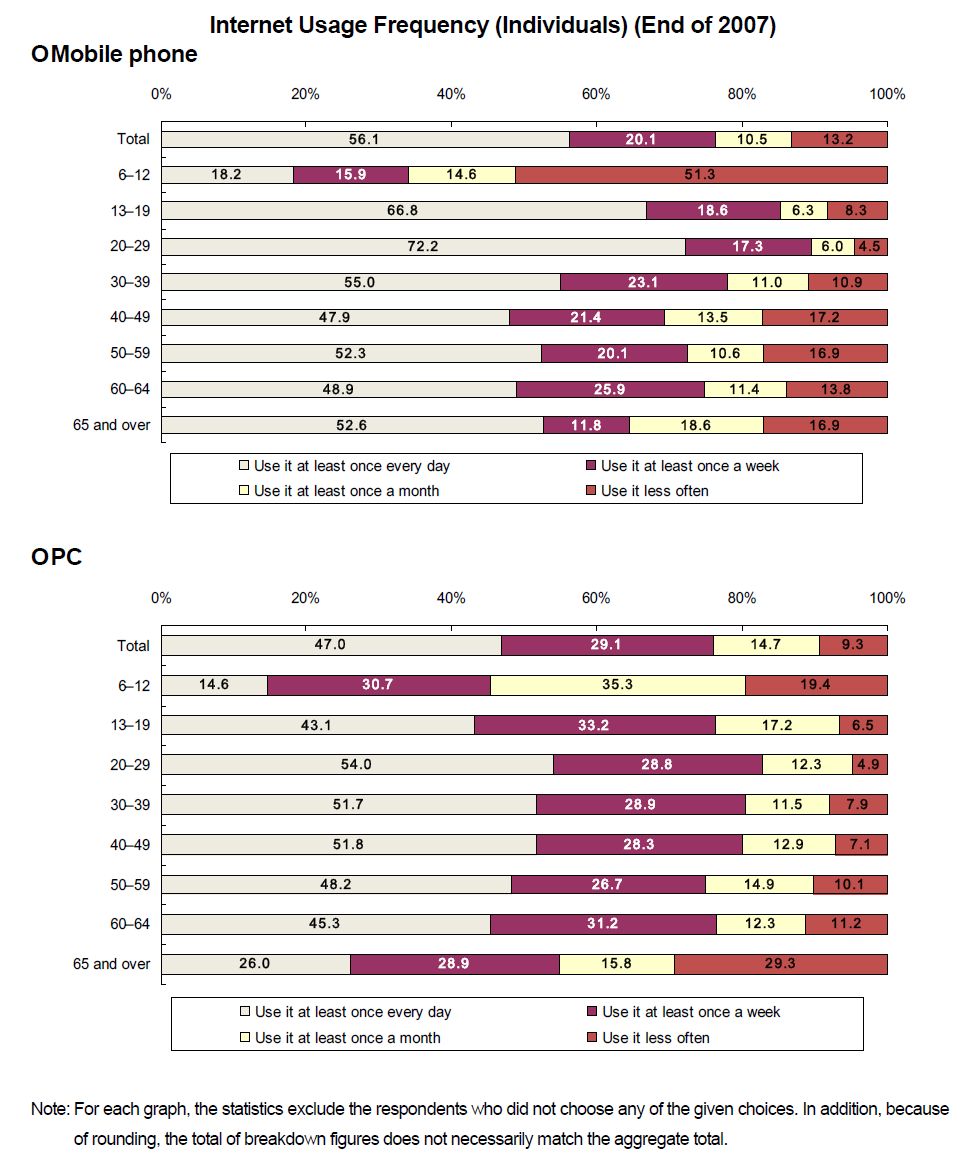
MIC data shows that 54.1% of Internet users use their mobile phones to access the Internet every day, compared to 47% of those who use a PC every day. Adding in the people who declined to respond to this question indicates that around 70% of both PC and mobile users access the Internet at least once per week.
By 2004, users were spending more time per day using the Internet than reading newspapers (TV: 3 hrs 31 min; Internet: 37 min; Newspapers: 31 min)) .
An 2007 MIC poll (graph here) found that 44.6% of people used the Internet at least once or twice a month, with the rest responding they use it “hardly at all” or “not at all.”
As for the male/female divide, it appears that significantly more men are online than women. The same MIC poll found that 35.2% of men use the net “almost every day” versus just 21.1% of women. A majority (52.7%) stated they never use the internet at all.
These overall figures are significantly skewed by the older demographics’ tendency to stay offline. More than half of people aged 20-29 use the internet almost every day, while a majority of all people aged 20-49 use it at least several times a week. These numbers drop off among those in their 50s or older.
Usage time
Two private-sector studies give an idea of how much time people in Japan spend using the Internet.
The Hakuhodo Institute of Media Environment did a random telephone survey (PDF) in 2008 of residents of Tokyo, Osaka, and Kouchi prefectures (presumably to compare two big cities with a more rural area) to find their relationship with the six major media (TV, radio, newspapers, magazines, PC Internet, and mobile Internet). In all three areas, respondents reported using the Internet (either via PC or mobile) for more hours than any other media besides television, though TV was the overwhelming winner, beating out Internet time by a ratio of around 2:1 in Tokyo. Tokyo’s reported Internet usage time per day was 77.1 minutes (versus 161.4 minutes of TV every day).
Internet research firm Netratings noted that total page views have fallen recently despite steady increases in overall usage time. The change comes as “rich content” such as Youtube videos have kept users at the same page longer.
Where people access – Overwhelmingly at home and work
The MIC asked respondents to answer where they have used the Internet over the past year. The top ten answers were:
Home (85.6%)
Work (36.6%)
School (12.9%)
Internet cafe (5.3%)
Hotel or other lodging facility (5.2%)
Public facilities (city hall, library, civic center, etc.) (4.7%)
In transit on public transportation (2.9%)
Airport or train station (2.2%)
Restaurant, cafe or other dining establishment (1.7%)
Other (1.7%)
This seems largely in line with the typical paradigm in the US and elsewhere.
People in their 20s and 30s were the most frequent in-transit Internet users (4.2% and 4.4%, respectively). The biggest in-transit demographic were men in their 30s at 6.2%.
While MIC data shows that Internet cafe usage pales in comparison to overall usage, a 2007 online survey (which will necessarily skew toward active Internet users) showed that around half of respondents had used a manga Internet cafe in the past, 20% for business purposes.
Data compiled from the receipts of Internet cafes between 2005 and 2007 by Plustar, a provider of business software for Internet cafe operators, shows that users are predominately males (70%) in their 20s and 30s.
PCs vs. Mobile
Much is made of the popularity of the mobile web in Japan, spurred on by images of trendy high school girls tapping away on their elaborately decorated keitai. It is true that Japanese consumers often suffer through long train commutes that give them time to surf online, and an infrastructure is in place simple web interfaces for the most popular sites, such as anonymous forum site 2ch and social networking giant Mixi. However, the available data is mixed on this issue, indicating that the hype could be outsized compared to actual usage. And it is highly possible that the perceived high usage of “the Internet” on mobile phones stems from Japan’s somewhat unique technology infrastructure – “text messaging” from mobile phones is all done using e-mail protocols, where in much the rest of the world it is done through SMS messaging.
The MIC tells us that while 88% of Internet users access from a PC vs. 82% with mobile phones, 68% of users use both a PC and mobile device. 16.7% of users only access from a PC, vs. 11.3% who only use a mobile device. The mobile-only population grew from just 7.9% in 2006, compared with a fall from 18 .6% for the PC-only group.
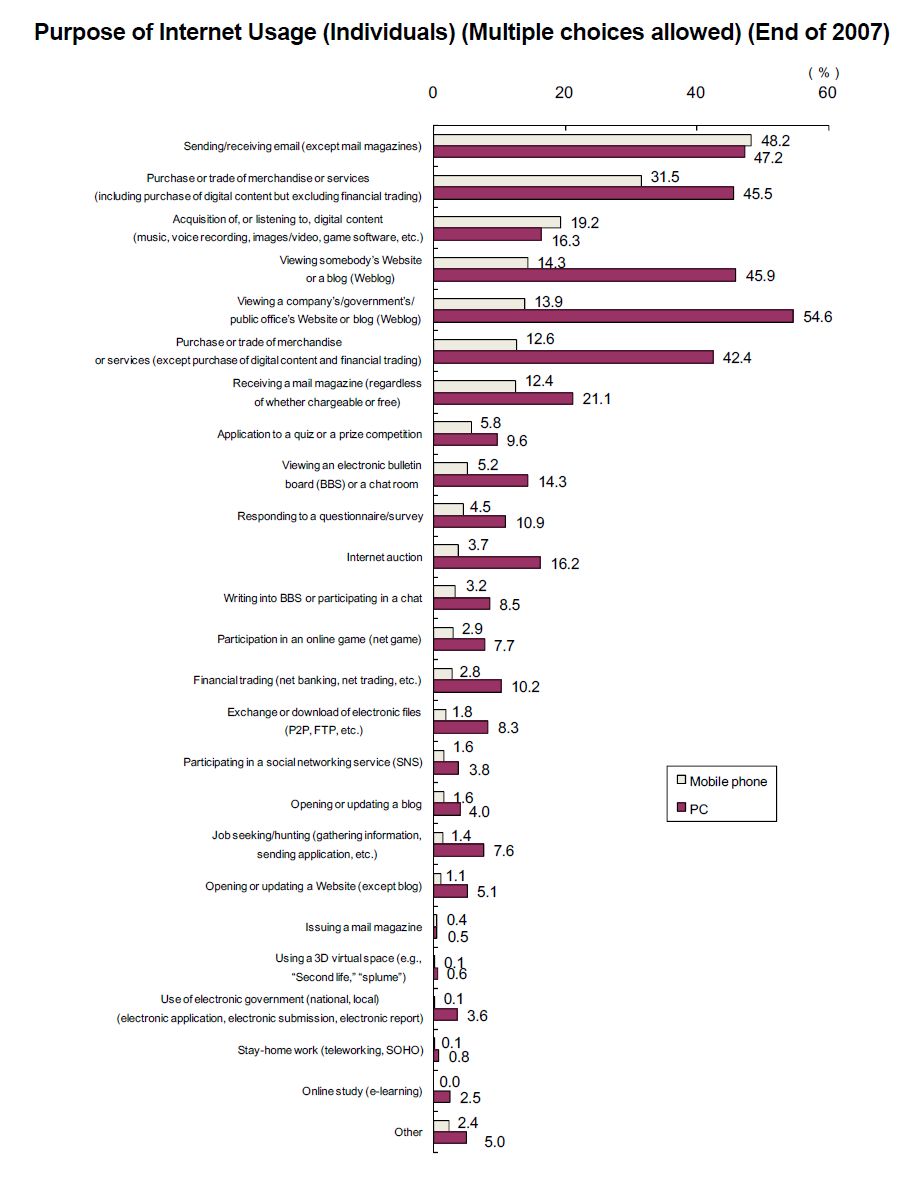
As noted above, MIC data shows that overall more people use their mobile phones every day to access the Internet, and about the same ratio use either their PC or mobile to access at least once a week. However, those surveyed appear to prefer using PCs for all Internet activities except e-mail, usually by wide margins. People also selected online shopping and purchasing online content as major purposes for using the mobile web:
Japan public opinion blog What Japan Thinks (whose author Ken Y-N I am proud to say is a regular commenter) has translated an online poll showing that users polled via mobile phone overwhelmingly use a PC as their main web conduit rather than their mobile phone (87% vs. 10%). There are important caveats to the data, such as “one way that they recruit their mobile monitors is by getting them to enter their mobile phone email address when they apply to be a PC monitor.” But the fact that it’s not even close suggests that there is something to it.
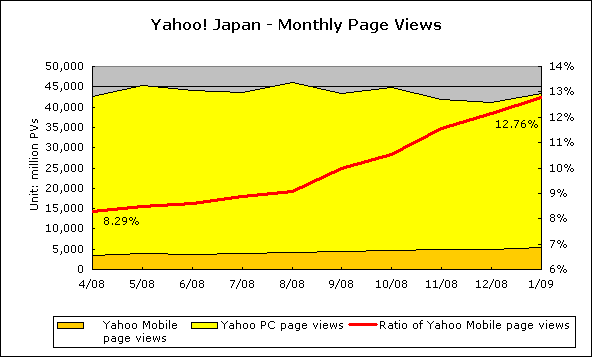
Yahoo Japan releases a breakdown of its unique page views each month for investors. The figures through January (PDF) similarly show that just 10% of their traffic comes from mobile users:
This rate of around 10% is comparable to rates in the UK and US as of June 2008, according to market research firm comScore.
***
OK, that’s about all I’ve got for now, but I hope it will serve as a starting point for discussion and future posting.
From what I see here, Japan is one of the most connected countries on the planet, and the people here use the internet, mostly on PCs, at a fairly high rate, especially the younger generation.
The next question I want to try and answer is how the Japanese people have adapted this new tool to their everyday lives (obviously there are lots of people studying this issue with intense interest, but so far I just haven’t seen a satisfactory answer). That will be for future posting. But to get started, I recommend two resources – Yamazaki’s recent post on the most popular sites for female users – unsurprisingly, social networking service Mixi topped the list); and this recent J-Cast article on the demographics of 2ch users.
(Updated – Fumi Yamazaki only used to work at Digital Garage)
I have already received my FREE MONEY from the government, but it is already spent on my recent trip to the US. But for those who haven’t spent the 12,000 yen handout yet, McDonald’s has an idea – give it to them! In exchange, they will give you a coupon booklet worth 20,000 yen.
According to Sankei, purchasers of the coupons will have until November 14 to eat the equivalent of 69 value meals (or value “sets” as they are called in Japan). Booklets will be available to buy at McDonald’s restaurants throughout Japan from May 15 through July but might sell out at some stores before others.
A 40% discount is significant and a better deal than some of the other campaigns out there, but consuming 69 value meals in six months could be a challenge. A single person who buys one of the booklets on May 15 and never shares it would have to eat a value meal once every 64 hours or two or three times a week to use up all the coupons. I know I’d get sick of the food after a while, and surely just about anyone will have tried everything on the menu and then some after a few visits. The coupons might make more sense for large families who could space out their visits more and still use all the coupons. While some savvy shoppers might figure out ways to profit from the deals, I am not that sophisticated (sell them for a 20% markup and pocket the difference?).
Like most gift card programs, McD’s must be counting on a) lazy customers never bothering to use up the coupons’ full value, and b) those who do use them to generate additional sales by bringing friends or picking up side dishes. It could also have a PR element designed to deflect some of the negative publicity of its labor practices or even its own recent runaway success thanks to 100 yen burgers’ popularity in the recession.
My verdict – keep your money and spend it on what you really need/want, and save by skipping McDonald’s and making delicious home-cooked meals. They are cheaper AND better for you.
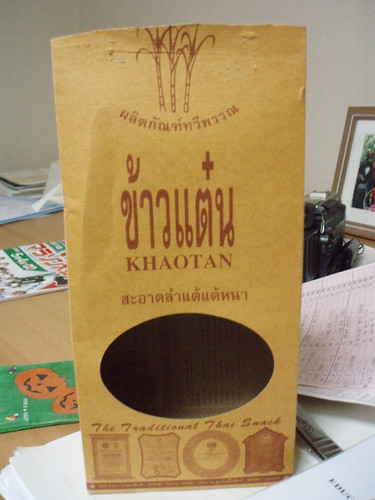
A friend of Mrs. Adamu’s brought us these “Khaotan” puffed rice crackers – “the traditional Thai snack” according to the package. Unlike many Thai snacks, these were actually not too sweet. They had a more subtle flavor that complemented the taste of the crunchy rice without overwhelming it.
We ate all the actual crackers already (Mrs. Adamu was especially fond of them), so here’s a random picture from the Internet to show you what they look like:
Hailing from Lampang in northern Thailand, Khaotan is part of the “One Thambon One Product” (OTOP) program sponsored by JETRO, an organ of the Japanese government. JETRO provides funding and expertise to help local areas develop their products for export to places like Japan or New Zealand.
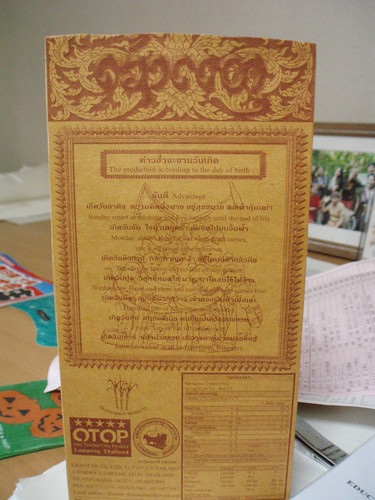
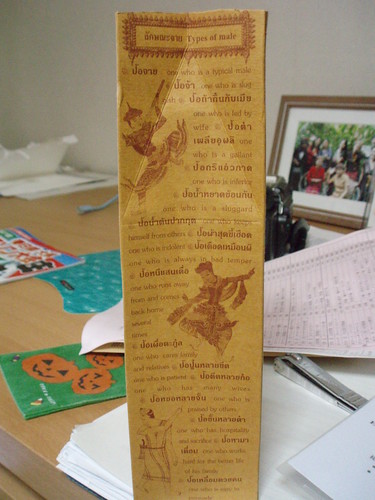
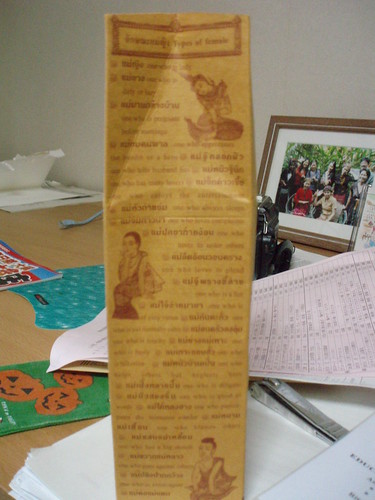
My favorite part of Khaotan was the extensive personality assessments on each face of the package. On the back is a chart of personalities based on the day of the week you were born (this day of the week system is pervasive among Burmese people as well), and a list of male/female personality types lines each side. The part about female personalities struck me as especially harsh – they have about twice as many different types as the men, but almost every type is just a different shade of dishonesty, vindictiveness, or irresponsibility. Just in case you can’t read the photos I will transcribe them for you:
The prediction according to the day of birth
Sunday: Smart at thinking and live happily until the end of life
Monday: Always cheerful and when death comes, one is supposed to be in heaven
Tuesday: Be brand and no fear of any danger
Wednesday: Clean and clear and can make dream come true
Thursday: Lots of properties and wealthy
Friday: Lots of fun till others envy
Saturday: No sad at all and has many followers
Types of male
One who is a typical male
One who is slug
One who is fed by wife
One who is a gallant
One who is inferior
One who is a sluggard
One who keeps himself from others
One who is indolent
One who is always in bad temper
One who runs away from and comes back home several times
One who cares family and relatives
One who is patient
One who has many wives
One who is praised by others
One who has hospitality and sacrifice
One who works hard for the better life of his family

 I am now the second MFT contributor to buy an iPhone. Roy took the plunge a few months ago.