Archive for the 'Burma' Category

Free Aung San Suu Kyi Free Free!

Friday, May 2nd, 2008

As part of Tokyo’s Earth Day festivities last weekend, author/rapper Seiko Ito held a poetry reading set to techno music, dedicated to the message of setting Burma free from tyranny. From the Burma Info website:

In the following video clip of the performance, Ito can be seen reading his statement, demanding that the military regime stop killing, beating, and imprisoning monks, and enter into dialogue. Htin Aung, the Democratic Voice of Burma stringer in Tokyo , reads out a statement in Burmese.

With a double DJ, Ito’s reading quickly turns into a hip-hop event. The audience rises, and many begin dancing and responding to Ito ’ s calls, waving arms, signs, and in some cases, babies. It was likely the first time ever that this many Japanese in one place expressed their support for a free Burma.

Watch the video here.

Here is my unauthorized translation of the poem:

You must not intimidate the nonresisting monks
You must not beat the nonresisting monks
You must not imprison the nonresisting monks
You must not kill the nonresisting monks

For they are outside the realm of power
And live under a wholly separate Law

Intimidating, beating, imprisoning, and killing such people is an overwhelming failure to understand, an overwhelming act of violence, in short the destruction of the other.

And, we too are the Other!

You must not intimidate the nonresisting monks
You must not beat the nonresisting monks
You must not imprison the nonresisting monks
You must not kill the nonresisting monks

For they are outside the realm of power
And resolutely possess a freedom to live under a wholly separate Law

Intimidating, beating, imprisoning, and killing such people is an overwhelming failure to understand, an overwhelming act of violence, in short the destruction of the other.

You must not destroy others
You must not destroy them, nor us

Don’t intimidate them!
Don’t beat them!
Don’t jail them!
Don’t kill them!

The junta in Myanmar
The Chinese government!

Free Aung San Suu Kyi!

Free the Dalai Lama!

We are they
And they are we!

You must not refuse dialogue!
For dialogue is the sole path to connect the other with the other
If the other and the other are not connected, hence springs intimidation, hence springs beatings, hence springs imprisonment, and hence springs murder!

So talk to them! Talk to them!
Communicate for the sake of dialogue!!
Freedom of speech and freedom of the press exist to prevent intimidation, beatings, imprisonment, and murder
Calling for dialogue and communication is to stand in the way of intimidation, beatings, imprisonment, and murder

The junta in Myanmar
The Chinese government!

Talk to them! Don’t intimidate them!
Talk to them! Don’t beat them!
Talk to them! Don’t jail them!
Talk to them! Don’t kill them!

Talk to them!

We are they
And they are we!

Burmese pop!

Tuesday, April 8th, 2008

A large catalog with flash video and downloadable mp3s.

Remembering the Railway of Death

Friday, March 21st, 2008

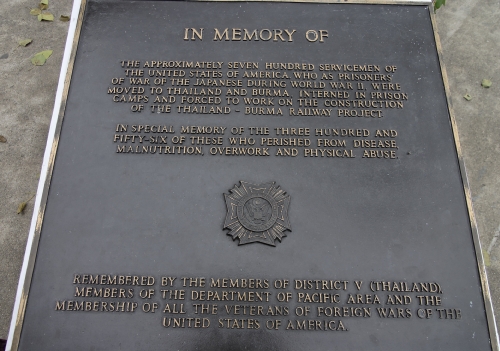
About a week ago the New York Times had an article entitled “Seeking Recognition for a War’s Lost Laborers” on the lack of recognition for the Asian victims of Japanese forced labor in the construction of the famous “Railway of Death.” According to the article, the history of the 200,000-300,000 Asians who were employed, and often killed, in the construction of the railway, which was being constructed to link Bangkok and the Burmese (Myanmarese) capital of Rangoon (Yangon) to provide logistical support for Japan’s invasion of Southeast Asia, has been almost completely overshadowed by stories of the smaller number of Western POWs.

Between 200,000 and 300,000 Asian laborers — no one knows the exact number — were press-ganged by the Japanese and their surrogates to work on the rail line: Tamils, Chinese and Malays from colonial Malaya; Burmans and other ethnic groups from what is now Myanmar; and Javanese from what is now Indonesia.

“It is almost forgotten history,” said Sasidaran Sellappah, a retired plantation manager in Malaysia whose father was among 120 Tamil workers from a rubber estate forced to work on the railway. Only 47 survived.

[...]

By contrast, the travails of the 61,806 British, Australian, Dutch and American prisoners of war who worked on the railway, about 20 percent of whom died from starvation, disease and execution, have been recorded in at least a dozen memoirs, documented in the official histories of the governments involved and romanticized in the fictionalized “Bridge on the River Kwai,” the 1957 Hollywood classic inspired by a similarly named best-selling novel by Pierre Boulle.


One reason given for this inequality of historical memory are that virtually none of the Asian victims were from Thailand, giving the local government little incentive to commemorate them. Another is that, unlike the American and British POWs who wrote memoirs and gave countless interviews to journalists and historians, virtually none of the Asian laborers were literate, and they lacked ready access to mass media.

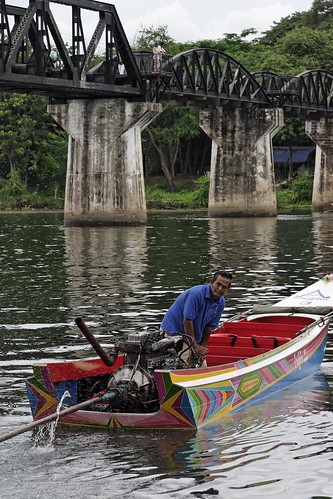
At this point, I would like to present some photos I took at a very peculiar museum that Adam, his (now) wife Shoko, and I visited when we were in Kanchanaburi, the location of the famous Bridge on the River Kwai.

The Jeath War Museum (JEATH is an acronym for Japan, English, American and THai) is a rather eccentric museum based on the collection of a wealthy Japanese history buff, who apparently purchased a building a number of years ago, stocked it haphazardly with local WW2 memorabilia of both great and small interest, and has not had arranged to have it cleaned since.

First, some photos from outside the museum itself.

This is a picture of the famous Bridge which I quite like.

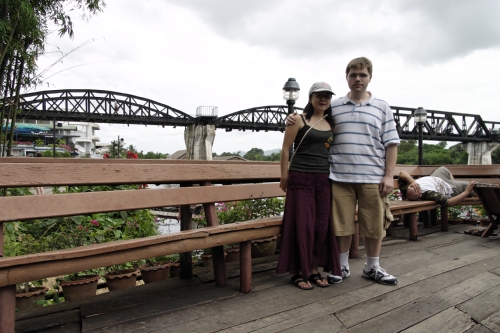
Here are Adam and Shoko posing with the bridge behind them. I do not know the sleeping man, but I have to assume that he is a war criminal of some kind.

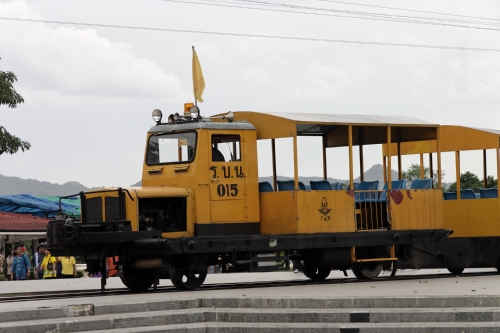
This is a silly little train which lets  tourists ride across the bridge and 1 or 2km into the jungle on the other side, and then ride backwards to the other side.

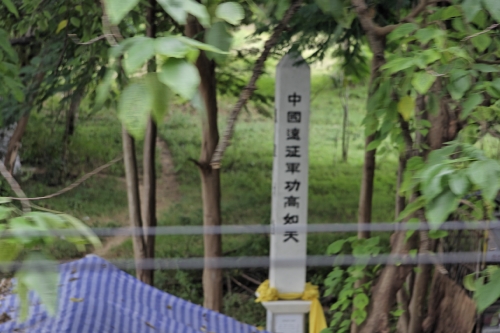
I blurrily snapped this memorial obelisk in the jungle across the river, from aforementioned silly train. It says something along the lines of “the remains of the Chinese army ascend into heaven.”

This plaque is location near the bridge. I did not, however, see one for the British POWs, although I certainly could have just missed it.

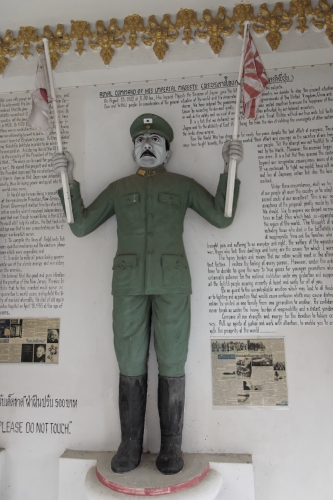
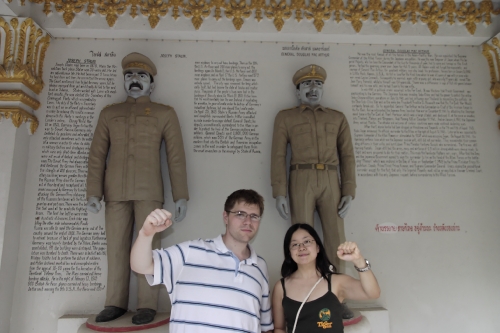
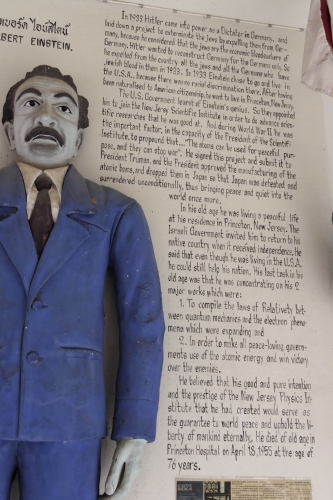
And now we reach the museum portion of our tour. I do not seem to have any photographs of the entrance area, but the first thing you see upon approaching the entrance to the museum proper are these statues of historical figures, with biography written on the wall behind them. I will transcribe the highly amusing text another time.

Here is Tojo.

Adam and Shoko again, with their good friends Josef Stalin and General Douglas MacArthur.

The lovable Albert Einstein gets a wall as well.

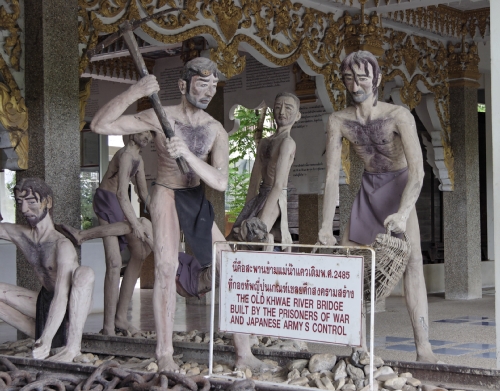
Inside the museum we are confronted with more dramatic statues, such as this tableau of POWs constructing the railway.

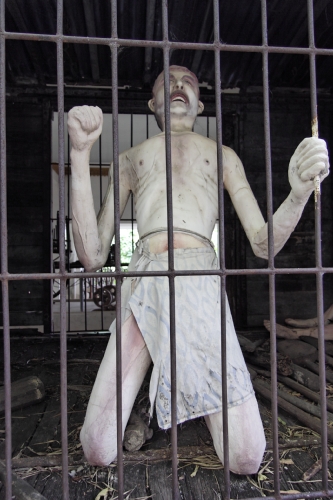
Here is one in a cage. Note the real straw.

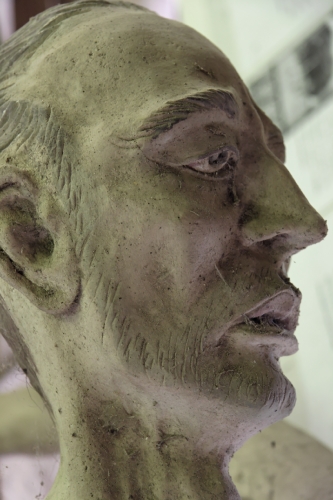
Eerie closeup of another caged POW statue’s face.

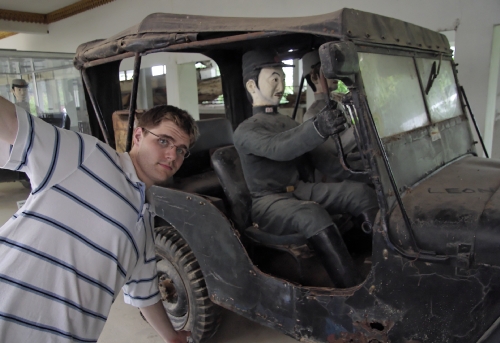
Adam and his new friend, the WW2-era Japanese soldier driving an old car.

The driver.

Another old car. I do not recognize the make, but it is covered in dust that may weigh as much as the steel.

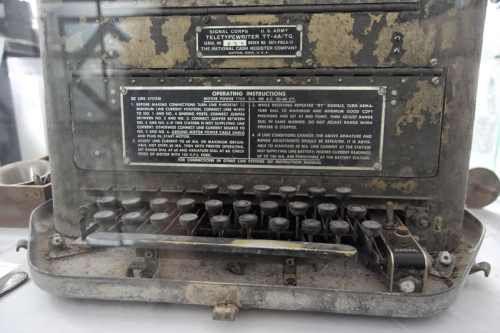
US Army signal core teletypewriter

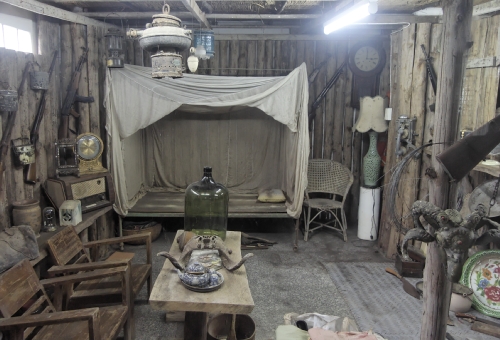
Recreation of Japanese army tent

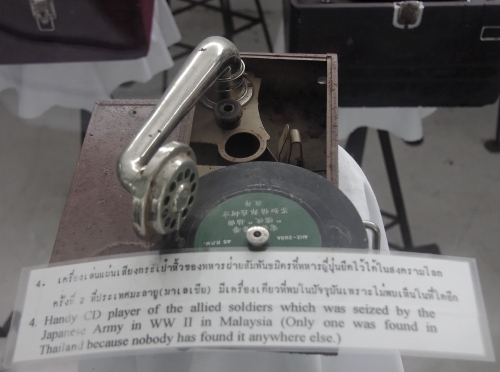
Read the text carefully. Do you know when the CD was invented?

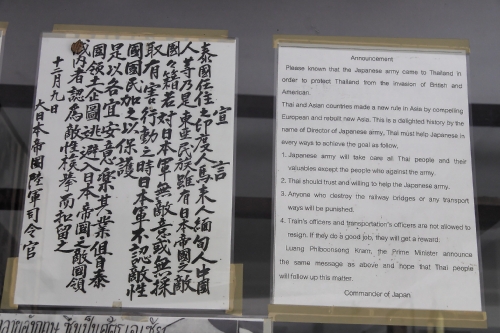
A message from Japan to the Thai people. It’s a bit hard to read, so if anyone wants I can transcribe it.

A British anti-Japan political cartoon

Overall, the museum is a complete shambles. While it has a huge array of cool stuff, it is strewn about almost at random, covered in dust, and sometimes behind other stuff. Not to mention placed in crowded and un-lit cases with poor labeling. Despite the numerous flaws, it is certainly worth a visit if you are in the area, but I can’t say that it will do much to provide any sort of historical narrative, and certainly does not even try to meet the standard hoped for by the Times article I began this post with.

Profile of Ryoichi Sasakawa in Irrawaddy

Wednesday, December 5th, 2007

Some recommended light reading: Burma democracy movement news site The Irrawaddy has published a profile of Ryoichi Sasakawa, the enigmatic right-wing figure who went from war profiteering in Manchukwo to development state profiteering as the yacht racing (kyotei) mogul/ostentatious philanthropist.

Some excerpts:

A report prepared in June 1947 by US army intelligence described Sasakawa as “a man potentially dangerous to Japan’s political future…He has been squarely behind Japanese military policies of aggression and anti-foreignism for more than 20 years. He is a man of wealth and not too scrupulous about using it. He chafes for continued power. He is not above wearing any new cloak that opportunism may offer.”

Twenty years later, Sasakawa was the head of a multinational foundation, named after himself, which funded health and educational programs mainly in Asia. He claimed to be a man of peace, and one branch of his philanthropical empire was even named “The Sasakawa Peace Foundation.” When he died in 1995, his deepest regret was said to have been that he never got the Nobel Peace Prize.

From the very beginning, Burma was one of the countries where the Sasakawa Foundation and its sister organization, the Nippon Foundation, were especially active. Apart from being an associate of Kodama, Sasakawa was also close to Nobusuke Kishi, the Japanese prime minister from 1957 to 1960—and, in the late 1940s, also a prisoner in Sugamo. Kishi led the once influential Burma Lobby in Japan, and the Japan-Burma Association counted among its members 11 trading companies allowed to operate in various aid projects in Burma prior to 1988.

A native of Osaka, he was born in 1899 into a family of wealthy sake brewers. In the 1930s, he led an ultranationalist group called Kokusui Taishuto, or the “Patriotic People’s Mass Party,” which grew to 15,000 members. Each one of them wore a dark uniform fashioned after Benito Mussolini’s Italian Blackshirts. He also had his own airplanes, which transported supplies for the Japanese army. In 1939, Sasakawa used one of them to fly to Rome, where he met Mussolini. Years later, he expressed regret about not meeting another European leader at that time: “Hitler sent me a cable asking me to wait for him, but unfortunately I didn’t have time.”

The problem after the war was that the American occupiers in Japan badly needed the extreme right to counter the leftist movement, which was growing strong in the late 1940s. So, in 1948, Sasakawa, Kodama and Kishi were all released and allowed to rebuild their former organizations.

Read the rest of this entry »

A bit more on KMT remnant in SE Asia

Monday, November 5th, 2007

I was pretty surprised and fascinated by a BBC mention last week of KMT soldiers who had fled to Southeast Asia instead of Taiwan, and turned to banditry and drug trafficking instead of soldiery. In an excellent coincidence, the Taipei Times ran an article on Saturday’s issue on just this subject.


Descendants of KMT soldiers living in limbo


ON THE MARGINS: The offspring of former KMT soldiers who fled China are finding that while they are welcome to study in Taiwan, they may not be able to reside here
By Loa Iok-sin
STAFF REPORTER
Saturday, Nov 03, 2007, Page 2 “Stateless” descendants of former Chinese Nationalist Party (KMT) troops stationed in northern Myanmar and Thailand yesterday pleaded with the government to naturalize them.

Tens of thousands of KMT troops retreated across the Chinese border and stationed themselves in northern Myanmar and Thailand following the defeat of Chiang Kai-shek’s (蔣介石) Nationalist forces by the Communists in the Chinese Civil War.

As the push to retake China never took place, many of the soldiers and their families were stranded in the region.

Since these people entered Myanmar and Thailand illegally, they are not recognized by the two countries. Their descendants have thus been denied citizenship, although many of them were born and raised in these countries.

Some of these stateless people faced a new challenge after coming to Taiwan to attend college.

Chen Chai-yi (陳彩怡), from northern Myanmar, told her story during a press conference held at the legislature yesterday.

“I passed the college entrance exam held by Taiwan’s Overseas Compatriot Affairs Commission [OCAC] and was accepted by a university in Taiwan in 2003,” Chen said.

However, since she had no citizenship from either country, Chen purchased a forged Burmese passport to travel with, she said.

It was only once Chen arrived in the country that she discovered she would be required to prove her status before receiving Taiwanese citizenship.

“I wasn’t aware of this and the OCAC didn’t tell me when I took the exam [in Myanmar],” Chen said.

“I cannot return to Myanmar because I will be imprisoned for life for holding a forged passport, but my stay in Taiwan will also become illegal once I graduate from college,” Chen said. “I’m basically stuck.”

Liu Hsiao-hua (劉小華), chief executive of the Thai-Myanmar Region Chinese Offspring Refugee Service Association, estimated that more than 1,000 students from the region are in a similar situation.

Lee Lin-feng (李臨鳳), an Immigration Bureau official, said that there are difficulties involved in granting these people citizenship.

“What has blocked these people from obtaining Taiwanese citizenship is that neither they nor the Ministry of National Defense have any proof that they are descendants of former soldiers,” Lee said. “Even when some had proof, they were unable to submit a certificate renouncing their original nationality.”


Lee said she would seek a solution at the next Ministry of the Interior meeting, “considering the special circumstances.”

I’m rather surprised that these former KMT soldiers and their descendants have remained stateless for so long. It is hardly expected that Burma or Thailand would have granted them citizenship. Although both countries do have communities of Chinese citizens, they would hardly have put escaping soldiers and criminals in the same category as immigrant merchants. The article does explain that “these people [do not] have any proof that they are descendants of former soldiers,” but I have yet to see any reason for why the KMT remnant in SE Asia never rejoined their main force on Taiwan, once it was clear that they were well established there, and the threat of invasion from the mainland began to recede.

The article mentions the Overseas Compatriot Affairs Commission [OCAC] (see their official English language website here,) which handles documentation and residency for overseas Chinese citizens (Overseas Compatriot.) While in a strict technical sense, Republic Of China citizenship theoretically extends to all of China, as the ROC is constitutionally the government of China, but as the ROC itself has shrunk to include what may someday be called merely the Republic Of Taiwan, ROC citizenship today more or less means Taiwanese citizenship, and in practice excludes any citizen of the People’s Republic of China.

While I do not have time at the moment to examine it in detail, the OCAC provides rules on Overseas Compatriot status, as well as rules for applying to study in Taiwan through the OCAC, using the process referred to in the above article.

Another mention of the KMT remnant turned criminal in SE Asia comes from a surprising source- the subject of the new Denzel Washington film American Gangster, the famous real-life New York based drug dealer Frank Lucas. The following text is from an interview article in New York Magazine:

Lucas soon located his main overseas connection, an English-speaking, Rolls-Royce-driving Chinese gentleman who went by the sobriquet 007. “I called him 007 because he was a fucking Chinese James Bond.” Double-oh Seven took Lucas upcountry, to the Golden Triangle, the heavily jungled, poppy-growing area where Thailand, Burma, and Laos come together.

“It wasn’t too bad, getting up there,” says Lucas. “We was in trucks, in boats. I might have been on every damn river in the Golden Triangle. When we got up there, you couldn’t believe it. They’ve got fields the size of Tucson, Arizona, with nothing but poppy seeds in them. There’s caves in the mountains so big you could set this building in them, which is where they do the processing . . . I’d sit there, watch these Chinese paramilitary guys come out of the mist on the green hills. When they saw me, they stopped dead. They’d never seen a black man before.”

Likely dealing with remnants of Chiang Kai-shek’s defeated Kuomintang army, Lucas purchased 132 kilos that first trip. At $4,200 per unit, compared with the $50,000 that Mafia dealers charged Stateside competitors, it would turn out to be an unbelievable bonanza. But the journey was not without problems.

“Right off, guys were stepping on little green snakes, dying on the spot. Then guess what happened? Banditos! Those motherfuckers came right out of the trees. Trying to steal our shit. The guys I was with—007’s guys—all of them was Bruce Lees. Those sonofabitches were good. They fought like hell.

“I was stuck under a log firing my piece. Guys were dropping. You see a lot of dead shit in there, man, like a month and a half of nightmares. I think I ate a damn dog. I was in bad shape, crazy with fever. Then people were talking about tigers. I figured, that does it. I’m gonna be ripped up by a tiger in this damn jungle. What a fucking epitaph . . . But we got back alive. Lost half my dope, but I was still alive.”


(Via the Fighting 44s blog, pointed out by my friend Jon Lung.)

Tangential end-note: searching for “military remnant” on Google produced an article on the remnant of the Galactic Empire in Star Wars, following the end of Return of the Jedi.

More skeletons in the KMT closet

Tuesday, October 30th, 2007

Just when I think I have a fairly good idea about what the Chinese Nationalist Party, aka Kuomintang (KMT) has been up to over the years, I read the following text in a BBC obituary of Burmese warlord, gangster, opium smuggler and “prince of death” Khun Su.

Born in 1933 to a Chinese father and a mother from Burma’s Shan ethnic group, Khun Su’s given name was Chan Chi-fu.

Growing up in the Burmese countryside, he had little education and came of age fighting Chinese nationalist Kuomintang (KMT) soldiers, who had been forced out of China by the Communists.

The KMT rapidly took over and expanded the opium trade in the region, but Chan Chi-fu and his gang gradually began to exert their influence during the 1960s.

Allied with the Burmese government, they are thought to have fought against both the KMT and the Shan nationalists in exchange for being allowed to continue trading opium.


All of us here know that the KMT as an organization, following their defeat by the CCP in the Chinese civil war, fled to Taiwan where they ruled a one-party police state for decades, and that many of them had been engaged in warlordism and banditry on the Chinese mainland before and during the civil war (this corruption was one factor in their defeat,) but I do not recall reading before about KMT members who fled to and engaged in banditry in SE Asia in large numbers. I do, however, find it a little amusing that Khun Su would, with his history of fighting the KMT, “play host to journalists and Western tourists, treating them to Taiwanese pop music.” After fighting KMT bandits in Burma, mightn’t be be a little bit sour towards Taiwan?

Anyway,  do any readers have any suggestions for sources to look at on similar KMT banditry/criminal activity in SE Asia, following their flight to Taiwan?

Burma: Will Japan show its teeth next week?

Friday, September 28th, 2007

The junta in Burma has “successfully” put down much of the protesting in the country, according to NYT, with unconfirmed reports from diplomats of dozens of deaths in the crackdown. The junta is divided as to how to move forward, while a UN inspector has arrived in the country to observe conditions there. This leaves the rest of the “international community” to figure out just how to successfully exert influence and whether stumbling blocks China and Russia can be brought along. One of the many open questions in the crisis in Burma is how Japan will act.

Amazingly, the debate in Japan has been transformed this week as a result of the apparently intentional point-blank shooting of Kenji Nagai, a photographer for a Japanese production company.

The Japanese government has gone from a basically hands-off approach to demanding full explanations at the highest level. Still, new prime minister Yasuo Fukuda has not gone ahead with sanctions and has decided only to demand an explanation and lodge an official protest over the incident. However, most significant is that major commentators have begun calling for Japan to initiate sanctions against the junta, which has so far not been a popular position as Japan has had a policy of so-called dual engagement, giving aid to the country while trying to maintain relations with democracy leaders as well.

Fueling the change in the government’s stance is the fact that Nagai’s death has put a face on the ugliness of tyranny for the Japanese public and the blunt shove and rapid-fire of bullets that felled him symbolize the almost casual brutality that Burma has faced for decades.

The protests’ coverage in the media was transformed overnight at the news of his death and intensified when it was learned that he was killed so brutally, going from the usual “instability in a foreign country that doesn’t affect us” sort of coverage to much more involved reports of the protests that more closely resembled the BBC’s intense up-to-the-minute reporting.

In addition to an increased volume of media coverage, the tone of commentary has changed dramatically. Just this morning, the host of a news talk show noted something to the effect of “the only reason the junta wants to stay in power is to protect their vast financial interests” backing up the biggest justification for targeted sanctions.

Newspaper editorials the morning after Nagai’s death made limited calls for escalated Japanese involvement. From Asahi: “Why not have Japan take the initiative? We must not allow the robes of monks to get tainted with blood.” Yomiuri noted: “As Japan has maintained ties with both the military regime and pro-democracy forces in Myanmar, it should explore ways to contribute to the settlement of that country’s difficult situation.”

However, once the news of Nagai’s apparent cold-blooded killing came out, Asahi’s latest editorial (Title: “Cooperate with Asia to Put Pressure on Myanmar”) dramatized the fact that Nagai continued filming even after being fatally wounded as a symbol of the junta’s fear of free expression of the public’s will. Asahi then called for Japan to initiate unilateral sanctions and wonders why the initial government reaction has been so tepid. “The power of Japan’s diplomacy is being called into question,” it claimed.

Sankei, Japan’s most conservative national newspaper, had a more concrete proposal while sounding the similar tone but did not call for sanctions (title “Time has come for democratization in Myanmar): “Japan, as the largest provider of economic assistance, has a major role to play. We must go further in explaining that if democratization comes to pass, aid from Japan and the West will begin again in earnest.”

Nikkei (Title: “Initiate Sanctions and Put International Pressure on Myanmar’s Military Regime”) goes the furthest of all and calls for unilateral sanctions and full participation in the international pressure on the Burmese government.

While all recognize the key role that other countries, especially China, must play in exerting pressure on the military government, it is heartening that Japanese commentators can see Japan as having an interest in democratization and will not (in some cases at least) merely toe the government line.

Expect the debate in Japan next week to center on whether Japan’s government will announce some form of sanction proposal, either unilaterally or in some kind of international proposal. While the Fukuda cabinet would like to focus on domestic concerns as it must face a tough Diet session, the pressure is on for the government to show it can protect its citizens and “play a responsible role” in the international arena. The Voice of America has described the situation in Burma as Fukuda’s “first crisis” (so we can see what the US would like Japan to do, but it would be smart for US Japan hands like Michael Green to stay out of the debate this time) and the Burma issue will remain at the top of the agenda for a while to come.

Sympathy protests have been going on in Japan (primarily in Nagoya and outside the Burmese consulate in Shinagawa). These protests are critically important to show that the message is being heard in Japan as well and its citizens are keenly aware of the situation. I will be out in Shinagawa this Sunday to show support and I hope some of the MF readers will come out as well!

BTW, Mrs. Adamu has been doing her part to get the message out to the Japanese audience. She has a translation up at BurmaInfo.net, a Japanese-language site for Burma news. The article she has translated is an account of the famous brief encounter the protesters had with democracy leader Aung San Suu Kyi in front of her home in Yangon/Rangoon. You can read the original article in English here.

The video can be seen here.

Video of journalist murder in Burma

Friday, September 28th, 2007

This video from Japanese news television shows the murder of journalist Nagai Kenji by Burmese security forces.

[Update] Second video added, link courtesy of Julián Ortega Martínez.


Kenji Nagai shot by Burmese soldiers DVB/NHK
Uploaded by equinoXio

[Update 2:] Adam has posted some excellent analysis of the effect that this video is having on the debate in Japan. I urge everyone here for the video clips to read his article as well.