Reconsidering the Reconsideration of Futenma

Comments closed, please join the fray at ComingAnarchy.

The Futenma US Marine Airbase is inconveniently situated in the center of Ginowan City in southern Okinawa. The location is awful, a relic of Japan’s imperial military infrastructure that has military aircraft constantly landing and taking off in a dense urban environment, and the locals want it gone. In the mid-1990s the Liberal Democratic Party (LDP) and the US started to hammer out a relocation plan, and fifteen years later, they finally agreed to move the base to an offshore facility in northern Okinawa.

futenmaJapan’s new Prime Minister Yukio Hatoyama of the Democratic Party of Japan (DPJ) wants to uphold an election pledge to “move away from U.S. dependency to a more equal alliance” — which means reconsidering the Futenma relocation. Hatayama wants to act boldly on this matter, and has decided that instead the base should be moved to… um… somewhere else. Well, maybe — he hasn’t decided yet. Hatoyama’s inability to envision an alternative plan, or even how to approach an alternative plan, combined with the DPJ’s replacement of bureaucrats with elected politicians in the public policy debate, has given the more ambitious members of the cabinet the opportunity to engage in public policy freestyling. Transportation Minister Maehara wants to scrap the plan and go back to square one, Defense Minister Kitazawa wants to keep the plan as it is, and Foreign Minister Okada wants to relocate the base -elsewhere in Japan- -to Guam- elsewhere inside Okinawa. The DPJ vision changes almost daily, and US officials, long numb to Japan’s tedious foot-dragging, are now getting pissed — most noticeably US Defense Secretary Gates, who visited Japan last month and called the reconsideration of the plan “immensely complicated and counterproductive.” But what else should we have expected from these guys? As I warned earlier this year, the DPJ are amateurs suffering cognitive dissonance when it comes to foreign policy, and the longer this abstract debate drags out, US officials will only become more frustrated. And this threatens the stability of the US-Japan relationship.

Most of the “Japan hands” in the blogosphere sympathize with the DPJ. Tobias Harris of Observing Japan says the US needs to wake up to the reality of this new alliance. Michael Cucek at Shisaku has a comprehensive and pessimistic analysis of Obama’s upcoming visit to Tokyo in the broader context of US-Japan relations, which concisely dissects the unique challenge that now face this critical bilateral relationship. To abridge Michael’s key section:

In international law there is the concept of “odious debt” — of national debts incurred by an oppressive regime that a successor regime has the right to refuse to pay. Given the decades the LDP clung to power, many in the present coalition government consider a whole host of Japan’s obligations to be “odious” that they should review and possibly repudiate.

The agreement to transfer Marine Corps elements from the Futenma Airbase to Henoko is the ultimate expression of an odious obligation. It was an LDP solution to an LDP problem: keep American bases off the main islands (even though the amphibious ready unit, the ships the Marines are supposed to ride on, are homeported in Sasebo [in Nagasaki] and the Marine fighter jets in housed at Iwakuni [in Yamaguchi]); keep the Okinawans down and quiet; and keep visiting Americans alternately enchanted and frustrated by disingenuous reports of progress toward the goal, which somehow had to along the way destroy vital dugong habitat. As the Prime Minister and others in the DPJ point out, not even 12 years of LDP governments could bring the Futenma transfer to fruition. That he and his party should be condemned for not imposing an arrangement they oppose on a population that does not want it baffles them. That the United States government continues to insist that they do so exasperates them.

Readers won’t be surprised that I find myself defending the LDP decisions and take issue with the description above, a position that matches that of most of Okinawa’s elected leaders. Let’s look at some key arguments for the Futenma relocation plan:

* The residents of Nago, where the base is to be relocated, support the plan. Mayor Shimabukuro recently came out to agree with Gates, saying the US Defense Secretary is right for being frustrated with the central government’s indecision. Shimabukuro was elected on a platform built on the status quo set by his predecessor, which emphasizes economic growth over everything else, and he won more votes than both of his anti-base opponents combined.

* It’s not just Nago — all twelve mayors of northern Okinawa have publicly accepted the new relocation plan. The DPJ’s waffling has been so unsettling to the locals that the mayor of Kadena is teaming up with the US forces to oppose relocating the relocation to Kadena, promoted by some members of the Hatoyama cabinet as the best alternative, and where one US facility complex already exists.

* Okinawa Governor Nakaima accepts that US bases must stay in Okinawa. Nakaima has a particular knack for balancing the concerns about US bases with the need for the economic benefits that come with it, and has become relatively popular in Okinawa by refusing to side with either faction and instead saves his ire for the national government — all while saying that, in an ideal world, he would prefer bases be relocated outside Okinawa. He criticized the Defense Minsitry under the LDP for “lacking delicacy,” and most recently, didn’t mince words regarding the DPJ’s scattershot public debate on the topic, saying “Okinawa is not the central government’s rock garden.”

* The biggest opponent of the relocation is Mayor Iha of Ginowan, and Ginowan is the center of all the protests — yet this is the municipality that would benefit from the relocation. It really doesn’t make sense — if the mayor and the residents don’t want the base in the city, why are they opposed to moving (most of it) out of the city? As it happens, Mayor Iha is the only elected mayor in Okinawa who vocally wants US forces not just out of Okinawa, but all of Japan. Of course he’s welcome to that opinion, but this is a view far removed from the mainstream public debate in Japan, making him unusual person to be quoted and referenced, unless the Hatoyama administration wants US forces out of Japan altogether (which it doesn’t).

* Construction on the project has already commenced. To a certain extent this follows a similar point I made when reviewing the Yamba Dam. Some dismiss it as the “sunk cost fallacy.” But I disagree, and the DPJ Defense Minsiter Kitazawa has spoken on this point in expressing doubts on changing the relocation plan.

Those are the practical and domestic political reasons for wanting the relocation. But beyond this, let’s review the relocation from the perspective of Japan’s national interest.

For more than half a century, the LDP management of the Japan-US relationship was, frankly, brilliant. Japan recieved dirt cheap defense services by letting the US base on Japan’s soil, yet managed to keep most American servicemen out of major urban areas (unlike Korea, where US bases are inside Seoul’s urban boundaries). Having defense outsourced to America and situated within the American economic sphere, Japan was able to concentrate on economic development and quickly grew to be the world’s second largest economy.

What has Japan done for the United States and the world in exchange for this discounted security? It makes minimum, token contributions to global security, bankrolls a few international development projects, and keeps proactive and material contributions at the bare minimum — or as Shisaku described Futenma, Japan kept “visiting Americans alternately enchanted and frustrated by disingenuous reports of progress.” That sentiment could be applied to much of Washington’s attitudes towards Japan when it comes to becoming more involved in world affairs.

Yet Washington has long tolerated Japan’s indifference to the world because under the LDP, it regularly granted the US unconditional support. Whether it be at the UN, or in supporting the US on tough foreign policy decisions, or in keeping bases available, Japan has long been a solid ally. That means a lot more than you might think. US bases have been kicked out of France, the Philippines, Saudi Arabia, Iceland, and elsewhere, and suffered various woes with regard to fierce public opposition in places such as South Korea and much of Europe. Save for the student protests of the 1960s, Japan has been remarkably reliable — if just in spirit. Or to quote a recent article in the Washington Post, “A senior State Department official said the United States had ‘grown comfortable’ thinking about Japan as a constant in U.S. relations in Asia.”

The DPJ is doing more than trying to break the Futenma deal — it’s breaking the unspoken understanding behind the entire alliance. By pushing for a more “equal” Japan-US relationship (whatever that means), and frustrating the Pentagon on its key issues (such as Futenma), the DPJ risks alienating it’s allies in Washington. And therein lies the danger for Japan’s national interest. America has been calling on Japan to “pull its weight” in contributing to global security for years, and we may be approaching the last straw. The Futenma controversy is compounded by the DPJ pushing to cancel it’s only proactive involvement in the war on terror by ending the refueling mission for US ships in the Indian Ocean.

But Hatoyama has got to accept the fact that neither he nor the Japanese people want an equal relationship with the United States — at least not if they actually saw what it would look like. Japan does not want to have to pay for US bases by sending Japanese SDF forces to Iraq and Afghanistan. They do not want to be diplomatically fending for themselves while repeating complaints about the North Korean abductions and Russia arresting its fisherman. They do not want to push themselves out of the US defensive perimeter, or even in the away direction from the US defensive perimeter. Of course, this may ultimately be good for US national interest, because this is a better time than any to demand Japan to step up to the plate and take a lead in the world. But Japan doesn’t really want that, yet that is where we are going if Hatoyama pursues the “equal alliance” mantra and continues to piss off the US just because it feels good.

Comments closed, please join the fray at ComingAnarchy.

Stuff I want to eat: Frijoles, a Chipotle knockoff in Azabu Juban

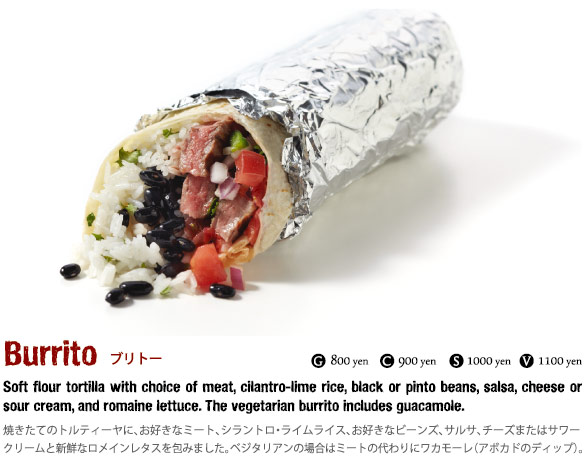
menu_buritto001

When I lived in Washington, DC, one of my favorite places to eat was Chipotle, the formerly McDonald’s-owned seller of giant burritos. The combination of spicy salsa, sour cream, guacamole, and seared meat all wrapped in an overstuffed tortilla made for a reasonably priced explosion of flavor, guaranteed every time.

Accordingly, a complete lack of anything comparable in Japan (or any decent Mexican food, for that matter) has been a source of considerable homesickness for me.

Until now.

Joe has pointed me to Frijoles, a restaurant in Azabu Juban with a menu essentially identical to Chipotle. I have not eaten there yet, but it has so far received some positive word of mouth. I’ll be sure to report once I’ve had the chance to try it out.

Cow madness

Over the past few weeks, Taiwan has been in a furor over a recent deal to resume the importation of  beef from the USA, which has been banned for some time due to the alleged risk of mad cow disease. Readers may remember a series of protests that gripped South Korea not long ago when their government similarly decided to life the ban on US beef. In Korea the US beef issue became a catalyst for large anti-American protests by throngs of protesters whose fundamental concerns were really far more about the macro view of the South Korea-US relationship, such as the continuing extraterritoriality of US soldiers, than about an arcane and minor, if horror-film creepy, food safety issue.

Creautzfeldt-Jakob disease, the term used for the human version of Bovine Spongiform Encephalitis (BSE), popularly known as mad cow disease, is a disease that lends itself to hysteria. An infection, not caused by the familiar bacterium or virii, or even a paramecium, it is produced by a truly exotic pathogen-a mutated prion, a class of protein itself unfamiliar to the layperson. The warped protein spreads throughout the nervous system, tricking healthy proteins into losing their shape, eventually causing such a complete breakdown of neural tissue that the brain is left full of small holes, like a sponge (hence the name, “spongiform”). To make it sound even more disquietingly like the contagion in one of the more science fiction themed zombie movies, neither thermal nor chemical – or even radioactive – means of sterilization have any effect on the mutant prion. Worst of all, the initial transmission vector of BSE or other variants of transmittable spongiform encephalopathy is cannibalism (as has been down since the discovery of kuru, a similar disease found among cannibals of Papau New Guinea), specifically the practice of rendering unsellable scraps of flesh, bone, and viscera left over from cow butchering into a protein sludge, which was then added to the feed of other cows on the feed lot. Even the most ardent carnivores among us reacts with visceral disgust to cannibalism, even in other species, compounded in this case by the fact that it is implemented so casually, for minor savings, so much unlike the rare cases when it is necessary for survival. Due to the disquieting nature of the disease, it is easy to see how A) people might overreact and B) how easy it might be to goad people into over-reaction for political purpose.

Taiwan’s English language Taipei Times, generally a strident partisan supporter of the Green (DPP/pro-independence) camp, carried a surprisingly non-partisan and fact-based editorial on Friday, in which they pointed out that there is in fact no appreciable risk of  catching the zombie plague from American beef.

The ferocity of politicians would be entirely justified if it were imports of UK beef we were talking about, as the UK was where the BSE epidemic was first identified and where the vast majority of cases of variant Creutzfeldt-Jakob Disease (vCJD), the human form of BSE, have been reported. The disease is a mainly British affair and the WHO says many of the cases reported in other countries were people likely exposed to the BSE agent while living in the UK during the height of the epidemic in the late 1980s.

Figures from the UK’s National Creutzfeldt-Jakob Disease Surveillance Unit show that at the end of last month there had been 167 deaths from vCJD in the UK, with the peak (28 cases) occurring in 2000.

In the US, to date there have been just three cases of BSE (one imported) and three deaths from vCJD, but two of these three deaths were likely cases of exposure in the UK, while the other was a recent immigrant.

Not to say that American been is entirely safe, but the danger is not mad cow disease. Just the other day a US meat company issued a recall for a huge batch of ground beef following two cases of fatal E-coli poisoning, a disturbingly common occurrence. Assuring food safety is one vital task of government in general, particularly when importing food from abroad, where standards may not be the same. But since the food safety issues here are largely fabricated (no-one has even mentioned the far more serious risk of E-coli), it is clearly about politics.

While the debate over US beef has similarly gone well beyond the realm of science into political theatre, the issue is not anti-American or Taiwan’s relationship with the United States. No, instead, as with almost every contentious issue on the island nation, it comes back to Taiwan’s hyper-partisanship, so extreme that it almost makes American political arguments look reasonable. (Well, maybe not America…)

The details are too complex and boring to get into, but the short version is that the KMT (Chinese Nationalist Party) government pushed through an unpopular accord over US beef in a attempt to curry favor for more important issues, while on the other side the opposition and pro-independence DPP (Democratic Progressive Party) is making ridiculous claims about the danger of US beef in a cynical attempt to peg the KMT as anti-democratic incompetents that are willing to trade public safety for a minor diplomatic advantage. However true such an assessment of the KMT may be overall, their opponents are being unfair in this particular case.

The beef issue has been a sticking point for US diplomats in several countries, due to the strength of the US agricultural interests that benefit from such exports, and in Taiwan specifically, eliminating the ban on US beef is widely considered to be one of several precondition for granting Taiwanese the visa-free entry status that has been rumored for a couple of years now. I also want to repeat that the idea of caving to US pressure is in and of itself not as much of an issue here as in many other countries, as both sides want stronger ties with the US in terms of trade, military, and diplomacy. However, the real issue, as always, is China. Since Ma took office the KMT led government has been promoting a series of pacts with the Communist governed People’s Republic across the strait, and the Taiwanese opposition has been far from happy, claiming (with some merit) that such pacts tend to favor China more than Taiwan, and promote economic and cultural integration that will eventually lead to political integration along the lines of Hong Kong. It is in this context that the protests over US beef must be considered.

As yesterday’s Taipei Times editorial states:

The government’s atrocious handling of the expansion of US beef imports — opaque, peremptory and confused, regardless of the merits of the products — is becoming a real cause for concern in terms of the bigger picture: cross-strait detente, and particularly a proposed economic pact with China.

[…]

One legacy of the US beef controversy is that many more people have little or no confidence in the government’s ability to negotiate with China without jeopardizing Taiwan’s interests.

[…]

Once again, this cavalier attitude toward ordinary people only raises suspicion as to how open and trustworthy any agreements between this China-friendly government and Beijing will be.

Even though the paper’s editorial board has correctly dismissed the health claims of the beef accord opponents, they are still greatly concerned about the WAY in which the accord was reached. If the pro-China KMT government is willing to negotiate behind closed doors and against public opinion with the US, why not with China? The government’s quid-pro-quo trade of US beef for progress on several outstanding issues (visa free status, progress on a larger trade accord, increased likelihood of more and better weapons systems) is therefore seen less as a capitulation to the US than an example of the KMT’s general attitude of capitulation towards China. And of course, food safety of imports from China is a far more serious problem. I’m sure everyone remembers the horrible milk-poisoning incident from last year. Well, some of those products made it into Taiwan, and although nobody was sickened, the incident spurred anti-KMT and anti-China protests. The controversy over American beef is actually more similar to those protests than to the anti-US beef protests in Korea.

Bush, baseball, Koizumi?

It’s been widely reported that Bush threw out the first pitch at a baseball game in Japan on Wednesday. (Game 3 of the Japan Series between the Yomiuri Giants and Nippon Ham Fighters for those who care.) But did you know that the former president was hanging out with former PM Junichiro Koizumi while he watched the game? Both of the men have been fairly inconspicuous since leaving office, but it’s kind of amusing to see they still hang out even when there’s no statecraft to be done.

<object width=”500″ height=”400″><param name=”movie” value=”http://www.youtube.com/v/A6Fv9J-2vI8&color1=0xb1b1b1&color2=0xcfcfcf&hl=en&feature=player_embedded&fs=1″></param><param name=”allowFullScreen” value=”true”></param><param name=”allowScriptAccess” value=”always”></param><embed src=”http://www.youtube.com/v/A6Fv9J-2vI8&color1=0xb1b1b1&color2=0xcfcfcf&hl=en&feature=player_embedded&fs=1″ type=”application/x-shockwave-flash” allowfullscreen=”true” allowScriptAccess=”always” width=”425″ height=”344″></embed></object>

In the video you can see Bush throwing the pitch right at the beginning, with Koizumi and someone who is probably US Ambassador John Roos on the other side of the catcher’s mound, but the other 9 minutes is tedious baseball.

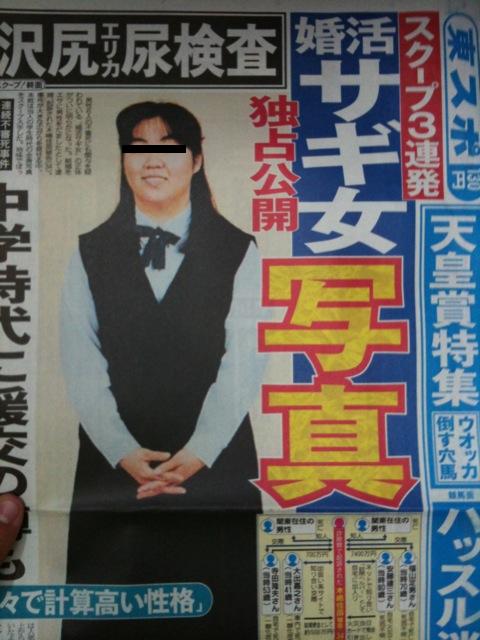
Kanae Kijima, the konkatsu killer: a black widow serial killer for the Internet age

konkatsu killer EFBD8AEFBD8A

Some of you may have heard the recent news of a black widow serial killer in Japan. The more I read about this story, the more fascinating and horrifying it gets:

Investigators probing the deaths of two acquaintances of a 34-year-old woman arrested on suspicion of fraud have found that at least four other men linked to the woman died under suspicious circumstances.

All of the men lived in the Kanto district, and in one case investigators initially thought the victim had committed suicide by burning briquettes to release deadly carbon monoxide. Police are continuing to investigate the details surrounding the men’s deaths. The name of the woman, a resident of Tokyo’s Toshima Ward, has been withheld.

Investigative sources identified two of the men who died suspicious deaths as a 70-year-old man from Matsudo, Chiba Prefecture, and a 53-year-old man from the Tokyo city of Ome. Unconfirmed details remained over the deaths of other men in the Kanto district.

Her name is Kanae Kijima. Investigators apparently learned of this woman’s possible involvement after reading through one of the victims’ blog posts, which is still online here. You can see from the blog this guy was very into his plastic model kits and thus might not have been all that sophisticated around women. Perhaps understandably, he was blinded by love. Here is what his last post says:

Today I will meet my fiancee’s family. Recently I have been spending most of my time looking for a new place with her and talking about our new life together. Starting tonight, we will go on a three-day, two-night pre-marriage trip.

He was found dead a mere ten hours later.

Kijima was a real piece of work. According to reports, she was a professional con-woman who met lonely men on the Internet and convinced them to ask her hand in marriage. Once “engaged,” she would start asking for money, sometimes pretending to need it for tuition. With the money from her many future husbands she lived an expensive, luxurious lifestyle, complete with the high-end condo, a wine-red Mercedes, and occasional stays at the Ritz-Carlton. She also liked gourmet food such as obscenely expensive green tea (Y2,000 for 100g), a habit that pushed her weight up to a whopping 100kg.

Born in 1974 in Hokkaido the granddaughter of a local politician, Kijima moved to Tokyo at age 18 to attend Toyo University but dropped out after a year without paying her tuition. In 2003 she was arrested for scamming someone in a Yahoo auction.

I was not able to find when her career as a black widow got started, but probably some time around 2006 when she began renting a large two-bedroom apartment in Itabashi-ku. Her scams were apparently so successful she netted a total of Y95 million before getting caught.  So over three years that’s a very comfortable annual income of around 32 million yen (or around $300,000), presumably tax-free.

It’s reported she met around 20 people on the dating site. She apparently didn’t always kill her marks – she was unsuccessful in scamming some and maybe just didn’t feel the need to kill others. The six men identified so far were the unlucky ones.

In addition to her online dating activities, she worked another angle “taking care of” an 80-year-old man who she also met on the Internet, whose house burned down in May under mysterious circumstances with him in it.

Amazingly, she left behind all kinds of evidence on the Internet. First, she gave her real identifying information to the dating site allegedly used for the crimes. Second, she documented much of her activity on her personal blog hosted by recipe site Cookpad (some of it is still available via Google’s cache, and some bloggers have been able to rifle through it). In it she posts pictures and tells stories about all the nice stuff she bought from the men she killed (of course she doesn’t go into that particular detail).

Details of this story underscore just how influential and entrenched the web has become in Japanese society. Not only did the “konkatsu” killer meet all these men on Internet dating sites (including an old man), the cops’ investigation hinges greatly on this woman’s sloppiness and overconfidence in failing to cover her tracks properly.

As juicy as all these details are, it’s important to note that this woman is being given the Noriko Sakai treatment – that is, the Saitama police haven’t officially arrested her for murder, just fraud at this point. The cops will likely hold her for a few weeks as they progress with their investigation, following the standard procedure in Japan. In the meantime, it’s possible the police are trying to get over a lack of damning evidence tying her to these killings by flooding the media with all manner of intimations (and the media is no doubt demanding details on this huge story). That may be why major media outlets have declined to report her real name for fear the character assassination could expose them to future defamation lawsuits, as argued here. Still, with all the reports of new evidence popping up they will probably get their woman.

Union Extasy court decision tomorrow

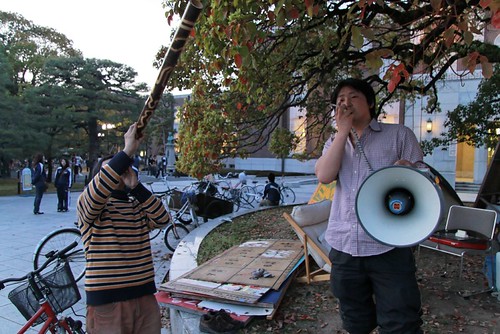
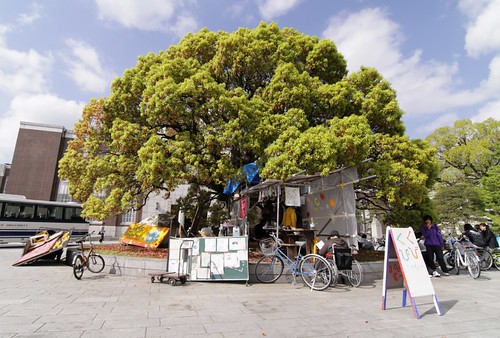
Back in March, while I was traveling, Adam wrote a post about Union Extasy, a two-man union of former workers at Kyoto University who decided to protest the limited term contract system after it forced them out of their staff jobs. While their most visible form of protest was the construction of a tent squat underneath the landmark camphor tree in front of the famous Kyoto University clock tower (a location which is the basis for the university’s logo and the preferred location for graduation photos and the like), they also engaged in the more traditional labor complaint route of filing a formal grievance, conducting formal union/management negotiations (団交), and eventually filing a lawsuit alleging the illegality of the mandatory limited-term contract system.

While the Union Extasy squat was inspired by the “temp worker village” set up in Tokyo’s Hibiya park during the 2008-2009 new years season, unlike that particular stunt it never actually ended. Although they had originally expected it to only last for a couple of weeks before shaming university management into doing something, when they realized that things were going to take a long, long time to resolve, instead of taking down the tent they instead expanded it, adding a public area with seating that was labeled the “Kubi Kubi Cafe.”Kubi is the Japanese word for the head or neck, and has also become a synonym for “firing” or “sacking”, as beheading is the Japanese metaphor of choice for such a practice.

The university was naturally displeased with the ongoing protest, particularly in such a prominent and symbolic location, and filed a lawsuit in May or so (the date escapes me at the moment) against Union Extasy, ordering them to vacate the premises. Why exactly they had or chose to actually file a lawsuit escapes me since I would have assumed that they could just ask the police to remove trespassers without any special legal maneuvering, but I presume there is some legal reason that they took such a course of action. Aside from the existence of the lawsuit itself, there were two things that struck me as rather odd about it. First, that the lawsuit was not filed against the two men (Ogawa and Inoue) but against the Union Extasy organization itself. The second odd point, and this one if very odd, is that they were not seeking an order for the union to vacate the campus completely, but only a specified zone including the area immediately in front of the clock tower. The university was actually so cautious about acting without a court order that they did not even disconnect the power cable siphoning electricity from the clock tower building (which kept the lights and vintage iMac running at night, network connectivity naturally courtesy of the campus Wifi). Inoue let me flip through a folder of documents that had been filed in the case, and sure enough there was a map of the campus with a rectangle drawn around the very specific area. Amusingly, among the supporting evidence was a land assayer’s appraisal of the land value of the entire campus, as if the market value of the national university’s grounds-which I expect is legally impossible to sell in any event-was somehow relevant to the matter at hand.

After receiving a court order to vacate the area, they complied with it-by moving about 10 meters over to another patch of lawn, just far enough away from the camphor tree and clock tower so as to allow an unobstructed view of the landmarks.

I have spent little time speaking with the involved parties since before I went home for the summer and had not been following the progress of their protests or court case, except of course to notice that the protest squat had never ended, but I just got word that the initial verdict of their lawsuit is due out tomorrow, presumably with a party to follow. I will be there tomorrow afternoon after lunch to see how things turn out and will report on it after, but in preparation, here is a gallery of photos I’ve taken at the Kubikubi Cafe.

Continue reading Union Extasy court decision tomorrow

Curzon visits Yamba Dam

Last week, I took a day trip out to see the Yamba Dam, a planned 130 meter high dam that would flood a small rural village snuggled in a valley in western Gunma. The primary motivation for the plan is to stop flash floods that rage through the Tonegawa River and cause havoc in Gunma, Saitama and Tokyo once a decade or so, and also to control and manage the water supply for the Kanto region and to generate power. If constructed it would only be Japan’s 25th largest dam and 10th largest reservoire, but it has turned into one of the more costly projects because of the massive peripheral infrastructure built to appease fierce local opposition.

The project has long been controversial and has dominated the headlines since the DPJ took power last month and announced the project would be cancelled — despite the fact that the project has burned through more than 70% of its US$4 billion budget.

As a student in the Robert D. Kaplan school of national policy, I wanted to see this project with my own eyes, and see the entire surrounding landscape, not suddenly arriving by train or car. So I took my bicycle by shinkansen out to Karuizawa in Nagano, from where I traveled north over the ride of Mt. Asama, then down into the valleys of Gunma and east into the valley, for a total day trip of more than 100 kilometers. This post summarizes my trip.

Traveling to the Dam
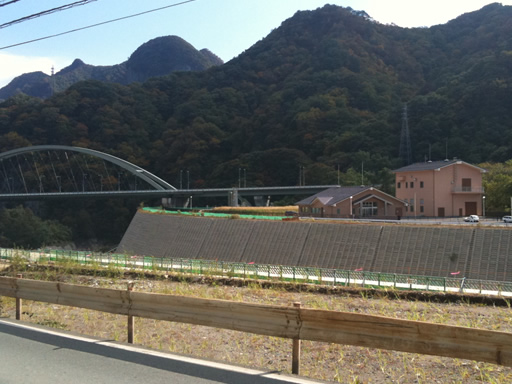
It’s easiest to feel the scale of the project by traveling from the west of the dam, down the river valley north of Mt. Asama in Nagano. As you approach the project, there are suddenly new bridges, most complete or near complete, covering imaginary areas of water. There is also the classic concrete lining of a natural water source that can be seen all over Japan. There are also brand new buildings sitting on the side of what will be a new lake.

Yamba Dam2

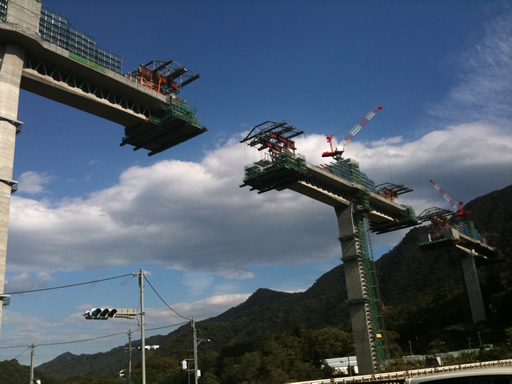
Traveling towards the dam brings the existing road “deeper” into the future lake, which brings us to the representative structure of the project, the No. 2 Yamba Dam bridge. The bridge is unique for its hollow structure and that they are building simultaneously out from the supporting stems. This bridge will permit road and rail to cross the lake and connect the two halves of the community. At present, there was also a JR line running through the town, which was also to be relocated up the mountain.

Yamba Dam1

You may notice that construction on the bridge is proceeding. The reasons for that soon became clear.

“Yamba Kan” (やんば館)
At the foot of the No. 2 Yamba Dam bridge sits a two-story facility called the “Yamba Kan,” built in 1999 by the Ministry of Land and Infrastructure to explain the dam’s purpose and its construction to locals and other interested visitors. Like a typical Japanese shiryoukan, it is a small but carefully organized and boasts an impressive set of topographical maps, audio-visual media, photographs, and information regarding the history and construction of the dam. There are also guides on hand to answer questions about the project.

Interest has exploded since the DPJ took power and have announced the cancellation of the dam. According to the informational (and pro-dam) website damnet.org, the number of visitors to the “Yamba Kan” hit a record in September, receiving three times as many visitors as in August. When I arrived on a weekday afternoon, the 40 car parking lot was full, and included a chartered tour bus.

The guides were busy answering visitor questions. I patiently waited my turn to ask questions and finally got to ask: “The government has said they will stop construction on the dam but the bridge is still being constructed, why is that?” I asked in the most neutral of tones, but the guide answered on the assumption that I was an anti-dam fanatic — she responded, “They have to finish it! There is no other option! Otherwise are community will be split in two! There are already people living in homes on both sides of the mountain!”

Her explanation and the Yamba Kan maps made the overview of the project more clear. Before the dam could be built, the government had to relocate all 355 households whose homes would be submerged by the lake created by the dam. After decades of fierce opposition, it was only when the central government conceded on a costly compromise to relocate the villagers up the mountain up the mountain from their homes did they finally agree. This is more expensive than it sounds, and calls for massive earthworks and bridges. It would have been easiest to move the people up or down the valley to join their neighbors.

Yet the project is even more expensive than just moving people up the valley mountains. The mountains are too steep to be flattened to accomodate the whole community on one side of the steep valley, so construction has taken place on two sides of the lake, with massive bridges being constructed to connect the two sides of the lake. The government is of course footing the bill to construct the new houses, schools, roads, bridges, and other facilities for the relocated community.

Most of this construction is completed, as evidenced by the almost finished No. 2 Yamba Dam bridge. But once all this is done, I started to ask myself,

What happens now?
Frankly, no matter how hard Transportation Minister Maehara and the DPJ hold out on refusing to construct the dam, I can’t possibly see how the project cannot be finished. At best the DPJ can delay the plan a year or two. Here’s why:

* All the preliminary infrastructure is complete. Learning more at the Yamba Kan, my understanding of recent news stories where the DPJ said that they would continue to invest in “lifestyle” construction became clear. The DPJ will only halt construction on the dam itself, which was scheduled to commence shortly, but will continue construction that affects the lives of the locals. In other words, the bridge will be finished, as will the rest of the construction, but the dam for which all the construction was invested will not be built. What this means is that billions will be spent relocating a community for no reason whatsoever.

* It could cost votes in important prefectures. The DPJ probably isn’t too worried that the conservative, LDP-allied governors of Nagano, Gunma, Chiba and Tokyo are opposed to halting the project. But the governors of Saitama and Tochigi are independents close to the DPJ. The DPJ caucus of legislators in the Saitama prefectural assembly is vocally opposed to the cancellation. The six affected prefectures together comprise more than 25% of Japan’s total population, and the DPJ has strong voter support in Tokyo, Chiba, and Saitama. The only people firmly opposed to the plan appear to be environmental interest groups. Who knows, it could cost the DPJ votes and they may decide to proceed because of it.

* A future LDP administration may turn things around. Even if the Hatoyama administration does refuse to proceed with the plan, the LDP could always pick up where the DPJ left off.

The other Tokyo Olympics which never were

The 1964 Tokyo Olympics were a milestone in Japanese history as the country’s great postwar coming-out party. The 1940 Tokyo Olympics, on the other hand, became a footnote, as they were planned and approved by the IOC but never actually took place.

Tokyo’s bid was announced in 1932 and won the IOC vote in 1936, defeating a rival bid from Helsinki, Finland by a vote of 34 to 27. There was some political maneuvering behind the vote: Rome had also been bidding for the Olympics, but Benito Mussolini pulled Rome’s bid as a gesture of support to Japan, then a strong ally of Italy.

A number of factors led to the eventual cancellation of the games. Several IOC members were uneasy with Japan’s military adventures in China, and the US was planning to boycott the Tokyo games in protest. The Japanese government was focused on the war with China and was becoming more reluctant to divert strategic and monetary resources to an international sporting event. Japan formally withdrew its bid on July 15, 1938, and the Olympics passed to runner-up Helsinki by default. However, the Helsinki Olympics were cancelled following the German invasion of Poland in the following year, and there were no Summer Games until 1948.

The plan for the 1940 Olympics centered around two main venues–the Jingu Gaien in central Tokyo and a new Olympic park in Komazawa. These venues were never built before the war, but both sites were later used for staging the Tokyo Olympics of 1964. Another instance of re-using resources: Ichiro Kono, who led the opposition to the 1940 Olympics in the Imperial Diet, became Construction Minister and Minister of State for the Tokyo Olympics under Prime Minister Hayato Ikeda, and thus got the chance to oversee the successful Tokyo Olympics on the government’s behalf.