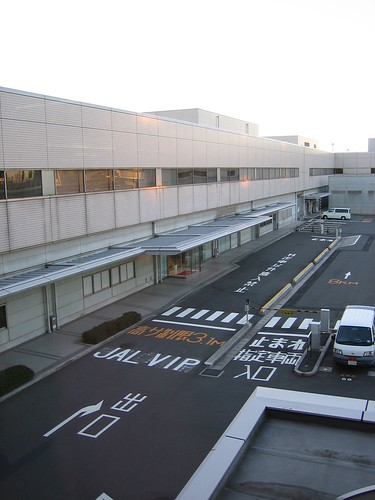
Kobe Airport opens, but far more wackiness might be in store

Kobe Airport, the third passenger airport in the Kansai region, opened just a couple of hours ago. So what’s next? How about a tunnel from Kobe to Kansai?

The “Cross-Osaka Bay Railroad” is envisioned to connect JR Shin-Kobe Station and Kansai Airport via Kobe Airport in 30 minutes, using linear motor cars over the total distance of 36 km. The Kobe Airport-Kansai Airport run will take only 17 min. The cost of the tunnel is expected to be 530 billion yen.

Apparently, this was one of those crazy bubble-era ideas that fell apart after the Kobe earthquake of 1995 and the stagnant traffic numbers at Kansai in the late 90’s. But now, authorities are saying that if traffic at Kansai picks up, the airport may have to go international-only, and this project might be needed to keep a steady flow of passengers between domestic and international flights. Hyogo Prefecture seems to be warming to the idea, but Kobe City and Kansai Airport (perhaps fortunately) think it’s pretty ridiculous.

Why the Frog Bridge is Stupid


Ampontan at Japundit had a thought-provoking post on the “Kaeru Hashi,” or Frog Bridge, that was built on central government largesse in Inami-cho, Wakayama Prefecture:

I can’t begin to explain how quintessentially Japanese this entire story is. They’ve managed to use a historical Japanese figure for inspiration, connect him to a unique public works project to gain a little recognition in a cheerful, positive way, and incorporate the Japanese love of wordplay. When I was new to the country, unaware of the extent to which I was affected–or infected–by the sense of fashionable, cynical irony so endemic in the West, I would have rolled my eyes until they slid out of their sockets at the dorky hellokittyishness of this bridge and the people who built it.

After all these years in Japan, however, I’ve come to realize that cynical irony is a dead end street and learned to appreciate the sincerity, simplicity, and earnestness of the emotion behind efforts such as those of the people of Inami-cho. I wish them the best, and if I’m ever in their neighborhood, I’ll be sure to stop by to look at the bridge and buy some vegetables or flowers. I’m sure they’re excellent. You can even see the bridge if you’re just passing through–they built it so that it’s visible from the local JR train station.

People at Japundit were too mesmerized by the hypnotic power of the bridge to respond to my comment, so here it is for my MF peoples:

You seem to present two possible interpretations of the Kaeru Hashi: cynical-ironic dismissiveness or appreciation for the earnestness of the people’s efforts.

Perhaps I haven’t spent enough years in Japan, but there must be at least one other way to look at something like this, because I think, with no irony whatsoever, that this bridge is a gaudy and horrible waste of money.

I mean, consider it this way: when you go into the house of a married couple and find that the wife keeps it decorated nook and cranny with frilly lace, pink bunnies, and countless antiques, scented with nostril-burning potpourri, and kept immaculately clean, do you (a) Appreciate the sincerity, simplicity, and earnestness of the emotion behind the woman’s efforts; or (b) Feel sorry for the poor schlep of a husband who has to put up with such tacky interior design (and probably isn’t allowed to sit on the couch)? I for one would choose (b). This bridge and other such projects look as if the federal government gave a team of domineering housewives with bad taste a million dollars to waste on whatever silly civil engineering project they could come up with.

That million dollars could have been put to much better use than yet another bridge. The problem is that the funds these towns get are tied to programs like the euphemistic “Self-conceived self-conducted Regional Development,” so they are forced to actually build something. If the federal government were truly interested in revitalizing these small towns (instead of padding the wallets of construction companies), they could have steered the money toward, just for example, scholarships to regional universities or maybe even incentive programs for industries.

The problem isn’t so much of different “worldviews” between the Japan and the “West” but rather one of the corrupt central government exploiting the small towns for its own benefit. It’s funny you call this post the “Great Leap Forward” because these types of federal programs actually do resemble China’s great leap forward in that they force local governments to perform economically unsustainable activities. The towns aren’t starving, at least, but without true economic development they are facing a slow death – depopulation. Koizumi’s “Trinity Reforms” are supposed to end the cycle of addiction to public works that afflicts the outlying regions of Japan by putting more tax revenue in their control, but prospects for their effectiveness are moderate at this point.

Is the LDP Unbeatable?

I have been digging marxy’s blog hardcore lately, and his latest posts have inspired a few lengthy rants from me. Since I am so very proud of myself for actually having written something, I’ll repost them here.

Today we will look at whether there can be a viable opposition to Japan’s ruling Liberal Democratic Party, which has, with only one brief (but significant) hiccup in 1993, ruled Japan since 1955 thanks at least partly to CIA funding.

First, marxy’s post, a reaction to Chalmers Johnson’s Blowback:

Academics are always convinced that the rebirth of Japanese politics is right around the corner, as if the DPJ will suddenly become a viable second party. But check the demographic breakdown: Japan’s most educated white-collar workers are thoroughly apolitical and the working classes depend even more now on LDP pork barrel projects and protection for their job security in the post-manufacturing era.

The One-Party Japanese State is here to stay, but perhaps Japan can at least cut the American leash in the future, right? Unfortunately for the Pacifist Japanese masses, the LDP only presents two options: remilitarize with a nod to past Imperialist glories or maintain a Japanese pseudo-pacificism under the American protectorate. Politics could offer a third way, but thanks to the gifts of U.S. foreign policy, they don’t have that here.

And my reaction, slightly edited for readability:

While I don’t count myself as one of those people who thinks that Japan is always just about to turn the corner, if you look at the elections that have taken place since major electoral reform was carried out (switch from multimember election districts to single-member) have shown that future LDP control of the government is far from certain.

There is no way to tell how involved the CIA is in Japanese politics right now (though I can more or less guarantee you that the top leaders of Japan have regular meetings with CIA officials). Also at this point, I don’t think that the LDP has any trouble raising funds on its own, and whatever slush funds the CIA set up for it have probably already been laundered somewhere.

But it is a fact that the DPJ had been gaining seats progressively in each election since its formation in 1998, so much so that it only required the defection of 18 or so LDP members in the Upper House to defeat the postal privatization legislation (though 30 eventually did rebel), which led to the General Election in September.

That election led to a huge victory for the LDP, but that victory was notable first for American support of a very different kind (Bush’s PR firm) modern PR techniques and for the types of voters it attracted to the LDP — TV-watching urbanites, the same people you (more or less rightly) dismissed as being apolitical. The LDP achieved this by having a charismatic leader with great hair, limiting the scope of debate by staying on message (postal privatization!!!), and orchestrating a riveting drama pitting the reform-minded LDP (and cute new “Koizumi children”) against the vested interests represented by the postal rebels and (somehow) the DPJ.

Remind you of US-style elections a little? Competing for constituents based on policies and theater is vastly different from the traditional way for the LDP to run an election, which was basically to round up its traditional support bases (as you quite eloquently described) and be done with it. The bad thing is the LDP played the new game to its advantage, but the good thing is that, in theory, anyone could do it, even the DPJ (which at least tried – they had a US PR firm of their own, it just happened to be caught unprepared for the ultra-effective push by the LDP [the ineffectual slogans “We won’t give up on Japan!” didn’t help either]).

Unfortunately, while the election system has changed, other aspects of Japan’s political landscape – the LDP’s close relationship with big business and the bureaucracy itself- have not. Why is this important? Well, one can see a telling example in the DPJ’s “counterproposal” to the LDP’s resubmitted postal privatization bills in October 2005. The counterproposal was a miniscule 11 pages compared to the LDP’s 500-plus megalaw.

This just goes to show that the DPJ very simply does not have the technocratic expertise to make policy, which is something the Japanese public understands. The LDP (well, the *governement*) postal privatization bills were formed after months of intense discussion and debate that involved the greatest minds in Japanese policy both in and out of the bureaucracy. The DPJ (or any other party for that matter) could not even begin to hope for such access because, for better or worse, there is no reason for bureaucrats, academics, academia, or even the Japanese people (it can be argued) to work with a party that can’t get things done. It’s a vicious cycle that will probably continue more or less unabated until the next time the LDP gets booted from power.

A few quick links before a brief absence

As of today, February 14th, I have exactly two weeks before I fly from Taipei’s Chiang Kai Shek airport back to New Jersey’s Newark. With that deadline pressing on me, I’ve decided to take a week and head to see some places in the south (and maybe East?) of the island that I haven’t yet gotten around to. I’ll hop a bus this evening to Taizhong, look around that area during the day tomorrow, and then meet up with a former classmate from Ritsumeikan in the evening. That’s as far as I’ve planned, but I’ve got my Lonely Planet Taiwan to look over on the bus ride.

First up is one that I’m amazed hasn’t gotten more attention.

Japanese sue over disputed history textbook
TOKYO (Reuters) – A group of Japanese sued over a history textbook that critics say whitewashes Japan’s wartime aggression and has angered Asian neighbors, demanding on Thursday that a local government cancel its adoption of the text.

Japan’s Education Ministry approved the new edition of “The New History Textbook,” written by nationalist scholars, last April, prompting outrage in China and South Korea, where bitter memories of Japan’s aggression until 1945 persist.

The lawsuit was filed by eight residents of Suginami, a residential district in western Tokyo that attracted media attention last year when it became one of the few school districts to adopt the junior high school textbook.

“As a resident, I can’t keep silent over the choice of an unwanted textbook for growing children,” Eriko Maruhama, a plaintiff in the lawsuit, told a news conference.
Read full article.

This sounds like a reasonable course of action for local residents to take, since they allege that the school board chose the textbook for political reasons, despite it having been given a poor quality assessment by local teachers. Perhaps this lawsuit will have a similar effect to that of the Dover, Pennsylvania lawsuit which blocked that schoolboard from teaching intelligent design.

Next is something that I briefly mentioned on in this rather silly post the other day. As reported by the prolific Norimitsu Onishi in the New York Times, Tsuneo Watanabe, the publisher of Japan’s conservative Yomiuri newspaper, has recently been reconsidering the long term impact of some of the right wing policies he had promoted, particularly in regards to the international relations, miltarism, and the Yasukuni issue.

The Yomiuri is the world’s single best-selling daily newspaper, and its impact should not be underestimated. Of particular interest is the fact that Watanabe has actually joined with the Asahi Daily newspaper, Japan’s major left-leaning daily, and the Yomiuri’s chief rival, in calling for a national, religiously neutral, and internationally respectul memorial to replace Yasukuni for official purposes.

As rivals, it is not surprising that The Asahi Shimbun and The Yomiuri Shimbun often adopt different editorial viewpoints. Even so, a recent exchange between the heads of the editorial boards of the two major dailies found some common ground, especially regarding Prime Minister Junichiro Koizumi’s controversial visits to Yasukuni Shrine.

The following is the abridged version of a discussion between Yoshibumi Wakamiya, chairman of The Asahi Shimbun’s editorial board, and Tsuneo Watanabe, chairman of The Yomiuri Shimbun group, that originally appeared in the February issue of Ronza, the monthly commentary magazine published by The Asahi Shimbun.

Time Europe has an interesting article about how Olympic wannabes are opportunistically changing their citizenship, often based on tenuous third generation bloodline connections, to qualify for elegibility to participate in that country’s national Olympic team. While I have no interest whatsoever in the Olympic games themselves, I do always like to hear about new twists in conceptions of citizenship.

hockey’s crossover nationals are hardly anomalies in Torino, where plenty of athletes are competing under the flags of second or adopted homelands. The practice is so common in both Winter and Summer games that International Olympic Committee ( i.o.c.) President Jacques Rogge blasted some of them as “mercenaries” last November.

And last, but not least, more tragic news regarding our slimy brethren.

he mountain yellow-legged frog has survived for thousands of years in lakes and streams carved by glaciers, living up to nine months under snow and ice and then emerging to issue its raspy chorus across the Sierra Nevada range.

But the frog’s call is going silent as a mysterious fungus pushes it toward extinction.

“It’s very dramatic,” said Yosemite biologist Lara Rachowicz. “One year, you visit a lake and the population will seem fine. The next year you go back, you see a lot of dead frogs scattered along the bottom of the pond. In a couple years the population is gone.”
[…]
The frog population has dropped by 10 percent a year for five years, Rachowicz said at a gathering last month of 24 experts trying to save the frog.

INR 101

Here’s an explanation of the international scene that anyone can understand:

Taylor Townsend is Saudi Arabia. America and the gang are sort of forced to be friends with Saudi Arabia, but they haven’t forgotten how she backstabbed them. She is probably bipolar — she’ll blow you or blow you away, depending on which Saudi Arabia decides to show up.

Last, but least, we have Canada, originally known as Chilly. Canada is one of the least important characters on the show. His main role is to be the dork everyone laughs at.

In fifth grade, we learned world history by treating it as a soap opera. That approach works pretty well for current events, too…

Images of Taipei 101 now restricted


The Taipei Times is reporting that “Taipei Financial Center Corp (TFCC), owner of Taipei 101, said it will start charging companies for any commercial usage of the image of the world’s tallest building in a bid to protect its trademark.”

Last year alone, TFCC found over 1,000 cases of other companies using Taipei 101 as a promotional tool — mostly in real estate advertising — that could potentially mislead consumers, Wei said.

As a result, TFCC decided to charge royalty for any commercial use of the building’s image. For example, a poster featuring the Taipei 101 tower will be charged NT$100,000 (US$3,099), Wei said.
[…]
Use for the government and public is free of charge, Wei said.

The decision drew the ire of advertisers and TV producers, as other major landmarks around the world, such as the Empire State Building in New York City and the Eiffel Tower in Paris, have no such charges.

Unfortunately, the last statement seems to be only half true. In a clever manuever, photographs of the Eiffel tower itself are not copyrightes, but in 2003 a new lighting display was installed. Since the design of the lights is copyrighted, photographs of the lighting disaply are as well, which by extension means any photos of the Eiffel Tower at night.

As a result, it’s no longer legal to publish current photographs of the Eiffel Tower at night without permission. Technically, this applies even to amateurs. When I spoke to the Director of Documentation for SNTE, Stéphane Dieu, via phone last week, he assured me that SNTE wasn’t interested in prohibiting the publication of amateur photography on personal Web sites. “It is really just a way to manage commercial use of the image, so that it isn’t used in ways we don’t approve,” said Mr. Dieu.

It may be some minor comfort that owners of iconic buildings such as the Eiffel Tower or Taipei 101 claim that they won’t prosecute non-commercial infringers, but the fact is that there is nothing stopping them from being a nuisance to anyone that publishes such a photo, even on a personal blog like this one. Does anyone really think that laws allowing for these kinds of restrictions are reasonable? I can’t wait for 2012 (to be optimistic) when security teams are stealing cameras from tourists snapping photos of the new “Freedom Tower” at New York’s World Trade Center.

Muneo Suzuki’s Life in Prison, as Told by the Man Himself (Plus advice for Horie)

I’ve kept this story on the back burner for a while, but I think you’ll still get a kick out of it.

Remember Muneo Suzuki, everyone’s favorite “department store of suspicion”? Well, after being convicted of bribery charges, leaving the Diet and LDP in disgrace, and then staging a major comeback in 2005 by forming a new party and getting reelected to the Lower House, Muneo wasted no time in punching back against those who ousted him from power just 2 years earlier. Soon after his reelection, Suzuki began flooding the Ministry of Foreign Affairs with official questions surrounding their questionable dealings (Such as this one accusing the MOFA of overpaying their overseas staff with juicy housing allowances). He’s abused the “memoranda on questions” system so much (known as the “paper bomb” among Japanese politicos), in fact, that the ruling LDP has revived debate on whether to eliminate it altogether.

Now Suzuki, who has the dubious distinction of being the only serving Diet member to be presently fighting a felony conviction, was not involved in the Horie scandal. Nonetheless, the former jailbird can offer unique insight into Horie’s state of mind as he faces imprisonment and now arraignment. ZAKZAK was there, of course, in this Jan. 26 interview, which I have paraphrased below:

Muneo tells of his 437-day stay in a 5m2 solitary confinement cell: No clock, no view of the outside


Muneo

Takafumi Horie is being held in the Tokyo Detention Center. Lower House Diet member Muneo Suzuki, in a Jan 26 interview with Yukan Fuji, told us of the center’s “coarse” living conditions. Horie denied his charges at first at the special investigation section of the Tokyo Regional Prosecutor, but he has now begun testimony that admits some of the facts. Perhaps he has broken in the face of the humiliating life within the cell walls.

Solitary Confinement

“The solitary confinement cell is in a 6.4m2 space with 1.6m2 used for a toilet and wash basin that are out in the open. Your living space is 4.8m2.”

That is Muneo Suzuki looking back on his life on the inside. His painful mental state at the time may have resurfaced because his face was bright red, and he seemed to be seriously fighting something making him well up with tears.

The first thing that happened at the detention center was “body inspection.”

“They take your mobile phone and datebook, make you get naked and search to see whether you have brought in something dangerous.”

The building of the detention center was rebuilt in March, while Muneo was imprisoned, so he went from the old building, where there was a window with a view of the outside, to the new one where he could not see the outside at all.

“There was no clock on the wall, so I had no sense of day or night.”

Until he fell asleep, he would lean against the wall, unable to fully stretch out, and on top of that he could not read newspapers or watch TV and could not listen to the radio freely. Muneo was banned from outside contact, so he was also banned from exchanging letters.

He admitted, “Since I was a person living on information, the hardest thing was for no information to be coming in.”

Meals were rice, miso soup, and one side dish. While Muneo says, “It was at least better than the meals from when I was an impoverished child,” will the food live up to Horie’s discriminating tastes?
Continue reading Muneo Suzuki’s Life in Prison, as Told by the Man Himself (Plus advice for Horie)

三島入門 (An Introduction to Mishima)

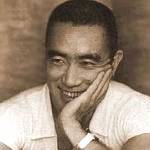
Mishima

I recently watched Paul Schrader’s 1985 film Mishima – A Life In Four Chapters. The film is a documentary style biographical portrayal of author Mishima Yukio’s final day, interwoven with three highly stylized vignettes of scenes from three of his works, and occasional explanatory flashbacks into Mishima’s past. Below is my brief review of the film, plus alpha.

Review

Seven out of ten stars. The concept and design of the film were unquestionably creative. Schrader took the stylization too far at times, but the exaggeration helped distinguish the vignettes from the main story line, as did filming the flashbacks in black and white. The transitions between the three were smooth enough, but could prove difficult to follow for viewers without any familiarity with Mishima. The connections drawn between specific experiences from Mishma’s life and their later distillation into major themes in his work was well done, and Schrader’s division of the film into four chapters – beauty, art, action, and harmony of pen and sword – further supported these themes.

To Schrader’s credit he shot the entire film, dialogue and narration, in Japanese. The actors in the Kinkakuji vignette even spoke with heavy Kansai accents. No complaints with the score – Philip Glass has yet to disappoint with a documentary soundtrack. Acting generally must be Episode I, II or III execrable for me to take notice so Mishima passes muster. Casting was convincing enough, although Ogata Ken did not much resemble Mishima.

The extra DVD commentary was informative – Schrader had clearly done his homework – and some of the tales about the trials undergone during filming are fascinating. (ex. Death threats from rightwingers lead to clandestine filming efforts and for a while Schrader, afraid of being stabbed, was even wearing a flak jacket. He was later informed by his Japanese crew that as a gaijin, he would not be a target because there was no way he could know better about his actions.)

Sexuality, controversy, and politics

Although nearly twenty years old, the full version of the film has yet to be released in Japan, largely because of a single scene in which Mishima is portrayed drinking and briefly dancing with a young man in a Tokyo gay bar. According to Schrader, he and his crew were initially given full cooperation by Mishima’s wife until he refused to remove said scene. They were also threatened with legal action (and presumably worse) if they depicted anything that could not be substantiated as true. Schrader was able to locate the young man and speak with him about the incident, so the scene could remain, but Mishima’s wife remained intransigent and never returned her support. Consequently, tthe film was not released in Japan at the time of its premier, and to this day the full version including the gay bar scene has yet to be released, distributed, or shown there.

Mishima biographer and former friend Henry Scott Stokes, addressed some of the controversy surrounding Mishima’s sexuality, including the above incident, in his 1974 work, The Life and Death of Yukio Mishima. At the time of Mishima’s suicide in November at the Jietai Eastern Army HQ in Ichigaya, rumors began circulating that Mishima had been lovers with Morita Masakatsu, who killed himself immediately Mishima.

The weeklies ran with these rumors and portrayed the incident as shinju, a double lover’s suicide. In spite of frequent homosexual themes in Mishima’s writings, including the autobiographical Confessions of a Mask, the truth of the matter has yet to be openly proven and probably never will be.

But what is most interesting about the shinju theory is something Stokes wrote in the 1999 epilogue of the book:

Years later I realized that the police, like all officials, were happy to see the homosexual shinju theory enlarge, thereby distracting the press form the politics of the Mishima incident.*

The politics of which he speaks are Mishima’s militant (and I mean this literally—the guy had his own “army”) right-wing leanings, but more importantly the support he received from prominent members of the LDP, including then Prime Minister Sato, then Defense Minister Nakasone Yasuhiro, and then Chief Cabinet Secretary Hori Shigeru. These three men possibly helped finance Mishima’s private army, the Tatenokai, and certainly arranged for them to train with and use SDF facilities for training. But, much like the shinju theory, the truth of this matter, including the full extent of the LDP’s involvement with Mishima, will likely never be known.

A bit of Mishima trivia

I also happened across an interesting nugget of trivia in Stokes book. When Mishima was in his early thirties his mother was (incorrectly) diagnosed with terminal cancer. Fearing that she would die without having seen her son married, he arranged to meet a wife through omiai. Although Mishima eventually settled on the young daughter of a traditional painter, his first meeting was with one Shoda Michiko. A job at Kunaicho awaits anyone who recognized that name without having to look.

Read Mishima’s famous short story “Patriotism” online.

(Note: Above quote taken from pg. 269 of Henry Scott Stokes. The Life and Death of Yukio Mishima. Cooper Square Press, NY. 2000.)

Mistyping Japanese names

After reading this rather interesting New York Times (by way of the International Herald Tribune) article about how Yomiuri Shinbum publisher Tsuneo Watanabe has recently been reconsidering the impact of the right-wing political views that he has helped to spread through his paper, I decided to look for some Japanese language coverage of this issue using Google News Japan.

As you may or may not know, Japanese names are more or less insane. That is, the method of writing them in Japanese. Despite their phonetic simplicity and easy spelling when transcribed in, say, the Roman alphabet, it feels to me little exaggeration to claim that becoming an expert in the reading and writing of Japanese names would take almost as much effort as learning to read and write the entire rest of the dictionary.

Japanese names (both people and places) are written using the same kanji (Chinese characters) as other, ordinary words, but are often pronounced in ways that are entirely unrelated to their pronounciation in other words, with some parents even assigning names to their children in which the characters used to transcribe it and the pronounciation have absolutely no historical relationship to one another. Furthermore, even many common names have several, or even dozens, of different possible ways that they can be written.

This can pose a severe problem when Googling a Japanese person’s name. Just because you know how to spell their name in English does not mean that you can type it correctly in Japanese. Sure, if you type sounds, the Windows IME will convert it to kanji, but with so many different ways of writing names, the odds are that it will have chosen incorrectly.

In the case of Tsuneo Watanabe, I had never read about him before, and therefore didn’t know what kanji he uses to write his name. Now, the family name is easy. (In Japanese, as many other Asian languages, the family name is written first, so to avoid cross-linguistic confusion I won’t say “first” or “last” name.)

Watanabe is one of the more common family names in Japan, and generally always written the same way, 渡辺. It CAN be written using other kanji, such as 渡部 or 渡邊 (although technically the latter one is just the old-fashioned or “traditional” version of the common character), but the standard 渡辺 is overwhelmingly the most common, and so I could easily assume that Tsuneo Watanabe writes his family name in this way.

Now comes the tough part. When you type Tsuneo in Japanese text input mode in Windows, the software gives you all of the following choices:
常雄 恒夫 恒雄 恒男 常夫 常男 庸夫 常生 恒郎 恒生 庸男 経雄 庸雄 経男 庸郎 経夫
Yes, there are actually 16 of them, and there are even more possible combinations that aren’t pre-programmed into the software’s dictionary. Naturally, I tried the first option that popped up, which was 恒夫, and lo, there was a hit. Strangely, a single hit. For a name important enough to pop up in the New York Times, I would have expected a huge amount of coverage in the native language, so I had a look at the article itself. Ok, it definitely seems to be the guy… but why only one hit?

Realizing what the problem was, I tried another search, this time And lo, there were 31 hits! Instead of searching for his entire name, I’d tried just 読売  渡辺, or in alphabet, Watanabe + Yomiuri, the name of his newspaper. Why did I get 31 hits on the second try, yet only a single hit on the original search? Because both I and the newspaper representing that single hit made the same mistake! Both of us had simply chosen the first possible kanji offered by the Windows IME instead of the correct name. As it turns out, his name is actually
渡辺恒雄.

While the frustration of trying to deal with Japanese names is something that I just have to deal with (at least, if I intent to keep using and studying the language!) at least once in a while I get the satisfaction of seeing that even Japanese people can’t keep it straight.

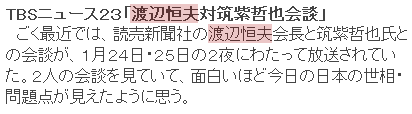
In case they correct their mistake, here it is, preservered, for the record.
tsuneo watanabe.gif

Now if you’ll excuse me, I have some articles to read.