
Stanford was nominated for cruelest rejection. Rutgers got a mention for “best acceptance” because its letter came in a “really expensive-looking black folder.”
Get Well Soon, Koike-san!
 Just as it starts to warm up, poor Environment Ministress and mother of Cool Biz Yuriko Koike has come down with pneumonia. Looks like she’ll be all right, but we would never wish an untimely demise on the woman who gave us Biz Caz Koizumi!
More obligatory cherry blossoms
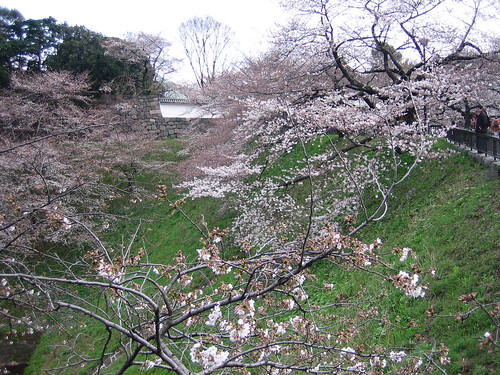
These were out in bloom last weekend by Kitanomaru Park, the area on the north side of the Imperial Palace around the Budokan (across the road from Yasukuni, which also has some gorgeous flowers in bloom).
This is the first sakura season I’ve seen since high school. Very, very natsukashii. One of the partners in our office, a retired judge who’s been practicing law since my parents were in diapers, insisted on taking a walk down Uchibori-dori after lunch the other day. Quite an excellent idea; nothing but pink flowers and gawking pedestrians in either direction. Times like this make me feel like there’s no place I’d rather be in the world. (Then I get on the Ginza Line and I just want to choke people.)
Am I a Japan Apologist? If so, sorry!
Found on the Marmot, this look at Japan apologists in Korea before and during the colonial period is fascinating.
It’s amazing to me how after Japan’s defeat in WW2 and subsequent economic growth and close relationship with the US, Westerners’ experiences in Japan have exploded from a few extremely coddled, monitored, and restricted professions (missionaries, academics, o-yatoi gaikokujin) to 10s of thousands of individual experiences in a free society and from a plethora of backgrounds (eikaiwa teacher, human rights activist, programmer, truck driver, Diet member, gangster). Meanwhile, both legal and illegal immigrants from China and Korea as well as those from “periphery” countries like Brazil, the Philippines, and Iran have made semi-permanent homes in Japan, adding to a growing multiculturalism that was spearheaded by the zainichi Korean population.
Despite the surge in openness and the increased diversity and exposure both to and from the outside world that came with it, Japan’s obsessive image management remains along with the “foreign apologists” who are strikingly similar to those employed in the 1920s. There are plenty of them, including Gregory Clark and Ezra Vogel (DISCLAIMER: Haven’t read Vogel yet). But thankfully we live in a time when a) Japan apologists don’t have to overlook unarmed Koreans sliced in half on the street by Japanese soldiers; and b) Those involved with Japan professionally and otherwise have the breathing room to maintain a more sophisticated view of Japan than the Visit Japan Campaign marketing copy. People can even spend all their free time griping about how much Japan sucks even as they live there! Or, more constructively, they can unionize and try and improve their lot in life.
 This article and the discussion on “Japanophiles” at several blogs got me thinking – what is it that keeps me interested in Japan after not living in the country for almost 3 years?
My own experiences in and related to Japan (obsessive language study, tumultuous relationship that ended in death threats, meeting and getting engaged to Mrs. Adamu here in Washington) have been, as life tends to be, bittersweet and full of as much pain as joy, but I still feel some pressure to speak well of Japan whenever someone (Japanese or non) asks me about it. Usually, I stick with the food. Nothing controversial about food, and really, Japanese food is the best. I used to have much more heartfelt and uncritical praise for Japan, back when the scenery, the people (“handler” types included), the language, and the fact that it wasn’t America kept me excited.
But right now, I don’t feel one way or the other about “Japan” as a whole. For one thing, 2 years is not enough to truly understand what a whole nation is all about. As I’ve said before: I love Japan, but it’s screwed up. The society’s got major problems that have translated into things that have affected me personally. But at the same time, I’ve been fortunate enough to befriend enough real, intelligent, and genuinely friendly people to keep me from dismissing the whole country as the kind of place that wraps foreigners in lacquer. It makes me sad to see someone who was unable in 12 years to get past all the superficial stuff of first meetings (his “GAIJIN MEETS A FOREIGNER kabuki”). Of course, not speaking the language where English is not widely understood and perhaps just being a reporter might make things difficult. It’s hard not to worry about how you’ll come across in an article when talking to someone from the press.
Anyway, as to the question in the title of whether I am a Japan apologist, I say not yet, but then no one’s paying me. Where I work (an American law firm) is about as far away as you can get from apologism. But if I were to get a swank job at JETRO or RIETI that might be a different story… Just let me apologize in advance for if and when I do get brainwashed and sucked into a world of untold luxury and all-you-can-eat sushi in exchange for my soul.
(Image is random)
Ann Coulter on Koizumi and Bush
Political commentator and psycho dragon bitch from hell Ann Coulter has this to say:
One year before elections in Japan, the [New York] Times was predicting defeat for Koizumi, a loyal friend to President Bush and an implacable supporter of the war in Iraq.
Reporting on the unpopularity of the Iraq War in Japan, the Times said “polls indicate that the population is against an extension” of Japanese troops serving in Iraq and that the opposition vowed to withdraw troops. Indeed, “some members of Prime Minister Junichiro Koizumi’s own party have been calling for the troops’ withdrawal.”
And then in September 2005, Koizumi’s party won a landslide. The Times described this as mainly a victory for the prime minister’s idea to privatize the post office, explaining that Koizumi had won “by making postal privatization — an arcane issue little understood by most voters — a litmus test for reform,” thus confirming the age-old political truism, “Most elections hinge on arcane, obscure issues voters don’t know or care about.”
As congressional Republicans decide whether to take the Times’ advice and back away from the war this election year, they might reflect on a fourth world leader who won re-election while supporting the Iraq war. Just about four months before Bush was re-elected in 2004, the Times put this on its front page: “President Bush’s job approval rating has fallen to the lowest level of his presidency, according to the latest New York Times/CBS News poll. The poll found Americans stiffening their opposition to the Iraq war, worried that the invasion could invite domestic terrorist attacks.”
Maybe it was his support for the post office.
As much as I hate to agree with her, I don’t think the war drives most Japanese voters. In fact, I don’t think it drives most American voters (although it certainly means more to them). And the NYT… just doesn’t get it, basically.
Of course, you would probably hear the same basic opinion from Jon Stewart. He would just be funnier about it.
Imperialist cuff links
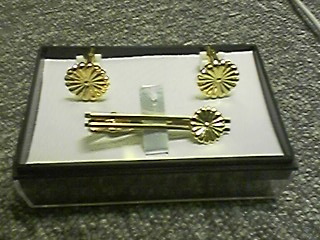
I bought these on a hanami (flower viewing) excursion to Yasukuni Shrine last weekend. Tie pins aren’t quite my style, but the cuff links are great. (And Lady Curzon, a true aristocrat, gives her approval.)
Other items on sale at Yasukuni:
* Japanese flag cuff links. I didn’t buy these because they seemed too loud. I now regret that decision, and plan to purchase them the next time I visit.
* An authentic-looking Imperial Rescript on Education you can put up in your home for that classic fascist feeling. (Framed with a portrait of Hirohito: ¥9,000. Unframed: ¥1000.)
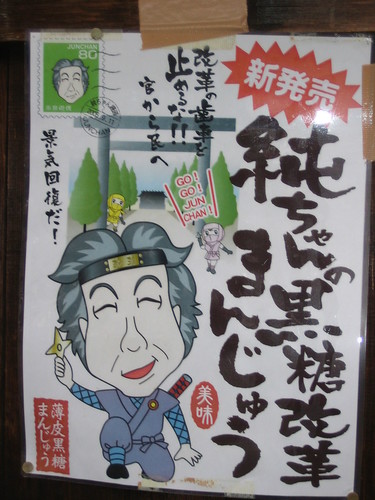
* Special manju, packaged with a caricature of Koizumi on the box and parodies of LDP slogans. Here’s a photo, because I love you:
Anyway, if you see a honky walking around Tokyo wearing chrysanthemum cuff links, you’ll know it’s me, so be sure to say hi.
KSG students do a good job of keeping up stereotypes
Some Harvard kids got some intimate time with Shinzo Abe and Seiji Maehara. So guess what the Korean wanted to ask about?
Wait for it…
A student from South Korea said Abe’s stance on visiting Tokyo’s Yasukuni Shrine, which honors Japan’s war dead as well as Class-A war criminals, did not come up during the meeting due to time constraints.
Hahahahaha. Riiiiight.
“If he (Abe) becomes the next prime minister, there would be no improvement in Japan’s relations with South Korea and China,” the student said on condition of anonymity.
However, the student also said Maehara was an engaging politician who gave “clear comments” on the party’s stance against acts of worship at the contentious Yasukuni Shrine by top Japanese political figures.
Meanwhile, the Anglosphere types are more concerned about different issues:
Andre Stein of Australia held a different view, criticizing the DPJ’s contradictory stance on national security.
“While Maehara agrees with U.S. (military) protection of Japan, the party is not interested in supporting the allied forces in Iraq,” he said.
One’s concerned with mismanaging the past; the other’s concerned with mismanaging the future. To be fair, the Japan Times only published two opinions; perhaps they’re just looking for what they think is most conventional.
diazepam, I hate you!

Go to hell you spamming bitch. I think you might be one of those “stealth Jews.”
(Picture by the “insatiable” Hokusai, whose works are now on display at Washington’s Sackler Gallery. I need to go there!)
Kochikai makes like Jesus and comes back from the dead (maybe)
Yomiuri reports that a sleeping LDP faction appears to be reviving itself for the post-Koizumi horse race. The Cliffs Notes version follows, with Wikipedia links for those of you just joining us.
The Asian strategy study group, headed by Ichiro Aisawa, the LDP’s acting secretary general and a member of the Tanigaki faction, shows signs of being anti-Koizumi in outlook.
The group appears to have come into being in an attempt to bring the Kochikai faction back–reuniting the three factions while, at the same time, reining in Chief Cabinet Secretary Shinzo Abe who has made a great show of following Koizumi’s reform policy …
Kochikai was a prestigious faction founded by late Prime Minister Hayato Ikeda. It forms part of the lineage of the Liberal Party and carved out a policy that called for the nation to be lightly armed and focus on the economy.
Mainstream and conservative, the faction produced four prime ministers. [Ikeda, Ohira, Suzuki and Miyazawa -ed.] However, it often found itself outside of the political power struggles that mattered, which led to it being ridiculed as a “group of court nobles.” …
If the reunited faction takes an anti-Koizumi policy line by being pro-Chinese in terms of its Asian diplomacy and seeking to correct the economic disparity in Japan, it would be hard for its members to support Aso.
If Aso’s attempts to seek the highest position in the party through the reunited faction is derailed, he will be inclined to instead seek the support of the Mori and Tsushima factions.
Tanigaki is trying to win the support of the three factions, but whether he will succeed in bringing them together is still uncertain–some members harbor hard feelings over events that took place when the Kochikai faction was last active.
The unification of the three factions may need to wait for the party presidential election after this one.
Yahoo still beats Google for mapping Japan
I made a big deal when Google Maps added data for Japan, but now Yahoo Japan has introduced a Java-based clone of Google Maps, complete with aerial photos. Check out this shot of the Defense Agency headquarters in Ichigaya…
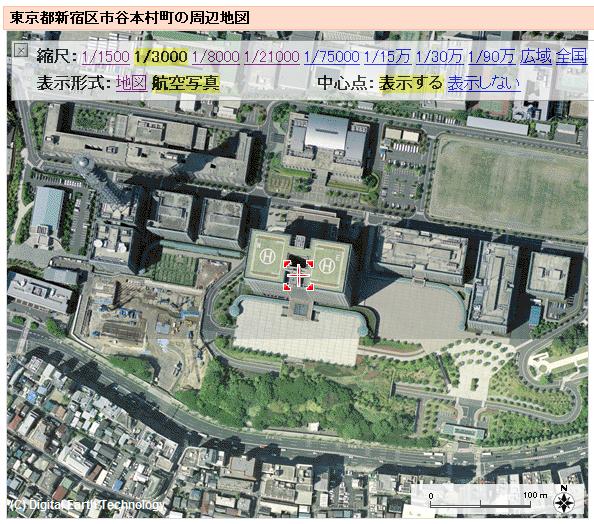
And the area map, slightly zoomed out:

It’s still beta, but it kicks Google’s ass (and for that matter, everything Google makes is still in beta anyway). If you’re “nihongo OK,” do check it out.