Winning through political theatre

So the Senate has now passed the detainee treatment bill that will essentially let the president do whatever he wants to anyone at anytime for any reason. Via Andrew Sullivan we have these photographs and description of waterboarding, the most infamous method of torture known to have been used by the US government in the “war on terror.” While there was 10 hours of debate over the legislation, including this speech by Senator Clinton, in the end it passed with a very wide margin of 65-34, most likely due to the fears of Democrats too spineless to stand up for anything due to fears that it would allow them to be portrayed as soft on terror.

How did this pass? Why was there so little public outrage over practices such as waterboarding in the first place?

I personally believe that this is because so few people really understand what these torturous practices look like. Even images graphically depicting the reality of waterboarding, such as the those linked to above have rarely, if ever, appeared in newspapers or on television in the US over the course of this debate.

Hillary Clinton may have made a decent speech about treating prisoners humanely, but it was too little and too late.This is why I think the only way for the Democrats to defeat the administrations torture plans once and for all would be to hold their own demonstration.What she (or some other opponent of government approved torture) should have done is this:

volunteer to be waterboarded on national television. Hold a press conference in a place of appropriate sentimental value. Someplace like the Vietnam memorial, Arlington National Cemetery, or the Holocaust Musem. She does not tell reporters in advance about the stunt, keeping the waterboard behind a curtain for the opening of the speech. Then after an introduction, pulls the cloth back, revealing the object in all its horrific glory (ideally, it should be one actually used to torture in the past, perhaps by the Khymer Rouge, borrowed from a museum). She then introduces the board, explains its history, and repeats the point that this is the same practice that the US has admitted to engaging in. There is a mild stir among the press corp, who are thinking that she has already reached the climax of her presentation and that it was a good try but not enough to swing the issue.

She then announces that there is now going to be a live demonstration of how exactly it works. The audience is quite surprised at this announcement, a murmering going through the crowd-but a shocked silence falls a moment later as the Senator herself lays down on the board and waits to be strapped in by the former CIA employees that have been recruited for this gruesome display.

“The [senator] is bound to an inclined board, feet raised and head slightly below the feet. Cellophane is wrapped over the [senator]’s face and water is poured over [her]. Unavoidably, the gag reflex kicks in and a terrifying fear of drowning leads to almost instant pleas to bring the treatment to a halt.”

The cellophane is torn off quickly, and her pained gasping for air is clearly audible. The former-CIA interogator lets loose the straps and helps her rise. Too weak to do so unassisted, she unsteadily stands, tears still running down her face, as she gripsthe man’s arm.

Having completed the demonstration, she makes a brief statement challenging the President, the Vice President, the Secretary of Defense, or any other member of the administration to submit to the same act, and is then rushed to the waiting ambulance for a medical exam without taking questions.

Hikki’s mom: high-stakes drug trafficker or poor business planner?

This is a fun story:

Junko Utada, the mother of once-awesome now-lame best-selling pop singer Hikaru Utada, was detained at JFK Airport back in March. She was spotted acting rather strangely (screaming into a telephone and appearing ill) prior to boarding a flight to Vegas.

When investigators searched her luggage, they discovered she was carrying over $400,000 in cash, two boxes of somebody else’s checks, and a lease agreement to a storage unit in Manhattan. She made up a weird story about donating her casino winnings to a foster home in Vegas, but the DEA agents decided that she was probably involved in drug smuggling, and so now the government has filed suit to have the money forfeited to the feds.

It’s a very weird situation, but it’s also not entirely clear why Hikki’s mom would be running drug money around. I’m skeptical, at least. Perhaps she just got caught in the midst of a poorly-planned tax avoidance scheme. Or maybe she just never got over her clueless Japanese tourist phase.

The beast of Ketagalan

I was just reading the latest news about the anti-Chen Shui Bian protests in Taipei when I saw it mentioned that they were camped out on Ketagalan Boulevard. Not recognizing the non-Chinese name of the street I nautrally punched it into Google. Ah, 凱達格蘭. Yes of course. Now, who or what is Ketagalan? As is often the case, Wikipedia has an answer.

Ketagalan 凱達格蘭 is a Taiwanese aboriginal tribe originating in what is now the Taipei Basin. Their language has now become extinct.

On 21 March 1996, the road in front of the Presidential Building was renamed from Chiang Kai-shek Boulevard (介壽路) to Ketagalan Boulevard by the Taipei City Government to commemorate this tribe. Traffic signs banning motorcycles and bicycles from that road were abolished at the same time.

Legend has it that their forebears originally lived on another island. One day, a ‘monster’ appeared on the island. Every night the monster would appear in the village, terrorizing the villagers.

Accordingly, the villagers laid traps for the monster all around their homes and fields. The wounded monster was forced back into the mountains and the village was peaceful again for a while. But soon afterward the monster reappeared. Crazed by hunger, the monster reached into a hut and seized a child.

The villagers lived in fear of being eaten by the monster and didn’t dare sleep a wink. The villagers debated heatedly but no one could think of a way to deal with the monster. So with no other choice, it was decided that they must pack up and leave the island. Following an arduous sea voyage, they sighted land. The island they landed on was Taiwan.

Many years later, the tribe was growing so one day the villagers agreed to draw straws. Those who drew long straws were permitted to remain living on the fertile plain while those drawing the short straws would have to move into the mountains. Thereafter, the villagers were separated into plain-dwelling and mountain-dwelling tribes.

If I were a KMT nationalist filmmaker during the days of the military dictatorship, I would make a film version of this story which actually takes place in the mythical past, but the “monster” is a symbol for Chairman Mao and the Chinese Communist Party. It would never be explicitly stated, but evident through symbolic use of colors and icons suggestive of both the CCP and KMT, the civil war, the famines of the Great Leap Forward, the oppression of the Cultural Revolution, etc.

Today it would be regarded as a classic of the propaganda genre, along with Leni Reifenstahl’sTriumph of the Will” and D.W. Griffith’s “Birth of a Nation,” but like them would also be considered an uncomfortable reminder of an earlier time and rarely watched by any but serious students of film or history.

In 2012, Ang Lee, the world famous Taiwanese director known for his love of exploring new genres, would direct his first animated, a lavish fantasy story whose animation is inspired largely by Studio Ghibli’s painterly backgrounds, but with a greater use of computer graphics for special effects and management of large numbers of actors and objects in scenes of fast action. This first Taiwanese-made animated blockbuster would be widely hailed as evidence that Taiwan, like Korea and Japan before it, is beginning to overcome its image of being merely a technocratic and business-obsessed East Asian nation, and the Taiwanese press would, in a somewhat lame attempt to copy the corny but effective phrase “Korean wave” present it as the beginning of a Taiwan Typhoon of pop culture that would finally give the diplomatically isolated yet economically powerful island nation a taste of cultural soft power.

This film would, however, be a straight adaption of the myth, lacking the political undertons of the earlier Chiang Kai Shek era film. It would, however, alter the myth slightly to accomodate recent archaeological research indicating that Taiwanese aborigines who probably immigrated from what is now the Chinese mainland may in fact be the ancestors of the entire Malasian/Austronesian culture/linguistic people. The Ketagalan tribe of the film would flee from, instead of another island, the Mainland, and in the end they would not divide themselves between lowlanders and highlanders, but lowlanders, highlanders, and a third group who in the films melancholy conclusion once again set off in their flimsy wooden boats, in search of the unknown with nothing to guide them except the stars and their prayers.
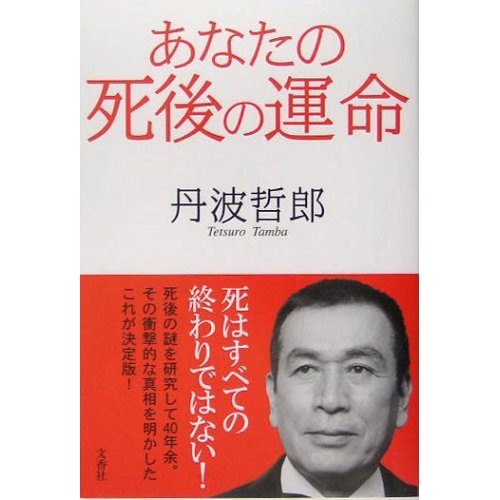
RIP Tetsuro Tamba

4938933632.01._SS500_SCLZZZZZZZ_V1120550405_.jpg

Veteran Japanese actor and noted occultist Tetsuro Tamba has passed away at 84. You may have known him as Tiger Tanaka in the James Bond film You Only Live Twice. I never saw that one, but he was good in the two things I did see him in – Harakiri and Tenkiri Matsu, a TV movie.

Mrs. Adamu and I share a tenuous connection with the man. She used to pass his house on her way to university in Kichijoji. I met him briefly on a movie set in Kyoto. An English student of mine who happened to live next door used her obasan powers to get us in to watch the filiming of Tenkiri Matsu, the story of a thief who lived at the end of the Edo Period. Tamba only played a bit part, but we got to shake his hand and get his autograph, pretty exciting as he was (I was told) a big name. It wasn’t until later that I saw the TV movie they were filming and realized his remarkable screen presence. He reminded me of a kind of Japanese Vincent Price, minus the snake voice.

Enjoying Root Beer in Thailand

Root beer is not popular in Japan, which makes things tough for me as both Japan watcher and root beer lover. During my stays in the country, the high prices at the import stores – formerly the only place that sells the stuff before the rise of discount stores – forced me to regard my beloved root beer as a rare treat to be enjoyed alone or in the company of other foreigners.

Attempts have been made to add the drink to the usual lineup of carbonated drink products, but the Japanese consumers are apparently having none of it. Why?

Japanese friends have told me it tastes like medicine. Wikipedia tells me that the specific reason root beer fails to gain popularity outside Okinawa (a legacy of extended US occupation) and US military bases (see previous paretheses) is because drinking it makes you smell like you’re wearing a compress. I have always found the comparison somewhat insulting. I mean, root beer used to be a folk medicine – it’s supposed to taste that way!

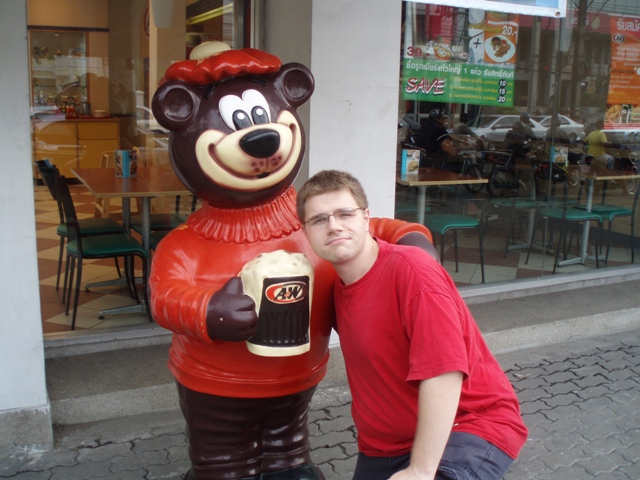
Thankfully, the Thais have absolutely no problem with stinky food (take dorians – please!). It was with great pleasure that I have found root beer to be plentiful here. Not only can one find A&W cans on the shelves of the ubiquitous 7-11s, right next to Coke and some unsettlingly hypersweet Lipton Iced Tea, but the A&W fast food chain is alive and well throughout Bangkok. You might be unfamiliar with A&W restaurants as they have a limited presence in many US states, but they but are, rest assured, a nationwide chain (and big in Canada!). They serve a lot of fried food and are known for having good curly fries (true) and chili dogs (not as true). Here I am hugging a statue of their beloved mascot the Great Root Bear (who knew they had a mascot?!) before enjoying their signature root beer in a frosty mug:

Adam and AW Bear 092306.JPG

Unlike the A&W cans, which for some reason taste almost like Dr. Pepper (blech), the root beer at the restaurant is authentic and delicious. We also had curly fries, which were good as ever, and some fried chicken that was OK but doesn’t hold a candle to some of the awesome fried chicken you get at street vendors around Bangkok. One interesting feature of the menu is that waffles a la mode are offered along with the rest of the value meals, served with curly fries and apparently intended to be eaten as a full-fledged meal. Sounds good to me!

Perspective on What the Thai Coup Means for Foreign Investors and the SE Asian Governments Who Love them from PESEK

PESEK!!!

…[P]olitical events [like the recent Thai coup] create havoc not only for economic growth and interest rates, but also for big business deals.

The risk is less about financial contagion in Asia than a less tangible political funk that hovers over markets and discourages investors. Reading an economy is hard enough; having one’s finger on the pulse of every political zig and zag a world away is an entirely different thing.

…[G]eopolitics are a big risk to a region that is still figuring out how to compete with a booming China, which itself may be subject to political upheaval one day.

Voters and military leaders may have valid reasons to want to oust elected leaders. Doing so undemocratically can set economies back even more than questionable politicians can. It unnerves the same international investors that companies and governments are trying to impress.

Google coming around

You might remember that I railed on Google’s products for being hard to use in Japan.

Well, two of my four beefs seem to be resolved. Tokyo weather is mostly accurate nowadays, and Google Calendar now sends properly-encoded notifications to Japanese mobile phones.

Now we just need stock quotes and mobile browser support, and I can almost consolidate my web services! (Except, of course, for del.icio.us and rememberthemilk.com and my bank accounts and…)

He’s a knight, even if he can’t be a Master

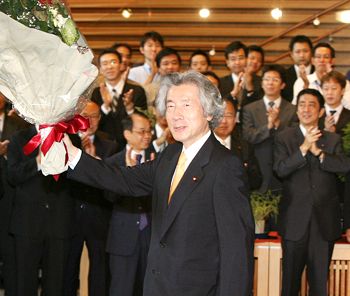
It’s ridden with clichés and won’t tell you anything that you wouldn’t have already known from reading this blog, but this obituary to Koizumi’s political career, written by the Northeast Asia bureau chief of the Washington Post, was at least kind enough to call the outgoing prime minister a “Jedi Knight.”

Needless to say, I’m assuming that the author ripped this idea from me and Curzon.

So are we reaching the end of Episode III now? Is Mori going to pull Koizumi out of the volcano, slap body armor on him and turn him into a Sith Lord? “Darth Kakuei,” maybe?

UPDATECurzon went straight to work on a Fireworks graphic. I also just recalled that Kim Jong Il was supposed to be the Emperor analog, so… hmm. Darth Bulgogi? I got nothin’…

The Happiest Coup on Earth

Soldiers at Democracy Monument 092406.JPG

Soldiers stand guard with unclipped rifles across from Bangkok’s Democracy Monument, built after a 1932 coup brought constitutional monarchy to Thailand, then known as Siam. That was the first of more than 20 that have occurred since that time, though the last coup in 1992 was supposed to be the last since the popular demand for democracy had grown so strong since an uprising in 1973 made them impossible to ignore.

The soldiers gladly allowed us to photograph them. In fact, they’ve been ordered to “keep smiling” and stay friendly as part of the effort to put a positive face on this bloodless coup, which has astonishingly enough been carried out in the name of democracy (a concession that speaks to the high expectations among the public to maintain the democratic institution that has built up over the last 15 years). Still, after four days of ingratiating themselves to the public, including scores of foreign tourists such as myself, the soldiers have started to look a little less than eager to enlighten us on the democratizing power of military force:

Soldiers under canopy across from Democracy Monument 092406.JPG

Now, don’t get me wrong – the dynamics of this coup d’etat are not as simple as elected government good, military coup bad, as writers for the Washington Post might have you believe. But for me, as someone whose idea of democracy is primarily a) Democrats vs. Republicans, and secondarily b) Mori Faction vs. ex-Tanaka Faction battling to please their bureaucrat overlords, the very likely explanation that Thaksin was planning a coup of his own and that the military’s commitment to democracy far exceeds that of the corrupt Thaksin’s (as indicated by Mango Sauce) is confusing. But what I do know that the political stability since the early 90s was a humongous boon for Thailand, and getting things back on track will be key if Thailand wants to maintain its status as the most developed major nation in SE Asia.

In the meantime, ironic scenes such as the one in the first picture will no doubt abound as long as this junta lasts. At least the Bangkok Post hasn’t lost its loopy sense of humor:

Two kinds of power
Armoured tanks can both destroy buildings and enchant children

240906_news01.jpg
People crowd the Royal Plaza to catch a glimpse of the tanks stationed there to keep the peace on orders of the Council for Democratic Reform under Constitutional Monarchy.

240906_news02.jpg
A vendor is about to hand a balloon to a young buyer at the Royal Plaza yesterday.