Consumer Finance Consolidation from STK

The following translation was done with the aid of my brand new copy of the Nikkei Japanese-English Dictionary of Current Economic and Financial Terms, an amazingly helpful (if pricey at 9000 yen) resource for anyone who does business or finance-related translation. It was put together by the people who write Nikkei Net Interactive, Nikkei’s English-language news site, so it includes a wealth of examples taken from actual Nikkei articles on recent events.

Normally, I use a combination of 3 free online dictionaries — Eijiro, WWWJDIC, and goo’s Japanese-Japanese dictionary (Yahoo’s is useful since it has both 大辞泉 AND 大辞林). But I’ve noticed that it’s not always easy to get financial terminology all in one place, or in a format that can be easily used offline (so far my attempts to download a bunch of online glossaries and search them using Google Desktop have proven time-consuming and ultimately unsuccessful), so I decided to splurge on a dead-tree solution.

If you just want a reference that explains recent events in the Japanese economy in simple (Japanese-language) terms, I would recommend picking up the much cheaper Dictionary of New Economic Terms 2007. I picked up a used lite version of the 2006 edition at Book Off and it is already coming in handy.

Anyway, here’s an article on the consolidation in some of the major consumer credit companies that occured after long-running string of crimes and suicides by people in deep to usurious consumer lenders, along with 2006 Supreme Court decisions ruling that companies like Aiful could not keep loans made over the legal limits, caused the Diet and Financial Services Agency to crack down on consumer lending. Measures that were taken included, in no particular order:
1) Business suspension orders on lenders for using threats to collect loans;
2) a phased-out closing of the “gray zone” interest rate regulatory framework that allowed lenders to legally charge 30% annual interest (as opposed to the legal limit of 15-20%) as long as borrowers gave legal consent;
3) a ban on the practice of taking out life insurance policies on borrowers that will pay out if the borrower commits suicide (a standard Japanese practice);
4) allowing borrowers to recover interest retroactively that was collected over the 20% legal limit; and last but not least
5) A thorough public humiliation in the media.

Number 4 was a particularly large factor in the net loss of a whopping combined 540 billion yen by the nation’s top consumer credit companies. Now that the times of easy money are over for Japan’s lenders, only the most healthy companies will survive, and as you will read below there is intense competition among the megabanks to find and acquire the picks of the litter:

Ambitious Mitsui Sumitomo Takes a Step Toward Acquiring OMC Card
May 17, 2007 (from Shukan Toyo Keizai’s May 19 edition)

A shockwave is rocking the financial industry — an unprecedented “change of management.” Central Finance is leaving Mitsubishi UFJ and joining the Sumitomo Mitsui group. Observers are watching to see what effects this will have on the battle for OMC Card.

Not all is quiet on the consumer finance front. Central Finance, a former member of the Tokai Bank group, has decided to leave Mitsubishi UFJ. Its new partners will be Sumitomo Mitsui Financial Group and Mitsui & Co. (recently famous for building the new Tokyo Midtown building complex).

Here are the details of the new capital tie-up: First, SMFG (including subsidiary banks) and Mitsui & Co. will invest 19.4 billion yen in common stock and corporate bonds with equity warrants. After those bonds are traded in for shares, the total investment by both companies will rise to 20%. Meanwhile, Central Finance will buy 7.5 billion yen of common shares in Quark, a Sumitomo Mitsui-owned consumer finance firm. Central and Quark will then merge by September 2009.

Shockwaves continue to riddle the consumer finance and credit card industries over developments such as the lowering of the legally permitted interest rate for nonbank “cash” lending dictated by a revision of the law regulating non-banking moneylenders. Yet even in such difficult times, at least one president of a major consumer finance firm was “frankly surprised” to hear about this most recent capital tie-up, since such a “change of management” is almost unheard of in Japan’s financial industry, which prefers to build up tight group-oriented relationships in both both capital and personnel.

That is part of what makes this such a big gain for SMFG. Compared to the group’s rivals, Mitsubishi UFJ and Mizuho, SMFG faces a conspicuous lack of consumer finance capabilities. And it was no small accomplishment to successfully bring in Mitsui & Co. in this capital tie-up. Of Japan’s major trading companies, Mitsui has been a latecomer to investments in finance businesses. This has allowed the banking side to cooperate in Mitsui’s plans to get back in the game, thus putting Mitsui in SMFG’s debt.

Past Merger Plans Crushed

What was behing the decision by Central Finance President Tatsuo Tsuchikawa? A former UFJ Bank official explains: “When UFJ was [created by the merger of Sanwa and Tokai Banks in 2002], Tsuchikawa, who was the Executive Director for Project Planning at the former Tokai Bank, strongly objected to the strongarm integration tactics of former Sanwa Bank officials.” Central Finance held tight to its independent strategy even amid the rapid-fire merger. It charted its own course amid the Mitsubishi UFJ-owned credit/consumer companies, including NICOS, UFJ Card, and DC Card.

A top official at a rival company points out that “that’s not the end of the story.”

“Central Finance had entered merger talks with another card company before, but the move was stifled after opposition from Mitsubishi UFJ.” In fact, that company was OMC Card. OMC is currently in the eye of the storm of reorganiztion in the credit card industry. Daiei, which is currently undergoing management rehabilitation, is currently in the process of selecting a buyer for its 30% stake in OMC. SMFG is one of the bidders.

CEO Masayuki Oku of SMFG, outwardly denies a relationship between the new capital tie-up and the battle for control of OMC: “We have not even remotely considered (bringing the two companies together).” However, another senior staff member of the group reveals what are likely SMFG’s true intentions: “(OMC) will probably be happy about this new capital tie-up.”

The first round of bidding for OMC has already ended, and hearings including the top executives of the remaining bidders will be held in mid-May. SMFG is more than likely going to play up a growth scenario for OMC involving Central Finance.

And the benefits for SMFG don’t end there. Central Finance is generally considered a consumer credit form run by the former Tokai Bank, but a glance at the company’s history shows a unique character of support from influential Nagoya business people. The former Tokai is just one powerful parent of several. President Tsuchikawa is a major presence in the Nagoya business community, and is said to be close with the founder of Toyota. That would quickly shorten the distance between SMFG and the Toyota Group.

The economy of the Nagoya area, which is experiencing continued vitality, is considered friendly territory for Mitsubishi UFJ, which is the successor organization to Tokai. However, the drama surrounding this capital tie-up could change the lines of battle in the “financial wars.”

(by Osamu Namikawa)

Copyright Term Extension in Japan: Balance shifting *against* extension?

Nikkei PC Magazine reports:

Arguments for Caution at Cultural Affairs Agency Deliberation Council on Copyright Term Extension Issue
May 16, 2007

The Subcommittee for the Protection and Use of Past Copyrighted Works Etc. of the Cultural Deliberation Council’s Copyright Commission, an advisory body to the Commissioner of the Cultural Affairs Agency on the copyright term extension issue, held its 3rd meeting of 2007 on May 16.

Continuing from the previous meeting, a hearing was held consisting of 17 people including stakeholders engaging in business activities related to copyright. This time, however, moderate-thinking lawyers and academics with a background in copyright made multiple arguments against term extension.

“Cases of Copyright Inheritance are Rare”

Professor Masaru Itoga (Library Information Science) of Keio University, pointed out that gaining permission to use copyrighted materials will become more difficult by extending the copyright term from 50 years after the death of the rights holder to 70 years. “With the exception of famous works, cases in which surviving family members inherit copyrights are rare. Also, finding the addresses of corporations is easy, but the contact information of individual rightsholders is not made public. If the copyright term is extended, there is a danger that there will be an increase in the number of works that are not passed on after the rights holder’s death and it is unclear who holds the rights to them.”

[snip issue of “free use labeling”]

“The International Balance of Copyright is -600 Billion Yen Annually”

Attorney Kensaku Fukui commented that while the US, Europe, and Japan have extended copyright term repeatedly, copyright term has never been rolled back, and called for caution on a hasty extension: “The effects from term extension will felt by posterity semi-permanently. I hope for and will watch carefully for a debate that will stand up to historical investigation, showing who and with what proof did people favor, oppose, or remain silent on extension.”

He went on to question: “Those in favor of term extension argue that if a database for copyrighted works is built then past works can be easily accessed. I think there is merit in that idea, but it would be difficult to create a database comprehensive enough to cancel out the problems posed by extension. The list of authors tops 790,000 just based on the archives of the National Diet Library. Extend that to overseas works and a database would grow exponentially in size if the copyright term is extended to 70 years retroactively. Are we going to place this cost on the Japanese people?”

Fukui also commented on the fact that according to Bank of Japan statistics, Japan’s international balance of payments for copyrighted works is negative 600 billion yen annually (meaning that more copyrighted work is imported than exported) and is growing year by year: “If prewar Western works’ copyrights continue to be extended, then over-importing and the international uneven distribution of intellectual property will become permanent. There are those who argue that ‘extension is necessary to protect the works of Haruki Murakami or Japanese animation,’ but these works’ copyrights will last for at least another 30 years. The decision to extend works such as those should be made based on the situation 30 years from now, and it is no reason to extend copyright term now. I think we should stop immediately trying to find a way to cooperate whenever we are told something by the US and Europe.”

“Economic effects of term extension no greater than 1-2%”

Keio University Professor Tatsuo Tanaka (Econometrics) claimed that the economic effects of term extension would be small and that the rational decision would be to promote use of the public domain. Tanaka explained his doubtful outlook: “Citing books with past case studies, the increase in revenue for rights holders due to copyright term extension would be only 1-2% of all copyright revenue. Will raising royalties from 10% to 10.2% actually boost creativity?”

Meanwhile, arguing that the term extension is set aside would allow works to be used freely in the public domain, Tanaka concluded that not extending copyright would be better for society: “Businesses that promote new uses by exploiting the public domain are increasing. For example, Aozora Bunko boasts a lineup of 6000 titles, and the top 1000 titles are viewed by 4.5 million people per year. Cheap DVDs sell 1.8 million copies per year. There are also many examples where works whose copyright terms have expired, such as Akira Kurosawa’s Rashomon and Ayaka Hirahara’s Jupiter, have been recreated. On blogs and social networking sites, 10 million average citizens are creating and transmitting content. The public domain is the lifeblood of creativity for the next generation, and forms the basis for the average person’s creations.”

Other participants arguments’ included “I am negative on term extension, but even if the term is extended, I hope that the part of the term beyond 50 years will require a notification and that the term will not be categorically extended.” (Keio Univ. Associate Professor Kim Jong Kun [金正勲]), “As a part of a system for notification of intent, I would like a free use label to be created that indicates permission to freely use work in a museum.” (Akira Inoue, Director General of the National Science Museum)….. “Ryonosuke Akutagawa worried whether people would read his work 50 years in the future. The greatest hope of a creator is to have his/her work read by a great many people. Extending copyright term would decrease the opportunities for works to be used and lead to a cultural loss.” (Authoer/poet Chico Ryomi).

Still others’ contended: “For orchestras, the burden from usage fees they will pay to JASRAC due to term extension is a serious issue.” (Japan Orchestra Federation Standing Director Naomoto Okayama), “It is almost inconceivable that software will be used 50 years after [its copyright holder dies], making term extension unrealistic.” (Association of Copyright for Computer Software Executive Director Hiroshi Kubota)

Others Argue “We Should Lead the International Current”, “National Cultural Assets will be Lost”

Meanwhile, there were also arguments in favor of term extension, mostly from officials from rights holder groups. Hide Ikuno, Executive Director of the Recording Industry Association of Japan, noted that “copyright term for records is already greater than 50 years in 21 countries. Japan has the second largest record sales in the world, and is in a position to lead the international current.”

Kazuhiko Fukuodera, standing director of the Japan Artist Association, argued: “Edvard Munch is still copyrighted in the West but is public domain in Japan. When that happened, dolls parodying “The Scream” went on sale. We should not do things that are rude to creators. In 2009, Taikan Yokoyama’s copyrights will become public domain. The Taikan Yokoyama Memorial Center’s operating costs are taken care of in part by copyright fees, and if they become public domain the operations of the center could become difficult, leading to a loss of national cultural assets.

(by Kanto Kaneko)

Comment: Some things to be learned from/noted about this article:

1. Those who will benefit from copyright extension in Japan are overwhelmingly foreign rightsholders, such as the Beatles, Elvis, Disney and other popular foreign artists/movies.
2. The arguments for copyright extension, when shown in the light of day, are extremely weak (lead by following?!) and hold no legal water unlike the previous extension to 50 years to comply with the Berne convention.
3. The Japanese system of public hearings before advisory committees long before any cabinet decisions are made or laws passed can work much much better than, say, the American system in which copyrights can be extended through the sheer political will of Sonny Bono’s widow and Disney. This did not stop the copyright term for movies from being extended to 70 years after the rightsholder’s death due to foreign pressure from the US etc, but an increasingly copyright-conscious Japanese public may just save Japan as a bastion of consumer-friendly copyright term.
4. The bulk of the Japanese media, as major rightsholders themselves, spew endless anti-piracy, pro-rights management propaganda, though as you can see this is not always the case as there are opposing business/consumer interests involved. I’ll try and locate a good example sometime soon.

Strange confession note by boy who sawed off his mother’s head and brought it to the police

A terrible crime was committed in Fukushima, Japan recently:

17-year-old boy turns self in with severed head / High schooler tells police he killed mother
The Yomiuri Shimbun

A 17-year-old high school student was arrested Tuesday on suspicion of killing his mother after turning himself in at a police station in Aizuwakamatsu, Fukushima Prefecture, carrying her severed head, police said.

According to the police, the boy, in his third year at a prefectural high school, came to Aizuwakamatsu Police Station at about 7 a.m. on Tuesday with the head in his school bag. He told the police he had killed his mother at about 1:30 a.m. Tuesday.

The police went to the boy’s apartment in the city, where they found the headless body of the mother.

The boy was quoted by the police as saying: “I killed her by myself at home early Tuesday morning while she was asleep. I wanted to kill somebody, whoever it was.”

Later it was revealed that the boy also sawed off his mother’s arm. After the crime, he went into an Internet cafe, watched a Beastie Boys DVD, and apparently wrote the following note (apparently leaked by police):

I have committed a crime that should never be committed.

–What was your motive?

A reason? Just because.

–Other people won’t be satisfied with that!

Well if I had to say something, I guess it’s a form of self-expression.

–You had no other way to express yourself?

Maybe not.

–Don’t you feel any regret?

Not right now. I feel relieved. But I’m sure I’ll probably regret it later.

–What will you do after this?

I will go have myself charged with the crime.

–Isn’t that a foregone conclusion?

Oh, you might be right. But at the very least there is no crime I desire in reality [Note: this line was a little hard to figure out. The Japanese is reproduced below:]
 あーたしかにそうかもしれません。でも現実でだけはボクの望む罪はないと思いますが。

–Do you feel like continuing on?

Not really.

–If you keep going, what will you do next?

I don’t know since I’ve just been acting on my whims.

–Don’t you feel like killing yourself?

No, that would be scary. Plus I promised I wouldn’t kill myself.

–Who did you promise?

I don’t want to say.

–Why not?

Just because.

–Aren’t you being evasive by saying “just because”?

Perhaps. I’ve always been running away like that anyway.

–Any last words?

Thank you for putting up with my nonsense all this time.
(Thanks to the Daily Yomiuri and ZAKZAK)

Comment: This is a sad tragedy that seems to contain similarities to both Columbine (troubled teenager who couldn’t make it through his last year of high school), the Virginia Tech slayings (weapons bought beforehand, a pre-planned media strategy and a clear “self-expression” motive) combined with the all-too-common Japanese mother-son tension. The reports that I’ve seen so far seem to regard this crime as a total aberration by a troubled youth, which it is. But it looks like this sort of thing could be prevented. It’s been reported that it was known that he had been skipping school and a doctor had already diagnosed him as “mentally unstable.” As hard as it is to rein in rebellious teenagers, it’s sad that there wasn’t more done to try and help (or at least medicate) someone with clear mental problems before he became a danger.

Dentsu in the News, Part 2: The Bad News

The Japan Communist Party flexes its awesome research muscle:

Dentsu Takes 40% of Government Public Relations Contracts
Representative Yoshii Presses Officials on Connection with Golden Parachute Scheme

At the May 11 Lower House Committee on the Cabinet, it was revealed that Dentsu is substantively monopolizing contracts for “government public relations” that the Cabinet Public Relations Office prints in newspapers, with the company garnering nearly 40% of the total value of contracts. The situation was brought to light via a survey conducted by JCP Representative Hidekatsu Yoshii.

According to the survey, of the 13.2 billion yen in contracts government PR placed in newspapers from FY2001-2005, Dentsu was the top recipient with 4.9 billion yen, or 38% of the total. Hakuhodo, the second largest recipient, received 2.4 billion yen (19%), while other companies all received less than 10% apiece.

In response to a request from Yoshii for disclosure of the expected bidding prices, Director Yasuyuki Takai of the Government Public Relations Office refused the request, stating that the office “uses regular competitive bidding.”

Yoshii pointed out that there are too many advertisement placement companies that participate in bidding but later withdraw. For example, from FY2001-2005, Nihon Keizai Co. (printers of Nikkei Shimbun etc) withdrew the most times, 101. The fewer times a company won bidding, the more times the company placed a bid but later withdrew. Yoshii concluded: “This is just too unnatural. I suspect this is a case of ad industry-related bid-rigging intended to maintain Dentsu’s unipolar control.” Takai repeated that “Withdrawal from bidding is the bidding company’s decision.”

A survey by the House of Representatives Research Bureau shows that as of April 2006, 12 [retired officials from the Govt PR Office] were in post-retirement jobs at Dentsu, while 5 were at Hakuhodo. Yoshii pointed out that this practice of “Amakudari” was likely behind the rigged bidding, and emphasized, “If [the current govt] says it will reform the public servant system, it should first thoroughly reveal the true state of amakudari.”

In other news:

Dentsu “Pale” in Apology for Retooling Reds Stadium Seats
May 10, 2007

The Japan Football Association revealed on May 10 that it had granted advertising company Dentsu permission for a Kirin Beer commercial that made unauthorized modifications to a photo of Saitama Stadium filled with supporters of the Urawa Reds without noticing the changes.

The Association claimed it had not received an explanation of the changes from Dentsu, who was in charge of the production. The modifications violate the J-League’s rules for commercial use of photos. JFA Executive Director Kozo Tajima commented, “This is very regrettable and unpleasant. I cannot express how sorry we are to the supporters of the Japan National football team.” The morning of the same day, a representative of Dentsu visited the JFA to apologize. The advertiser, Kirin, reportedly was also not made aware of the changes.

The advertisement that caused the controversy was part of a rally campaign for the Japan National team. The seats in Saitama Stadium were changed from the Urawa’s red to the Japan National team’s blue, and the ads were seen in newspapers nationwide from April 27.


Also, former Dentsu executive and noted novelist Iori Fujiwara (known for the Naoki award-winning Terrorist’s Parallel, a story of the men and women who gave their lives in the 1960s student communist movement) has died of esophagal cancer at age 59.

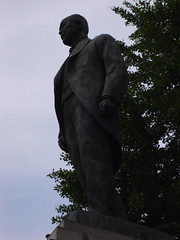
A brief and random tribute to Masaru Inoue, father of the Japanese railways

Masaru Inoue, father of the Japanese railwaysIf you go to the Marunouchi side of Tokyo Station, you can see a big statue of this fellow, Masaru Inoue (井上勝).

Inoue was one of five Choshu samurai sentsmuggled to England in the mid-1860s to figure out how to modernize Japan. He studied railway technology at the University College London, and following his return to Japan served as head of the Japanese national railway program, in some form or another, from 1869 to 1893. During this time he supervised the building of Japan’s first railway line from Tokyo to Yokohama (the first Tokyo station has been reconstructed and can now be seen in Shiodome), and the eventual completion of the Tokaido Main Line between Tokyo and Kobe in 1889.

In his later years he was made a Viscount and served in the House of Peers (sort of the old Japanese equivalent of Britain’s House of Lords). He is also the last “i” in the Koiwai food company, which he co-founded in 1891.

So next time you pass through Tokyo Station, tip your hat to a fellow who helped pave the way for the most awesome railway system in the world. (Or, if you don’t have a hat, do what I do and just take pictures.)

Another Casualty of JASRAC’s Fun Police

I recently came across this sad story in my referrals:

Live music spots are disappearing one by one in Japan!
2006-11
I am a live Jazz fan, and often go to Jazz clubs in my home town. Recently I visited one of my favorite clubs and was informed that live jazz was to be canceled at the end of the month.

I couldn’t believe it, and asked why this was going to happen. The owner replied “JASRAC (Japanese Society for Rights of Authors, Composers and Publishers, equivalent to ASCAP) ordered retrospective fee payments for the last 10 years of the club’s operation. There’s no way I can afford to pay, so I’ve decided to stop live music”. The JASRAC representative then presented a scrap of newspaper with a story reporting a recent lawsuit and subsequent closure of another Jazz club that had fought, and lost, a similar situation. In the end, however, the owner decided to submit to JASRAC’s demands and pay the fees.

JASRAC also refused to negotiate future licensing costs, and stated that a fixed fee must be charged regardless of how many live performances are held. The club could have one live show each week, or a show every day of the year, and the cost would be the same. JASRAC also refuses to reveal how they calculate fees for each club.

In Japan, NHK(National publicly funded television) fees must be paid by all people that own TVs. However some people manage to avoid paying fees, are unaware of fees, or simply slip though NHK’s administrative cracks. When these people are discovered, NHK usually just asks these people to begin payments from the next month onwards. JASRAC, however, demands payments for the past 10 years.

Does JASRAC truly protect the rights of musicians? I often by CDs from musicians playing at live Jazz clubs. I believe live Jazz promotes CD sales and helps artists succeed.

It’s just appalling that JASRAC can nitpick and police even the most minor activities. The hyper-aggressive protection of intellectual property is not just limited to JASRAC, mind you: Johnny’s Talent Agency (the promoters of SMAP etc) fiercely guard their superstars, a practice that leads to odd rivalries and ridiculous news like Takuya Kimura refusing a major movie award for no apparent reason. Disney is also particularly heavy-handed. I read (on 2ch mind you) that Disney once forced a school to remove an image of Mickey Mouse from their pool that was to be used in an event. How can a culture of openness, ambition and imagination flourish when there’s an environment that often punishes even modest forms of creativity?

Dentsu in the News, Part 1: The Good News

Lots of Dentsu-related stories in the pipeline these days. But first, the good news:

* Dentsu reports revenue exceeding 2 trillion yen, but sees slower growth ahead

From Asahi:

On May 11, Dentsu reported 2.939 trillion yen, or a 6.7% boost, in consolidated revenue for the 2006 fiscal year, the first time the company’s total has ever topped 2 trillion. Revenue in the major media (TV, newspapers, magazines, radio) all slightly dropped, but ticket sales for the 2006 World Cup in Germany, which was undertaken by a Dentsu subsidiary, pushed up the total.

Operating profit (which is mentioned last in the Asahi report) grew at a similar pace of 6.9% (30.6 billion yen or approx $1.7 billion). To compare, OmnicomGroup, the largest Madison Avenue ad company, posted $11.3 billion in revenue and $1.5 billion in operating profit.

Revenue in the 4 mass media, which make up 65% of the company’s non-consolidated profits (or 48% of consolidated revenue, which would mean that the Dentsu parent company’s total of 2.169 trillion make up 73% of total Dentsu group revenue), dipped 0.7% to 1.410 trillion yen.

A surprising note in this profit announcement is that Internet ads are not Dentsu’s biggest growth area, as earlier reports from Dentsu might have seemed to indicate. Internet ad growth of 14.8% (21.5 billion yen) lost out to outdoor ads, such as train ads, grew 19.2% (43 billion yen) with the rise of ads coordinated with web content (infrared bar codes, search keywords). Note, however, that these two areas remain small compared to Dentsu’s traditional businesses. However, Dentsu is predicting huge growth in the Internet sector in general, and sees its share in the Net ad market going from a present 15% to 20% by the end of FY 2009.

But the overall outlook for Dentsu is for slower growth, for reasons which an AP’s report goes into more detail about (unsurprising for an article aimed at investors):

Dentsu, the world’s fifth-biggest advertising company behind Omnicom Group , WPP Group , Interpublic Group and Publicis, said growth might also be held back by a wave of mergers among its client base.

The company, whose rivals in Japan include Hakuhodo DY Holdings Inc. and Asatsu-DK Inc., forecast group operating profit to rise 1.6 percent to 63.8 billion yen ($532.2 million) in the current business year to March 2008 on sales of 2.107 trillion yen, up 0.6 percent.

The profit estimate is in line with the consensus of 64.2 billion yen from a poll of 13 analysts by Reuters Estimates, but the forecast for sales growth is decidedly below the expected growth rate of about 2 percent for the Japanese economy.

The seemingly conservative forecast also comes with Japanese corporate profits at a record high.

“We are always told that our forecasts are conservative, but one factor probably at play here is the fading correlation between corporate profits and the economy on one side and growth in advertising spending,” Dentsu Managing Director Setsuo Kamai told a news conference.

Kamai said the trend could be explained by a handful of factors including booming industry consolidation in Japan, which leads to fewer advertisers, and a move by an increasing number of companies to lower costs by combining their brands.

For 2007/08, Dentsu expects its revenues to get a boost from the IAAF World Championships in Athletics Osaka 2007, elections in Japan and the Tokyo Motor Show, but no event on schedule is likely to match last year’s soccer World Cup in Germany.

Dentsu logged strong revenue gains to the information and technology, food and retail sectors, which offset declines to makers of cosmetics and toiletries, producers of home appliances and electronics, and consumer finance firms.

Speaking of profits, Hakuhodo just posted its first loss (due to lower than expected real estate revenue and dips in auto ads and government PR work) since converting to holding company status in 2003. It posted a 2% loss in revenue (1.884 trillion yen) and a 1% loss in operating profits (24.4 billion yen). Bad news for Hakuhodo, good news for Dentsu.

A new president will be leading Dentsu:

Dentsu to name Takashima president
Kyodo News

Dentsu Inc. is set to appoint Executive Vice President Tatsuyoshi Takashima as president of Japan’s biggest advertising agency, while the current president, Tateo Mataki, will become chairman, company sources said Saturday.

He is expected to accelerate a shift in Dentsu’s business base from newspapers and television to relatively new media such as the Internet by continuing the efforts of Mataki, who aggressively concluded capital and operational tieups with startup companies specializing in Net advertising.

Meanwhile, Dentsu is consolidating some of its various Net ad subsidiaries (in the affiliate advertising section [similar to the Amazon Associates program]) to form a more unified strategy:

Dentsu to Merge, Amalgamate Action Clip
May 10, 2007

Dentsu and Cyber Communications (CCI, a member of the Dentsu Group) announced that they intend to merge Dentsu subsidiary Action Clip and CCI subsidiary Criteria Communications.

CCI will continue to exist but will amalgamate the two companies in a cash tender offer. The ban on cash tender offers to shareholders in the case of an amalgamation merger that absorbs the target company was lifted as of May 1.

Action Clip’s affiliate operations will be united with Criteria’s advertisement distribution network with the goal of consolidating the Dentsu Group’s affiliate business.

Japan’s obsolete songs, part 1 of ?

“My Pager Won’t Ring*” the opening theme from a 1993 TV drama series. Thanks to whoever posted it and thanks in advance to the good folks at TV Tokyo for not suing the crap out of me for using their ultra-dated content.

For a more recent technology-centric piece of pop culture, may I direct you to Atlanta rapper TI’s 2005 hit “What You Know” which prominently features “chirping” the two-way walkie talkie function currently popular in US cell phones. I get the feeling it too will seem dated 14 years from now, though the smoothly-epic synth-heavy production will live on forever (as, I suspect, will jokes about “getting a midget pregnant”).

* This literal translation doesn’t quite convey the loneliness implied by the song title. Perhaps a better interpretation would be “My Pager Won’t Ring (And I Miss You)”

FAKE DISNEYLAND IN CHINA

Amazingly creepy! The pandas are going to haunt my nightmares for sure. Video is in Japanese, but you don’t need to understand to get creeped out with the fake Disney characters.

Unfortunately, Shukan Bunshun reports that the extra attention this Bizarro wonderland has gained is causing the managers of the state-run park to cut back on the flashier piracy.