BBC reports on the beginning of a disturbing trend

Satellites to monitor panda sex

Scientists in China plan to use satellites to track pandas to learn more about their sexual behaviour.
A Chinese-US project will use Global Positioning System (GPS) satellites to monitor panda movements in a reserve in remote Shaanxi province.

It is part of an attempt to understand the panda’s poor breeding record.

To summarize-

Stage 1: We us satellites to track the sexual habits of pandas and calculate the best ways encourage their reproduction.

Stage 2: The panda population explodes.

Stage 3: Our panda masters use satellites to watch US having sex.

Lining up

Shelton Bumgarner at the Marmot’s Hole blog quotes from a recent NYT article about how Disneyland Hong Kong has been redesigned to accomodate Chinese culture’s lack of waiting online.

There are, in fact, cultural differences in how people behave while in line, according to social scientists and park designers. Those differences have even led to physical changes in so-called queuing areas at some parks.

Rongrong Zhou, an assistant professor of marketing at Hong Kong University of Science and Technology, said the differences went beyond a Hong Kong-mainland split. Ms. Zhou, who has studied the psychology of queuing in Hong Kong, although not at theme parks, said there was a tendency among Asians and others in more collective cultures to compare their situation with those around them. This may make it more likely that they will remain in a line even if it is excessively long.

(The NYT article is old enough to only be avaliable to Times Select subscribers, which I am not, hence no link.)

When I was traveling in China, my fellow backpacker stumbled across a book, written in English by a Chinese man for a presumably Chinese audience, entitled something like “An introduction to English culture.” This book contained a sentence, now forever emblazoned across my mind, that almost perfectly defined the experience of being a foreigner in China, and perhaps of being a Chinese abroad.

“In England there is a phenomenon known as queueing.”

What more needs to be said?

Shelton also notes that Koreans seem to have no trouble with waiting on line. I can attest that the same is true of Taiwan, one of the many cultural differences between this island state and its parent continental nation. Perhaps waiting on line is, like removing ones shoes when entering a private home, a habit picked up from the Japanese during the 50 year rule?

A Zen koan

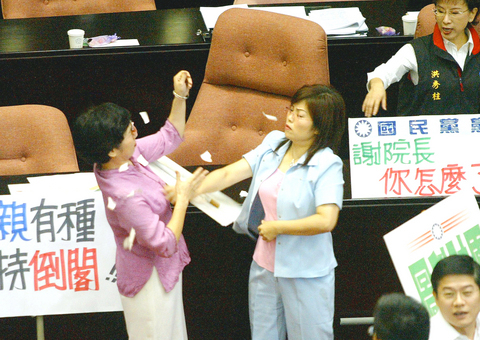
If a country elects their legislature through free and fair elections, but they spend their sessions physically fighting each other and don’t actually pass any bills, is the country still a democracy?

Photograph and caption from the Taipei Times:

DPP Legislator Wang Shu-hui, left, attacks KMT Legislator Kuo Su-chun, right, after Kuo tore up a copy of Premier Frank Hsieh’s policy report that he was scheduled to deliver yesterday at the opening of a new sitting of the legislature.

Oh, and please, please don’t refer to Taiwanese politics as ‘kabuki.’

As if good taste wasn’t enough of a reason to avoid cosmetic surgery

The Guardian reports that an investigation by their reporters has discovered evidence that tissue from executed Chinese convicts is being harvested for use in collagen (injected into lips to make them puffier) and other biological products used in cosmetic surgery.

Agents for the firm have told would-be customers it is developing collagen for lip and wrinkle treatments from skin taken from prisoners after they have been shot. The agents say some of the company’s products have been exported to the UK, and that the use of skin from condemned convicts is “traditional” and nothing to “make such a big fuss about”.

Of course, this may seem like a horrific and inhumane practice, reminiscent of the most profane and perverted practices of the Nazis, and yet there is probably a small segment of the population who would actually be more likely to buy implant tissue harvested without permission from executed Chinese prisoners.

International jockying across the Taiwan Strait reach a new level of silliness


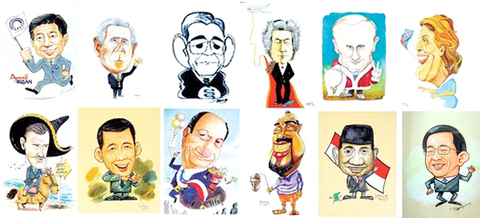
The cartoon figure of President Chen Shui-bian (陳水扁) has finally been granted permission to appear in the exhibition to celebrate the upcoming Asia-Pacific Economic Cooperation (APEC) summit in Busan, South Korea, thanks to the efforts of officials from the Taipei Mission in South Korea and the Busan Cartoon Club.

The cartoon figure of Chen was put on display yesterday at the APEC Summit Cartoon Figure Exhibition in Busan City — the venue of this year’s annual event — along with those of other heads of state slated to attend the APEC summit in November.

Did you know that North Korea has an animation industry?

Uniting the Two Koreas, in Animated Films at Least (NYT)

“North Korean animators are excellent,” he added. “They learn quickly and work very hard.” The SEK animation studio in Pyongyang, the North Korean capital, which did the animation, has been involved in an array of international productions since the late 1990’s.

[…]

Mr. Shin has not finished working with North Korea, though. He said that both North and South Korea have agreed to produce his next project: a six-part animated series on Goguryeo, an ancient state that once occupied the northern half of the Korean Peninsula and much of Manchuria about 2,000 years ago. China recently created a furor in Korea when it claimed historical ownership of Goguryeo.

While South Korea is well known as a source of low-end cell drawing and inbetweening contractors for Japanese and American animation studios, the number of creative productions coming from that country has been dismally low. Despite being a fairly big animation fan, I have only seen a single long piece, a beautifully drawn film called Oseam, and a few shorts. Why after all these years is Korean animation so undeveloped? Why haven’t they benefited from this so-called ‘Korean wave’?

Be careful what you say about kimchi in Pyongyang

Be careful what you say about kimchi in Pyongyang

By Nopporn Wong-Anan Wed Aug 31, 5:40 AM ET

PYONGYANG (Reuters) – In
North Korea, it may be a crime to speak ill of the Dear Leader, but visitors are also advised not to badmouth the beloved national dish.

“Kimchi can prevent
SARS and bird flu,” a North Korean official told reporters at a dinner in a state-owned restaurant in Pyongyang, urging them to spread the word around the world.

Kimchi, typically radish or cabbage that has been packed with garlic, ginger and hot pepper and then pickled, is a staple on both sides of the divided Korean peninsula.

Although kimchi has been said to prevent bird flu and SARS, cure the common cold, prevent certain types of cancer and improve the skin, few of the claims have a scientific basis.

That meant nothing to an official guide escorting a group of Thai journalists travelling with Thai Foreign Minister Kantathi Suphamongkhon on a recent visit to the secluded Communist country.

Asked by one journalist how he knew the SARS and bird flu claims were true, the guide — who gave his name only as “Mr Kim”, answered in an angry voice:

“Where were you? I don’t understand why you never knew this information. Everybody in North Korea knows about it.”

North Korea had an outbreak of bird flu at poultry farms in Pyongyang earlier this year.

ALL HAIL THE LEADER ETERNAL

Other questions agitated the guide.

A journalist working for a Japanese news agency wondered aloud if North Koreans used “Ajinomoto” — a Japanese brand name for monosodium glutamate seasoning — in kimchi to make it so tasty.

“What do you mean?,” Mr Kim asked. “You said a Japanese word. We live in Korea and we only eat Korean food.”

North Korea’s official media roundly criticises Japan, the former colonial overlord of the Korean peninsula which was divided into North and South at the end of World War Two.

North Korea has stayed isolated since the split in the spirit of its national ideology of “juche”, or self-reliance, and is now feared by the international community to be building a nuclear weapons programme — the subject of so-called six-party talks being held on and off in Beijing.

Propaganda about North Korea’s leaders and the Communist revolution is part of life in the state. It assails visitors arriving at Pyongyang airport and thrusts itself from fields and roads on billboards in the countryside and from state television.

In fact, propaganda is launched at visitors before they even get out of the plane. Soon after touchdown, the plane’s speakers lauded Kim Il-sung — North Korea’s founding Great Leader, Father Leader and Eternal Leader — and his son, Dear Leader Kim Jong-il.

Billboards plastered with slogans are everywhere, from the government’s reception hall to paddy fields along highways.

“Long Live the Dear Leader, Kim Jong-il!” reads a group of billboards, each carrying a Korean syllable, erected in the middle of a paddy field outside Pyongyang.

Another row of billboards on a grassy foothill read: “Whatever the party decides, we will do it!”

When asked who put up the billboards, Mr Kim consulted a colleague, then said: “It is the people who put up those signs themselves.”

The visit by the Thai foreign minister was timed to celebrate 30 years of diplomatic relations between Thailand and North Korea. Foreign journalists rarely visit and are closely supervised when they do.

Media Executives Court China, but Still Run Into Obstacles

August 29, 2005
Media Executives Court China, but Still Run Into Obstacles
By GERALDINE FABRIKANT

In June, Yu Youjun, the executive deputy governor of Hunan Province, came to lunch accompanied by 16 dignitaries at the home in Beverly Hills of Sumner M. Redstone, the Viacom chairman.

Viacom, like many other American media companies, is already active in China. Its MTV network is carried in 10 million homes in Guangdong Province. Two-hour blocks of Nickelodeon programming like “CatDog” and “Wild Thornberries” are beamed on the government-run CCTV to more than 120 million homes.
Continue reading Media Executives Court China, but Still Run Into Obstacles

Korean president “really jealous” of PM Koizumi’s ability to “gamble”

Asahi Daily, August 24, 2005, 8:23pm:

“I am so jealous of how Prime Minister Koizumi was able to take the gamble of dissolving parliament for the sake of reform,” South Korean president Roh Moo-hyun revealed on August 24th to a reporter on the presidential beat.

While the Korean president controls both the national government and international diplomacy, he is prohibited from uniting with any political party. His term is limited, and he has no power to dissolve the parliament. Invoking Prime Minister Koizumi’s situation, he fumed about how due to the inability of the ruling and opposition parties to work together, attempts at reform have stagnated.

“What the hell is the president of Korea? I can’t even risk my party or my job,” he whined, while expressing his desires. “A great flood can sometimes change the course of it’s own river. I want to make fundamental changes in the political structure and culture [of South Korea].”

North Korea: Underground Republic

I just spotted this great five-month old article on the Daily NK website. Written by a defector from North Korea, it alleges to describe Kim Jong Il’s various offices, secret facilities, and homes around the country.

Kim Jong Il founded a special military engineering unit and proceeded the underground facility project for the past several decades. For this reason, North Korea probably has the best skill to dig underground in the world.

North Korea is “Underground Republic”

The subway in Pyongyang was built mostly between lithosphere about 80m to100m underground. However the underground road for Kim Il Sung and Kim Jong Il were built much deeper underground than the subway. By building underground facilities, Kim Jong Il is able to create fear in the society while making economic profit by exporting tunnel digging skills to the countries with ties in preparation for both the conventional and nuclear wars.

The outstanding achievements of the underground facilities is the residences and chalets for Kim Jong Il. In case for the exhibition, the residence contains basic equipments and all the residents and chalets, including the inner facilities of the chalets, are connected to each other.

Reading this piece there are two things that strike me. First, how awful it is that Kim Jong Il has raped his own country, exploiting his people and every resource they possess to build such a large number of these ludicrously extravagant structures for nothing but his own personal amusement. He easily puts Saddam Hussein to shame in this department.

The second thing that strikes me also allows for comparison with Saddam Hussein. Everyone remembers how pathetic Saddam’s defenses really were, how quicky his army and government collapsed, and his ignonimous capture hiding out in a little hole in the ground.

Read the following description of North Korea’s underground battle HQ and then try and imagine how a war against North Korea would compare with the recent one against Saddam Hussein’s government. (I’m not even going to mention the ongoing war in Iraq, which I would consider a separate campaign.)

Youngsung 21 Complex

This is North Korea’s “underground wartime headquarter.” In case a war breaks out, the Supreme commander unit, bureaucratic department, commanding department, worker’s party unit and other departments are to be stationed together at this place. In case of a nuclear war, (it is known to have) the walls built with iron rods and concrete covered with lead will protect the headquarter. They facility was completed in 1983.

There are numerous military units to protect the headquarter stationed around the building in possession of mass scale conventional weapons. The size of the lot is about as big as a block in North Korea, and there are enough of supplies for the headquarter to survive for ten years without any outside contact.

The headquarter complex is connected to the main chalets and has a subway of its own, which are all connected with the underground tunnels. It is also connected to the Jamo Mountain Chalet in Sunchun-gun, which is located about 40km away from Pyongyang.

If, as President Bush must fantasize as he gently rocks himself to sleep at night, we actually did invade North Korea, the chances of humbling Kim Jong Il as Saddam was humbled seem most remote indeed. In fact, I imagine that everything that has happened (and will happen) in Iraq, as bad as it is, is nothing compared to the devastation that would result from any war involving North Korea.

For those who don’t know much about the Great Generallisimo Kim Jong Il, let me refresh your memory with this manga profile I translated from Japanese some time back.