OK, so I had a dream with this insane concept for a movie

I have lunch with Roland Soong and his Chinese girlfriend (petite, bubbly voice, intelligent) at a Chinese restaurant in a Japanese city (Osaka?). We discuss poverty in Japan and China and I mention something about a black underclass in Japan. We discuss other really intelligent things and then go and take some kind of weird water ride that’s kind of like underwater paddleboats. The end of the ride deposits us in a huge pond where this funny white guy is splashing everyone.

Then we walk outside the building, which was white with this glass exterior. I have a thought that I really like it when people have toothy grins and the reason I don’t like people sometimes is just because their smiles are a little off, or really just not toothy enough.
Continue reading OK, so I had a dream with this insane concept for a movie

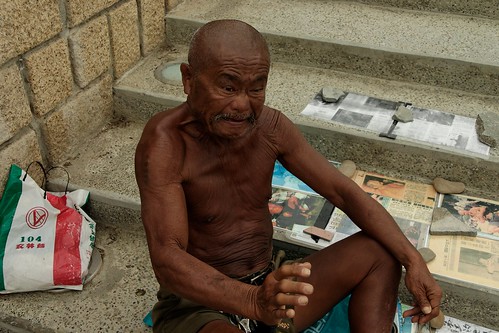
The Kung-fu Master [photo]


Zhanghua, Taiwan February 16, 2006

He sits on the steps leading up to the giant Buddha of Zhanghua, which was the largest Buddha in the world until Hong Kong built theirs at Tian Tan. Laid out on the ground around him are old, laminated newspaper articles about him when he was younger. As visitors to the temple come up the stairs, he strikes a pose for them, but few even look at him.

Straight from the Horse’s Mouth: METI Explains Stance on Secondhand Game Consoles

It’s amazing how fast misinformation can spread. Despite our best efforts to the contrary, people seem to be accepting at face value Akihabara News’ mistaken claim that the Japanese government is about to ban its thriving used video game electronics market. Though some consoles will be banned without proper certification (contrary to what Roy indicated, Sega fans might be screwed!), the truth is that no comprehensive ban is forthcoming. We at Mutant Frog Travelogue intend to set things right.

The only source that Akihabara News cited in the post is this Japanese government Q&A regarding the provisional measures to the Electrical Appliance and Material Safety Law, which regulates the safety of old electronics, electric appliances, etc. by instituting an inspection system.

On the top of the Q&A page it states in big letters (paraphrased since the Japanese is kind of awkward): The items that were given a 5-year grace period in 2001 when the law came into effect will come under regulation starting in April 2006.

Below that is a table outlining what kind of labelling will be required of which types of electric/electronic goods. The items that will come under regulation this April are listed as follows: “Electric refrigerators, electric laundry machines, television receivers, electric musical instruments, audio equipment, gaming devices, etc.”

GAMING DEVICES?! My guess is that Mr. Akihabara News must have panicked at this point and typed up his post immediately to warn people.

But if you glance down at Question 4, you’ll find this (provisional translation):

Q4. Will the sale of all secondhand electronics no longer be permitted?

A4. It is not the case that one will no longer be able to sell all secondhand electronics.

The Electrical Appliance and Material Safety Law does not designate all electronics. If an electronics product is not designated in the Electrical Appliance and Material Safety Law, then it is not subject to the regulations of the Electrical Appliance and Material Safety Law.

For the electronics products that are designated in the Electrical Appliance and Material Safety Law, it is possible to sell them the same as ever if the new labels are included.

(snip)

Even if an item is on the list, such as electronic musical instruments, audio equipment, gaming devices, etc., the console/body will not be subject to the regulations if it receives its power supply via a removable AC adapter (AC adapters are subject to the regulations with a 7 year grace period (ending on March 31, 2008).

End of story, right? Well, I hate to tell you this, but the scenario is apparently not as rosy as the government would have you believe.
Continue reading Straight from the Horse’s Mouth: METI Explains Stance on Secondhand Game Consoles

Images of Taipei 101 now restricted


The Taipei Times is reporting that “Taipei Financial Center Corp (TFCC), owner of Taipei 101, said it will start charging companies for any commercial usage of the image of the world’s tallest building in a bid to protect its trademark.”

Last year alone, TFCC found over 1,000 cases of other companies using Taipei 101 as a promotional tool — mostly in real estate advertising — that could potentially mislead consumers, Wei said.

As a result, TFCC decided to charge royalty for any commercial use of the building’s image. For example, a poster featuring the Taipei 101 tower will be charged NT$100,000 (US$3,099), Wei said.
[…]
Use for the government and public is free of charge, Wei said.

The decision drew the ire of advertisers and TV producers, as other major landmarks around the world, such as the Empire State Building in New York City and the Eiffel Tower in Paris, have no such charges.

Unfortunately, the last statement seems to be only half true. In a clever manuever, photographs of the Eiffel tower itself are not copyrightes, but in 2003 a new lighting display was installed. Since the design of the lights is copyrighted, photographs of the lighting disaply are as well, which by extension means any photos of the Eiffel Tower at night.

As a result, it’s no longer legal to publish current photographs of the Eiffel Tower at night without permission. Technically, this applies even to amateurs. When I spoke to the Director of Documentation for SNTE, Stéphane Dieu, via phone last week, he assured me that SNTE wasn’t interested in prohibiting the publication of amateur photography on personal Web sites. “It is really just a way to manage commercial use of the image, so that it isn’t used in ways we don’t approve,” said Mr. Dieu.

It may be some minor comfort that owners of iconic buildings such as the Eiffel Tower or Taipei 101 claim that they won’t prosecute non-commercial infringers, but the fact is that there is nothing stopping them from being a nuisance to anyone that publishes such a photo, even on a personal blog like this one. Does anyone really think that laws allowing for these kinds of restrictions are reasonable? I can’t wait for 2012 (to be optimistic) when security teams are stealing cameras from tourists snapping photos of the new “Freedom Tower” at New York’s World Trade Center.

Great news photo

From the Washington Post home page.


Mongolians ride past the limo that carries Bush during his historic presidential visit to their nation. (AP)

I was kind of miffed they don’t have a larger version of this photo. I’d also like to see the rest of the scenario play out, with the Mongolian Hordes overrunning the limousine.

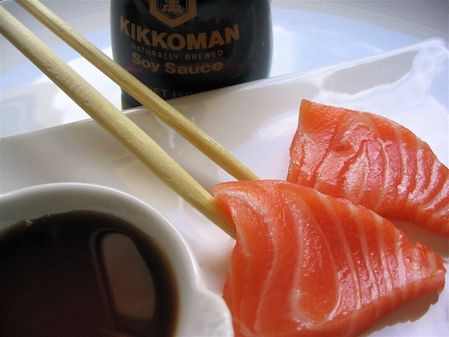
But, I like sashimi!

My translation of a Nikkeinet article.

I even like sashimi” Taiwan’s KMT party secretary denies being “anti-Japan” to media

“Reports that the KMT walks lockstep with the mainland (China) in their anti-Japan campaign do not reflect my real feelings. I even love sashimi!” On the 10th Ma Ying Jiu (mayor of Taipei), chairman of the KMT[Chinese Nationalist Party], Taiwan’s largest opposition party, assembled Japanese reporters resident in Taipei and issued a denial of the viewpoint that he was himself a believer in anti-Japan ideology.

There are indications that the KMT has been intensifying their anti-Japan tendencies, such as stressing their own role in the Sino/Japanese war. “We criticize even the white terror (of KMT despotic rule) and (China’s) Tainanmen incident from the same basis of human rights and constutituional government. There’s no reason to make an issue out of only Japan,” Chairman Ma Ying Jiu said.

However, “I do not approve of Prime Minister Junichiro Koizumi’s Yasukuni Shrine visits,” he said, not forgetting that stab in the neck. Ma Ying Jiu is currently considered the favorite to win in Taiwan’s next presidential election.

Doesn’t the “but, I like sashimi defense” have the same ring to it as, “but I have so many black friends” or “but Jews are so funny”? I’m amazed that this is the best that Ma could come up with.

China angry over Japan’s arms trade

Younghusband pointed out this brief news article related to my earlier post.

BEIJING — A Chinese newspaper and the Japanese Embassy in Beijing are in dispute over coverage of Japan’s firearms exports. The dispute was triggered by an illustrated, full-page Jan 17 article in Elite Reference, a newspaper under the China Youth Daily, that Japan exported $65 million worth of arms in 2003, becoming one of the world’s top eight arms exporters.

The article, titled “Examining the Reality of Japan’s Military Spending,” said that in 2001 Japan exported $55.7 million worth of bombs, hand grenades and other arms, mostly to the United States. Embassy spokesman Keiji Ide visited the newspaper’s offices in Beijing on Jan 19 to meet the reporter, Qiu Yongzheng, question his sources and challenge some parts of the article.

Ok, I know that Japan exports handguns under the claim that they are sports equipment and not actual “arms,” but bombs and hand grenades? Is there any truth to this whatsoever? Keep in mind that the report comes from Chinese state media, not widely knows as the most reliable source.

FDI in Japan (Part I)

My previous post on possible linkages between the Livedoor scandal and Foreign Direct Investment in Japan got me curious about the latter topic, so I did a little reading over the weekend.

I started with last year’s report by U.S.-Japan Business Council on expanding FDI in Japan. This is a fascinating and surprisingly easily approachable document that I strongly recommend to anyone with an interest in investment issues is Japan.

Below are a few of the more interesting points from the report, along with some graphical illustrations I worked up using data from the United Nations Committee on Trade and Development’s annual World Investment Report, and the Ministry of Finance‘s on-line FDI data.

Japan’s inward FDI falls well below international standards:

At 2.1% of GDP, the accumulated foreign direct investment (FDI) in Japan is much less than the average of 20% for all developed economies, and G-7 economies such as the United States (14%), Germany (22%), and the United Kingdom (37%).
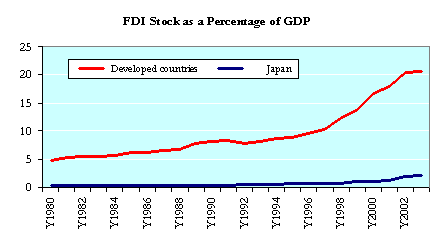
In spite of the quantitative difference, the composition in terms of type of investment is very similar to other developed countries:

According to the OECD, over 70% of the FDI in developed economies takes place via Mergers and Acquisitions (M&A), transactions in which one company acquires a whole or partial ownership stake in another. Japan is no different. Over 70% of FDI in Japan since 1997 has been through M&A.

Still, Japan still falls far behind the pack in cross border M&As.
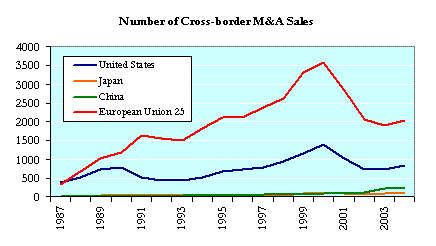
Furthermore, a large number of these M&As share a similar characteristic:

Where most of these Japanese/U.S. and U.S./EU transactions can be characterized as “friendly” transactions, most foreign acquisitions in Japan are cases in which U.S. or European firms acquired stakes in financially troubled Japanese companies. The Japanese companies generally agreed to be acquired only because they needed capital to survive.

Regular readers of Japanese news are probably already aware of some of these cases. Two biggies named in the report are Renault/Nissan and Long Term Credit Bank/Ripplewood Holdings.

In spite of these sucessful cases however, attitudes towards FDI in Japan are slow to change:

Japanese attitudes are much like they were in the United States in the 1980s. While foreign companies are much more prevalent now, there is still much uncertainty and suspicion about – and some outright hostility toward – FDI among politicians, the private sector, and the public, particularly with regard to M&A and distressed asset purchases.

To avoid generalization however, it should be noted that not everyone in Japan shares this ambivalence towards FDI:

There are some positive steps being taken by the Government of Japan, particularly METI and JETRO, to overcome this legacy and promote FDI in Japan. Most positive of all, of course, is Prime Minister Koizumi’s January 2003 goal to double FDI in five years, as this for the first time put the government squarely behind the goal of increasing FDI.

Advisory groups such as the Japan Investment Council (JIC) and the Invest Japan Forum (IJF), have also issued reports recommending ways to encourage FDI in Japan.

Nor is ambivalence towards FDI a uniquely Japanese characteristic. I’m sure most readers will recall the fuss Cnooc caused last year when it attempted to purchase the U.S. energy firm Unocal. (Not to mention the Japanese purchases of Pebble Beach, Rockefeller Center, and Columbia Studios in the 1980s.)

Part II of this post will examine why all of this matters.

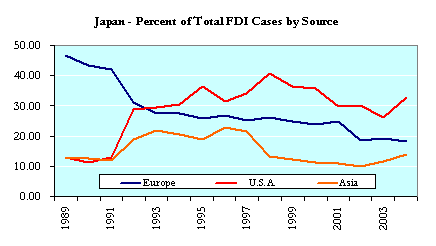
p.s. I really couldn’t figure a way to work this graph into the post, but since I already made it I may as well append it here. This is a breakdown of investment by the three largest global economic regions.

Jenkins Update


I still need to read his Confessions memoir, but I suspect it’s pretty juicy. Here’s a quick update on what he’s been up to:

Jenkins: DPRK targeted Soga

Shigefumi Takasuka Daily Yomiuri Staff Writer

Charles Jenkins, a U.S. Army deserter to North Korea and husband of Hitomi Soga, a repatriated Japanese abductee, said Thursday that North Korean agents targeted Soga and waited a month to get a chance to kidnap her.

He said he was planning to apply for Japanese citizenship in July.

“I am planning [to become a Japanese],” he said. “What happened is I must wait for one year since the day I got my Japanese identification card. That’ll be July, I think.”

He also said he had been asked by a local tourist association in Sado to work as a tour guide during the summer.

“I think I’ll do that,” Jenkins said.

Asked if his book “Kokuhaku” (To Tell the Truth) would be published in countries other than Japan, Jenkins said he hoped so. “Maybe in the Korean language,” he said. “But it’s not definite yet. I’ll wait and see.”
(Feb. 3, 2006)

Come on, print an English edition! We all know it was originally written in English anyway. Are you afraid of unkind reviews in the New York Times, Jenkins? You can’t spend your whole life running away, you know.