PSE Law update: Call for comments

You may remember the April 2006 flap about a law in Japan that bans the sales of a whole slew of used electronics, such as the original Playstation and used musical instruments, unless they could be tested to earn a seal proving their electrical safety. In response to massive protest from musicians and secondhand retailers, the relevant ministry, Ministry of Economy, Trade, and Industry (METI), came up with a stopgap solution – allow and assist dealers in performing the tests themselves – that would supposedly. help ease the burden on the “recycle” industry. I, lacking the intuition to know a half-baked compromise idea when I see one, declared METI’s bone-throw along with other loopholes in the law to have “thoroughly declawed” the painful aspects of the PSE Law.

However, a recent survey conducted by the “Japan Reuse Association” indicates the following:

  • 47% of secondhand electronics retailers have stopped selling affected recycled goods that don’t already have the PSE mark;
  • 33% are inspecting and affixing the PSE stickers themselves;
  • 6% are making use of a “rental” scheme in which buyers of affected goods sign a rental contract for the goods but never actually have to return it and pay a rental fee equal to what would have been the purchase price; and finally,
  • 6% are ignoring the law and selling affected goods as they always have.
  • So regardless of METI’s attempt to ease the transition, if this survey is correct the new regulations are significantly harming the industry, and by extension, consumers. In that sense, the “assistance measures” taken up by METI seem to have had only limited effect.

    So to get the real scoop, here’s what I want to know from you: is this what it looks like on the ground? Can one easily buy old Playstations/Dreamcasts/Saturns etc at the “recycle” shops in Japan?

    Now keep in mind this survey came from an industry group chaired by a Mr. Koichiro Ogawa, a secondhand “wholesaler” and former chair of the “Association to Consider the PSE Issue” who was quoted in many articles during the PSE scare. The group was founded specifically to try and get the law amended so that it makes sense.

    Allow Japanese nukes?

    Washington Post columnist Charles Krauthammer has a silly and misinformed column arguing that the US needs to allow Japan to arm themselves with nuclear weapons to protect against North Korea. Right. The nuclear weapons program that Japan has been longing for all these years and has only refrained from starting because of US pressure.

    Japan is a true anomaly. All the other Great Powers went nuclear decades ago — even the once-and-no-longer great, such as France; the wannabe great, such as India; and the never-will-be great, such as North Korea. There are nukes in the hands of Pakistan, which overnight could turn into an al-Qaeda state, and North Korea

    I’m frankly surprised at how bad his reasoning is in this column, how much it sounds like the writing of an enthusiastic but narrowly informed freshman in Poly-sci class.

    The fact of the matter is that Japan does not have nuclear weapons because the Japanese population is almost unanimously opposed to the idea. Yes, a couple of higherups in the LDP have suggested the idea of maybe talking about considering discussion of the issue, but quite frankly I cannot think of a better way for them to finally start losing elections seriously than to make the acquisition of nuclear weapons part of their official party policy.

    His last paragraph is particularly absurd.

    Why are we so intent on denying this stable, reliable, democratic ally the means to help us shoulder the burden in a world where so many other allies — the inveterately appeasing South Koreans most notoriously — insist on the free ride?

    This is a mind boggling reversal of reality. Yes, South Korea has been friendly to North Korea. (Unlike some people they actually have to live next door to the crazy man with the gun, which suggests a different perspective from the other side of the Pacific.) But they also have a draft for all adult males, which can hardly be a free ride. Not to mention that fact that South Korea actually DID have a program to develop nukes a couple of decades back, which the US forced them to abandon.

    On the other hand, Japan actually DID have a long-term policy of insisting on a free ride. Following the end of the US occupation, the US actually tried to persuade the Japanese government to abandon the principle of pacificism that the US had forced on them only a few years before, and rebuild their military so that they could participate in the Korean war. Japan refused to have even a token military for many years, using the pacifist constitution as an excuse to keep from spending any national resources, capital or human, on military or weapons-a policy that was partly responsible for the country’s fantastic industrial development.

    Cold economics were of course not the only reason for Japan to keep from investing in a military for so long. After the disastrous defeat of World War II, culminating in the only use of a nuclear weapon so far, were was also a widespread belief that war was a failed strategy for national success, and that lesson has over the decades transformed into a very strong and nearly universal value of national pacifism.

    I see political campaign posters every day calling for the protection of the pacifism clause of the constitution (Article 9), and anti-war and especially anti-nuclear messages are more common and mainstream here than in any other country of which I am aware. In fact, I have never even seen a public protest or demonstration in Japan that did not include that message in some capacity.

    I think this comment left by some Japanese person on the Washington Post site says it well.

    Get a grip Charlie. While there is an active right wing here of course, the majority in this country where I live is so opposed to nuclear weapons that it would defy your comprehension. Many people here would simply choose non-existence total elimination of both the nation and state of Japan over nuclear weapons possession, let alone use. The Japanese government would run out of fire hoses to put down the demonstrations. Calls for a nuclear Japan are still very premature, and indicate a lack of familiarity with the culture. It aint gonna happen anytime soon.

    I think the bit about choosing “non-existence total elimination of both the nation and state of Japan” is frankly over the top, and if Japan were faced for some reason with a genuine war they would came around to full acceptance of their military, but not as things stand now.

    Japan’s best offense is their lack of capability for offense. Yes, North Korea distrusts Japan more than anyone, but even they know that Japan is bound by their constitution, laws, and tradition not to use their military for combat purposes unless they are attacked first. North Korea does have to worry about the very real (if unlikely) threat of military action on the part of the US, South Korea or even China, but as long as they do not attack Japan first, Japan is no threat to them-and that more than anything else is what keeps Japan safe today.

    [Addendum]: I should have mentioned that the policy of specifically relying on US military protection and instead developing the industrial economy is not a theory of mine, but the Yoshida Doctrine, named after the postwar Prime Minister Shigeru Yoshida , who was incidentally Aso’s grandfather.

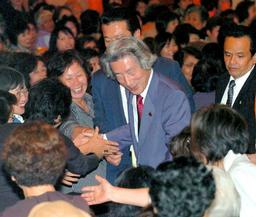
    We still miss you Koizumi!

    Koizumi post PM stump speech 200610160287.jpg
    Koizumi has made his first public speeches since leaving office in support of LDP bids for office in two simultaneous by-elections to be held this Sunday in Kanagawa and Osaka Prefectures. I’m not all that interested in the races, since they both seem to be swinging LDP, it’s great to see the man’s face again.

    Unfortunately, it looks next to impossible to get a full version of this speech. TV stations seem to only have carried parts of it, the online news sites don’t seem to be carrying it, Koizumi doesn’t have his own website, and the LDP’s site hasn’t uploaded it yet, if they plan to at all. Japan does have something like America’s C-Span, but it’s an extremely minor channel that very few Japanese people receive.

    And yes I checked YouTube as well, but it wasn’t there. Thankfully I found some sweet footage while I was looking:

  • A Koizumi anime outlining some highlights of his administration, such as his style in selecting cabinet members and bringing his own boxed lunch to the historical summit meeting with Kim Jong Il – even Abe looks interesting when animated!
  • A TV clip reporting on a magazine article in Shukan Post that Koizumi moved out of the PM’s official residence the next day after the LDP presidential election, stayed in a 520k yen per night hotel room, only to move into a meager 50k yen/night room immediately after stepping down as PM. He brought dozens of classical music CDs with him, said he’d take a year to “recharge” and is enjoying a “leisurely retirement.” Meanwhile, Yoshiro Mori, Koizumi’s predecessor, has increased his political wheeling and dealing and is rumored to have a great influence on Abe. Mori had pledged to step down as his party faction’s chairman when Koizumi left, but apparently since Abe will do whatever he says, leading the faction is just too “fun” to quit. Despite Abe’s pledge to go it alone when deciding on a cabinet, Mori leaked to the press that he had a sit-down with Abe to discuss his new administration. The rumors are
  • And last but not least, a great retrospective of what made Koizumi rock – the photo ops. Watch closely to see Koizumi in a Guardian Angels uniform, with beret!
  • Deconstructing an alleged compliment

    Bush administration White House Press Secretary Tony Snow was quoted in the NYT as describing his boss (George W. Bush, for the dim) like so:

    “He reminds me of one of those guys at the gym who plays about 40 chessboards at once.”

    In my experience with gyms, there is in fact noone there playing 40 chessboards at once. Now, there are chess geniuses who can manage such an incredible feat, but they don’t go to the gym to do it. In fact, I would even go so far as to say that someone wanting to play 40 games of chess at once who thought that the proper venue for such an event was a gym is probably an idiot.

    I am reminded of the episode of The Simpsons, in which Bart plays a dozen games of chess, blindfolded, simultaneously. Onlookers are briefly astonished. Bart loses every match.

    Quick note on the NK Nuke Test

    Go read about the test elsewhere (“Fundamentally changes the landscape” is a good one as well as Washington Post’s just-the-facts coverage), but I just have one thing to say that I’m sure the news reports won’t focus on:

  • NK’s July 4 missile tests: rained on America’s Independence Day
  • Monday’s nuclear test: Screws up Columbus Day in the US and Sports Day in Japan.
  • Both were long weekends, both incidents required top US leaders to wake up in the middle of the night.

    Exploding an in-your-face nuclear bomb just isn’t enough for Kim Jong Il, he’s so evil he won’t even wait till the US has had its morning coffee! Well, I’m sure the government pays overtime for whatever non-exempt employees have to respond.

    Update: One country’s interrupted holiday is another’s celebrated holidays:

    UPDATE 7: Why today, you might ask? Well, Korean-language Money Today suggests that because today—Oct. 9—falls between two holidays in Korea: the anniversary of Kim Jong-il assuming the position of Korean Workers Party general secretary ( Oct. 8 ) and the anniversary of the founding of the Korean Workers Party ( Oct. 10 ).

    Ibuki seeking to further dehabilitate young minds

    According to this report by Debito, new Education Minister Bunmei Ibuki is opposed to English in the elementary school curriculum.

    The reasoning is that Ibuki (as do many conservatives) believe that students’ Japanese language abilities are going down. They should work on their native language, hone that to a good level, then work on English. Studying a foreign language at such an early age a) apparently confuses the kids, and b) takes class time away from good, honest study of our language.

    Now, check out this translated quote from the Japan Times:

    “I wonder if (schools) teach children (the) social rules they should know as Japanese,” Ibuki said. “Students’ academic abilities have been declining, and there are (many) children who do not write and speak decent Japanese. (Schools) should not teach a foreign language.”

    No wonder he hates English–he wants kids to speak nice hazy traditional Japanese, where sentences have no subjects. It’s very handy for imperial mind control when you never have to say who’s doing something!

    Anyway, everyone should have to study a foreign language, even if they never plan to actually use it. Learning another language changes the way you view your own language. Every time you have to translate a sentence, you gain a deeper understanding of the grammar and vocabulary of your own language. Of course, it might also dilute your language with random foreign jargon, but what’s the real harm in that?

    (Fun fact: The name “Bunmei” means “civilization.” You know this guy must have had some weird parents.)

    The value of apology

    Letter to the Mainichi Shimbun:

    The “three principles of love” proposed by an organization called the “National Husbands’ Advisory Association”—if you don’t want your marriage to end in divorce, you should say “I’m sorry,” “Thank you” and “I love you” without fear, hesitation or embarrassment.

    If North Korea doesn’t want to be estranged from the international community, it should at least try following principle number one.

    Hey, if apologies let you get around immigration law, maybe they’ll let you get around international law, too!

    I know you’re busy, Mr. Abe, but…

    Update your website!!!!

    abe_top.jpg

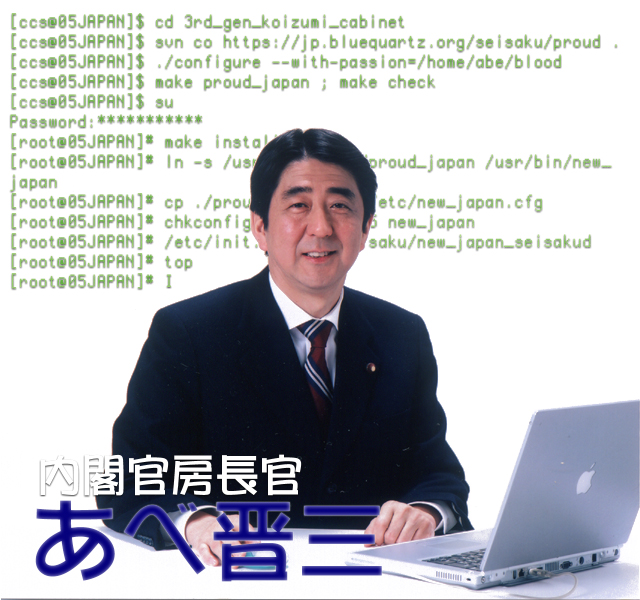
    (As of the evening of Oct 2, Prime Minister Shinzo Abe’s website still indicated that he was still Chief Cabinet Secretary and was still trying to use some sort of DOS prompt to “./configure –with-passion=/home/abe/blood”. Blood?)

    Hopefully his people are just too busy gearing up to make Abe the first world leader to offer a regular podcast… or a mixi profile?

    LIVE BLOGGING of the Abe questioning

    Japan’s new PM Shinzo Abe is in the Diet today answering questions fomr Diet members on his policies. You can watch the proceedings now here (in Japanese). Abe just said to the effect:

    There was a question on the enshrinement of Class A War Criminals at Yasukuni Shrine. On the topic of Class A War Criminals, there are many opinions on each side so I don’t think it would be appropriate for the Japanese government to comment one way or the other on the matter.

    Pardon my ignorance, but doesn’t the Japanese government generally respect the results of the Tokyo tribunals? I’m interested to see what the press has to say (if anything) on Abe’s comment. More likely, they will comment on what he said next, which is that he still refuses to comment on whether he himself plans to visit the shrine.

    UPDATE: The video of the questioning is now available.

    Here’s what he said:

    There was a question on the responsibility as national leaders of the so-called “Class-A war criminals.” Regarding the responsibility for the last great war, there is a variety of opinions, so I feel that it may be inappropriate to make detailed, sweeping comments as a government [on this issue]. Whatever the case, our nation accepted the judgments of the Tokyo tribunals based on Article 11 of the San Francisco Peace Treaty, so I believe that in state to state relationships, the Government of Japan is in no position to raise any objections regarding this judgment.

    His explanation is almost an exactly lifted from the foreign ministry’s explanation of the issue:

    The Government of Japan acknowledges that there are various arguments regarding this judgment. However, Japan has accepted the judgment of the IMTFE under Article 11 of the San Francisco Peace Treaty. Therefore, in state to state relationship, the Government of Japan believes that it is in no position to raise any objections regarding this judgment.

    Isn’t that cheating? I thought this was a man with strong opinions!

    One other interesting development during the questioning: Abe screwed up, if only a little bit. DPJ member Takaaki Matsumoto asked the PM whether Abe’s reference in his Friday inaugural policy speech to “research” what situations would allow for collective defense by Japan meant that the “quite detailed” constitutional interpretations by previous governments would be changed. In response, Abe repeated what he said last week: He will research into what kinds of circumstances would allow Japan to exercise collective defense, founded on previous constitutional interpretations and Diet debates, and “focusing on actual situations that could occur.” According to Abe, there is a need to look into this issue due to “increased expectations” of Japan so that the U.S. Japan alliance can “operate more efficiently.”

    However, minutes later, Abe came back and “supplemented” his response by saying that at this stage he was simply stating a “summary of his views” on the matter and that he intends to “duly consider” the matter of collective defense. This essentially backtracks his earlier, more concrete statement that he would research the issue.

    Matsumoto, an opposition lawmaker who has never held a cabinet post, then found himself in the unlikely position lecturing the youngest (and one of the least experienced) postwar prime minister on how to run his cabinet: “I think that there might be a need for you to reread your statements on the…collective defense issue at the cabinet and get them organized.”

    Not sure why Abe tried to delete his previous remarks, but perhaps he is trying to avoid making headlines about his efforts to rewrite the constitution ahead of his Oct. 8 summit meeting with the Chinese premier.