Up and Down on the Abe reform agenda

Though it seems like everyone and his brother (including myself) are writing off Abe as a dishonest hack who might be replaced after the July upper house elections, not everyone sees it that way. I thought I’d take a quick look at some of my favorite opinionated pundits to see who’s up and down with Abe’s performance, particularly in the realm of the reform agenda (something we don’t hear too much about these days:

Up — Robert Feldman of Morgan Stanley:

Brilliant, Mr. Abe, Brilliant!
February 01, 2007

By Robert Alan Feldman | Tokyo

Political commentary on PM Abe has been unrelentingly negative. Indeed, there seems to be a bandwagon effect, as more and more pundits jump in to criticize. Unseen by these pundits, however, is a revolutionary change in the process of government. Policy competition within the government is emerging and seems to be a permanent feature of governance. Prior to PM Koizumi’s tenure, policy areas were typically monopolies. One ministry had control of the agenda for a given area. By gentlemen’s’ agreement, other ministries did not move beyond their jurisdictions.

Under PM Abe, competition between the PM’s Office and the bureaucracies has become the standard. Now, from the very start, PM Abe has formed special committees of non-government experts to deal with a broad range of issues. Examples areas include labor policy, agricultural policy, education policy, innovation policy, and — most interestingly — financial sector reform policy.[1] Action in the latter area has accelerated sharply over the last few days, and points to what we can expect in other areas.

[Feldman then describes the series of events that have led to the formation of competing committees — one in the Council on Economic and Fiscal Policy (a cabinet advisory body intended to take initiative of the budgeting and policymaking agenda away from the bureaucrats), and one in the Financial Services Agency (who currently has jurisdiction in this area)]

Now that both committees exist, they will have to compete in the public eye. Both will release materials and minutes, so that investors and the public can follow the debate closely. Moreover, since PM Abe’s committee has been formed under the CEFP, the matter will have to be discussed in that committee, under his own chairmanship. Naturally, both committees take the debate seriously.

The next phase of the debate is gathering opinions from the public. Both committees are eagerly seeking advice from around the world. Indeed, a friendly competition has emerged to see which committee can come up with the best plan. Expert witnesses will be called by both committees, and the press will notice.

Even more important could be the effect on confidence [in the market that sparked by the “intelligent policies” that Feldman is sure will result from this policy competition] in the Abe government itself. The government has already scored major wins in foreign policy, but a clear victory on reform has yet to emerge. The financial system debate is a major opportunity. The conclusion will not be far off. The PM’s own subcommittee on the issue is reportedly scheduled to submit its ideas by the end of March. The FSA committee cannot lag far behind, for fear of losing the battle.

Comment: This is very encouraging as this policymaking style is a similar of Koizumi’s smart management of reform campaigns: Take a sector that is in dire need of reform (in this case Japan’s financial markets), take up bold reform measures at the cabinet level, and then spark competition among agencies to try and work out the best policy. This is similar to Koizumi’s tactics that resulted in privatization of the highway public corporations and Japan Post — two interrelated sources of waste in the economy and a drag on public resources. Of course, “international competitiveness” for the financial sector is a relatively small issue compared to the quixotic goals of the Koizumi years.
Continue reading Up and Down on the Abe reform agenda
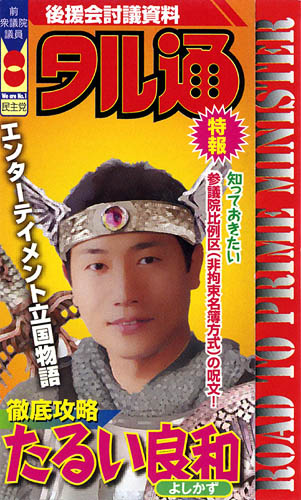
“Akiba-kei” nerd to run for the upper house: ZAKZAK is there

ZAKZAK:

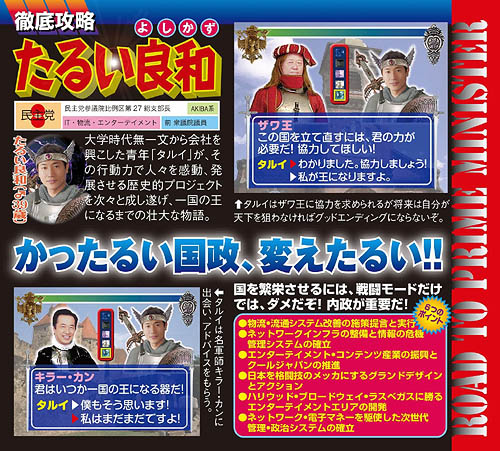
An Akihabara Nerd to Run for the Upper House… Tarui Dresses Like a Fantasy Warrior on RPG-like Homepage

The LDP’s Foreign Minister Taro Aso is well-known for being popular among the Akihabara (read:anime/manga/video game nerd) set, but there is one man in the DPJ who considers himself an “Akiba-kei” (Akihabara-style otaku). That man is 39-year-old Yoshikazu Tarui, a former Lower House member. He is gaining attention for his uniqueness in such odd moves as putting pictures of himself dressed like a fantasy warrior on his business cards and homepage and displaying images of DPJ President Ichiro Ozawa dressed as “King Zawa.”

t2007021310tarui1_b.jpgOpen Tarui’s homepage, and a story on the theme of “a country built on entertainment” will begin. It’s set up like a role-playing game, and King Zawa asks “Warrior Tarui”: “Hey, what happened Tarui? What is it?” as the story progresses.

Tarui is well known as a professional wrestling and kickboxing fan in the DPJ, and “Killer Kan” a great general played by Acting President Naoto Kan also shows up. This is a pun on the famous wrestler Killer Khan who was big in New Japan Pro Wrestling and famous for his special move the Mongolian Chop. DPJ Secretary General Yukio Hatoyama’s appearance is still in the planning stages, reportedly.

Tarui is running in this summer’s upper house race as a proportional representation candidate, but in response to questions from Yukan Fuji (=ZAKZAK), he explains, “Since there are no Akiba-kei Diet members in Nagata-cho, I thought that I’d try and grab the segment of people who are interested in pop culture and digital contents, so I made this site.” His campaign promise is “promotion of the entertainment content industry.”

t2007021310tarui2_b.jpgHe has a fold-out business card with the word “Tarutsu” on the cover in the style of famous video game magazine “Famitsu” along with a photo of Tarui dressed as a warrior. Open the card, and along with pictures of Tarui with “King Zawa” and “Killer Kan” there is a pun-filled message: 「かったるい国政、変えたるい!!」 (I’ll change the tired old national politics!). On the back is the strong slogan: “Bring the first akiba-kei Diet member in history back to national politics!”

You’d think he’d have confidence in this masterwork, but Tarui actually seems to be keeping his distance: “I gave this to Kan, but I’ve been too scared to show it to Ozawa since I made it without asking. This might freak regular people out, so I am not giving it out so much. I am mostly just giving it to people in the industry.

Certainly, there are those in Nagatocho who are cool on the wacky concept, saying “all we can do is laught,” but a source close to Tarui explains that he’s “a totally serious person.”

Actually, in Tarui’s own running column in “Weekly Famitsu” magazine, he seriously explains his ‘pet project’: “Promotion of entertainment not only has economic effects for the country, but will also help to raise [Japan’s] image. Would you want to fire a missile at Korea after having seen Winter Sonata? If you consider those feelings, you can understand that entertainment content is truly the best diplomat for prevention of wat and boosting tourism and economic exchange!”

Even Aso must be surprised at this guy!

ZAKZAK 2007/02/13

Both sides are likely to run celebrities and other fluff candidates for the national PR seats this summer, but a seasoned policy wonk with a taste for the absurd? I like.

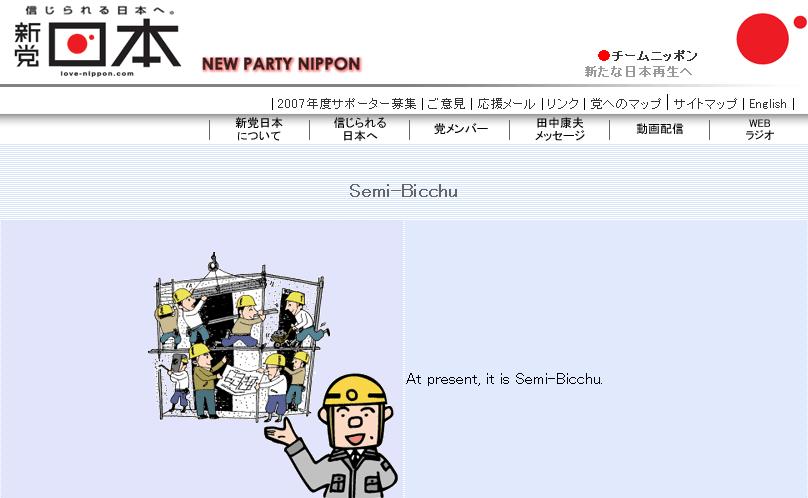
Shinto Nippon: Semi-bicchu?

People looking for information on Shinto Nippon, a Japanese opposition party formed amid the 2005 LDP splitup whose leadership includes former Nagano Governor Yasuo Tanaka, may be puzzled and disappointed at the current state of its English website (click for full-sized version):

shinto-nippon-semi-bicchu.JPG

Semi-bicchu? This cryptic bit of faux-English is, I believe, something of an oyaji gag: someone translated the “jun” of “jumbichu” (under construction) as “semi” and left the rest unchanged. I can’t tell if that is supposed to be funny or if someone was just too lazy to open a dictionary.

Asahi explains the Dentsu>Government>Local newspaper triangle of shadiness

A very interesting article has appeared in the Japanese-language Asahi today introducing the results of its investigation into a scandal involving Sankei Shimbun and another newspaper paying people to attend government-sponsored forums to educate people about the Supreme Court’s new lay judge system. It turns out that the practice of “co-sponsoring” these forums with regional newspapers is widespread, as is the practice of bribing people to participate (11 events managed by 4 newspapers were tainted). I won’t translate it since I suspect it will appear in Asahi’s English version after the Monday press holiday, but here’s a brief summary:

Headline: A dependence on government agencies for ad revenue was behind the “attendee mobilization” issue at regional newspapers

In the past decade or so, local newspapers have seen their ad revenues from regular companies drop significantly as their readership loses out to the larger papers. Newspapers have seen their total share of ad revenue drop from 21% to 17.4%, and regional papers have been hit harder than the major national ones. So in 1999 advertising giant Dentsu, who has a significant stake in the success of local newspapers, organized a “National Regional Newspaper Liaison Council” (office conveniently located a block away from Dentsu headquarters). The council was established as a network to collectively seek out ad suppliers (though looking at their website you’d think they existed only to co-sponsor government forums). The administrative director, managing researcher, and other positions are staffed by senior Dentsu employees.

The arrangement goes like this: The Council or Dentsu receives a contract from a government agency to hold an event to promote “understanding” of a new policy among the general populace. They then farm out operations to the local papers, who manage and report on the event in exchange for placement of ads/official announcements from the government agency.

Cosponsoring these events with local newspapers do benefit the agencies trying to get the word out about their new policies to the outlying regions, but that is only if people actually attend them. A promotional document provided by Dentsu to the Supreme Court for its forums on the lay judge system boasted attendance of “200 people or more.” A person involved explained: “The newspapers apparently felt pressure to get people to attend or else their orders from the Council would be reduced.” An employee at the ad department of one of the newspapers involved went so far as to name names: “We felt nervoud since we were co-sponsoring this with the national government. We were told by Dentsu to fill the room. Of course, the Council and Dentsu deny that they ever put any such pressure on the newspapers.

For a PM as boring as Abe, even a doctor’s visit makes the news

abe-blazer-turtleneck20070210-05016834-jijp-pol-view-001.jpg

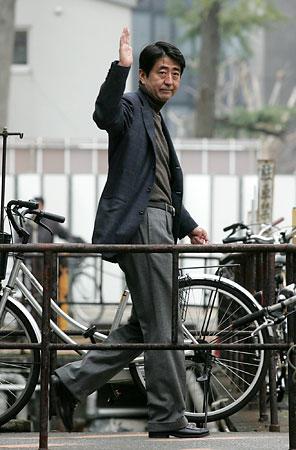
Abe on the way home from getting his health checked. I can’t say for sure why they published this almost totally un-newsworthy photo, but it goes to show how doggedly the press in Japan is hounding the Prime Minister no matter where he goes. Why would he wave to the camera? My guess is in response to the reporters’ catcalling. The caption? “‘This is my regular checkup. There were no problems at all, so I can work at ease again.’ Will the embattled prime minister now be refreshed to mount an attack to reverse his fortunes?”

The constant media hounding is nothing new, but here’s one possible reason this otherwise unremarkable photo made the news: People miss Koizumi’s consummate newsworthiness. As the right-leaning policy monthly Shokun! (Hey You!) has pointed out, at least Koizumi had hobbies (even though they were lame ones like opera). Abe hasn’t been seen doing much besides his job, except for when he’s very obviously posing for the cameras (such as when he was seen holding hands with his wife or when he made a trip to buy dictionaries). So these bored reporters might have been desparate to capture the prime minister doing anything.

There have been reports comparing the Abe and Koizumi styles of leadership ever since Koizumi left office. TV commentator Terry Ito puts it bluntly: “Koizumi spoke to the people, Abe speaks to Nagatacho.” But ever since the K-man made a well-received campaign appearance during lower house by-elections in October, reports of rumors/hopes started bubbling up that Koizumi might try and take back the premiership. The above-mentioned Shokun! article outlines one wild scenario:

The Abe cabinet will hit a dead end over the nonstop scandals and dissolve the lower house. The DPJ, internally divided as it is, will win the general election as it rides this wave of dissatisfaction in a “marriage of convenience.” Part of the disjointed LDP will break off and join the DPJ. Ozawa will step down for health reasons and leave the DPJ leadership to either Yukio Hatoyama or Naoto Kan, forming a coalition government with the Socialist Democratic Party. It will, of course, immediately falter. People will then start calling for a “strong leader” amid the fluid political conditions. This is a prediction for 2, 3 years into the future, but it could well be that Junichiro Koizumi is quietly waiting for that day to come.

The “Koizumi comeback” storyline (always proffered by unnamed sources, of course) picked up momentum after Abe’s administration started to stumble in December. All the while, Koizumi himself has been indirectly quoted as saying he has no interest whatsoever in running the government again.

But the idea has picked up such steam by now that Koizumi’s longtime personal assistant Isao Iijima came out and flatly stated at an appearance in his native Nagano that there would be “100% no comeback” for Koizumi.

The coverage of Iijima’s comments may have been due to the fact that Iijima himself has become a part of the “Koizumi comeback” story, partly for his reputation as a shady manipulator of media coverage (he’s been called “Japan’s Karl Rove”; read a 2001 profile here). This report in January 15 edition of news weekly AERA, quotes unnamed political insiders and a passage critical of the Abe administration’s use of special advisors to explain that Iijima is disappointed with the Abe administration. The article goes on to speculate that Iijima harbors a “wild ambition” to put Koizumi back in power. Amid this coverage, Koizumi has been indirectly quoted as saying he isn’t interested.

Even though Iijima has denied that Koizumi is making a comeback, the very fact that Koizumi’s personal secretary is out making speeches makes me suspect something’s up. His comments were somewhat cryptic: “Koizumi has been keeping silent for the time being. I see that as the best support for Abe,” referring to the fact that Koizumi has largely managed to stay out of the press, at least directly, after leaving office. But this conspicuous absence only seems to make Japanese reporters’ hearts grow fonder.

Foreign Crime File – is all the fuss really necessary?

Today I want to talk about the “Foreign Crime Files” manga. It’s an offensive, disgusting book that tries (albeit poorly) to exploit Japanese people’s fears and prejudices. By now many of my readers will have heard about this since the Japan bloggers have duly reported it with furious anger. But my preliminary and very unscientific research seems to indicate that this book has not made much of a splash in Japan as of yet. It’s enough to make me worry that this outrage might actually be building more of a market for the book (and a platform for its fear-mongering) than it would have had otherwise.

The sole Amazon review (1 star): “Uses lots of discriminatory phrases, low level content. It seems as if the author has a major inferiority complex as a Japanese person. This will engender a bias against foreigners among ignorant Japanese people.” Also from Amazon: People who bought this book also bought “Completely Master the Japanese Language Proficiency Test Level 1!” (a test of Japanese as a second language). Amazon rank: 1004 in books.

Japanese-language Technorati results: zero!

2ch presence: One very short thread on the “Books” board. Overview:

Thread starter: Did you know about GAIJIN HANZAI FILE, this horrible, discriminatory book?!
2channeler 1: It’s an ad!
TS: No, it’s not an ad, I just want to know why Japanese people allow this kind of thing?
2channeler 1: Well, I guess it’s more that we don’t really care about foreigners.
2channeler 2: My opinion is that people who overreact to this discrimination are pretty depressing. Just leave it alone. The fact that the foreign media has picked this up is just what I’m talking about. They understand that life and racial discrimination can’t be separated. A worldview that relates and compares issues to one’s own life is very Christian.

No mention in a news thread on the lower “foreign crime rate” reported by the National Police Agency.

Google results: The multitude of booksellers’ websites selling the book and foreign Japan bloggers’ reactions, plus one blogger/J-pop singer cocco (wiki), who explained: “It isn’t being talked about much by Japanese people yet, but one book (Foreigner Crime File) is enraging foreigners who live in Japan… I worry that this might turn into an international problem!”
According to cocco, there is a movement going on within mixi to boycott Family Mart over this book, one that debito has helped organize outside of mixi and that has in the end kept it off the shelves there as well as in other places.

It could be early to conclude that Japanese people just aren’t all that interested in this book, or perhaps they’ll just never have the chance to read it due to the success of Debito and others to get this book censored. But in this era of viral marketing and unscrupulous people, you have to wonder if all the coverage we foreign Japan bloggers are giving this awful book are giving it more attention than it ever really deserved. I feel like this book would have died a death in the sleazy porno section of the convenience stores if it weren’t for its almost made-for-the-Internet inflammatory illustrations.

“Child-bearing Machine” T-shirts

Fans of Japanese political kerfuffles can thank Kikko for letting us know how we can get T-shirts commemorating Health and Labor Minister Hakuo Yanagisawa’s clueless statement implying that women are “child-bearing machines.” No maternity sizes available yet, unfortunately.

ts.jpg

You can get some background on this and Abe cabinet’s other “gaffe” scandals here, but basically the opposition parties went nuts over this misstatement, sitting out on Diet deliberations (a move that goes against the supposed principles of a Japan’s proud new truly parliamentary system) on a supplementary budget to carry over Japan for the rest of the fiscal year. They came back after this tactic of shrilly lambasting the LDP produced only mixed results in local elections, and then Acting President of the DPJ Naoto Kan made a strikingly similar flub: “Tokyo’s birth productivity is low”. So, as with other recent scandals, the DPJ comes off looking no better than the LDP.

Continue reading “Child-bearing Machine” T-shirts

More on rectification of names in Taiwan

Any HTML gurus know why the hell I have a gigantic mess of white space before the table below? If so, let me know!

A week ago I mentioned how Taiwan’s DPP administration has been editing grade school history textbooks to refer to Chinese history as “Chinese history” instead of “this country’s history” and removing the honorific title “Father of the country” from references to Sun Yat-sen, leaving only his name.

A few days later, there were reports that the Ministry Of Economic Affairs (MOEA) is engaging on a systematic campaign to remove references to China from the names of state run enterprises, and to encourage private corporations to do the same.

Some examples from the article:

Chinese Petroleum Corp (CPC, 中國石油) and China Shipbuilding Corp (CSBC, 中國造船) would soon be renamed to include “Taiwan” in their company titles in accordance with government policy.

Chinese Petroleum Company ->”CPC, Taiwan” (台灣中油)

Chinese Ship Building Corporation (CSBC) -> Taiwan International Shipbuilding Corp (台灣國際造船)

Another company that has been targeted in the name change campaign is China Airlines Ltd (CAL, 中華航空), but Chen did not address this yesterday.

CAL said earlier that its name was valuable in the greater China market.

Although previously well-known in the international community and with a large number of overseas branches, the state-controlled International Commercial Bank of China (ICBC, 中國國際商銀), is now called Mega International Commercial Bank (兆豐國際商銀) after merging with another state-run entity, Chiao Tung Bank (交通銀行).

[From Taipei Times, Feb 3]

Of particular note is this sentence buried in the last paragraph.

The issue of changing the name of state-run enterprises is part of the government’s “name-rectification” policy, aimed at avoiding Taiwanese companies being mistaken for Chinese ones.

My previous post on the revision of history books had mentioned how this concept is central to Chinese thought, at least since Confucianism referred to “rectification of names,” and in fact this phrase concept is extremely common in Taiwanese political discourse.

To get an idea of how common, take a look at the top 10 most emailed articles at Taiwan’s Liberty Times newspaper on today, February 7 2007:

1. 不認同 李筱峰退出李友會 342 票
2. 李登輝:制憲正名達成國家正常化 255 票
3. 王又曾被拘留美週內決定去留 237 票
4. 追討格瑞那達7億貸款 我在美興訟 201 票
5. 財金高層:央行正名 英文名應去中… 200 票
6. 廉能會調查…馬特別費 300餘萬… 170 票
7. 更名難 綠委促中正紀念堂搬家 132 票
8. 邱義仁陳唐山互調 許惠祐掌國安局 122 票
9. 2000萬保釋金不用籌 王家疑有… 120 票
10. 大法官林子儀 股票交易漏報200… 120 票

Of these, #2 and #5 both include the phrase “name-rectification” (正名) in the headline. #1 refers to comments made by former president Lee Deng-hui regarding Taiwan’s status, which is intimately bound up with name-rectification. #7 about the proposed relocation of the Chiang Kai Shek Memorial Hall from Taipei to Taoyuan country, where his mausoleum is located, and the re-purposement of the current building for use as something like a “Taiwan Democracy Memorial.” This same article #7 also mentions the recent renaming of Chiang Kai Shek airport to Taiwan Taoyuan International Airport. So that makes, out of the ten most popular articles of the day, there are four related to the politics of name-rectification.Let’s look for a moment a bit more about the Chiang Kai Shek issue. While no one denies that Chiang is a critical figure in the history of China and Taiwan, exactly how he should be remembered is a major point of contention between the Taiwanese political factions. As his former party, the Chinese Nationalist Party (Kuomintang/KMT) still respects his memory and praises his role in the original revolution, the birth of the Republic, the fight against the communists, and the development of Taiwan’s economy after the flight from the mainland. On the other hand, the Taiwanese independence oriented Democratic Progressive Party (DPP) tends to look at him as a military dictator, who invaded Taiwan with his ragtag army of mainlanders and spent decades suppressing native culture and liberty on the pretext of national security.

As part of their name-rectification agenda, the DPP administration has already changed the name of the Chiang Kai Shek International Airport, and has now proposed the more radical step of actually removing him from his own memorial hall. In addition, they have also ordered the removal of outdoor statues of Chiang Kai Shek from all military bases, to be placed in storage. The excellent China affairs/media blog ESWN has a short bit on this, with an amusing quote from the defense minister Lee Jye.

Lee: “Why not remove them?”
Reporter: “Why remove them?”
Lee: “You tell me why not remove them? This is a democratized country. I am in an awkward position, right or not? The ruling party has some idea that they want me to carry out. The opposition party also has its own opinion and it does not want me to carry this out. So what do you say that I should do? Removing the bronze statues does not mean discarding them. It is to move them to where they belong. As you say, you are the opposition right now. If you become the ruling party next time, you can tell me to bring the statues back again. It is such a simple issue. Why are you arguing about this all day?”
Reporter: “The blues are not happy, but the greens are not happy either?”
Lee: “Yes.”
Reporter: “Could it that you feel pressed and aggrieved?”
Lee: “Then I ask you to help me. Please do not keep picking up rocks and throwing them at me.”

There is also an article at the Taipei Times about the statue removal campaign. Significantly, the removal of the statues is being accomplished before February 28 of this year, which will be the 60th anniversary of the famous 228 incident, in which military police occupying Taiwan for Chiang Kai Shek’s KMT led Republic Of China government beat an elderly female street peddler (on 2/27), triggering a protest the next day (2/27) in which several civilians were shot and killed by police, which caused rioting and near-insurrection by the Taiwanese, which led to the introduction of military law by the KMT government, and a crackdown against rebels and former “Japanese collaborators,” in which thousands were killed. The 228 incident, now commemorated with a holiday known as Peace Memorial Day, is considered by the DPP to represent everything bad about the decades long period of military law in Taiwan. While the KMT officially does not consider Chiang Kai Shek to be responsible for the 228 violence because he was not in Taiwan in the time and did not order order the reprisals against civilians, there are many who blame him either based on the principal of a military commander’s responsibility down the chain of command, or because they believe that he did in fact authorize the post-insurrection massacres.

Interestingly, despite the history textbook revisions removing his title as “father of the country” the final paragraph of the Liberty Times #7 article from above, on the possible removal of the Chiang Kai Shek memorial from the Chiang Kai Shek Memorial Hall, makes a point of saying that because are still many people who respect the great doctor’s principles of democracy and fraternity and all that noone would ever consider doing anything to the Sun Yat-sen memorial hall. Of course, who knows what a future government might find objectionable?

A Chinese perspective on Kokaryo

A few days ago I wrote about Kokaryo, a decrepit student dormitory in Kyoto which is the center of a 40 year long legal battle between China (People’s Republic of China) and Taiwan (Republic of China). Here is a translation of an article produced by the Chinese state owned press. I first found a Chinese language version of this piece here, on the China Central Television (CCTV) web site, under the section on “Problems in China/Japan Relations” in a special celebrating 30 years of normalized relations between China and Japan. Later on I found a Japanese translation of the very same text on an official Chinese Consulate web page, verifying that it does in fact represent the government stance. Here is a translation of that article.

Problems in Sino-Japanese Relations

(7) Kokaryo


Kokaryo is in Kyoto City, Japan, and is a student dormitory that at first Kyoto University rented for the use of Chinese students during World War II. The building has five floors above ground, one below ground, and an area of 2130 square meters. In May of 1950, the representative body of the Taiwanese authorities in Japan sold off assets that had been seized from the Japanese army that had invaded China, and used those government funds to purchase the building. In December of 1952, the Taiwanese “Ambassador to Japan” [Ed: take note if the use of quotations] entered into a sales contract with the former owner of the building, and in June of 1961 registered the property under the name of “Republic of China.” In June of 1961 Chen Zhi-mai, Taiwan’s “Ambassador to Japan” filed a lawsuit at the Kyoto District Court with the patriotic overseas Chinese as the defendants, requesting their eviction from the Kokaryo. However, patriotic overseas Chinese and foreign students of our country had consistently been managing and living in the property since Japan lost the war, and there had been no participation from Taiwan in this. After the normalization of Sino-Japanese relations, the Chinese Embassy in Japan and the Chinese Consulate in Osaka had continually been fiscally supervising and guiding the Kokaryo. The Chinese government made special payments, made repairs to Kokaryo, and used it as a dormitory for study abroad students from our country.

In September 1977, the Kyoto district court rejected the plaintif’s complaint and recognized that, based on the normalization of Sino-Japanese relations, the property rights of Kokaryo belonged to the People’s Republic of China, but on the other hand, pronounced that the plaintiff did have the right to litigate as an interested party. In October of the same year, Taiwanese authorities filed an appeal in the Osaka Supreme Court under the name of “Republic of China.” In April of 1982, the Osaka Supreme Court accepted the appeal of the “Republic of China” as “the confirmed de-facto government” of Taiwan and overturned the verdict of the Kyoto District Court. In February of 1986 the Kyoto District Court, quoting the main argument of the Osaka Supreme Court, found against the patriotic-for-China overseas Chinese. In February of 1987, the Osaka Supreme Court decided a second trial upholding the verdict of the original trial. In response, the overseas Chinese appealed to the Japan Supreme Court in March of 1987.

From 1974 until now, China has made several appeals to Japan, stressing the following. Kokaryo is a national asset of China, and China has sought the cooperation of Japan in rectifying the name under which Kokaryo is registered, as the property rights of Kokaryo should have belonged to the People’s Republic of China since the normalization of Sino-Japanese relations. The Kokaryo issue is not an ordinary civil suit. It is an issue related to the legal interests of the Chinese government, and a case related to the basic principles of relations between Japan and China. The substance of this problem is the very public creation of “two China’s” in a formal Judicial manner, and violates the Joint Communiqué of the Government of Japan and the Government of the People’s Republic of China and Treaty of Peace and Friendship between Japan and the People’s Republic of China, and shatters the understanding that relationed between Japan and Taiwan shall be limited to private and regional channels. The verdict of the Osaka Supreme Court is not only politically mistaken, but is also of no use legally, violated the fundamentals and principles of international law with a number of problems such as the distinction between national succession, governmental succession and government recognized legal validity and the nature of property, and also does not accord with the Japanese constitution. At present, this case is still in progress at the Japanese Supreme Court. China is watching with great interest.