METI rushes to adopt anti-SLAM policies

When you are trade minister and the economy is in trouble, the last thing you need is to get SLAMMED!!!

Thursday, February 12, 2009

ANALYSIS: Exit Strategy Needed As Govt Role Expands

TOKYO (Nikkei)–The Japanese government is becoming more active in combating the ongoing downturn, and while such efforts might be necessary, an exit strategy must be formed so that the economy is eventually able to thrive without life support.

The government is under immense pressure to take action amid the crisis. In early January, the Ministry of Economy, Trade and Industry (METI) hastily created a program to inject public funds into nonfinancial firms. Late last year, METI was flooded with complaints — not only from small and midsize companies, but also from big ones — about the difficulty of securing loans from banks and fundraising through the issuance of corporate paper and bonds.

The trend toward greater state involvement seems clear in Japan, with ruling-coalition lawmakers and business leaders now calling on the government to save jobs.

“Speed is essential,” said METI Minister Toshihiro Nikai. “Unless we do something now, we will be slammed (by criticism).”

Private-sector activity is essential to healthy markets. Without an exit strategy, the Japanese government and the BOJ will find it difficult to withdraw to their proper supporting roles, and the Japanese economy will be worse for it in the long run.

Given that the current crisis is arguably the worst since the Great Depression, the government and BOJ likely have little choice but to take action.

I realize this is a semi-serious argument against how offering protection to industry over short-term concerns could crowd out the private sector and possibly lead to a deleterious trade war. But Nikai has it wrong — come September at the latest, the LDP is going to get totally SLAMMED no matter what.

And weren’t “the Japanese government and the BOJ” already fulfilling a fairly intrusive role in the Japanese “markets”? Sure, many of the lost decade/Koizumi-era programs had been put to rest, but not that long ago. Japan remains full of so-called “zombie” companies kept afloat by previous bank bailouts and the like, but these new measures outlined in this article would presumably create a new breed of these – companies that would be insolvent without direct government support (or indirect through government-mandated loans). So while I share the Nikkei’s concern that the government of Japan will soon essentially become the “main bank” of a sizable number of companies, I just want to mention that rather than going from a state of being merely in a “supporting role” to an active role, these measures appear to push the GOJ from an already pretty active role to a very active role.

Stimulus or investment? Japan vs. USA

Ever since the start of our current financial disaster various economists and pundits have been comparing first the US banking problems with Japan’s, and then more recently the infrastructure-heavy stimulus program with Japan’s construction state. Today’s NYT has a substantial article that easily marks the most high profile comparison yet. I’m certainly no economist and I’m not even taking the time to look at numbers right now, but my quick take on the issue is that the comparison is being significantly overblown, but it is still a very worthwhile comparison to make, so that Japan’s various successes and mistakes can be absorbed as lessons. See the following summation of Japan’s massive pork spending:

Dr. Ihori of the University of Tokyo did a survey of public works in the 1990s, concluding that the spending created almost no additional economic growth. Instead of spreading beneficial ripple effects across the economy, he found that the spending actually led to declines in business investment by driving out private investors. He also said job creation was too narrowly focused in the construction industry in rural areas to give much benefit to the overall economy.

He agreed with other critics that the 1990s stimulus failed because too much of it went to roads and bridges, overbuilding this already heavily developed nation. Critics also said decisions on how to spend the money were made behind closed doors by bureaucrats, politicians and the construction industry, and often reflected political considerations more than economic. Dr. Ihori said the United States appeared to be striking a better balance by investing in new energy and information-technology infrastructure as well as replacing aging infrastructure.

Japan’s huge boom in public works spending was less a national stimulus program than a gigantic rural welfare program of pork-barrel projects designed to prop up the ailing LDP in its long decline. The money was largely directed not to the areas where it would benefit the largest number of people, but the areas where it would benefit the largest number of politicians. This was not done entirely out purely cynical political motives but also due to a genuine desire to arrest the decline of the rural regions themselves, in the face of continuing urbanization and a decline in Japan’s traditional and lionized (if anachronistic) agricultural lifestyle. Regardless of intent, a huge proportion (I won’t use words like “most” without looking at actual numerical research) of the spending was “stimulus” but not “investment”.

I am very, very wary of the general principal of “economic stimulus.” I am not opposed to government spending, or even large amounts of government spending, as long as it is being spent on something that is actually necessary or build further value in the future, i.e. services or investment. I think this attitude should be obvious from the mass transit funding letter I wrote and posted here a few days ago. In short, I worry that the discussions on spending currently ongoing in Washington may turn into a series of worthless boondoggle projects oriented at unpopulated rural areas, combined with random tax cuts and other expenditures poorly aimed at short-term (i.e. one election cycle) economic recovery, while continuing to ignore the trillions of dollars in outstanding repairs or upgrades as well as vital new investment that the country needs. I think it’s safe to say that politicians are going to spend this money. The question is, what will it buy us? Would we rather have a bunch of bridges to nowhere, vacant museums and amusement parks in virtually deserted rural towns, and paved-over mountain tops, or would we rather have a modern electrical grid, mass transit that at least meets late 20th century standards if not 21st century, a safe and reliable water system, bridges rated to not collapse, and maybe even an adequate system of public health care?

F-U journalism from Matt Taibbi

Following on the heels of yesterday’s post on a 1993 long-form, take-down profile of Gregory Clark, readers might be interested in taking a look at Matt Taibbi. He is a true master of what I call fuck-you journalism, something of a subset of gonzo style. If you thought the reporter for The Australian was a little harsh, you haven’t seen anything. Taibbi has got to be the biggest out-and-out dickhead in the entire business, though I am sure he could find far more biting insults for himself. Some choice bits:

On the death of Yeltsin:

Death of a Drunk
At long last, former Russian president and notorious booze-hound Boris Yeltsin dies

Boris Yeltsin probably had more obituaries ready in the world’s editorial cans than any chronically-ill famous person in history. He has been dying for at least twenty consecutive years now — although he only started dying physically about ten years ago, he has been dying in a moral sense since at least the mid-Eighties. Of course, spiritually speaking, he’s been dead practically since birth…I once visited Boris Yeltsin’s birthplace, in a village in the Talitsky region of the Sverdlovsk district in the Urals, in a tiny outhouse of a village called Butka. I knocked on the door of the shack where Yeltsin was born and stepped in the soft ground where his room had once been. Boris Yeltsin was literally born in mud and raised in shit. He was descended from a long line of drunken peasants who in hundreds of years of non-trying had failed to escape the stinky-ass backwater of the Talitsky region, a barren landscape of mud and weeds whose history is so undistinguished that even the most talented Russian historians struggle to find mention of it in imperial documents.

Reviewing Thomas Friedman’s latest book:

When some time ago a friend of mine told me that Thomas Friedman’s new book, Hot, Flat, and Crowded, was going to be a kind of environmentalist clarion call against American consumerism, I almost died laughing.

Beautiful, I thought. Just when you begin to lose faith in America’s ability to fall for absolutely anything—just when you begin to think we Americans as a race might finally outgrow the lovable credulousness that leads us to fork over our credit card numbers to every half-baked TV pitchman hawking a magic dick-enlarging pill, or a way to make millions on the Internet while sitting at home and pounding doughnuts— along comes Thomas Friedman, porn-stached resident of a positively obscene 114,000 11,400 square foot suburban Maryland mega-monstro-mansion and husband to the heir of one of the largest shopping-mall chains in the world, reinventing himself as an oracle of anti-consumerist conservationism.

Where does a man who needs his own offshore drilling platform just to keep the east wing of his house heated get the balls to write a book chiding America for driving energy inefficient automobiles? Where does a guy whose family bulldozed 2.1 million square feet of pristine Hawaiian wilderness to put a Gap, an Old Navy, a Sears, an Abercrombie and even a motherfucking Foot Locker in paradise get off preaching to the rest of us about the need for a “Green Revolution”? Well, he’ll explain it all to you in 438 crisply written pages for just $27.95, $30.95 if you have the misfortune to be Canadian.

I’ve been unhealthily obsessed with Thomas Friedman for more than a decade now. For most of that time, I just thought he was funny. And admittedly, what I thought was funniest about him was the kind of stuff that only another writer would really care about—in particular his tortured use of the English language. Like George W. Bush with his Bushisms, Friedman came up with lines so hilarious you couldn’t make them up even if you were trying—and when you tried to actually picture the “illustrative” figures of speech he offered to explain himself, what you often ended up with was pure physical comedy of the Buster Keaton/Three Stooges school, with whole nations and peoples slipping and falling on the misplaced banana peels of his literary endeavors.

Remember Friedman’s take on Bush’s Iraq policy? “It’s OK to throw out your steering wheel,” he wrote, “as long as you remember you’re driving without one.” Picture that for a minute. Or how about Friedman’s analysis of America’s foreign policy outlook last May:

The first rule of holes is when you’re in one, stop digging.When you’re in three, bring a lot of shovels.”

First of all, how can any single person be in three holes at once? Secondly, what the fuck is he talking about? If you’re supposed to stop digging when you’re in one hole, why should you dig more in three? How does that even begin to make sense? It’s stuff like this that makes me wonder if the editors over at the New York Times editorial page spend their afternoons dropping acid or drinking rubbing alcohol. Sending a line like that into print is the journalism equivalent of a security guard at a nuke plant waving a pair of mullahs in explosive vests through the front gate. It should never, ever happen.

And on Tom Daschle (Glenn Greenwald dug this up when the tax problems that cost Daschle his cabinet position surfaced):

I know several reporters who are either officially or unofficially on “Whore Factor” duty, watching the rapidly kaleidoscoping transition picture and keeping track of the number of known whores and ghouls who for some reason have been invited to befoul the atmosphere of the next administration.

Obviously there has been some dire news on that front already. When Obama picked Tom Daschle to be the HHS Secretary, I nearly shit my pants. In Washington there are whores and there are whores, and then there is Tom Daschle. Tom Daschle would suck off a corpse for a cheeseburger. True, he is probably only the second-biggest whore for the health care industry in American politics — the biggest being doctor/cat-torturer Bill Frist, whose visit to South Dakota on behalf of John Thune in 2004 was one of the factors in ending Daschle’s tenure in the Senate.

But in picking Daschle — who as an adviser to the K Street law firm Alston and Bird has spent the last four years burning up the sheets with the nation’s fattest insurance and pharmaceutical interests — Obama is essentially announcing that he has no intention of seriously reforming the health care industry. . . .

Regarding Daschle, remember, we’re talking about a guy who not only was a consultant for one of the top health-care law firms in the country, but a board member of the Mayo Clinic (a major recipient of NIH grants) and the husband of one of America’s biggest defense lobbyists — wife Linda Hall lobbies for Lockheed-Martin and Boeing. Does anyone really think that this person is going to come up with a health care proposal that in any way cuts into the profits of the major health care companies?

That image has been burned into my head over the past week or so…

Of course, in Japan Taibbi would find himself up to his ears in defamation suits. In the US, he appears merely to be ignored as a sensationalist who can only get published in Rolling Stone.

Mass transit pleas sample letter

I’ve posted the sample latter I published here the other day on a few relevant Facebook groups to try and spread the word, but I want to remind any registered-to-vote American readers to follow up on this. I know everyone reading this is a train fan. You’ve either been to Japan or Taiwan or you want to go, and that means you appreciate what real mass transit infrastrucute can do for a county. If you decided to go ahead and send my letter or a modified version, great-and if you decided to write your own, send it to me or post it here to share.

Mass transit plea

Having been rather frustrated by the lack of much serious discussion of guiding any of the so-called stimulus money towards investment in much needed mass transit infrastructure upgrades, I decided to compose a letter to my two Senators and one local Representative asking them to work towards this agenda. I’ve attached my text below, and I implore registered USA voters to send a similar letter to their own congressional delegation, and to pass along a request to potentially interested registered voters you know. So few people actually write politicians on these issues that a surprisingly small number of contacts can, on occasion, spur them to take at least a mild stand on an issue. This is the first time in many years that Congress has even considered taking an interest in mass transit/rail investment and we mustn’t let it pass Continue reading Mass transit plea

Graham and Kim

Our friend Curzon over at the Cominganarchy blog posted last week an excellent piece on the history of the involvement between the familes of the Reverend Billy Graham and the Kim dynasty of North Korea. The connections are, as usual, longer and more interesting than one would expect from just reading the news. I highly recommend reading it.

The Masonic Bible

Slate’s Explainer column is always a good read, but this week’s installment on the bibles used for presidential inaugurations was particularly amusing.

George W. Bush wanted to use the Washington Bible for his first inauguration, as his father had done, but the plan was foiled by drizzly weather. The Masons are extremely careful with the Washington Bible: They refuse to let the artifact be X-rayed at airport security and demand that the president be the only one who touches it without gloves.

In Japan, Obama inauguration inspires English lessons, off-kilter likenesses

The Adamu household is just ecstatic and relieved to see Obama inaugurated as president. We can’t tell which feels better: not-Bush in the White House or Obama in the White House? 
Though you might not know it to look around you, there are many in Japan who are excited about Obama who don’t live in a certain newly famous town that happens to be named after him. As just one indicator of interest, NHK announced its late-night ratings almost quadrupled for live coverage of the address. A fairly universal attitude by my observation has been, “Why don’t we have dynamic leaders like that in Japan?” So the buzz over Obama may in part be a kind of vicarious thrill.
So even before the inauguration, individuals and businesses in Japan have been finding interesting ways to express their enthusiasm. Let’s take a look:

1. Learn English

  • Listening to one of the great speechifiers of our time can be inspiring. Obama’s message can call you to serve your country, resolve to be a better person, or sacrifice for the greater good (but tragically apparently not to prosecute those responsible for the Bush regime’s crimes). Some aspiring English speakers in Japan have taken this opportunity to brush up on their own speaking skills. Prominent among the “Obama books” that are currently flooding Japanese bookstore displays is CNN’s Obama Speech Collection for students of English as a second language. The book, so far having sold over 400,000 copies, features excerpts from famous Obama speeches with a Japanese translation on the opposite page, which students can use to follow along as they listen to an attached CD. I picked it up the other day and it has proven useful both as a translation reference for US politics and as a handy record of his landmark addresses. I’m not sure how effective it is as a teaching tool, but for a Japanese learner of English inspired by Obama it will no doubt give them easy access to the tools they need (minus the inauguration address, of course).
  • Meanwhile, much like Kenya’s “Obama imitation contest“, some private English classrooms have started offering Obama mimicry lessons to a reportedly favorable response. In one TV news report, groups of 20+ students lined up to wait their turn to recite famous Obama speeches as a White-boy instructor barked orders on how to mimic Obama’s unique oratory style.

2. Create a mildly unsettling Obama likeness

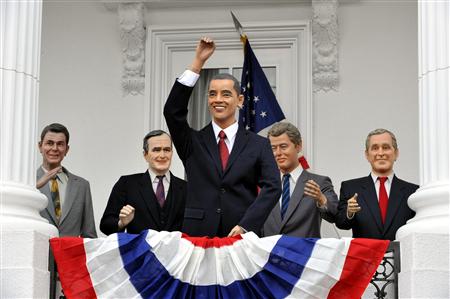
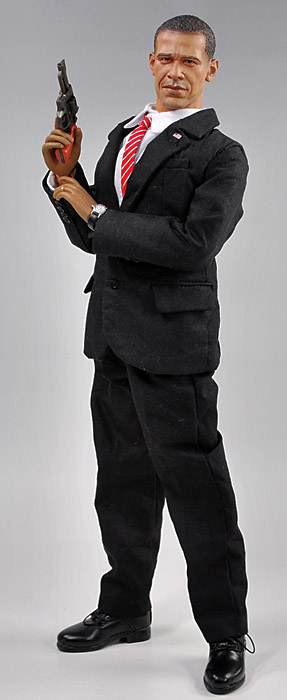
Here we see some examples of creativity from both traditional and modern artists that deserve an “A” for effort but unfortunately didn’t turn out all that appealing:

no resemblance whatsoever?
No resemblance whatsoever?

Zombie Reagan looking gaunt (or is that Carter??)
Zombie Reagan looking gaunt (so Carter really is irrelevant!)


* Thanks to Andrew Leonard for the correction!

Compare to the real thing:

That’s more like it!