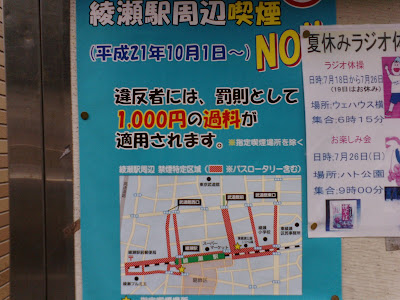
Ayase to start fining smokers starting in October

In my last post about bicycle parking, I noted that the enforcers didn’t seem to be making much of an impact on illegal bike parking, except maybe at the margins (I’d be tempted to park there more often if I didn’t have a reliable space at my apt. building).

Another rule in Adachi-ku that’s only effective at the margins is the ban on smoking on the streets. In a reverse of the common American rule, in Japan smokers are often allowed to smoke in designated areas of public buildings but banned from smoking on the street. This makes for some smoky izakaya, but to me it makes sense because Japan’s narrow streets and urban lifestyle mean you are affected more by street smokers than you would be in a big American city.

Unfortunately, the bans tend to be ignored by whoever is insensitive enough to light up. They obviously know it’s against the rules but wear a “screw you” scowl on their faces and no one does anything.

One effort to combat these scowlers has been to enhance enforcement in high-traffic areas by dispatching workers who enforce the rules by collecting small fines on the spot. Adachi-ku has imposed such a ban since October 2006 starting with a 1,000 yen fine in the Kitasenju Station area. Ever since I have been in the area I have seen elderly people (volunteers I presume) asking some very surprised and incredulous smokers to pay 1,000 yen on the spot.

Similar exchanges are expected to come to my neighborhood this October as the fine is set to be expanded to include the Ayase Station area:

From Adachi-ku bicycle parking enforcers

The details of anti-smoking ordinances vary from place to place, but most appear to follow similar guidelines – ban smoking on the street everywhere (except some small smoking areas) but only enforce in areas of major foot traffic such as train stations. Many places such as Tokyo’s Chiyoda-ku post their enforcement stats online. Since beginning its policy in November 2002, Chiyoda-ku has fined a total of 42,230 people. Though I could not find figures on whether these people are actually paying the fines, if everyone has paid they have collected a total of 84.5 million yen, which adds up to something like 11.3 million yen a year.We also don’t know how many people the enforcers tried to stop but couldn’t.

For its part, Adachi-ku claims to have issued 3,498 fines in the Kitasenju area. As noted above, the preferred collection method is to demand payment on the spot. Enforcers are required to show proper ID upon request, and you are allowed to appeal if you don’t think you deserve the fine. However, there appears to be nothing the enforcers can do if you simply ignore them or refuse to take possession of the ticket.

In the initial period of enforcement, Ayase can probably expect a similar reaction that was documented when Kobe expanded its enforcement in 2007 – refusals by people who claim ignorance of the rule, people tossing out cigarettes just before entering the restricted area, and lots of people simply refusing to acknowledge the existence of the enforcers. Seeing the jerks who light up even when they know the smoke bothers everyone is one of my pet peeves, so here’s hoping our friends the elderly enforcers can get the job done.

Koreans will say goodbye to seals

A few months ago, I wrote about the declining use of seals in Japan, and Adamu commented that Japan ought to abolish seals altogether. Well, South Korea is almost there:

At present, 32.89 million Korean nationals, or 66.5 percent of the entire population, have personal seals registered with the authorities, while a total of 48.46 seal certificates were issued last year, incurring enormous social and economic costs, according to government data. Hundreds of personal seal forgery cases are also reported every year.

The Ministry of Public Administration and Security said the government plans to scrap 60 percent of official demands for the personal seal registration certificates this year, with the remaining 40 percent set to be gradually abolished over the next five years.

A separate Joong Ang Daily article explains that this policy was the work of a “Presidential Council on National Competitiveness,” and that Korea’s use of seals only dates back to its days as a Japanese colony (its seal registration law was instituted in 1914).

Meet the bicycle parking enforcers

Yesterday evening on the way home I caught Adachi-ku’s bicycle parking enforcers in action:

From Adachi-ku bicycle parking enforcers

The open area outside Ayase Station’s east exit is normally filled with illegally parked bikes (because it basically serves no other function). As in most areas, Adachi-ku bans bike parking near stations except in designated parking lots (there is one that’s free of charge on the south side and several fee-based ones). But in reality, most of the time the only thing stopping people from parking in this area are some old men in yellow vests (apparently officially sanctioned volunteers) who verbally warn people not to park there (even as 5 others are parking their bikes directly behind them).

But about once a week the enforcers come around, and it’s on these days that the park becomes oddly bike-free. On this Saturday in particular I was walking in an area that’s usually so flooded with bikes it’s impossible to walk through comfortably, but when the enforcers came around there were only two or three bikes to be found. Somehow everyone seems to know what day the enforcers will be there.

According to the Adachi-ku homepage, the district only enforces bicycle parking within a 300-meter radius of train stations, as those are the places where offenders concentrate.

If your bicycle is caught by the enforcer’s net outside Ayase Station, you must make your way to the Kita-Ayase relocation center (on foot, presumably). To retrieve a bike that’s been confiscated will cost you 2,000 yen and require you to produce proof that you own the bike along with a working key. Act fast, though – bikes in custody for two months will be “disposed with.” While I don’t know exactly what Adachi-ku does with the orphaned bikes, many abandoned bicycles nationwide end up exported to North Korea,  so if you don’t want to fund Kim Jong Il’s regime, you need to retrieve your bike as soon as possible!

MM20071025145737747L0

A Yomiuri photo of bicycles slated for export.

The Wikipedia article on this issue makes an interesting point – in most cases, there are more people who benefit from illegal bike parking than who are adversely affected by it. No one might be explicitly advocating that bikes should be permitted to park wherever they want, but the fact remains that the fee-based parking lots are expensive and often inconvenient. This means that politicians have a hard time taking decisive action as it would upset the population.

Meet the new boss, same as the old boss

Comments are closed — please join the discussion here.

I’ve written several posts this year regarding the absurdity of the foreign policy of the Democratic Party of Japan (DPJ). The politicians in the party regularly read off a laundry list of popular positions, with no realistic basis of how these policies would affect Japan’s national interest. This includs the US alliance, Japan’s dispatch of forces overseas, the UN, and relations with Asian neighbors. The cornerstone of this collection of cognitivie dissonance is distancing itself from its primary ally of more than half a century without any alternative security policy — madness, pure and simple.

Here are some examples noted in my previous posts:

We want to move away from U.S. dependency to a more equal alliance… We are only looking for an equal relationship, which we believe the U.S. also prefers.

The DPJ regards the the Japan-US alliance as very important… But we think that Japan should say what it needs to say to the United States. In return, we will be involved at the frontlines in UN activities.

For for all intents and purposes, the DPJ has no foreign policy — only a random collection of popular positions snatched from opinion polls. Yet reality is now catching up to the DPJ as it faces the strong likelihood that it will take power in the election to be held next month. Specifically:
* The party now calls for strengthening the US alliance without conditionals and hesitations previously held in official party policy.
* The DPJ is now silent on its previous opposition to maintain naval ships in the Indian Ocean to refuel US warships used for Afghanistan security.
* Policy concerning the deployment of ships to Somalia remains undecided, but there is no criticism of LDP policy in this regard.

On a sidenote, I also expect there will be a reduced focus on the abstract call that Japan be a more practive “member of Asia.”

Not surprisingly, the DPJ apologist crowd is calling this a welcome move towards realism. I basically agree. But where is this going? More on that as the election date of August 30th approaches.

Nemutan’s revenge – some fact-checking and reaction to the NYT story on anime fetishists

The New York Times has an article in its Sunday magazine section by Tokyo Mango author Lisa Katayama about a “thriving subculture” of men who prefer “2D women” to real women, sometimes engaging in serious relationships with anime characters. On the website, the story is billed under the tagline “Phenomenon” which would give readers the impression that this sort of thing is common in Japan.

Seeing as it comes from America’s most prestigious and influential news outlet, the article has already been widely read (see here for a Japanese translation of a Korean-language summary), and reactions have ranged from uncritical acceptance of the reporting (wtf is wrong with Japan?!) to absolute incredulity (she just ripped off an Internet meme and borrowed from WaiWai so this “phenomenon” is completely overblown and is an example of the NYT exploiting Japan for cheap thrills).

Responding to the reaction, Katayama said on Twitter, “imho, responses to my 2D article reflect readers’ biases + issues more than the offbeat situation of story subjects.” So at the risk of revealing my biases plus issues, I am going to respond to this article.

But before I get to my overall thoughts, I want to point out what appear to be two small but important factual errors. While the article focuses on profiling individuals who are either examples of the “2D love” phenomenon or who promote the concept, at one point she cites some government statistics to bolster her claim that there is indeed a thriving subculture of men who literally think a pillow is their girlfriend:

According to many who study the phenomenon, the rise of 2-D love can be attributed in part to the difficulty many young Japanese have in navigating modern romantic life. According to a government survey, more than a quarter of men and women between the ages of 30 and 34 are virgins; 50 percent of men and women in Japan do not have friends of the opposite sex.

 After I asked the author via Twitter where she got the numbers, she helpfully directed readers to “the gov’t agency that monitors population and social security” which in proper noun terms means the National Institute of Population and Social Security Research.

So I looked around to find where she might have gotten the information. The results? I could find nothing to credibly back up either of those statements, but there are survey results that show similar but critically different results. Let’s take them one by one.

Friends of the opposite sex

First, the good news – there is rough statistical backing for the claim “50 percent of men and women in Japan do not have friends of the opposite sex.” A 2004 study “The Japanese Youth” conducted by the Cabinet Office shows that only 43.7% of Japanese youth aged 18-24 reported having friends of the opposite sex.

The only relevant figures from the population institute I could find were from its most recent survey from 2005, which state that around half of unmarried men and women are not currently dating anyone of the opposite sex as friends, as a serious boyfriend/girlfriend, or as a fiance.

Still, both figures are much different from saying that half of all Japanese people have no friends of the opposite sex. As kids grow up they are much more likely to have platonic friends, though it’s true that this is less common than in the US. But that in no way backs up the argument that men and women are isolated in Japan. And as for the stat on single people dating, it really is a coin flip whether a person surveyed will be dating someone or not at the time. And it’s completely irrelevant to the “2D Love” story.

Are a quarter of Japanese 30-34 year-olds virgins? No way.

Now let me repeat the other claim: “According to a government survey, more than a quarter of men and women between the ages of 30 and 34 are virgins.”

Think about those numbers for a minute – if true they would be staggering news and quite possibly a major cause of Japan’s demographic problem. Yet in all I have read about the topic this article marked the first time I have ever seen that claim made. (Mostly it’s attributed to long life expectancies and low birth rates caused by late marriage, quality of life factors, etc.). 

It turns out that the real statistic from population institute states that around 25% of unmarried 30-34 year olds are virgins. It doesn’t say anything about the population as a whole. Note that a separate survey finds that around two thirds of men and women have lost their virginity by the time they are in university, so I find it very hard to believe that another 15% or so won’t have met someone special in the intervening 10 years.

I’ll admit that I have not scoured the entire Internet, so there may be a survey that I just didn’t come across. So to give her the benefit of the doubt, let’s see if this claim is even close to realistic. According to the institute’s 2005 survey (PDF in English, page 15), single people with no kids aged 30-34 (defined as one-person private households) make up 34% of all households in the age group.  On the other end, 54% of private households whose head of household is in that age bracket are married. That means in order for more than one quarter of all Japanese adults aged 30-34 to be virgins, one of the following must be true:  either a) almost all unmarried people at that age are virgins (and we already know that’s wrong); or b) even a good portion of married people fail to consummate their marriages several years into their lives together. And that I am afraid is next to unfathomable.

The WaiWai Connection?

So what happened? Some have accused the author of using the notorious WaiWai as a source. WaiWai is a discontinued feature of Japanese national daily Mainichi Shimbun’s website that specialized in creative translations of Japanese tabloid articles. It was taken down in 2008 after angry Japanese internet users discovered it and found scores of misleading, exaggerated, and false stories depicting Japan as a perverted and even deranged society.  

Katayama has claimed that the government reports were her sources and specifically denied using WaiWai. But thanks to James at JapanProbe, I have found the following June 2007 article that contains a passage very similar to one claim made in the NYT story: 

 The Japan Cherry Boy Association is facing a crisis after the National Institute of Population and Social Security Research revealed that almost one in four Japanese men aged 30 to 34 remains a virgin, according to Weekly Playboy (7/2).

Obviously I wasn’t there when she wrote the story, so I can’t tell where that number came from. But it could easily have come from this source as it makes the same mistake of omitting the key fact that the survey in question only covered unmarried men and women.

Getting facts like this wrong can lead to some unfortunate consequences. Already, the Korean daily Joong Ang Ilbo has posted a summary translation of the article in Japanese (and presumably Korean), complete with a verbatim repetition of the claim “more than a quarter of men and women between the ages of 30 and 34 are virgins.” Without a correction, this idea is likely to spread and might end up becoming a commonly cited myth about Japan, much like the similarly unrealistic but widespread claim that over 90% of Japanese women in their 20s own a Louis Vuitton handbag.

Without these numbers, the background for this story becomes somewhat undermined. While the isolation between men and women in this country is commonly cited by both foreign and Japanese observers, this gap tends to be reflected in the different ways adult men and women spend their time, particularly married couples. For some fascinating anecdotes on the gulf that opens up between housewives who never leave their neighborhoods and their husbands who never leave the office, read this fascinating interview with author Sumie Kawakami.


Overall thoughts

Aside from the statistics issues, I think Katayama and NYT did readers a disservice by making Nisan the focus of the story, because that turns the real story on its head.

Yes, there is a subsection of otaku who are unapologetic about their dedication to anime porn and proudly wear their virginity on their sleeves. But it’s a stretch to characterize all moe anime fans as walking a blurred line between normalcy and 2-D Love, and it’s even more of a stretch to equate all 2-D Lovers with Nisan, who is clearly in a class by himself. It would have been much fairer to start with the Okayama character. He is a collector of body pillows but isn’t public about it, which is far closer to the typical consumption pattern for these products, though even he is on the extreme side. Most American men have seen porn, but you know you’ve lost your way if you buy one of those fake rubber vaginas. In Japan, most men are probably more like economic commentator Takuro Morinaga who grew up on a diet of anime and maybe even dabbled in some “2D Love” content but never made the plunge into Nisan territory (btw, Morinaga is not one of “Japan’s leading behavioral economists.” He teaches at Dokkyo University but only has his bachelor’s and is best known as a populist TV pundit who commonly makes no sense).

It’s also important to note that since at least Evangelion in the late 1990s there’s been an element of eroticism present in most popular animated series aimed at teenagers and adults, and in general sexual content in manga and anime is much more common and accepted in Japan than it would be in the US. So most otaku may in fact own things Americans might consider erotica such as sexually explicit manga or suggestive figurines (not exactly 2D), but that does not make them Nisan- or Okayama-style 2D Lovers nor even place them outside the mainstream. The US and Japan also have the first and second largest live-action pornography industries in the world, so I think that makes both populations rabid 2D Lovers in their own ways. The key difference is the preference in Japan for underage girls (both real-life and 2-D) as objects of desire, a topic that’s not discussed in the article but deserves its own investigation.

To the extent that 2D love is a real phenomenon, it is driven by pop culture and consumption preferences led by people like Toru Honda and Momo who have books and pillowcases to sell. The market for this stuff is a relatively small niche of the overall otaku market, and I don’t see much of a serious ethos that goes far beyond a kind of brand loyalty (but please by all means prove me wrong; you could say the same thing about NASCAR fans but no one doubts NASCAR’s importance and influence on the identity of certain subsections of the US). And yes, the erotic body pillows are a popular accessory among that demographic. But Nisan and the few people who have an abnormal attachment to their pillows are merely the extreme example of what is largely a story of private porn consumption. And while I have never met or spoken with Nisan, how much do you want to bet he carries his pillow around either as an elaborate joke or to prove his otaku street cred? The whole idea of a proud life-long virgin has the air of a joke about it, and you can read any 2-channel thread on the topic to get an idea of how common it is for people to riff on this meme.

I want to be clear that I am not necessarily against this type of reporting. Far from it, I would say that all weird stuff everywhere should be documented and presented to the world. It’s an amazing world out there with countless stories waiting to be told. Lisa Katayama wrote an interesting story in her field of specialty, so I don’t hold it against her for publishing this article or trying to entertain by finding interesting aspects of Japan to present to the world. And as someone who loves to dig through government reports, I hereby offer that the next time she wants to write a story she is more than welcome to enlist my help if she wants to know what government studies are actually saying about Japan. It’s just in this case she got a couple of facts wrong and mischaracterized what I see as the real situation.

To be honest, if I didn’t notice the potentially groundbreaking statistics, I don’t think I would have bothered to write about this story. The “weird Japan” theme in the English-language media is what it is – viewed from the outside a lot of what happens in Japan does seem odd. And the New York Times is in the business of presenting the world to Americans in an entertaining and digestible manner. Producing stories that cast Japan as a backward country that got modernization wrong lets the readers feel better about their own country and confirm the basic rightness of the American dedication to social progress. But Japan is interesting enough without having to resort to exaggeration.

(Thanks to James at Japan Probe for help with some of the research in this post)

Blogger party tomorrow – Adamu will be there

Sorry for the short notice, but I just wanted to let people know I’ll be at The Pink Cow in Shibuya tomorrow night attending a Japan politics blogger party. Observing Japan‘s Tobias Harris, Japan Economy News‘s Ken Worsley, and other luminaries will be “dropping knowledge” and “busting freestyles” – should be a good time!

Here is the info:

Following our successful nomikai in January of this year, some of us politics bloggers have decided to hold another party to give our readers an opportunity to ply us with drinks to put faces to blogs.

Once again we will be gathering at The Pink Cow in Shibuya, at 7pm on Saturday July 25th.

If you are interested in attending, please send an email — the sooner the better — to me (observingjapan@gmail.com) and Ken Worsley (japaneconomynews@gmail.com) so that we can get a rough sense of how many people to expect.

Awesome eclipse pics and video

(Updated with video below)

The solar eclipse this morning was absolutely gorgeous. Watched on NHK’s live streaming coverage, you could see the sunlight flicker as it peeked out from behind the moon.  Here is what it looked like from Iwo Jima:

im20090722AS1G2200I2207200913

TKY200907220160

Asahi has a nice photo gallery of views from around the country. The full eclipse was only visible on outlying islands in southern Japan, but much of the rest of the country could enjoy a partial eclipse if the weather was right.

NHK will have user-submitted videos on its site momentarily.

Update: Here is some sweet aerial video footage from Asahi Shimbun:

And here is NHK with video and running commentary from Iwo Jima. I love how the scientific terminology like “corona” and “prominence” is in katakana English:

“Economic Downturn Forced Japan Election, Says Analyst”

My last post was complaining about crappy headlines. And on that very subject, I’m reading this list of headlines and see one that I think is absolute nonsense: Economic Downturn Forced Japan Election, Says Analyst, written by Victor Beattie.

My first thought: who is this turkey of an analyst? Anyone with any knowledge of the Japanese political framework knows that an election must have been called by September, coming as it does four years after the last election in September 26, 2005, and the poor economy over the past year hasn’t forced an election, despite critics and pundits calling for an election. But reading through the article we see that Charles Morrison, president of the East-West Center in Hawaii, said nothing of the sort.

“The LDP under former Prime Minister [Junichiro] Koizumi was quite popular until 2005, but it’s had lackluster leadership and, of course, the economic crisis has not helped.”

Morrison said Japan has been hard hit by the global economic crisis because its export sales have been badly hurt by the downturn, although he expects a modest improvement next year.

Morrison said he does not expect a clear cut winner in next month’s election, given, in his view, the relative unpopularity of both the LDP and the opposition Democratic Party. And, he said, while the LDP has been the dominant party in Japan for more than 50 years, any change would not be significant.

“The opposition party is a split off from the LDP. There could be some realignment of parties, but it’s the same basic (political) elite that has governed Japan for some time,” he said.

There we go, a very vanilla analysis of the upcoming election. If I was Mr. Morrison, I’d be mighty pissed that Victor Beattie is warping my quote for his bogus headline.

LDP releases YouTube-only attack ad against DPJ

Leading up to Japan’s Lower House election on August 30, the ruling LDP has come out with an interesting animated attack ad against main rival DPJ:

The scene: a fancy restaurant overlooking the Diet building. A young Yukio Hatoyama lookalike is proposing to the girl of his dreams. He asks, “won’t you switch to me?” (僕に交代してみませんか?) and promises that if she chooses him, she can have everything she ever wanted – free childcare, free education, no more expressway tolls, the works.

Unimpressed, the woman asks, “Do you have the money for that?”

His reply: “I’ll consider the details once we’re married!”

The scene goes black, and we see the slogan:

“Can you entrust your life to confidence without any basis in reality?”
(根拠のない自信に人生を預けられますか?)
“The Liberal Democratic Party – We have a basis.”
(根拠がある。自民党)

Trust me, it sounds better in Japanese.

Frankly, this is a well-made and impressive ad, much like the American attack ads from the 2008 presidential elections. It casts the DPJ as irresponsible, frames the choice using a clear and apt analogy, and presents the LDP as the viable alternative.

I can easily see it becoming a viral hit as it’s already making the rounds of 2ch and at least one “alpha” blogger. As of this writing the video has merely 70,000 views, though that already makes it the most viewed LDP video ever in just three days since it was posted.

I am a little conflicted here – I want to say there’s not much potential for Youtube to be a decisive factor in the upcoming Lower House election given that the majority of the voters are elderly and thus not Youtube viewers. But these ads might not be so much about getting out the youth vote for the LDP as much as dampening any good feelings people might have about the DPJ. That way more of the youth vote might stay home, thus mitigating LDP losses.

The DPJ does not appear to have any similar attack ads. Their focus seems to be more on defining the DPJ as the party of responsibility that can solve Japan’s various problems.

Their attempts at “animation” could use some improvement if they want the otaku vote:

(videos via Hiroshi Yamaguchi)