Just a couple quick links related to the DPJ’s transition to power:
Nikkei reports that ministries are struggling to find enough individual offices for the more than 100 DPJ political appointees who will serve as their new midlevel bosses. The DPJ demands they don’t need their own offices – let the political appointees sit among the rest of the bureaucrats, the better to let them order them around. But the bureaucrats (unnamed as always) are saying unless the DPJ MPs are segregated into their own offices, this could result in a world of face-losing hurt if division directors and other higher ups have to be yelled at by politicians in front of their subordinates, particularly the political appointees’ assistants (actually very capable mid-level bureaucrats provided by the ministries).
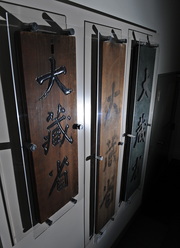
Great caption from the Nikkei.com English service: “Like these historic ministry nameplates, the Ministry of Finance has survived war and economic downturns with its powers intact.”
Here’s a list of major political pressure groups in Japan and their vote-rallying power, again from Nikkei. Most of them are not hesitating to ditch their support for the LDP in favor of the new patron.
Dentists’ association (日本歯科医協会) – 228,000 votes
National construction industry association (全国建設業) – 227,000
Medical association (日本医師会) – 186,000
Pharmacists’ association (日本薬剤師協会) – 168,000
Nursing association (日本看護協会) – 167,000
A lot of new stuff going on in my life prevents me from posting much, but I felt I should weigh in with this tip for fellow commuters in Japan:
Business weekly Shukan DiamondPresident has an article that explains how you could potentially save around 9,000 yen a year by buying two commuter passes — one that goes most of the way, and another that covers the rest of the ground. Because of the oddities of Japan’s train pricing system, your commuter pass might go up or down if you split your commute into two separate passes.
But it’s not as simple as buying two train passes along the same route. If you do that, generally you’ll have to either get off and on again halfway through your commute, or explain to the station attendant every time you get off the train. Not practical.
But one successful example they give is this: If you live in Omiya and commute to Tokyo Omori station, you could save 9,060 yen a year by buying one pass from Omiya to Ochanomizu, and the second from Ochanomizu to Tokyo Akihabara to Omori. This will let you ride all the way to Tokyo Omori (and let you stop at Ochanomizu at no charge if you want).
As you can see, it can get kind of complicated. To help sort things out, someone has developed an application that determines the most advantageous route for any given individual. Sadly, it’s already gone viral and is thus unavailable.Those who don’t want to wait for them to add server space and Google ads can try experimenting with Yahoo’s train route finder in the meantime (if you’re desperate, try waiting until late late at night when most others are sleeping. If you do, open a mirror site for the rest of us!).
The article states that this practice is hardly new and has been used by train-savvy salarymen for some time now.When some of Tokyo’s planned new routes come online it should create whole new levels of complexity to exploit.
(Diamond article found on Yahoo Japan front page)
Note: This practice is not the same as a train scam known as kiseru in which the rider has a ticket for the beginning and end of the trip but skips out on the rest of the fare.
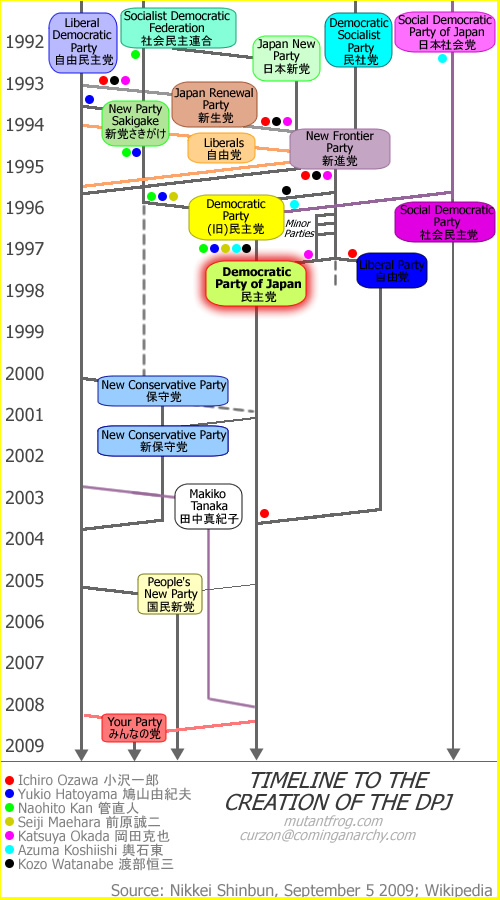
The Nikkei on Saturday had a chart of the history of the Democratic Party. I have translated, and substantiated, the graph and included it below here.
Thus did the party arrive at it’s coalition today of LDP defectors, socialists, and free market conservatives. After a decade of wondering what the DPJ would do in power, we finally get to see what happens. Let the party begin.
Reports are out that Katsuya Okada will be the foreign minister in Hatoyama’s first cabinet, which is (unfortunately) not nearly as cool as the footnote to the AFP report:
One of [Okada’s] more peculiar hobbies is collecting items that depict frogs. But there is a serious political point — “frog” in Japanese is a homonym for “change” — the slogan used by the DPJ during last month’s election campaign.
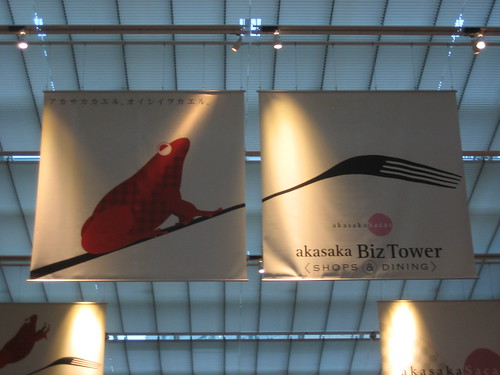
This is a fairly popular pun in Japan. Last year I came across this banner at the Akasaka Sacas complex in Tokyo. It says “アカサカカエル、オイシサヲカエル” (Akasaka kaeru, oishisa wo kaeru) which could be read several ways, such as “The Akasaka Frog is changing tastiness,” or perhaps “Change Akasaka and frog the tastiness.”
In case you didn’t catch it, you can watch me commenting on the other night’s election results with Ken and Garrett from Transpacific radio and special guest International Attorney Christopher Gunson.
Skip around a little because apparently there are parts where the sound didn’t quite work. All the same you can hear us cover:
Our election predictions, which are almost instantly shown to be way off
How the lower house members are chosen
Breakdowns of several races
What the religious parties New Komeito and Happiness Realization Party are all about
What kind of makeup politicians use to smooth out all their wrinkles to achieve the signature “Ichiro Ozawa as slimy salamander” look (thanks to viewer Kozo, we now know they use a kind of grease-based face makeup known as ドーラン in Japanese).
And much more!
Once again, thanks so much to TPR for putting everything together and making it a spectacular evening (and for all the pizza too). Also thanks to Marcus for going out of his way to do the sound and video (he even brought a TV light!)
There’s a lot out there, but these two took the cake:
Next first lady feels affinity with Michelle Obama
Miyuki Hatoyama, who has a certain bug-eyed similarity to her alien-looking husband, has said she feels affinity with Michelle Obama. Next weird line: “He is blessed by his ancestors and his supporters and protected by their power, so whatever happens, he should be all right,” she said.” Man, I would have loved to see that in the original Japanese, if such an article exists perhaps some intrepid googler can track it down for me. She also wants their son, a shy engineer studying in Moscow, to run for office soon, a statement not exactly in line with the DPJ’s pledge to end hereditary politics.
Japan’s Underpopulation Crisis Led to Recent Election Upset Demographer Says
Lifenews.com, an anti-abortion news site based in the US, has said that Japan’s demographic crisis led to the DPJ win. Without explaining the logic behind that assertion, we heard that legalized abortion is the cause of the upheaval — which I declare to be complete nonsense considering the frequency of “dekichatta kekkon” in Japan, although I don’t have stats to back me up.
In line with the overall nationwide trend, voters chose DPJ candidate (and ryokan heir) Tairo Hirayama to represent Tokyo’s 13th district (covering all but the western end of Adachi-ku). Hirayama beat LDP incumbent Ichiro Kamoshita by a small margin of 3,000 votes. Kamoshita will stay in the lower house as a proportional representation member, which will make things awkward if they ever run into each other in the halls of the Diet building.
In a statement on his website written last night, Hirayama adopted the same cautious tone as PM-to-be Hatoyama. He thanked supporters but said he considers the votes to be not for him personally but instead as votes for a change in government. Since he had already taken some painkillers to combat his lower back pain (ぎっくり腰 a new vocab word for me) he expected to stay up all night before heading to Kitasenju Station this morning to thank voters for their support.
At 62.82%, voter turnout in Tokyo’s 13th was lower than the 69% national average and not much higher than turnout in the July Tokyo assembly election.
***
Hirayama might want to shake hands with Kazumasa Fujiyama, his rival candidate from the Happiness Realization Party. Though Fujiyama received less than 3,000 votes or 1.1% of the total, that was just about in line with Hirayama’s margin of victory. Had those voters gone LDP the race would have been much closer. Even considering that the HRP voters were almost all Happy Science followers, Hirayama should thank his spirit guide that Okawa didn’t decide to throw his weight behind the LDP this time around.
Nationwide, the HRP failed to win a single seat or even surpass 1% of the popular vote in most districts. Without any significant voter support, the party stands to lose over 1 billion yen in security deposits for the more than 300 candidates it fielded.
Happy Science’s political movement, born of guru Ryuho Okawa’s vision of a nuclear holocaust, has failed. At one point it appears they considered giving up before the election, but in the end this was a bad idea that took on a life of its own. In a personality cult, once the leader sets his mind to something it can be very hard to stop. The leader himself may hesitate to admit to a mistake out of fear he’ll lose credibility, and of course his followers who think he’s a divine being would never go against his wishes.
I hope the authorities will keep a close eye on this group as it’s possible Okawa may still feel the urgent need to save Japan from certain doom by taking control of the government.
***
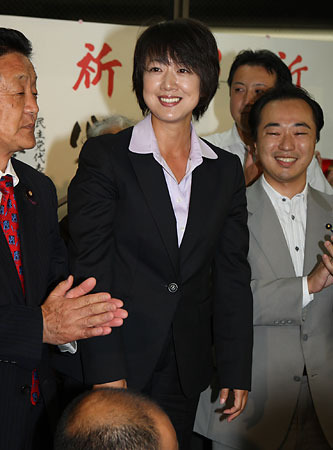
Perhaps the biggest national story set in Adachi-ku is the DPJ’s defeat of New Komeito President Akihiro Ota in Tokyo’s 12th district (covering Kita-ku and the western tip of Adachi-ku) was yet another humbling setback for the ruling coalition. Former DPJ President Ichiro Ozawa had considered running against him but decided to field a different challenger, singer and DPJ upper house member Ai Aoki (see photo above) instead. It ended up working, and Ota, who had not run in a PR spot, will have to turn in his MP badge (and of course resign as New Komeito leader).
Update: Follow my Twitter stream for random thoughts on the election.
Today the polls are open for Japan’s 45th general election. It’s all but certain that the opposition DPJ is going to make significant gains, and might even win a two-thirds supermajority.
So while the results aren’t exactly in doubt, my colleagues and I will still try and keep things interesting. I’ll be following the election all day, and tonight I’ll be on live with Transpacific Radio.The coverage starts at 8pm Japan time and you can access the video feed here. See this link for more info on the live video.
For now, I’ll leave you with a couple photos I took of my local polling station:
Now that I’ve covered my local race, now it’s time to take a brief look at some of the more notable candidates for Tokyo’s 17 proportional representation seats. I am limiting myself to candidates who are only running for PR seats, not those who have doubled up with a simultaneous candidacy in a single member district (With two exceptions: The DPJ’s Tairo Hirayama and LDP’s Ichiro Kamoshita are both running as PR candidates in the first spot in addition to Tokyo’s 13th). This means we are scraping the bottom of the barrel – candidates included just in case the party does well. We can’t be sure any party really believes in these people, but they are trustworthy enough to gain party backing.
Keiichiro Nakayama, political commentator (People’s New Party, never before elected) – A former Yomiuri reporter turned independent commentator who served as a member of Yoshiro Mori’s PR team when he was prime minister (not exactly a stellar record…) He ran for the upper house in 2007 under the PNP ticket but lost. He has penned several books, apparently getting his big break covering the short-lived Takeo Miki administration (Miki took over from Kakuei Tanaka following the Lockheed bribery scandal and overreached in his efforts to achieve political reform), and seems to have made his career as one of those political reporters who becomes a mouthpiece and fixer for the politicians he’s supposed to be covering as a journalist.
Kazuo Ishida, LDP Tokyo Prefecture staffer (LDP, age 65, never before elected) – Ishida is the 28th and final candidate on the LDP’s PR roster. In 2005, their last choice for PR candidates was Taizo Sugimura, who got in and has come to be widely considered a disaster. It’s possible they decided to go with the safest possible candidate (a lifelong party man who has no delusions of grandeur or, from the looks of it, any real ambition).
Junichiro Yasui, lower house member (LDP, never before elected) – Yasui is one of the Koizumi children who won his diet seat in 2005 on the wave of LDP support for Koizumi’s postal privatization plan. He’s a dropout of Waseda University but was known as the head of the Waseda retail district (one of the familiar-looking shotengai that you see around Japan). Once again he is low on the PR list and will probably not make it in this time.
Masaaki Kuniyasu, former ambassador to Venezuela, former ambassador to Portugal (LDP, age 71, never before elected) – This guy doesn’t look happy to be running for election with such slim hopes of victory. He’s also toward the bottom of the LDP’s Tokyo PR list. According to his Asahi questionnaire, he’d like to see Japan known as a “an environmentally advanced nation.” It appears that he (or someone with the same name) wrote a book in 1996 titled The Truth Behind The Philippines’ People Power Revolution.
– The New Komeito are running two people named Takagi next to each other in the Tokyo PR block, but they appear to be unrelated. One, Yosuke Takagi, is a former Mainichi Shimbun reporter.
Eiko Ishige, NPO board member, author (DPJ, age 71, reelected three times) – Thanks to Jiji I know she her sign is a Leo. Her field of specialty is elderly benefits, and she has written several books on the topic, including The Elderly and Welfare (A Book to Understand the Elderly). Judging from the title of one of her books, she considers herself a citizen activist. Her name has a difficult kanji for Ei that won’t show up when you try to search for it.
– The Happiness Realization Party has adopted a strategy of placing recognizable names in their PR spots. The bassist from the Blue Hearts, a manga artist, and shady inventor Doctor Nakamats are all there in the Tokyo block. The former two are apparently believers, but Nakamats is just looking for cheap promotion just as he was when he ran to be Tokyo governor in 2007. He charges exorbitant amounts for dubious-looking inventions such as the Love Jet 69 sex toy available for 30,000 yen plus shipping.
OK, that’s it for now! You can see me tomorrow night with the live coverage of the election results with the good people at Transpacific Radio.
The final candidate in Tokyo’s 13th district is Kazumasa Fujiyama, running under the Happiness Realization Party ticket.
Before I get to this guy’s profile, I want to quote from an excellent piece on the party from the Irish Times:
Founded earlier this year to offer voters a “third choice”, the HRP has an eye-catching manifesto: multiply Japan’s population by 2.5 to 300 million, overtake the US to become the world’s premier power, and rapidly rearm for conflict with North Korea and China.
If elected, its lawmakers will inject religion into all areas of life and fight to overcome Japan’s “colonial” mentality, which has “fettered” the nation’s true claim to global leadership.
… A new book, The Guardian Spirit of Kim Jong-Il Speaks , by party founder Ryuho Okawa explains that earlier this month at a session in the party’s Tokyo headquarters, the voice of Kim’s guardian angel warned of his plans. But at least Kim is alive – Okawa also claims to be able to receive the thoughts of Japan’s notorious wartime monarch, emperor Hirohito (1901-1989), and his deceased predecessors.
Being able to commune with the dead is but one string to Okawa’s bow. A reincarnation of Buddha, he achieved great enlightenment in 1981, according to the party’s website, “and awakened to the hidden part of his consciousness, El Cantare, whose mission is to bring happiness to all humanity”.
Before he founded the Happy Science religion in 1986, Okawa wrote books under the names of Muhammad, Christ, Buddha and Confucius. Conveniently, if improbably, speaking in Japanese, some of the prophets had much the same message: Japan is the world’s greatest power and should ditch its constitution, rearm and take over Asia.
…
The Happies boast that they have sold 11 million copies of their bible, Shoshin Hogo (The Dharma of the Right Mind), in Japan since 1986, and opened 200 temples.
Okawa’s books, mixing new-age philosophy with self-improvement tips and political views, have sold millions more, apparently providing the funding for the campaign. Translating those beliefs into political power, however, has proved easier said than done. Tokyo voters shunned the Happies’ candidates in this month’s municipal election, which ended LDP rule in the city and set the DPJ up for a historic national win next month.
Also, you might be interested to see the Happy party’s new manifesto video. It’s very similar to the one they produced for the Tokyo assembly elections (that animated treasure was unfortunately taken down), only this time slightly more professional:
Now, to the candidate:
Profile: An architect by trade, Fujiyama became a full-time Happy Science member in 1995 and has since risen to become a leader in Tokyo – he previously served as the head of the Science’s Nippori Branch and Adachi Branch before being named deputy leader of the Tokyo Branch in 2009.
Before becoming a full-time Happie, Fujiyama was an employee of Haseko Corporation, a construction/engineering firm that’s listed on the Tokyo Stock Exchange. It’s unclear whether he was a member of Happy Science before 1995 or if he
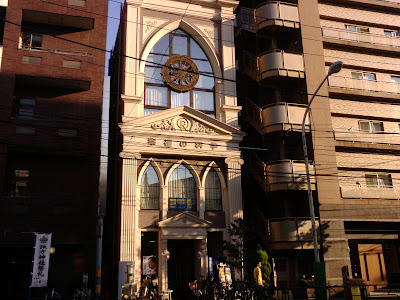
One of Fujiyama’s bases of operations is the Science’s Nippori branch (seen here on Google Street View), which I happened to spot during a walk the other day:
Policy: As all Happiness Realization Party candidates appear to be carbon copies of one another, it’s no surprise that Fujiyama supports all the planks mentioned in the above video – slash taxes, smash North Korea, and somehow make Japan the world’s biggest economy by 2030 (I suspect they’d have to destroy all other countries to do this).
When asked in an Asahi questionnaire about how he would like the world to see Japan, he answered as “a great economy.” (経済大国)
Fujiyama claims in a blog post that the owner of a building near Kameari Station said she’ll support him because she hates paying consumption taxes.
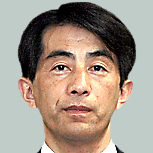
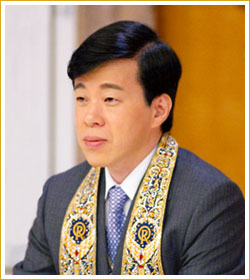
Something interesting: Fujiyama bears an eerie resemblance to party founder and leader Ryuho Okawa:
Fujiyama:
Okawa:
OK, I’ll admit that their parts are on opposite sides, but don’t you think they both have a sort of “divine salaryman” look going on?
***
My next and final profile post will look at a few of the Tokyo proportional representation candidates.