Yomiuri and Asahi both Call for Moratorium on Implementation of PSE Mark Enforcement

Major Japanese dailies Asahi and Yomiuri, who rarely agree, have both come out in favor of postponing enforcement of the mandatory electrical safety testing of used electronics and appliances (known as the PSE Law and last mentioned on MF here). The Yomiuri is especially hard on METI, the government ministry responsible for the confusion:

Ministry to blame for PSE mark confusion

The Yomiuri Shimbun

The current confusion arising from the planned introduction of the product safety of electrical appliances and materials (PSE) mark must be dismissed as the result of the makeshift policy on the issue adopted by the Economy, Trade and Industry Ministry. There are concerns that the confusion could worsen.

All this has caused the ministry to hurriedly reverse its policy, permitting the sale of vintage instruments and some other items without the PSE mark. The abrupt change indicates the ministry may be willing to acknowledge it has not properly prepared to introduce the PSE program.
Continue reading Yomiuri and Asahi both Call for Moratorium on Implementation of PSE Mark Enforcement

The beauty of the warranty

Over the past couple of weeks I have had the fortune of testing the warranty services of three different companies.

First, my 200GB SATA Seagate hard drive began developing bad sectors. Knowing full well that this is always a preliminary stage of drive failure (the variable is how preliminary-it could be hours or months) I hastened to move all of my files onto other avaliable hard drives, of which only a small number of mp3s and (hopefully) unimportant photos were unrecoverable. This first occured during my last week in Taiwan, the last time at which I wanted to be bothered with such irritating tripe, so although the file backup was unavoidable, I waited to call Seagate until a couple of days after I returned home to Jersey.


Continue reading The beauty of the warranty

Uniqlo arrives in the US

I had actually heard about this a few months ago, I think on some Japanese news site. But yesterday I was surprised to see that The Motley Fool had reported on it.

You’ll have to forgive me for not catching this one sooner. A year ago, I wrote about the possibility of Japanese retailer Fast Retailing’s Uniqlo business setting up shop in the U.S. and the potential competitive problems that could cause for Gap (NYSE: GPS). However, it looks like I wasn’t paying close enough attention, because in the last six months, Uniqlo has opened three stores in New Jersey and now has one store open temporarily in the SoHo neighborhood of Manhattan.

I must admit, I was a little puzzled to see that their first three stores were in New Jersey malls, at least there is some kind of sense to it. After all, while we may not have the largest mall in the country, we are the undisputed center of the shopping mall lifestyle – as much as that association pains my holier than though New York oriented Montclair ass. Now, the fact that their next store was in Soho really shocked me. At least, shocked insofar as I can have any kind of emotional reaction to retail clothing. Which, I should not have to inform you, is rather minimal.
Now, will Uniqlo have any impact? Well, they’ve already managed to expand profitably into China, Korea, Hong Kong and apparently, England. I assume that if England had been a flop they would never have bothered with the US. But what does the Fool think?

Overall, I still believe Uniqlo poses the biggest threat to Gap’s namesake stores and its Old Navy shops, because the price point, style, and level of quality are similar. Whether or not Uniqlo ends up being a true threat will take years to play out, and Uniqlo will also need to prove that it will endure in the U.S. and is not just a passing fad. As a customer of Uniqlo for a number of years, I believe the company can compete successfully, largely because the company has had some success in the U.K., Hong Kong, and Korea.

I must say, I always liked Uniqlo well enough when I was in Japan. I have a jacket from there that I’m rather fond of, and the zip-up black hooded sweatshirt I got almost 4 years ago for something like 2500 or 3000 has very possibly been worn more days in total than any other single piece of clothing that I own, but in all honesty the main attraction of Uniqlo was that it was the only decent store in Japan where I could find clothes that I was comfortable with at a decent price. While the Gap and Levis stores in Kyoto might offer clothing that I would be willing to wear, they did it at prices dramatically higher than I would pay for identical items in the US, while Uniqlo, despite being in Japan, cost no more than the Old Navy at the Willowbrook Mall a short drive from my house in Jersey. Uniqlo may be a pretty good store in Japan, but is there any particular need in this country for a Japanese clothing brand whose style is, in my eyes, virtually indistinguishable from the preexisting mainstream American brands?

Update on used electronics restrictions – some good news

Update to an earlier post where I discussed Japan’s new restrictions on sales of second hand electronics. I’ll start by summarizing what I know about the issue so far, and then add the good news at the end.

To summarize, Japan is (from April 1) requiring that most used electronics older than 5 years of age must be certified as electrically safe for usage before resale, which puts a serious cramp in the business of small scale used goods stores. While few people really care about being able to get their hands on a decade old refrigerator or rice cooker, fans of vintage electronic musical instruments were particularly outraged, and organized a strong campaign against the new regulations.
This issue became widely discussed on the English internet when retro gaming fans became scared that sales of used consoles would become illegal. I pointed out that foreign export sales of all items will remain unrestricted, which is at least a boon to retro electronics fans outside of Japan, but it could still potentially cause problems for Japanese gamers.

Since the regulations are about electrical safety, in the case of units that operate off of an external power supply, it seems that only the power supply itself will be tested, and there will also be a grace period of 2 additional years before regulations regarding AC adapters and power cords come into effect. Now, it would be possibly to replace the old power supply with a newer one of the correct voltage/amperage, but that’s a rather serious step for an ordinary gaming store, and would probably cause serious price increase. Also, there are unfortunately a few models of consoles that integrated the power supply, which means that they will be affected right on April 1, without the AC adapter related grace period.

HOWEVER, thanks to an anonymous comment, I noticed that there is some very good news on this front. In fact, I’ll just repost the text of the comment below, since it covers it pretty well.

Yesterday March 14, 2006 the Japanese ministry in charge of the PSE law and its interpretation announced that “Vintage Electric Equipment” including guitar amps, audio, electric musical instruments, and electric powered photographic equipment etc. will be exempted from full PSE testing requirements, and will be allowed to sell after a simplified registration procedure is followed by the merchant.

For those who can read Japanese, see news item at Yahoo Japan:
http://dailynews.yahoo.co.jp/fc/domestic/pse_law/
http://headlines.yahoo.co.jp/hl?a=20060314-00000053-mai-bus_all

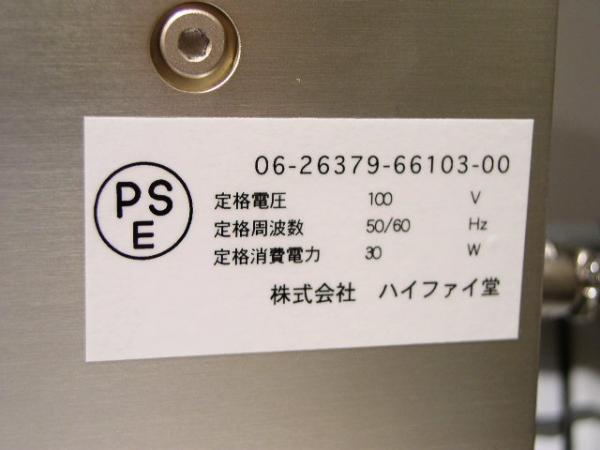
Also notice that major second-hand audio retailer HiFi Do had already registered with the ministry as a re-manufacturer of used audio equipment and has set itself up to do fully compliant testing and certification, and also will equip each piece of used equipment they sell (after testing and modifying the equipment to comply with the law) with a properly registered PSE sticker.

See http://www.hifido.co.jp/merumaga/osu_sale/060310/

So this means the good Ryuichi Sakamoto (who campaigned against the law prohibiting sale of vintage synthesizers etc.) and his friends were successful.

Check out that last link for a neat series of photos of the solder-smiths at Hifido testing, repairing, and certifying equipment under the new PSE regulations (the source of the above image.)

According to the Mainichi Shinbum, the Japanese Synthesizer Programmers Association delivered a petition with 75,000 signatures to the PSE office, prompting their decision to reclassify musical equipment. This is obviously great news for fans of vintage music and photographic equipment, it also offers hope to retro gamers. While gaming machines (software and peripherals are of course safe, since they aren’t serious electrical conduits) are still classified as restricted items, this decision clearly opens the door for their inclusion on the list of vintage, exempt, items. While their may not be a Japanese Vintage Gaming Association, I wouldn’t be surprised to see some higher-ups from companies like Nintendo or Sega step forward and ask the government not to cordon off their legacy with red tape.

Japan called upon to curb small arms trade

You may have read this post I made a little while back, discussing Japan’s international trade in small arms under the guise of “sporting equipment,” in defiance of their official stance against exporting weapons. Well, the Japan Times is carrying a brief Kyodo article stating that a London based group is now asking Japan to lead the fight against international small arms trade.

Japan urged to champion curbs on firearms trade

By WILL HOLLINGWORTH
LONDON (Kyodo) Campaigners on Monday called on Japan to lead efforts to strengthen the international code on the export of small arms.

The London-based International Action Network on Small Arms, a group of more than 700 civic organizations around the world, wants the rules to be made more explicit to deter exports to countries that abuse human rights.

It will call on members of the United Nations in June to strengthen the code and wants Japan to take more of a lead in discussions.

IANSA estimates that more than 300,000 people are killed each year by small arms, with the largest number of deaths occurring in Russia, Latin America and the United States. Legal trade in small arms is worth $ 4 billion annually, with another $ 1 billion generated on the black market.

In its domestic laws, Japan recognizes how deadly small arms can be. There are a growing number of countries which are getting behind the idea of an international treaty to stop small arms transfers to countries which abuse human rights, or where they are going to be an obstacle to sustainable development,” said Rebecca Peters, director of IANSA.

Have you noticed the curious omission from this article? Nowhere does it mention why Japan should be the country taking the lead. Is it because Japan is known as a nation of pacifism with an official policy of not selling weapons, or is it because they violate that very policy and are being asked to begin the reforms at home?

Saipan, Desperate for Japanese Tourist “reparations,” Offers to Open its Own Version of Yasukuni

The governor of Saipan has made a morbidly cynical offer to the Japanese families of those who died in the bloody Battle of Saipan:

Banzai Cliff as cemetery for Japanese war dead?

By Agnes Donato
Reporter

Monday, March 13, 2006

The Banzai Cliff in Marpi could soon turn into a cemetery for the Japanese war dead, with the governor offering the property to the families of World War II soldiers who lost their lives on Saipan.

Gov. Benigno R. Fitial announced Friday that he had received two pledges of donation amounting 10 million Japan yen (about $84,000) each for the planned cemetery.

A separate offer of $100,000 has also been made for the sole benefit of the Public School System, he said.

“I am making land available at Banzai Cliff for Japanese groups to build a temple. This temple will be a token of our appreciation for the Japanese people visiting Saipan. I am also offering the same property to all the families and relatives of 47,000 war heroes who lost their lives here on Saipan to come and erect monuments,” Fitial said during his weekly press conference.

I can’t think of a more depressing idea. The Banzai Cliff was what hundreds of Japanese civilians jumped from in the aftermath of the battle. They chose to end it all rather than be raped and tortured by the Americans (UPDATE: …or so they may have believed. Another blogger, objecting to this “spin” – though it was unintentional – helpfully pointed out some of the sacrifices US soldiers made to save Japanese civilians in Saipan. Take a look.). I remember seeing on the History Channel a mother jump with her child no more than 50 feet from the American soldiers who looked on with a video camera rolling.

But will this save Saipan’s embattled tourist industry? It remains to be seen:

Tourist arrivals from Japan continue to drop as a result of Japan Airlines’ decision to cease all regular, scheduled flights to Saipan in October 2005.

Data from the Marianas Visitors Authority showed that the CNMI received only 25,555 visitors from Japan in January 2006. This represents a 29-percent decline compared with the 35,795 Japanese who came to the islands in January 2005.

But MVA is hopeful that the Japan market would recover when Northwest Airlines increases the frequency of its Tokyo flights beginning next month.

Northwest, which currently operates seven weekly flights between Saipan and Narita, will have 10 flights a week between the two points starting April 24, 2006.

The new service will operate a second Boeing 747 jumbo jet from Tokyo, flying three times a week. The aircraft will carry 400 economy and 30 business class passengers.

Homework assignment: Does anything similar exist in the world? There are certainly things like the Normandy memorial or Auschwitz, but are there any war memorials designed almost purely as tourist traps? I’m kind of offended — maybe Saipan does suck!

Avoiding lameness in Narita ground transportation: a primer

I leave in a few hours to spend my spring break in Florida—actually one of the last places I expected to spend spring break, but Ms. Joe has a new, difficult job and needs someone to give her backrubs at night.

Anyway, Narita is a really inconvenient airport. No matter how you do it, it takes at least an hour to get there from the city. Then there’s the time you have to spend getting to wherever you’re boarding your transportation, and the time you have to spend wandering around the terminal to get where you need to be. If you’re like me, you also have to factor in the time you spend being held for questioning.

It used to be worse, actually. Back in the day, the trains to Narita didn’t even stop at the terminal. You had to get off on the edge of the airport property and then take a bus. Fortunately, the Transport Minister figured this was daft, and he opened up some underground platforms that were originally intended for a Shinkansen line. (He’s a great guy—his name is Ishihara.) So today, the trains drop you off inside the terminals… but you still have to go up four stories to get to check-in. Hmpfh.

So what’s the best way to get to and from the airport? Continue reading Avoiding lameness in Narita ground transportation: a primer

A question of national economic security

I’ve been posting recently on the global backlash against FDI. So, in scanning today’s news, this headline caught my eye: “INTERVIEW-China official slams foreign investment spree.”

Here’s a sample:

Li Deshui, head of the National Bureau of Statistics, called for legislation to curb “ill-willed” acquisitions of domestic companies by foreign firms… Echoing recent concerns over China’s sale of stakes in its major banks to foreign investors, Li said that unchecked acquisitions by foreign multinationals could pose a threat to China’s economic security.

Reading this latter remark made me wonder just how one nation’s “economic security” should be defined. Where does one draw the line? Borders are the obvious place to start, but everyone knows that this is no longer true. The same may be said of nationality.

Let’s face it, when it comes right down to it, when someone (be it a company or an individual investor) stands to lose millions or even billions of dollars on an investment, national economic security goes right out the window along with concern for everything else but one’s own ass.

Think about a bank run: are those people lining up to withdraw their deposits before the next guy concerned with national economic security? Of course not. They’re worried about their own damned money.

I don’t mean to downplay the seriousness of the issue. “Bank runs” on an international scale are exactly what governments are worried about. But they should consider other ways of preventing such things from happening (i.e. better policy or more effective regulation) than by prohibiting them altogether. You don’t deal with bank runs by outlawing banking; you deal with them by creating systems of deposit insurance, by providing lenders of last resort, and by requiring banks to keep a certain percentage of deposits on hand at all times.

Say it with a nose

From the greatest magazine on Earth:

This Valentine’s Day in Shanghai, people said “I love you” not with roses but with noses. Business at Shanghai’s plastic surgery clinics has risen by 30% since the beginning of the month, a trend fuelled by Valentine’s Day and the Chinese New Year, when young people receive job bonuses and cash presents from relatives. Some clinics offered special Valentine’s Day packages, such as a 20% discount between February 14th and 17th. The most popular treatment was for couples to opt for matching noses, or to have their eyes reshaped.

Liu Yan, who is 24, was quoted in a newspaper as saying, “I suggested it [to my boyfriend] as a way of celebrating our relationship and bringing us closer together with a special kind of bond.” Miss Liu said her 28-year-old boyfriend “loved the idea of matching noses”, and readily paid the 10,000 yuan ($1,200) for the surgery.

Watch who you talk to

From today’s NYT article on the contents of newly released documents on the Guantanama Bay prisoners.

Another Saudi, Mazin Salih Musaid al-Awfi, was one of at least half a dozen men against whom the “relevant data” considered by the annual review boards included the possession at the time of his capture of a Casio model F-91W watch. According to evidentiary summaries in those cases, such watches have “been used in bombings linked to Al Qaeda.”

“I am a bit surprised at this piece of evidence,” Mr. Awfi said. “If that is a crime, why doesn’t the United States arrest and sentence all the shops and people who own them?”

Another detainee whose evidence sheet also included a Casio F-91W, Abdullah Kamal, was an electrical engineer from Kuwait who once played on his country’s national volleyball team. He was also accused of being a leader of a Kuwaiti militant group that collected money for Mr. bin Laden.

As for the Casio allegation, Mr. Kamal said the watch was a common one in Kuwait and had a compass that could be used to find the direction of Mecca for his prayers. “We have four chaplains” at Guantánamo, he said. “All of them wear this watch.”

Obviously the real issue is not are any of these men innocent, but how long as Casio been in league with the terrorists.