
J-Cast on the new Ghibli movie: A chance to “re-educate” Goro

English-only Ghibli fans might be interested to know how people are reacting to the recently announced new Ghibli film “Ponyo of the Cliff top”. J-Cast has the story:

Hayao Miyazaki to Re-educate Son with New Film
Mar. 20

Director Hayao Miyazaki’s latest project, “Ponyo of the Cliff Top” was announced yesterday for a summer 2008 release. The main character, a 5-year-old boy named “Sosuke” was modeled after Miyazaki’s son Goro. Goro directed the Ghibli project “Tales of Earthsea” in 2006, and while the film was a major hit, many slammed how the film turned out. As a result, Hayao is attempting to re-educate his eldest son, and has included a message in the film of how he wants his eldest to turn out. Or at least that’s what everyone is saying.

The 5-year-old Lead Resembles Hayao’s Son
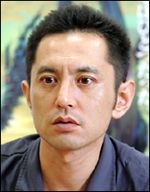
goro-nni20060814ti7miyzk01.jpgThis will be the first film from Hayao Miyazaki ever since Howl’s Moving Castle achieved huge box office totals of 19.6 billion yen when it was released 4 years ago (November 2004). The new film is a story of Ponyo, a goldfish princess who wants to become human, and the five-year-old Sosuke. Producer Toshio Suzuki explains, “This is kind of like Miyazaki’s version of ‘The Little Mermaid.'” Tales of Earthsea, which came out last year, was supposed to have been directed by Hayao himself — he negotiated the film rights with the original author 20 years ago — but the director changed to his eldest son, Goro (pictured). As J-Cast reported earlier:

“Ghibli’s Suzuki said in an interview ‘(Hayao) said that “it would be inconceivable for Goro to take the helm.” In other words, he was totally against Goro directing it.'”

Afterward, Suzuki convinced Hayao to go along, but while the production ended up being a hit, the movie received less than favorable reviews from viewers and the original author.

The father-son feud was reported as follows in a March 20, 2007 article in Sports Nippon:

“Sosuke was modeled after Goro Miyazaki, Hayao’s 40-year-old eldest son. Goro made his directorial debut with Tales of Earthsea last year, and Hayao interpreted his son’s actions as a rebellion against his father, reportedly expressing remorse: “Things turned out this way because I was working all the time and didn’t spend time with Goro when he was 5 years old. [I’m making this] so there won’t be any more children like Goro.”

It looks like this will be a film about regrets over raising an eldest son.

“Thank goodness it’s Hayao!”

Since Hayao Miyazaki has made several statements indicating he’s retiring from directing, rumors had been circulating on the Internet wondering if there would be another Hayao-directed film. Perhaps influenced by such concerns, there are lots of blog entries from Yahoo, Livedoor, and Excite-hosted blogs placing their hopes in Hayao:

“Thank goodness it’s Hayao!!! But it looks like the kid is modeled after Goro…”
“Yes!!! YES!!!! I LOOOOOOOVEEEE Miyazaki’s movies!! Goro’s movie was just so poorly received I still haven’t watched it [Translator: Same here!], but I wonder how Earthsea turned out? Hayao’s movies almost never fail to please, so I am simply looking forward to it.”
“I am looking forward to this. Since this is coming after Goro Miyazaki seems to have misjudged the public, I am interested to see how people react to this one.”

Will this new film feature the father’s overwhelming dignity and serve to re-educate Goro?

Comment: This looks like a continuation of the human drama initiated and encouraged by Ghibli (who printed Goro’s blog that detailed the feud and an interview with Suzuki that explained more about it) since it was learned that Earthsea would be directed by the inexperienced Goro. Since, as J-Cast notes, Earthsea ended up being a hit despite bad reviews, perhaps the promoters and investors (which include notorious hit-generators Hakuhodo and Dentsu) see this reality-show spectacle as an effective way to generate hype. The personal stories probably resonate with fans of Studio Ghibli, which was voted Japan’s top-ranking brand name in a 2006 poll of consumers conducted by Nikkei BP:

Miyazaki magic

Studio Ghibli stepped up from second place in the 2005 survey, receiving fairly high marks in two of the four categories the survey conductors determined to be key factors in creating brand power. The two categories were friendly and outstanding.

The animation studio has spawned an array of popular films, such as “Howl’s Moving Castle”, released in 2004, successfully connecting with consumers on an emotional basis.

Resonating with consumers is the ultimate goal of corporate marketing.

A recent trend in Anime: Small production teams (think Homestarrunner or Adult Swim)

An interesting piece from FujiSankei Business-i (in translation):

Animation Produced in Small Teams is a Breath of Fresh Air for the Industry: FROGMAN Co., Others Showcase A Powerful Individuality
March 13, 2007

Animation produced in small teams have been hitting the market one after the other recently, which is a new development as works are usually produced in production teams of dozens or even hundreds of people. The new works, which maintain a high level of quality while showcasing the creators’ intense vision in every nook and cranny, a feat that can only be achieved in a small team, are blowing a new wind throughout Japan’s animation industry. (by Ryuichi Taniguchi)

Improved Performance of PCs Plays a Role

Makoto Shinkai, director of “Five Centimeters Per Second” (秒速5センチメートル) gave thanks before the 200 people who had gathered to watch his animated film shown at Cinema Rise in Tokyo’s Shibuya Ward on March 3: “I am happy to show a film that I made the way I wanted it in a large space.” This was his first film since his long-form “Beyond the Clouds, at the Promised Location” (雲のむこう、約束の場所) was shown at the same theater in November 2006. He seemed to have felt a positive response from the excited crowd of waiting fans that filled the seats.

In the past, animation production was assumed to require a large staff, but Shinkai released his first 25-minute short “Voices of the Stars” (ほしのこえ) created almost entirely by himself on a PC. The imagery, which measures up to animation made by pros, and the story, about susceptible young men and women, made the piece a hit with the younger generation and gained its creator recognition as a member of the new generation of animation directors.

However, Shinkai did not choose the path of producing his work in a major studio with a large staff at his beck and call. He continued using PCs and producing his films with a small staff to complete his “Beyond” and the more recent “Five”.

Shinkai explains, “For a year and half, I had the animation staff come to my home, and created it at a steady pace using my desktop. He didn’t create the whole thing by himself as in “Voice of the Stars,” but he made drastic staff cuts compared to the number of people involved in “Beyond.” As a result, Shinkai was able to realize a film in which his vision crept into every nook and cranny, from depictions of the lyrical countryside, to the village landscapes, to the endless sky and ocean.

Productions that can make full use of the creator’s individuality because of such a small staff are made possible by high-performance PCs that can be used to draw, color, and even edit finely detailed images. It’s easy to see how individual creators like Shinkai can make it into the animation industry if they have talent and backup in terms of funding.

Product Placement Comes to Anime

The films produced by FROGMAN Co, led by a man who goes by the same name, were also born of superior talent, a PC, and the Internet. The company creates animation using Flash, an animation software that can play simple video on a PC, and began offering programs on the Internet starting in 2004. These short films gained an following, and in April 2006 FROGMAN’s “Falcon’s Claw, Secret Society” (秘密結社鷹の爪) debuted on TV Asahi.

On March 17, “Falcon’s Claw, Secret Society The Movie: The Fuhrer Dies Twice” (総統は二度死ぬ) opens in theaters. FROGMAN spoke at a sneak preview held in Roppongi on March 4: “I’m so happy because cinema is the apex of film.” Just as in the TV version, FROGMAN does almost all the voices himself and drew most of the animation. He was overjoyed to see his brainchild up on the big screen.

The big-screen version of course cost more, but the costs were covered by including product placement within the film. Since it’s a comedy, the film blatantly displays company logos and products to make the crowd laugh. They even included a “budget gauge” on the side of the screen that dips during the more elaborate CGI scenes as a gag for the audience.

Another Internet-based talent is Rareko. She published her work on the Internet and eventually worked into picture books and DVDs after they became popular. As more and more companies seek out dormant talent, it looks as though we’ll keep seeing unique, individual animation.

The Companies Backing up Individual Talent

Individuals’ talents can only blossom fully with the support of a corporation. Shinkai has received support from Comics Wave (headquartered in Shibuya) since he began work on “Voices”. CW is a company that manages publishing rights for content and scouting/development of creators. They contract with manga artists and illustrators and serve as a conduit for bargaining with companies that want to use the creators’ characters.

DLE (HQ: Chiyoda Ward), a company founded in 2001 as a company that provides consulting for the video content industry, serves as FROGMAN’s producer. In addition to producing television programs, the company also aids in Flash animation and helped bring FROGMAN into the limelight.

Fanworks (Shibuya) produces independent animation and supports Rareko, of “The Fragile Tank” (やわらか戦車) fame. When the Internet-based animation took off, they served as a conduit for commercialization demands and helped boost its popularity by forming the “Fragile Tank Coalition Force.”

To close out, here are some YouTube clips of some of the shows mentioned in this article:

Falcon’s Claw Secret Society:

Fragile Tank:

Five Centimeters Per Second:

Japanese newspaper holidays make my brain hurt

Nikkei Net warns:

Press Holiday
Morning Edition will not be updated on Monday, March 12, because of a press holiday on Sunday.

That’s right. The concept of a 24-hour news cycle (or even a day-to-day news cycle for that matter) means nothing to Japan’s newspaper companies. On Sunday, none of the major newspapers will go to print, nor will they update their websites (though to be fair, most of them slack off on weekends anyway). This behavior is unheard of in the US, but I have to admit giving reporters a day off isn’t that bad of an idea. Given the sometimes volatile nature of breaking news, there might be a similar justification to forcing reporters to sit it out a while that there is for keeping capital markets closed on holidays and after hours. Still, it’s pretty ridiculous that newspapers took the day off on the day the postal privatization bills were initially rejected (Aug 8, 2005):

As news days go in Japan, it rarely gets bigger than it was Monday. In a narrow vote, the upper house of the Japanese Parliament voted down a pivotal piece of legislation intended to privatize Japan’s $2.9 trillion postal savings system, the world’s biggest bank. Prime Minister Junichiro Koizumi had staked his reputation on postal reform, so in retaliation, he dissolved the lower house and scheduled a general election for Sept. 11. Pundits bloviated that the turn of events could even mean the end of the ruling Liberal Democratic Party’s half century of nearly unbroken control of government…

Yet if you relied on Japanese newspapers for your news, you wouldn’t have heard about those momentous events Monday. That’s because Monday was one of Japan’s monthly newspaper holidays.

The holiday coming up is less likely to make Japan’s newspapers look so obviously like archaic relics of the past, but it still bores me half to death. I mean, why are Japan’s newspapers even allowed to form a cartel and agree all at once when not to publish? More on that later.

Read more about newspaper holidays (kyukanbi / 休刊日) at the sadly defunct Japan Media Review.

Update: This citizen journalist claims that there were no newspaper holidays when he was young. I can’t seem to find when this practice started, but apparently it’s rather recent, though these days they are accepted as a part of everyday life. And as JMR notes, the wire services Jiji Press and Kyodo News as well as the sports newspapers don’t participate. I will get to the bottom of this.

JAL joins oneworld. Yawn

On April 1, Japan Airlines is joining the oneworld airline alliance, whose largest members include American Airlines, British Airways, Cathay Pacific and Qantas.

This is not really news, because JAL has been in the process of joining oneworld for years. They just happened to run into a number of issues, chief among them an oddly-structured merger with JAS, and barely compatible booking systems that required an overhaul of how JAL sells its tickets. (ANA, on the other hand, has been an integral member of the Star Alliance for years now with no major issues. Not to mention a much better safety record.)

Anyway, the main effect of the JAL-oneworld consummation is that you can include JAL on one of oneworld’s special round-the-world-type tickets. All the other benefits (frequent flyer mile sharing, code sharing, lounge sharing, etc.) were already more or less in place.

Nonetheless, JAL took out a full-page ad in US FrontLine, one of the weekly Japanese tabloids published in the US, to announce how totally awesome this transaction is. Opening line: “JAL’s New World Begins!”

Who are they kidding? I’m really into the airline industry, and I’m freaking yawning here. Get a life, JAL. The rest of us already defected to Star Alliance.

Marxy’s exciting new project

Marxy of neomarxisme is writing for a new site under the auspices of his employer the Diamond Agency called Clast, reports Jean Snow. It’s a blog aimed at “breaking down consumer and media insights in Japan.” Here’s more from Clast’s about page:

clast is a bilingual blog created by Diamond Agency to analyze contemporary consumer and media trends in Japan. The word “clast” means literally “a fragment of rock,” and we see our mission as breaking down the extremely complex systems of Japanese market culture into easily-discernible parts. At the same time, however, we also hope to break down misconceptions about the market that have buried their way into the conventional wisdom and provide a new perspective based on a multi-disciplinary analytical approach. Reaching consumers requires an accurate portrait of their world, and clast aims to draw that picture in vivid detail.

I know I’m overjoyed, especially with the “vivid detail” part.

The posts so far (a look at the declining magazine industry and an introduction to influential women’s fashion magazine CanCam and the women who read it) are a must-read for anyone interested in Japan’s media industry (as some of you have asked). You might not hear much about kisha clubs or other issues removed from the promotion and marketing of products, but you will definitely find out why some magazines are doing better than others and how fashion-conscious Japanese women are spending their money. How is this different from his old blog? So far, it’s more focused on the Japanese consumer issues and media. And perhaps more importantly, it does not accept comments, which have proven something of a distraction at the neomarxisme blog.

Not much else to add right now, just check out the site!

SHOCKING! Asahi.com is ending their excellent “Today’s morning edition” feature

Remember my recent post praising Asahi’s Japanese website for getting better and better? Well I take it all back. Asahi’s website is about to get worse.

Mere days after I lauded Asahi for making their Japanese-language website more useful, the site has decided to take a huge step back.

According to a Feb 26 news release, they will no longer offer the “Today’s Morning Edition” service as of March 4. The feature gave a full list of the day’s print edition headlines and offered one (almost) full-length article in each section per day. It was a great way for people who can’t get access to the paper to ascertain what is making news in Japan.

But no more. Editorials and the front-page column “Tensei Jingo” will still be available going back 1 week, but otherwise you have to go to fee-based sites such as Asahi Perfect to get access. No other explanation is given.

The Morning Edition section wasn’t started all that long ago (I can’t seem to find a reference to when they started it), but I’m presuming they started it on a trial basis to see if offering one free article per section would attract sufficient interest in the fee-based services. I’m guessing that they didn’t generate enough interest, not that the feature was marketed all that well (I didn’t notice it existed until I decided to check the editorial section one day).

If this decision is one made by the new editor that asahi.com was looking for, I humbly request they reconsider. Offering more of Asahi’s flagship content online will only attract more interest in the site and would not hurt newspaper sales.

I can understand why Asahi, the number 2 newspaper in Japan, is reluctant to take the plunge into offering more free content. Japan’s newspaper circulation has been falling much more slowly than their American counterparts. In particular, the Asahi’s circulation has declined by only 2% from 1996-2006, though that slightly outpaces the industry-wide drop of 0.5% for the entire industry (1995-2005, all figures in absolute terms). Though I can’t be bothered to dig up roughly comparable statistics, this 2005 Washington Post article indicates that US newspaper circulation has been plummeting for 20 years, due to restrictions on telemarketing and competition from the Internet/cable TV, 3 problems that have not proven major obstacles for the Japanese industry.

Still, I’m shocked that they’re just pulling the rug out from what was a great service (I mean, you wanted to read the full report on recently unearthed diaries by Major General Taro Utsunomiya describing the March 1st uprising in 1919 colonial Korea, didn’t you?). Ah well, none of this will matter come April when I’ll more than likely become a print subscriber anyway.

Business advice from J-Cast

J-Cast is a relatively new Japanese online news service co-founded by Asahi Shimbun veteran and AERA founder Masao Ninagawa. Rather than aim to serve as a straight news site like the major news media (which would be practically impossible since online news organizations aren’t allowed into government press clubs), they try to form a conduit between “primary” information (direct investigation/reporting) and “secondary” information (news reports from other companies, websites, blogs, 2ch etc) to achieve something they term “1.5-degree information.” I’ve been using the site for a while because it has an RSS feed (that lets me read entire posts in my reader no less) and often has good links or covers an issue in more detail than I can get elsewhere (such as the recent controversy over claims that Prime Minister Abe wears diapers due to recent health problems).

But what I wasn’t aware of (in yet another “news to me but maybe no one else” moment) is that they have an English site. It doesn’t seem to get updated often enough, but I thought I’d share with you this useful highlight from a series on how to succeed in business as a foreign company in the rough and tumble world of Japan’s “capitalist controlled economy” (English mistakes theirs):

Why Are Bureaucrats So Arrogant?
by Atsushi Yamada

Administrative measures are taken according to the law, but government offices, not courts actually decide how to interpret the law for implementation. Bureaucrats’ feeling like “Sairyo” (discretion) or “Gyosei-shido” (administrative guidance) often set the rule of business. People who are not accustomed to this kind of system led by bureaucrats, especially foreigners would be bewildered. There are two ways to cope with this. First off, ask government offices openly. Regarding the non-transparent measures like administrative guidance or permission rights let your lawyers ask for the view of government offices in writings. You should explain that you would like to do it as business and ask them whether it was lawful or not for avoiding the accusation later. If they do not permit, ask them the reasons for it in writings.

As Japanese government offices lead the private sector with “Aunno-kokyu” (perceived feeling), they are susceptible when they are asked for logic. Act aggressively with the backing of the law. Recently this has become very effective. When foreign companies are not abundant in Japan, they do not react seriously even if you ask for the view directly. But they are not allowed the poor treatment now, as “transparency of administrative measures” is required. This kind of measure is the right one even though the relationship with the government office might become difficult. They would see you as “lousy” and would not treat you well.

Another way is “When you are in Rome, do as the Romans do.”

You would see them with low posture and respect. Try to go often to government offices and approach government officials. Try to find time to dine and play golf together with them. Build the cordial relationship that will allow you to consult with them. If possible, become a member of the related organization and contribute to the activities of the organization. Try to become friend with “Amakudari” officials in the organization, and get the information of government offices like internal situation or frank opinions. It might be possible to have an introduction to government officials. With the introduction from the inner circle, they react differently. It might be a good way to become senior official in the related organization and skill up the negotiation tactics. It might be possible to form an industry with only foreign companies. In that case, you could find a way to receive a politician who has an influence to government offices as an adviser. But in that case, you might be forced to buy tickets when the politician held fund raising parties.

Attack from the front or take appeasement policy, judgment is manager’s task.

Deference? Golf? Political fundraisers? Screw that, I think I’ll call my lawyer.

Lame “no liquids” rule coming to Japan airports

From Bloomberg:

South Korea, Japan to Limit Liquids on All Overseas Flights

By Seonjin Cha

Feb. 27 (Bloomberg) — South Korea and Japan will expand restrictions on carrying liquids on board international flights from Thursday, to thwart terrorist attacks.

Passengers on all international flights from South Korea, including transit flights, will only be allowed to bring in liquids, gels and aerosol items in containers no larger than 100 milliliters (3.38 oz.), which must be placed in transparent plastic bags, the Ministry of Construction and Transportation said yesterday on its Web site.

The same restrictions will go into effect for all international flights from Japan, the country’s Ministry of Land, Infrastructure and Transport said on its Web site on Dec. 19.

The move is an expansion of current restrictions on flights to the U.S. and EU countries that began last year based on guidelines from the International Civil Aviation Organization, the Korean ministry said.

Food for infants and medicines will be exempt from the restrictions but must be reported to security staff in advance, the ministry said.

I thought the “liquid bomb” theory was already discredited! There needs to be some kind of multilateral negotiating body where cooler heads can veto very bad ideas like this liquid rule and infinite copyright term extension.

Sankei’s Iza! is great, Asahi’s Japanese website is improving

UPDATE: I am forced to take back my praise of Asahi.com since it has come to light that a) The photo section isn’t new or any better than other similar services; and b) They are ending the great “Today’s Morning Edition” feature.

Last June, the Sankei Shimbun corporation launched a new site called Iza! (meaning “when it counts”), a “participatory news site” that has proven groundbreaking for the online Japanese-language media. The site unites some content that was previously on disparate websites for Sankei group publications (including the flagship Sankei Shimbun, trashy daily Yukan Fuji/ZAKZAK, and sports daily Sankei Sports), features blogs run by their own reporters (such as Washington-based Yoshihisa Komori and the reporters assigned to intellectual property issues), allows the creation of user-generated blogs, displays trackbacks for all its stories, RSS feeds for everything, and — perhaps most importantly — includes a whole bunch of content that once could only be found online.

I am pleasantly surprised at the site’s quality, but at first I was skeptical that Japan’s most conservative national daily could “get it” when it comes to online news. But they do get it, and they are leaving other sites in the dust. Sankei has a motivation to revamp its business: the main Sankei Shimbun is only the 6th-place newspaper in Japan, the last among the nationally-circulated papers and behind even the regional Nagoya-based Chunichi Shimbun. One sign of success: Sankei is using the site to launch blog-inspired books, such as this one by a political reporter.

Though most of the major newspaper sites give out their editorials and some columns for free, many (Nikkei is probably the worst offender) still feature pitiful two-line summaries of their feature news articles (or brief reprints from wire services) and offer nothing that could be termed full news coverage. An August 2006 Bivings Report study of Japan’s online media market concluded that in general “Japanese papers are not taking aggressive Web strategies (except when it comes to cell phones).” Focusing on cell phone content may be in line with many readers’ demands, but there is a growing market for online journalism that I believe will match the US’ development of online media as a main source of news, even if many of the users will in fact be reading from cell phones.

There are many factors that contribute to a general reluctance among the national newspapers to modernize (government-sanctioned protection against price competition chief among them), but they are under increasing pressure to get their act together. The share of ad spending that goes to newspapers has declined from 21% to 17% over the last 10 years. Online ad revenues have doubled in the past 2 years and are making up a growing share of the total ad market. Perhaps more importantly, Dentsu, which is the primary ad agency for an astonishing 92% of Japan’s dailies, is starting to focus more of its attention on this exploding area of the market. And unlike print newspapers, there are no government-provided barriers to entry in place, which lets companies that aren’t even in the newspaper business try and challenge newspapers’ dominance of print media and compete for ad money. Livedoor already has excellent news and citizen journalism sites, for example. Also, Yahoo and JANJAN have politics websites that blow away anything the newspapers have had to offer in the past.

One newspaper site that seems to be getting the hint is Asahi Shimbun. Ever since a string of reporting scandals left the newspaper weakened in terms of credibility and access to politicians, the Asahi launched a campaign to reform itself called “Journalist Declaration.” The paper pledged to return to the principles of its mission statement to “Persevere in freedom of expression from a position of neutrality” and “fight corruption without any illegality or violence.” Specifically, the Asahi decided to take on major organizational reforms to “create a flexible reporting organization that allows for fully developed investigative reporting and meets the needs of the times.”

Asahi decided to stop running TV ads for the campaign after it was found that an evening edition article on winter rice cakes had been plagiarized from an online Yomiuri article. One of the ads is thankfully still on YouTube, however.

Nevertheless, the cleaning house has done the Asahi some good. There really have been some great stories broken by the Asahi in the past year and a half or so, some of which I’ve mentioned here. But the biggest personal benefit for me is that the Asahi’s Japanese-language website has improved quite a bit:

An idea of what’s in the day’s morning edition – Click on the Editorial link on the front page and above the editorials there is a list of the various sections of the paper (Front page/International/Society etc). One article per section is available in (I assume) full length, along with just the headlines for other articles. Even apart from this section, however, it seems like most of the big news items get a much more detailed treatment than other major news sites, even though they might not be full-length.
Better RSS – You can now preview the first line of the article along with the headline where previously all you got was the headline (they put in ads, but it’s not a bad trade-off). You can get the Asahi’s Japanese-language RSS feed here. It’s still hidden from the front page for some reason. I’d of course like to see them offer some more variety in the RSS rather than a single feed of latest headlines.
Bigger pictures – One of my biggest pet peeves about Japanese news sites is the use of tiny, often indecipherable photos to go along with their stories. I don’t know why they did that, but I am guessing it was some compromise reached over copyright concerns. Whatever the case, Asahi’s new photo gallery section now lets you get a big eyeful of newsmakers like Bank of Japan governor Toshihiko Fukui:

fukui-tky200702210188.jpg

None of the Asahi’s new features allow for any “Web 2.0” style interconnectivity a la Iza, but in terms of pure news transmission this is a big step in the right direction. Other sites are of course not standing still (Yomiuri has a forum!), but so far I am most impressed by these two efforts.