Chikan


In the West, few social problems are thought of as more typically Japanese than the random molester, known aschikan . He may lurk in a parking garage or dark alley, as if some sort of fungus, but his most common natural habitat is the train. During rush hour, when commuters of all ages, professions, genders are packed together like sardines-to the point that certain stations in Tokyo famously (used to?) have platform workers help people squeeze inside before the doors shut-and the hapless victim has no escape from the perverts embrace. Whether he merely breaths too close and too damply to her neck, rubs his pelvis up against her side, slides his hands over her breasts, crotch or buttocks, slips them into her clothes, or actually opens his own clothing to perform that most inappropriate of public acts, the response is always the same-nothing. The woman may be disgusted or terrified, fellow passengers may see, feel, or hear what is going on, but regardless nobody stops it, nobody calls the police, and of course nobody is ever punished.

Of course, this is all a product of Japan’s unique culture, superficially sexually repressed and yet if you scratch the surface ever so perverted. In other, normal, nations perhaps these chikan would be well-adjusted men, allowed to slake their sexual appetites with their wives or girlfriends, instead of being forced to work like robots for a family that doesn’t love them, virtually castrated by society. With no accepted outlet, he turns to increasingly depraved pornography, which gradually programs his pyche to associate his libidinous urges not just with the image of a pretty girl but outlandish scenarios until merely watching is no longer enough, and without any good Protestant values to reign him in, he feels compelled to take to the streets and do something about his fantasies, heedless of the victim’s rights or the consequences.

At least that is how the common stereotype goes. But really it’s all absolute rubbish.

The New York Times has an article on the prevalence of illegal sexual groping and exposure on the NYC subway system.

This week, as the Police Department announced the arrest of 13 men charged with groping and flashing women in the subways, women around the city nodded. Yes, they said, this had happened to them. Yesterday. Last month. Last fall. Twenty years ago.

“Every girl I know has at least one story,” said Barbara Vencebi, 23, a studio photographer standing outside the No. 6 train station at 116th Street in East Harlem yesterday.

It is a crime abetted by the peculiar landscape of the underworld that is the subway system, by the anonymity of a crowded car where everybody is avoiding eye contact. And by the opportunity for a quick escape at the next stop, to disappear behind a pillar, into a tunnel, up an escalator.

An impromptu survey of riders during the morning rush yesterday found that, for many women who have experienced it, the worst part of the crime is the sense of helplessness. What is the right way to react to a humiliating, but not life-threatening, situation? Should you announce to an entire car of strangers that you have just been violated?

Most of the time, the women said, they seethe inwardly but say nothing.

Certainly Japan has its share of sex crimes, does it really have MORE than its share? I heard so many times over the years about the prevalence of chikan and other sexual assault in Japan, but is it really any more common than other countries, or is the belief in its exceptional commonality just another turn in the decades old racial and cultural stereotypes seen in American media since before World Was II?

As an aside, for an interesting take on chikan, check out the novella J (cover image above) by the nobel prize winning Oe Kenzaburo, in which the Jay Gatsby-ish title character apprentices himself to an elderly subway chikan

Two articles on whale in school lunches

I would like to present translations of two different articles on the use of whale meet in school lunches in Japan with little additional comment. These articles are actually half a year old, but they appeared on the exact same day, which makes the contrast all the more striking. My personal take on this issue is contained in this post and comments on Adam’s recent post. Now to me, one of these sounds like a real news article and one sound like propagandistic fluff, but you be the judge. As an aside, if you are looking for some English language material in support of Japanese whaling activities, there’s an entire blog of it here.

Whale meat is super delicious
Students at the No.5 Kouyou Elementary school have “nostalgic school lunch”

Kyoto Shimbun January 27 2006

For the school lunch week from the 23rd to the 27th a menu item from the mid 1950s to mid 1960s named as “nostalgic school lunch” re-appeared for several days running at an elementary school of Mukou City, Kyoto prefecture. On the 27th whale meat with sweat and sour sauce made an appearance, and this rare menu was sampled with pleasure by the children.

The plan was to deepen the students understanding of the history and significance of school lunches. Nutritionists created the dished by consulting menus from 1957-1968 that had been preserved by Kouyou Elementary. Boiled cabbage, mixed pork and beans-even these basic foods were provided.

On this day, the menu at No.5 Kouyou Elementary had four dishes: whale with sweat and sour sauce, sesame marinated vegetables, white rice and miso soup. The whale, which these days rarely appears in school lunches, was mink whale caught for study. The whale meat was cut into cubes, deep fried with wheat flour, and slathered with sweet and sour sauce. Although it was the first time the children had eaten whale, they were delighted saying “it’s super delicious!” They never stopped asking for second helpings.

At the same school there is also a display in the hall way outside the computer lab to introduce the children to the history of school lunches, starting in 1949, and telling them about the changed in menu and preparation methods.


A week of school lunches
Whale meet appears on menu at elementary schools in this prefecture, etc.

January 27, 2006
The pan-Japan school lunch week began on the 24th, and on the 25th Tatsuta-fry made with whale meat appeared on the menu at Tanabe City’s Uwaakitsu Elementary School (Haraakira Komatsu, principal). In the prefecture a total of 174 Elementary, Junior High and other schools served school lunches using whale meat throughout the week.

Throughout the week a variety of functions were carried out to increase the awareness of children and students, teachers, guardians and area residents towards school lunches. In this prefecture they promoted this by making school lunches using various traditional and locally grown ingredients.

This is the second time that whale meat has appeared in Uwaakitsu Elementary school, the first having been March of last year. On this day the “taste of Wakayama Prefecture” menu also included the other dishes of vegetable and plum rice, boiled egg and kouya style frozen tofu, and ponkan oranges grown locally in Uwaakitsu.

In their own classrooms, the children tasted the dish which they hadn’t had in a long time. Wakana Sugi, a second year girl said of the whale meat, “I guess it’s kind of tough.”

Whale meat has largely disappeared from school lunches since commercial whaling temporarily ceased in 1982. The prefectural school lunch association called on the city, town and village education association to use whale meat to try and move along the children’s education of Wakayama food culture, and it began to appear in school lunches in January of last year.

There are also plans in Tokyo, Osaka, Kyoto and Nara prefectures to use whale meat in school lunches throughout this month.

The Ministry of Education, in commemoration of the first test school lunches in Chiba, Tokyo and Kanagawa Prefectures starting on December 24 1946, every year designates a “school lunch week” starting on January 24th, but not conflicting with winter vacation.

JAPAN NEEDS TO GET LAID!

This did not come from The Onion:

More sex. That’s what one expert says is needed to solve Japan’s baby shortage.

Japanese people simply aren’t having sex,” Dr. Kunio Kitamura, director of the Japan Family Planning Association, was quoted as saying by the Japan Times, an English language daily.

An association survey of 936 people between the ages of 16 and 49 showed 31 percent had not had sex for more than a month “for no particular reason” — a condition known as “sexless.” (Where I come from, we call it “NERD!”)

“As much as subsidies and welfare programs are important, sexlessness is also a critical issue in this problem.”

To which a friend of mine replied:

Seriously, what Japan are they surveying?

Obviously not Roppongi.

Philip K Dick android stolen?

Well, that may be what the mainstream media wants you to believe, but come on-we ARE talking about a Philip K Dick ANDROID here! How could anyone familiar with the man who wrote A Scanner Darkly, Valis, Ubik, The Man in the High Castle, and of course We Can Build You, which stars a cybernetic simulacra of Abraham Lincoln think that a robot containing a complete copy of his surviving records was merely stolen, like a mere piece of luggage? I fully expect to see this android again. My guess: the Replicant Liberation Front freeing their spiritual leader.

The other world cup

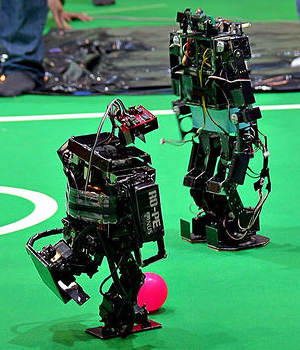
World cup fever has gripped the, ummm, the world I suppose. But in all of this fuss over teams of humans from one country competing against teams of humans from another country for the greater glory of their history/race/ideology/religion its important not to forget the as of yet infantile league that will some day destroy them all. I am of course talking about the RoboCup.

And not only humans and robots are caught up in football fever! For according to this report from the BBC even monkeys are new getting in on the action, and this is something that is of great concern–for when monkeys and robots meet on the battlefield, no good can come of it. We have been down that dark road before and we much be very mindful of that awful conflict re-awakening.

Apocalypse Soon

There’s a good article in the LA Times about some of the more extreme members of the three great monotheistic apocalypse cults of the Middle East (in chronological order, Judaism, Christianity and Islam) who take their religion so literally that they are actively trying to hasten the end of this world because, presumably, they just don’t like it very much.

some Jewish groups in Jerusalem hope to clear the path for their own messiah by rebuilding a temple on a site now occupied by one of Islam’s holiest shrines.

Artisans have re-created priestly robes of white linen, gem-studded breastplates, silver trumpets and solid-gold menorahs to be used in the Holy Temple — along with two 6½-ton marble cornerstones for the building’s foundation.

Then there is Clyde Lott, a Mississippi revivalist preacher and cattle rancher. He is trying to raise a unique herd of red heifers to satisfy an obscure injunction in the Book of Numbers: the sacrifice of a blemish-free red heifer for purification rituals needed to pave the way for the messiah.

So far, only one of his cows has been verified by rabbis as worthy, meaning they failed to turn up even three white or black hairs on the animal’s body.

Interestingly, this phenomena is largely confined to the US and the Middle East. Yes, of course there are apocalyptic cults in other regions (Japan’s own Aum Shinrikyo being one near and dear to my heart) but they are hardly a mainstream phenomenon over there. In fact, according to the article as many as 40% of Americans believe that an apocalypse is not merely coming but imminent. Now, some people believe that some of the more obscure foreign policy moves engaged in by the US governmental leaders can be traced to this very belief in the end time-and I myself have even engaged in some joking speculation of such a nature-but of course when examined logically the argument falls apart. After all, how could anyone who believes that the world is coming to an end in a couple of decades time be so enthusiastic about being midwife to the creation of a landed hereditary aristocracy by enouraging the repeal of the inheritance tax?

People will bet on anything

You’ve probably already heard about how Ann Coulter said something stupid and offensive about widows of some WTC terrorist victims, and now thanks to the Internet you can also bet on whether or not she is going to be sued for defamation.

Analysts at BetUS.com posted favorable 4-6 odds that the Widows of 9/11, who were also called “self-obsessed women,” will sue Coulter for defamation. However, the chances of Ann Coulter retracting her remarks are slim with only 1-2 odds. Either way, Coulter’s outrageousness has shot her new book to number one on Amazon.com.

Executives at BetUS.com have posted the following odds:

Will Ann Coulter retract her remarks?
Yes: 6-4
No: 1-2

Will the 9/11 Widows Sue Coulter for defamation?
Yes: 4-6
No: 11-10

“You’re such a Japanophile, your picture is in Wikipedia”

Seriously. Quote from one of the people supporting the picture’s inclusion in Wikipedia:

I reapplied the picture from the original inserter because it fits the catagory properly. It is only helpful to the this word listing, and follows closely what the wiki definition is. Saying he is an expertert in Japanese culture is pretty bogus, but then again, a Japanophile never really is classified as an expert. It says within the definition itself as a misguided interest sometimes. “Japanophile” is not something that one person can represent, but this picture and what this person has done makes this picture adequate.

Then someone decided to replace the picture with Lafcadio Hearn. Then someone added the picture back, saying:

Though the addition of Lafcadio is notable, it was far from purposes of benefit of the article, but more to suite your harassment of the “Japanophile” picture. You seem to be trying to crash this picture as well as the one simular on another article for your own personal goals, not the benefit of Wiki. Lafcadio does suit this article, but I have reinstated the previous picture also as it touches on the fanatic/popular culture side of Japanophile which is so common today and what most people recognize the word as.

This is one of those rare situations where you can really learn more from the commenters at Japundit than from Wikipedia.

Kikko Misjudges English “Nuance”

Japanese uber-blogger Kikko scoffs in her most recent post at what she terms lame and unpatriotic promises that certain celebrities have made “if Japan beats Brazil” in the upcoming World Cup match. Kaori Manabe, for her part, has reportedly promised to “hold a Carnival in a bikini” in the off chance Japan can topple the current World Cup defenders. Sure, maybe they shouldn’t be prematurely predicting Japan’s elimination in the first round, but to me it makes perfect sense to make wild wagers when the odds are stacked in your favor.

In the (as always, too long) intro to her post, however, Kikko-san makes some interesting claims about the English meaning of the word “cop”:

Speaking of Croatia (NOTE: the team Japan recently tied against in the World Cup), that’s the homeland of (PRIDE kickboxer) Mirco Crocop. Since I heard it a while ago, I know that Mirco, who worked as a police officer, took that ring name from the “Cro” in “Croatia” and the English “Cop” meaning “police officer” to make his ring name “Cro-Cop” meaning “Croatian Police Officer.” In other words, since a robot police officer is “RoboCop,” then a Croatian police officer would be “Crocop.” But “cop” has the sense of “beat cop” (NOTE: omawari in Japanese) or “po-po” (NOTE: pori-ko in Japanese) or “the fuzz” (NOTE: mappo in Japanese), doesn’t it? “Police officer” (NOTE: keisatsukan in Japanese) means “police” or “policeman” [in English], as in “strange police officer” or “a policeman with his nipples in the wrong place,” so “cop” has more of an informal (NOTE: kudaketa in Japanese) connotation. Then, if you pronounce it “cop” (NOTE: as it is normally pronounce in English; “cop” in Japanese is normally pronounced COPE-poo), then it has an even more informal connotation. So if someone says “Cops are coming!” then it’s like “The fuzz are here!”

Um, no? First of all it’s always pronounced cop (i.e. カップ; it would be different in British English, I guess, but that doesn’t change the meaning at all). And another thing: “cop” is something of a colloquial term, but it has none of the pejorative connotation contained in the Japanese satsu, pori-ko, or mappo (unless I misread these terms), or even the English slang “po-po” or “fuzz.” Any lame-o on the street will “call the cops” on someone if they’re acting like a douchebag. Your posts are always enlightening, Kikko, but you might want to stay away from analyzing the “nuance” (a Japanism meaning “connotative meaning”)of the English language.

UPDATE: In related/parallel lives “news“: Home Depot Criticized For Pledging $10 Billion To American Cancer Society For Every Padres Home Run

Quiz: What was BOJ Chief Fukui’s 1st “Yellow Card”?

As many of you know, the Bank of Japan Chief Toshihiko Fukui is in trouble for not dropping an investment in the discredited Murakami fund after he took the position in 2003 (though he was not legally required to do so, nor was he required to disclose the investment through an uncanny oversight by regulatory authorities – the US, for its part, does require full financial disclosure from its FRB chiefs such as the last one, Alan Greenspan). It only makes sense since the BOJ Chief is the ultimate insider in a capital market.

In a recent column for his website, opposition DPJ Dietman Yoshihiko Noda (Lower/Chiba 4th) called the so-called transgression Fukui’s “second yellow card”, which in soccer means you’re out of the game.

Question: What is the first yellow card to which Noda is referring? Answer after the “jump”!!

Answer: He quit as vice chief in 1998 after it was found officials from banks, including the former Dai-ichi Kangyo Bank, treated Ministry of Finance and BOJ bureaucrats to “no panties shabu shabu” – at a restaurant Fukui is known to have regularly attended (though Fukui was never actually prosecuted for anything). Shabu shabu is a kind of Japanese meat soup – it’s good, and apparently even better when the waitresses aren’t wearing their underwear. It was this and other, much worse incidents that led to MOF’s financial regulatory authority being stripped away and given to an entity we know today as the Financial Services Agency. And now you know!