Neojaponisme is finishing out its first full year of existence in style with a review of all the events that mattered. My first contribution to the project, wherein I post the question “Was Roppongi Hills Tokyo’s last good idea?” is up right now for your entertainment. Go check it out!
Category: Culture
Still more on Tamogami
Following up on my initial report on November 4 and an update on November 21, here is yet more information on the Tamogami Toshio affair.
Most important is today’s Asahi front-page article, which is the best media confirmation so far of my initial hypothesis on the entire Tamogami/APA link, which readers may remember was as follows:
Combining his attraction to both power and military, [APA CEO Motoya Toshio] invited ASDF General Tamogami Toshio into his circle, bringing him to the Wine no Kai and to address the launch party for his latest right-wing tract. Motoya then had APA sponsor an essay contest promoting his book-possibly an illicit use of corporate funds-with the grand prize awarded to Tamogami , in a decision I suspect was actually arranged by Motoya personally, with the “selection committee” only choosing the lesser prizes.
Adam spotted the Asahi article and forwarded it to me, and provided a summary in the comments of my previous Tamogami post.
Apparently, several of the contest judges were really miffed at how Motoya ran things… Of over 400 entries, the company only sent the four-member panel 25 for the first round of anonymous scoring. Motoya himself was apparently on the panel (though APA did not list him as a judge), and he gave the top score to Tamogami’s (anonymous) essay while giving low scores to all the others. In the second round of judging, the names and profiles of the contestants were revealed and the judges met to discuss the winner. Three essays, including Tamogami’s, had the same number of points. Motoya apparently proposed that they just give the prize to Tamogami and award a kind of tied-for-second prize to the others. None objected.
Apart from Motoya, the judges named in the report:
Shuichi Yamamoto, a former Diet member’s secretary and current legal scrivener and guest lecturer in Okayama Prefecture.
Nobuaki Hanaoka, conservative commentator
Kazuo Komatsuzaki, President of (Yomiuri affiliated) Hochi ShimbunApparently the fourth judge was Motoya, but I can’t tell for sure by the way the report is written.
The article also includes direct quotes from two of the judges. Yamamoto said that he “felt there was something unnatural about how Motoya gave low scores to pretty much all of the essays that the other judges gave high scores to.” Yamamoto went on to accuse Motoya directly, saying that “one has to believe that the top essay was chosen to award the prize money to Tamogami.” Komatsu gave similar statement, saying that “Thinking about it now, Motoya must have known all along that it was Tamogami’s essay, and deliberately put it on top.” Oddly, the article makes no mention of conservative commentator and Sophia University English Professor Watanabe Shoichi, who is described on the APA web site as head of the judging committee.
The article certainly does make it sound as if Motoya was one of the judges, although I do not believe any previous source has acknowledged his direct involvement. Naturally there was no comment from APA for this article. Considering that even the Inspector General’s Office of Legal Compliance of the JSDF is investigating the possibility that Tamogami encouraged his subordinate officers to enter the contest, and the fact that Tamogami and Motoya had a relationship stretching back a decade when Tamogami was commander of the very same Komatsu air force base that Motoya runs a civilian support committee for, it seems very likely that the entire essay contest was in fact staged.
There is even speculation that the conspiracy goes even deeper than I suggested in my initial post. According to the Japan Times on November 20, in an article which also presents many of the connections I had pointed out previously:
Hirofumi Hayashi, a professor at Kanto Gakuin University and an expert on modern Japanese history, pointed out that Tamogami may have landed the top post because of his close ties with Toshio Motoya, head of hotel and condo developer Apa Group, who had connections with then Prime Minister Shinzo Abe, a staunch nationalist.
Is it really possible that the Motoya connection could be that strong? Could Abe have actually been persuaded to promote a known militarist to the head of the JASDF based on the recommendation of an ultra-rightwing activist?
Another professor, Kotetsu Atsuhi (whose published books include one on relations between the civil government and military in modern Japan), was quoted by the Japan Times as saying “Mr. Tamogami went out of control and his act was close to a coup.” In a Mainichi debate column he gives a more detailed statement, which reads in part:
In the final paragraph of the essay it is written that the SDF needs to return to a position of independence, away from the eternal dependence on America. This adds up to the “Asian Monroe Doctrine” that Japan had before the War. For Japan to have singular hegemony in Asia, they thought that they had to secure their own sources of raw materials and military equipment, without depending on America or Britain, and the fact that this spread to the financial and political spheres as well is one of the factors that opened the road to war. I am horrified to think that there may be a desire for this in today’s uniformed officers.
The article also contains an opposing quote from right-wing historian Hata Ikuhiko, in which he says:
Compared with the pre-war system, things are effectively controlled in Japan now. Today, you do not hear the uneasy discussion of a coup de’etat that you did 20 or 30 years ago. If the defense minister and prime minister, who is the Commander in Chief, do their jobs properly then the SDF should not be able to run wild and take hold of political power.
The two problems with this statement are that A: following the Tamogami affair there actually ARE people (Koketsu for a start) mentioning the danger of a coup, and B: Prime Minister Abo Shinzo was the one who appointed Tamogami to his job in the first place. On the other hand, Tamogami’s prompt dismissal following the uproar over the APA essay demonstrates the current effectiveness of civilian control. And although current PM Aso Taro did promptly dismiss Tamogami, he is well known for having a similar view of history.
(Incidentally, Hata’s essay calling for the restraction of the Kono Statement acknowledging Japanese responsibility for comfort women is among those offered as a free download by the so-called “Society for the Dissemination of Historical Fact”, which publicizes the Japanese right-wing historical revisionist agenda in English, and includes such people as Watanabe Shoichi and Japafilic Taiwanese Ko Bunyu on its board.)
Whan now-PM Aso was CEO of his family firm, Aso Cement Company in 1975 (he was CEO from 73-79, see here), they published an official corporate history which closely matches the views of Tamogami and Motoya. As described in a FEER article by Mindy Kotler (head of DC’s Asia Policy Point, known for her testimony on behalf of the US House resolution calling on Japan to apologize for comfort women, and William Underwood, a specialist in the history of Japanese WW2 era forced labor):
The “Aso Fights” section of the book states that top U.S. leaders had detailed knowledge of Japanese military plans prior to Dec. 7, 1941. Japan was purposely allowed to strike the first blow, in this telling, so that “Remember Pearl Harbor” could become a rallying cry for Americans. Like Gen. Tamogami, the Aso historians conclude that “this cleverly united American opinion for war against Japan.”
Aso Mining then became a “kamikaze special attack production unit,” according to the book. “People like Korean laborers and Chinese prisoners of war filled the void” in Kyushu’s coalfields as Japanese miners left for military service.
Despite having fired Tamogami, he and Aso are still ultimately on the same side in the history wars, along with former Prime Ministers Mori and Abe, at the very least. (Tamogami has been quoted as saying that “former PM Abe and former PM Mori also support my philosophy.)
While Prof. Koketsu’s coup reference may be a bit exaggerated, there have been a number of comparisons made with the February 26 incident of 1936, a failed coup in which “a group of young radical Army officers led some 1,400 troops under their command on a attack on the Prime Minister’s residence and other buildings in Tokyo, killing Home Minister SAITO Makoto, Finance Minister TAKAHASHI Korekiyo, and Army Inspector General of Military Training WATANABE Jotaro.” As has often been the case in Japanese military coups (such as the Meiji restoration), the young officers claimed to be fighting in the name of the Emperor, but when it was clear they lacked his support the rest of the military put down the revolt. This 2.26 Incident was famously orchestrated by “young officers” of the Imperial Way Faction, which was an unofficial grouping of hardcore rightist officers within the military, who called for a “Showa Restoration“-evoking the Meiji Restoration – in which the military would purge government and society of degenerate left-wing elements and re-institute traditional values based around militaristic Bushido.
The Imperial Way Faction was largely based around the philosophy of Araki Sadao, a rightist officer who ascended to the position of War Minister in 1931, after having served as Inspector General of Military Training, and began publically promoting the “Imperial Way” in a September 1932 news conference. Although he was forced to retire from the military following the failed 1936 coup, he was apparently not accused of any direct involvment and was allowed to become Minister of Education the following year, a job which allowed him to promote his militaristic agenda in the civil sphere.
Although the names “Tamogami” and “Araki” have as yet only appeared appeared together in a handful of obscure Japanese blogs, I do sense some concern that Tamogami could be (or at least could have been) an Araki-like figure. I strongly doubt anyone is particularly worried that Tamogami himself was plotting a coup, but rather a lot of people are worried about the influence he may have had on subordinates, as represented by the dozens of JASDF members under his command who submitted essays to the contest. Then, does this mean that people should be worried that the 94 who served under Tamogami and submitted essays will be a “young officer” vanguard of the Heisei Restoration armed uprising circa 2012?
This is another pretty farfetched scenario. Japan today is a very different country from the one it was in the 1930s, with a decades-long popular antiwar attitude that few could have predicted in the 1930s. Shifting back towards that level of militarism would likely require both a generation of re-education and a massive shift in the international balance. But the militaristic right wing is thinking long-term. They have been pushing their version of history increasingly hard recently, but despite much of the media coverage has actually not been very successful in altering public school education. And yet, the general attitude towards the revision of the Japanese constitution’s famous war-renouncing “Article 9” seems to have gone from being an absolute impossibilty to being undesirable but perhaps only a matter of time.
Some time in the next several months Japan will hold a general election, in which it is very possibly that the opposition Democratic Party of Japan will take power for the first time. This would be a stunning defeat for Tamogami’s supporters, however many of them really exist. Despite political apathy, most of Japan still firmly believes in national pacifism, and if the LDP falls from power it will likely be in part due to Tamogami.
Lo Sheng preservation in doubt
The historic Lo Sheng Sanitarium, built by the Japanese colonial government in 1930 and located in Sinjhuang City, Taipei County, may not be preserved after all. As I wrote about following my visit there this summer, activists have been working to arrange a preservation agreement for the site with the government, following a plan to demolish it entirely to make room for a metro train depot. The government had made a promise to preserve 40 (approximately 3/4) of the buildingds on the site, but now appears to be reneging.
The protest came after the Taipei County Government posted a bulletin on Tuesday in which it said that residents who have not moved out before Monday would be evicted, including residents living in 25 buildings the government had promised to preserve.
[…]
The government agreed to preserve 22 buildings at the first site.“Of the 40 buildings that were to be preserved, the Department of Rapid Transport Systems only guarantees the safety of 15 during construction. It will fence the other 25 buildings, which means residents cannot live there anymore,” the group said in a statement.
[…]
They said the government’s sincerity in vowing to preserve the sanatorium was doubtful.“The preservation agreement was made last May, but until now, the government hasn’t declared the sanatorium a historical site … Before it is declared as a historical site, we will not allow the MRT department to destroy the complex,” the group said.
(From Taipei Times)
Saizeriya burned by yen carry trade
Saizeriya said it signed derivatives deals with BNP Paribas Securities (Japan) Ltd. twice, in October 2007 and February 2008, to procure Australian dollars needed to import food from that country. Under the deals, Saizeriya is to receive 1 million Australian dollars every month, payments of which started in September.
If the yen weakens below the level set in the contract, Saizeriya is entitled to buy the Australian dollars at a discount. But should the yen appreciate beyond that threshold, the purchase price rises.
(Nikkei)
Underground typography
AIGA.com has a great article on the history of signage in the New York City Subway. I’ve always loved the old tile mosaics in the stations, including the lack of uniformity, and I’ve always wished the MTA would actually make an effort to keep them looking new.
Asian Immigrants in Florida
One of the most obscure footnotes to the recent American elections was the failure of little-known ballot initiative in Florida, which would have symbolically removed from the law books a currently inactive 1926 unconstitutional provision of the state constitution which was intended to prohibit Asians from owning land in the state. The 1926 prohibition is specifically directed at foreigners ineligible for citizenship, which at the time applied to Asians-who were at the time barred from naturalization by federal law.
The language before voters did not explain that the laws first appeared around 1913 during a public panic that Asian immigrants, mostly from Japan, would work on farms for less than Americans and buy up vast tracts of land. It failed to spell out that state provisions were intended to work hand-in-glove with discriminatory federal laws that prevented Asian-Americans from becoming naturalized citizens until 1952.
Rather the ballot simply asked voters if they were willing to delete “provisions authorizing the Legislature to regulate or prohibit the ownership, inheritance, disposition and possession of real property by aliens ineligible for citizenship.”
Steve Geller, a former state senator who worked to get the initiative on the ballot, said Florida election rules only allowed a description of 75 words, and required that the language of the old provision — “aliens ineligible for citizenship” — be included. As a result, he said, “a lot of people thought it had to do with illegal aliens, and it had nothing to do with illegal aliens.” (NYT)
Few traces remain in Florida of this brief and ill-fated wave of Japanese immigration, and the most prominent is likely the Morikami Museum and Japanese Gardens. It happens to be located very near to my grandparents’ house (like all Jews from Brooklyn, they eventually retired to Florida) and I went there with them a few years back. The garden is pretty nice, I suppose, although I actually got the impression that it is too big to replicate the feeling of an actual Japanese garden, the design philosophy of which is largely based on a fractal-like recreation of the large on a small scale. The significantly different vegetation of Florida also does not help. But the museum does have some neat exhibits (their temporary one the day I went was a pretty cool collection of Japanese kites, which based on my experience is a dead art form in Japan. I saw kites all over in China-does anyone fly them here?) and resources that could be of great interest to a Palm Beach County resident who wants to learn a bit more about Japanese culture. For me, of course, the most interesting thing was the history of the museum itself. And the iguanas.

Their website has a tantalizing, but brief, history of the Japanese in Florida.
In 1904, Jo Sakai, a recent graduate of New York University, returned to his homeland of Miyazu, Japan, to organize a group of pioneering farmers and lead them to what is now northern Boca Raton. With the help of the Model Land Company, a subsidiary of Henry Flagler’s East Coast Railroad, they formed a farming colony they named Yamato, an ancient name for Japan.
Ultimately, the results of their crop experimentation were disappointing and the Yamato Colony fell far short of its goals. By the 1920s, the community, which had never grown beyond 30 to 35 individuals, finally surrendered its dream. One by one, the families left for other parts of the United States or returned to Japan.
One settler remained. His name was George Sukeji Morikami. A modest farmer, George continued to cultivate local crops and act as a fruit and vegetable wholesaler. In the mid-1970s, when George was in his 80s, he donated his land to Palm Beach County with the wish to preserve it as a park and to honor the memory of the Yamato Colony.
It is sad that a legally meaningless ballot resolution intended only as a posthumous apology to these poor immigrants was accidentally voted down by people who thought they were doing something to hurt current illegal immigrants, but one must admit that the resolution was very poorly worded.
Behind the WaiWai scandal at Neojaponisme
In a FIRST-EVER collaboration with Global Voices Online’s Chris Salzberg, my translation of an article by tech journalist Toshinao Sasaki is up at Neojaponisme. As a preview, here are the key introductory paragraphs:
No doubt WaiWai is something of a household name among many Néojaponisme readers. For those who missed the recent absence of sensational, sex-fueled articles on the Mainichi English website, however, WaiWai was the name of a now-defunct feature that published sleazy, often plainly false articles loosely translated from Japanese tabloids. For years a guilty pleasure to millions in the English-speaking world, the fun came to an end this spring when a firestorm of outrage over the content broke on Internet forums such as the popular 2-Channel, leading the Mainichi to take the articles down and apologize.
While anyone can find the superficial details of what happened to WaiWai on Wikipedia or the apology on Mainichi’s website, a discussion of the larger significance of this incident has been harder to find. And significant it was — this appears to be the first time backlash from Internet-based readers posed a real threat to the business of a major media institution: a development that, as Sasaki describes, could prove “the milestone that turns the relationship between the Internet and the mass media on its head.”
Chris’s translation of the second half will follow. Now go read the rest!
Gen. Tamogami Toshio, Motoya Toshio, and Abe Shinzo
Note: I have followed up this post on November 21st, and then again on December 1st.
The publication of an essay denying Japanese aggression in the Pacific before and throughout the WW2 by Japan Air Self-Defense Force Chief of Staff Gen. Tamogami Toshio (pictured below) could have led to another major international diplomatic incident. This seems to have been curtailed by his immediate firing, and a reaffirmation of the Government of Japan’s official stance of acknowledging Japanese aggression.

The essay was published on the website of APA Group, a large construction and real estate conglomerate best known for scandals involving inadequate earthquake proofing and falsification of records, as the grand prize winner of an “essay contest.” (The essay can be found on the award page, in both Japanese and English. Oddly, none of the lesser prize-winning essays are available.)
Almost all of the news coverage I have seen reports simply on the contents of General Tamogami’s essay, the fact that it was a contest, his prompt dismissal, and some half-hearted complaints about the essay from overseas (clearly headed off by the rapidity of his firing), but aside from this article at Mainichi virtually nothing about the contest itself. My first reaction was to wonder what the background story here was.
Naturally I started poking about online. I’ll start with what the Mainichi story had to say about the contest:
Watanabe etc. on the selection committee
According to the APA Group web page, essays were solicited for the purpose of “steering Japan towards a correct understanding of history as an independent nation”, and a prize of ¥3 million (Note: around $30,000 USD) was awarded as the grand prize. The head of the selection committee was Sophia University Distinguished Professor Watanabe Shouichi, a conservative commentator. APA Group CEO, Motoya Toshio, writes essays on historical perceptions under the pen name Fuji Seiji (藤誠志).
Mr. Motoya does not simply write essays under this pen-name, but actually publishes them in the APA corporate newsletter, Apple Town (“Fresh Information For Your Best Life”). He has also published a number of books under his own name, which you can order through the APA website, most notable “Modern History The Media Doesn’t Report on: Postwar History is an Argument over Nuclear Weapons”, for which he has a promo page on the APA site. (There are also a couple of books written by his wife, Motoya Fumiko CEO of APA Hotels.) Incidentally, another of Mr. Motoya’s books, “Business is Romance”, appears on a “Japanese National Bibliography” page on the National Diet Library website.
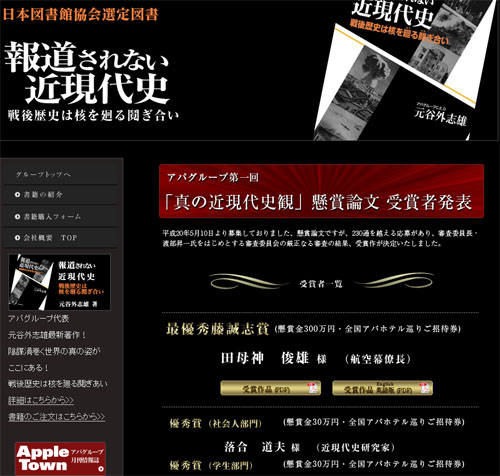
As you can see from the above screen capture of the contest website, the essay contest actually appears to be a promotion for his book. In fact, the grand prize is self-aggrandizingly named the “Fuji Seiji Prize Award”, after Mr. Motoya’s pen name. Although APA Group is a publicly traded company and not a family business (I believe this is the case, but I am not 100% sure, so I would appreciate someone checking), CEO Motoya is not only using the corporate website and magazine to promote his right-wing political agenda, but may also very well be using corporate funds for the contest prize money. According to this blog post, the book is also being promoted and sold in APA hotels.
At or near the bottom of the sidebar present throughout the entire APA Group website (some pages have other links below), there is also a link to an external political organization run by Motoya, the “Kanazawa Friends of the Komatsu Military Base.” (小松基地金沢友の会) The purpose of the group, according to a statement from Motoya on the front page is “get the entire citizenry of Japan, in which there is yet a shallow understanding of the importance of national defense, to understand that a balance of power involving military deterrent leads to international peace,” and to “support the Komatsu Base, which covers the entire Sea of Japan region, which is close to such countries as Russia, China and North Korea.” Googling a few sample names from the members list produces what would be expected: old men from Ishikawa Prefecture involved mostly in business, and one LDP Diet member who had held a minor position in Koizumi’s cabinet.
The website is located on a domain which appears to be independent of APA Group, at jasdfmate.gr.jp (Japan Air Self Defense Force Mate at the Japanese secondary .gr domain for volunteer groups). They also appear to be hosted at different locations, as the traceroute path is significantly different. However, the WHOIS database indicates that the contact person for both websites is a Nishikawa Harumi (西川 治美), who according to the apa.co.jp WHOIS entry is an employee in the Business Section of APA Co.,LTD. and according to the jasdfmate.gr.jp WHOIS entry is a “Clerk” for “Air Self-Defense Force in Komatsu, Kanazawa Mate.” Ms. Nishikawa has been listed as the contact person for the sites since at least 2001.01.16 and 2000.03.21 respectively, when the contact information was last updated. The shallow attempt at separation of private form corporate breaks down, however, when the JASDFMate site lists the contact email address as office@apa.co.jp. You too can join the group, and go on their various activities-such as tours of the base-for a mere ¥10,000.
“Modern History The Media Doesn’t Report on” was published on April 18 of this year, and a combination publishing celebration party and birthday party was held in early June, which is commemorated at this page on the APA site. This page contains some videos which were screened at the party, the third of which finishes off with a list of the party’s sponsors. The list is long, but contains quite a few names of note. Some of the ones that jumped out at me were (in order of appearance):
- Asao Keiichiro (DPJ Shadow Defense Minister)
- Abe Shinzo (former LDP PM)
- Ikeguchi Ekan (Shingon-shu leader)
- Koh Se-kai (Former Taiwan representative to Japan, Taiwan independence activist)
- Ko Bunyu (Japan-resident Taiwanese independence activist and writer, darling of Japan’s far right)
- Dewi Sukarno (Japan-born former wife of Indonesian dictator Sukarno)
- Tamogami Toshio (just-fired JASDF chief)
- Hatoyama Kunio (LDP politician, currently Minister of Internal Affairs and Communications)
- Bobby Valentine (Former MLB baseball player and manager, current manager of Japan’s Chiba Lotte Marines baseball team)
- Jose de Venecia, Jr. (Speaker of the House of the Philippines)
- Mori Yoshirou (Former LDP PM)
- Watanabe Shouichi (Sophia U. Distinguished Professor of English and right-wing commentator, and head of the essay committee)
According to this Sankei article on the party, over 1500 guests were in attendance, of which several dozen were thanked by name in the video.

In this photo of the party (again, from the APA page) you can see General Tamogami was not merely a guest at the event, but actually addressing the crowd. This was just under a month after the contest had been announced, on May 10. According to the above-linked Sankei article, Tamogami jokingly referred to himself as a “controversial figure” and said that:
After the war, speech arguing to defend our country was suppressed, but speech that was anti-Japan or badmouthing Japan was free. As long as the fundamental problems of security are not dealt with, it is impossible to be ready to protect this country in the manner it deserves.
This is a reference to constitutional revision to eliminate or revise Article 9-Japan’s famous pacifism clause. Essentially, the grand prize winner of an “essay contest” was a speaker at an event which was both the launch party for the book the essay contest was promoting, as well as the birthday of the author, expressing essentially the same opinion later given in that essay.
Tamogami and Motoya actually had a political association dating back some time, at least to a “Wine no Kai” (Wine Party for Discussing Japan)documented in Motoya / APA’s own magazine. (Click here for PDF of the article, originally copied from the APA web site.) In this photograph you can see Tamogami , Motoya, Hatoyama Yukio (one of the leading hawks in Japan’s opposition Democratic Party, which differs little from the permanent ruling LDP on substantial matters, his family name ironically means “Dove Mountain”) and his wife, as well as Sankei Journalist Oshima Shinzo.
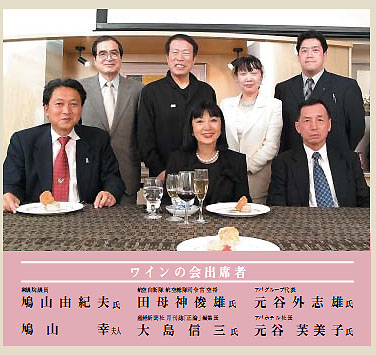
I am actually slightly unclear whether the article text is a summary of the discussions had at the party or simply yet another of Motoya’s essays, but it is probable that the participants at least agreed with the ghist of it. The article concludes by stating that “the statement that ‘Japan must absolutely not equip itself with nuclear weapons’ is absurd.” Japanese nuclear armament seems to be one of Motoya’s main issues.
Motoya has apparently hosted a number of annual sessions of the “Wine no Kai,” including a session the following year attended by not-yet Prime Minister Abe Shinzo.
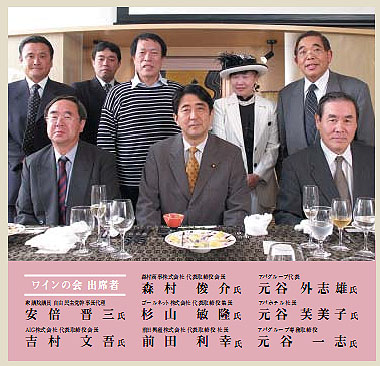
That’s Abe sitting there in the middle, flanked by Motoya Toshio, with the horrific grimace and weirdly out of place striped shirt, and Mrs. Motoya Fumiko, wearing one of the silly hats she is famous for. PDF of the entire article is here.The article contains nothing nearly as inflammatory as the previous year’s call for nuclear weapons, but I would like to share this brief and bewildering excerpt.
A certain Japan-born Korean said that “The Japanese value respect. Japanese culture is excellent on the inside. But I shed tears when looking at today’s Japan.” The lazy attitude of young people is particularly offensive. Korea still has a military draft system, and although I am not saying that Japan should revive militarism, I will say that the draft system should be introduced. They would not need to serve for two years, but let them live for a year in a group to teach them rules and endurance. If you invite a young person today to say “let’s go drinking” they refuse saying, “that’s OK.” In the old days, they were happy to get an invitation from an elder.
Abe and Motoya are reputed to have far stronger links. Although it seems to have been rarely discussed in the mainstream media (keep in mind that Japanese newspapers keep articles online for a very short time and I am not actually going so far as to check archives), it has been repeatedly claimed on blogs (most notably Kikko’s Diary, but also many smaller ones) that Motoya was vice-chair of Abe’s political support committee known as the Anshinkai, (安晋会, J-Wikipedia article). The name “Anshin” is a pun derived from part of Abe Shinzo’s name, which also sounds like the Japanese word for “safety.” neither the existence of Anshinkai nor Motoya’s membership in it has ever been publically acknowledged, but the above photograph of the “Wine no Kai” is often cited as evidence of both.
One blog wrote in February 2, 2007, that “mentions of Anshinkai have finally started appearing off-line as well,” indicating that this story actually began in the blogs before being taken up by the offline media, in a pattern considered to be generally un-Japanese. Another blog, on the same day, has a roundup of weekly news magazines (traditionally these magazines and not daily papers is the place for news that is more based on investigation or rumor) which had recently mentioned the Anshinkai, including Shukan Post, Shukan Bunshun and Shukan Asahi. The blog says that Shukan Post had been the first to report on Anshinkai, in February 10, 2006, alleging a connection with the Livedoor scandal.
Another blog, from January 31, 2006, has some more information on the Livedoor connection, notably that HS Securities VP Noguchi Hideaki, who committed suicide after falling under suspicion, was director of Anshinkai. The same article contains a dizzying chart of connections between various persons, groups and companies, which does not include Motoya/APA but does include another interesting name – HUSER (Human User Company). Huser had been involved in a construction inspection scandal, seriously enough so that President Ojima Susumu was actually called to testify before the Diet, where he admitted to meeting with Abe Policy Secretary, Iizuka Hiroshi.
As I mentioned at the beginning of this increasingly long post, APA Group is now infamous for their involvement with a similar scandal. I don’t want to spend more time on this, so I recommend you read the good English coverage of at Shin Fukushige’s blog (note that Adam commented on this post.) The CEOs of both Huser and APA are allegedly members of Anshinkai, and there has much much suspicion that Abe and his people deflected as much heat as he could. The connections between Motoya and Abe are strong enough that Kikko titled one January 2007 post “APA Group is Abe Group.”
As I write this, the US 2008 election results are coming in and I want to wrap this up so I can concentrate on that, so let me summarize briefly.
Motoya Toshio is a very successful construction and real estate entrepeneur, with extreme right wing views, an obsession with political leaders and celebrities (he brags about having met a wide variety of famous people, starting oddly with Castro), and an otaku-esque fascination with military things (he also brags about having taken a test flight on a fighter plane). Having built his company into the massive APA Group, he used his company’s publicity apparatus to promote his political ideas, and his significant financial leverage to support Japanese politicians supportive of his militaristic agenda. He appears to have also used those political connections to promote large business projects, and when his company became embroiled in a serious construction inspection scandal, he also turned to his political allies for help.
Combining his attraction to both power and military, he invited ASDF General Tamogami Toshio into his circle, bringing him to the Wine no Kai and to address the launch party for his latest right-wing tract. Motoya then had APA sponsor an essay contest promoting his book-possibly an illicit use of corporate funds-with the grand prize awarded to Tamogami , in a decision I suspect was actually arranged by Motoya personally, with the “selection committee” only choosing the lesser prizes. Motoya was probably hoping that Tamogami , who had a history of making controversial public statements and escaping serious censure, would be able to step up and continue the main-streaming of right-wing militaristic views, but his gamble failed. His friend Abe Shinzo was no longer Prime Minister, having perhaps spent too much of his political capital defending Motoya’s APA Group and Huser during the earthquake proofing inspection scandals, and Aso’s government was just not interested in risking blow-back by defending a general who had so egregiously violated the rules on political speech by uniformed officers and the supremacy of civilian leadership. Fukuda Yasuo had worked to improve relations with China and other neighbors following the Abe administration, and perhaps newly appointed Prime Minster Aso Taro, despite his right-wing views and his own well-earned reputation for making gaffes decided to take the pragmatic route and declined to protect Tamogami .
Halloween in Tokyo
Apparently the Halloween party train on the Yamanote Line went off without a hitch:
This year’s story is rather interesting because of the crazy 2channeler element — check out the organizers’ assertion that the police showed up to protect the drunk foreigners from crazy organized otaku. Guess the latter get more scrutiny than the former these days.
Nobuo Ikeda: We don’t need no stinkin burasagari
Nobuo Ikeda is clearly not as sanguine about the Prime Minister’s press availabilities as our intrepid Sankei reporter (thanks again to commenter Aceface):
The “burasagari” press availability on PM Aso’s “extravagant nightlife” was hilarious:
Reporter: You’ve spent several nights in a row going to meetings at high-class restaurants that cost several tens of thousands of yen [per person] a night. I think this is rather divorced from the feelings of the people. What do you think, Prime Minister?
PM Aso: Does the Hokkaido Shimbun regularly use the definition “the people”? At the very least, I think I have mostly been going to hotels. You are changing the story to make it sound like I go to high-class restaurants every night, but that’s not right.
Reporter: But high class…
PM: I’m telling you, stop saying it in such a “gotcha” manner!
In the middle of a financial crisis, it is a waste of time for the Prime Minister to have such worthless conversations twice a day. I think many readers don’t understand why these availabilities are called “burasagari” (literally “trailing behind”). Originally, it’s because the reporters would literally trail behind the PM as he walked from the PM’s office to the Diet building, but so many cameramen tripped and injured themselves that Koizumi took the policy that he would “no longer respond to burasagari.” In a bind, the PM’s office press club asked the PM, “We will behave properly, so please [let us do the burasagari]” and restarted the availabilities in a fixed location.
When Fukuda [announced his resignation] and stopped [holding press availabilities], the Worst Newspaper Ever (tr: Yomiuri Shimbun) whined “Relinquishing the Responsibility to Explain is Unacceptable“, but this kind of thing is neither a responsibility nor an obligation. It is a back-scratching arrangement with the press club to provide fodder to reporters who won’t investigate. In no other country in the world does the top leader hold two press conferences every day. I think that even the Chief Cabinet Secretary, whose job it is to administer the cabinet, should stop holding a press conference each morning and evening. Instead they should install a dedicated Press Secretary. Government leaders have much, much more important things to do than act as protector of the press club.