The original fortune cookie

This may shock you, but fortune cookies are not Chinese food, nor are they really Chinese-American food. They started out as a Japanese product, and were copied by Chinese-Americans in San Francisco decades ago to form the dessert staple of cheap Chinese restaurants across the US. (This was detailed in a New York Times article last year, and linked by Roy in a post which I somehow missed; I learned of it from watching the author of said article, Jennifer Lee, give this fascinating presentation on the evolution of Chinese food outside China.)

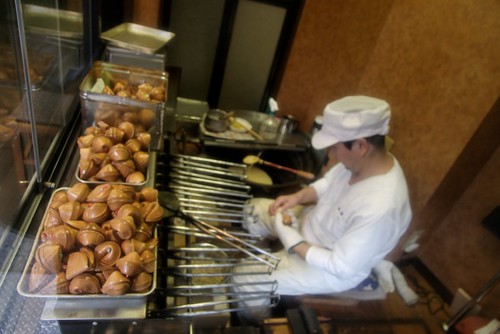
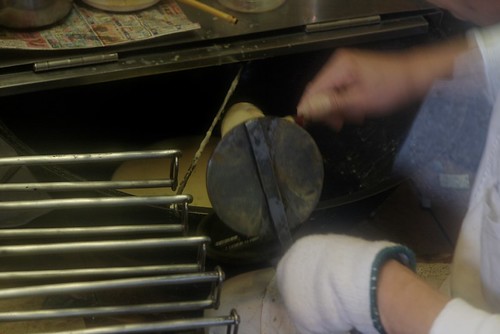
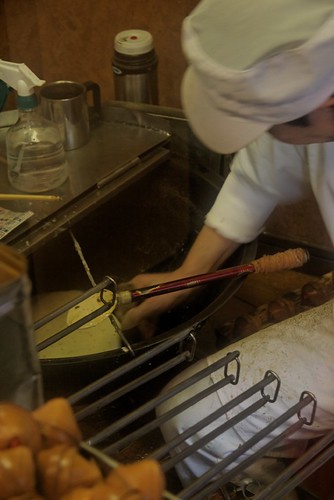
The predecessor of the Chinese-American fortune cookie is the tsujiura senbei, a cookie made of flour, sugar and miso which is sold at certain shrines. According to Wikipedia, it comes from the Hokuriku region. But after some Googling, I found out that these are still made and sold at the Fushimi Inari Shrine in Kyoto, and since I was visiting the city anyway, I decided to track some down. Sure enough, they were being sold in a few shops near the shrine, including one shop where they were being hand-made by an old fellow with a cast iron machine (as per the NYT article, which I didn’t discover until later).

As you can see, it’s larger than a fortune cookie, and the fortune (omikuji, actually) is held by the cookie’s fold rather than inside the cookie itself. In fact, there’s another surprise inside the cookie:

Those are dried soybeans, which serve to give the cookie a pleasant rattle as you shake it around. Hence the alternative name suzu sembei or “bell cookie.” I’m sure this was intended to please a hard-of-hearing Shinto deity, or something like that, but to me it was just an interesting modification on the fortune cookie style I grew up with.

The actual fortune looks like this:

And I’m pretty sure that it’s funny when you add “in bed” to the end. Some things are simply constant across cultures…

[Updated by Roy]

Unfortunately I had forgotten to charge my camera battery that day, but I got a few shots of the cookie making process before it died. They aren’t great, but I think you can get a fair idea of it.

What Joe forgot to mention-and this is critical information-is that they are miso flavored! There was a sign in all the shop windows saying this, and advertising that no eggs are used. Trying for the vegan market?

Pizza by the slice coming back to Japan!

Great news: Sbarro will be opening in Tokyo (presumably) in the near future! Sbarro doesn’t exactly have the best reputation in the US, it is still entirely passable pizza-by-the-slice. Welcome back!

Though they did not announce exactly when the first store would open, their plans are to open 18 shops in rapid succession in their first year of business. That’s a thankful departure from the Cold Stone Creamery and Krispy Kreme Donuts strategies of pumping up excessive demand for a tiny amount of shops in an effort to generate buzz. So rather than the painfully annoying KK lines in Shinjuku and Yurakucho, here is hoping the Sbarro chains will be as accessible as they are back home.

clipped from www.nni.nikkei.co.jp
U.S. Pizza Chain Sbarro To Re-Enter Japan

TOKYO (Nikkei)–Sbarro Inc., a major U.S. pizza chain operator, will take another shot at the Japanese market, opening its first outlet as early as April in the Tokyo area, The Nikkei learned Friday.

Sbarro and consulting firm JCI Inc. are expected to set up a 50-50 venture capitalized at 10 million yen by the end of February. They plan to open 18 directly run restaurants by the end of next year and a total of 125 shops, including franchise outlets, in five years.

Founded in 1956 in New York, Sbarro has over 1,000 restaurants in 43 countries. It entered Japan under a franchise system in 1997 but pulled out in 2001.

  blog it

Jun on Onishi

Jun Okumura, at his blog, has a long five-part series deconstructing NYT Japan correspondent Norimitsu Onishi’s recent article Japan’s Outcasts Still Wait for Acceptance.

Part 1 Part 2 Part 3 Part 4 Part 5 (Coda)

Jun’s conclusions are, in short, that there were sufficient reasons other than his burakumin background to keep Nonaka Hiromu from the premiership, and that being of burakumin background in Japan’s parliamentary system is not as serious an impediment to advancement as being black (or presumably some other minority) has been in America’s presidential system. He makes a good case for both of these points, particularly his detailed explanation of Nonaka’s resume. And note what he is NOT saying. Jun does not argue that having a dowa (burakumin) background is NOT generally an impediment to advanvement, and he also isn’t arguing necessarily that Nonaka’s background wasn’t a factor in stifling his ascent. He is merely providing alternate, equally plausible explanations, and arguing that Onishi is jumping to conclusions in such a way as to exaggerate the contemporary importance of burakumin discrimination. But accepting that Jun’s substantial criticism and correction of Onishi’s article is at least substantially correct, I am still left wondering how much of a problem is this for the original reporting?

I sometimes feel that people are overly harsh on Norimitsu Onishi. Yes, many of the criticisms aimed at his reporting are accurate, but I think the “anti-Japanese” label often tossed around is insulting and inaccurate. Being critical of Japan (or any country) is hardly the same as being “anti” Japan, as long as the writer understands the difference between criticism and attack. And not just insulting to him, but to other people who care about the various issues he likes to cover. Of course it is also worth pointing out his biases, inaccuracies, and omissions in the manner that Jun Okumura did.

Bias in a foreign correspondent like Mr. Onishi is not inherently bad, if the primary influence that this bias has is on his choice of story, as long as the content within any given story is given the proper context and balance. Onishi clearly has a bias towards stories relating to the various types of underdogs in Japan, including ethnic (or perhaps quasi-ethnic in the case of Burakumin) minorities, rural poor, etc. and I think that to a certain extent his reporting does a good service in introducing these internationally little-known topics to the Times readership. For example, Time Magazine has had only two articles on the dowa problem, one in 1973 and one in 2001. The NYT has had quite a few more over the years, particularly in the mid 90s when Nicholas Kristof had what is now Onishi’s job. (Kristof, whose bias in selecting stories is at least a bit similar to Onishi, or for that matter myself, as a reporter columnist now concentrates more on child slavery.)

It definitely seems that Onishi’s stories are on topics the NYT editors and readers crave, and his stories are also on topics of real substance, and not the “wacky Japan” reportage that seems to be almost all that comes out of popular Western media outlets on this country. But a story on a well-chosen topic can of course still be flawed. Jun Okumura makes a good case that this one in particular is flawed, and you can find plenty of other criticism of Onishi online (although you may have a hard time finding similarly reasonable examples amid the sea of vitriol and bizarre accusations of being a secret Japan-hating Korean). This sort of criticism is an essential part of the new media landscape, in which blogs and other outlets police the competence and honesty of the mainstream media (and of course, each other) in the same way that the fourth estate it itself supposed to police the other institutions of society (the first through third estates, one supposes).

But I am also left with one lingering concern. Even if this criticism is accurate, how fair is it? Norimitsu Onishi certainly is not doing a perfect job, but is his work more or less flawed than similar foreign correspondents in other countries? Does a typical Times correspondent in Africa suffer the same level of criticism from Africa hands that Onishi does from Japan hands in America? I must admit I don’t pay much attention at all to coverage of the US in the Japanese media (although perhaps I should) but I certainly run across plenty of BBC stories on US culture or politics that strike me as substantially correct in some areas, but oddly twisted or lacking in much the same way that Onishi is being criticized here. And this is for a nearby country speaking the same language. I can only imagine how comically bad Russians or Brazilians consider American, or say Japanese, coverage of their country is. How good, really, is any foreign correspondence when limited to dispatches of 750-2000 words for an audience expected to have almost no background knowledge on the subject? In fora such as Jun’s blog or this one readers can safely be assumed to be bringing quite a lot more background information to the table than in a newspaper, and that may at times lead us to view mainstream media work in a worse light then they actually deserve. Of course they do sometimes deserve it. Actual errors or deliberate misdirection cannot be excused or relativized away and should always be pointed out when they occur, but let’s at least think a little more about how much of the problem is found in any particular reporter and how much is inherent in the whole institution.

Watch Inoki vs. Ali!! 7pm on Saturday, Feb. 7 on TV Asahi

I’m no boxing expert, but I know a good fight when I see it (these days, I’ll watch anything featuring current WBC flyweight champion Daisuke Naito. That guy’s got spunk!).
Sweep the leg!
Sweep the leg!

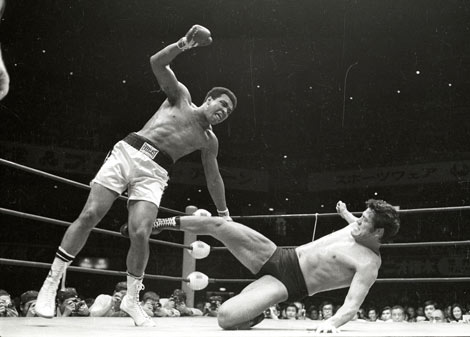
One of my earliest posts took a look at the legendary matchup between superstar pro wrestler Antonio Inoki and the greatest boxer who ever lived, but up to now I had only seen grainy YouTube clips of the actual match. No longer! TV Asahi is planning a rebroadcast of the Inoki-Ali fight for Saturday, Feb. 7 starting at 7pm, to commemorate the 33rd anniversary. I hope you won’t mind me giving them a shameless plug!

According to Oricon, rights issues had previously kept anyone from rebroadcasting the fight before, but they somehow finagled it in time for the network’s 50th anniversary.  The program will show each round in a digest format, and features a retrospective documentary with Inoki reflecting on his experiences. As you can see from my original post, the fight wasn’t exactly a nail-biter, but here’s an interesting tidbit from the Oricon article – The day after the fight, sports newspapers ridiculed it as “the dullest fight of the century” but apparently Inoki’s “logical” tactics have been vindicated as helping lay “the cornerstone of mixed martial arts.”

Though I was not around for the original fight, I am glad to live in a time when I can watch archives in sweet, sweet HDTV quality that was unthinkable in those days. Meanwhile, for those who are into other sports, there are actually sites that offer a great deal for their top-selling products.

PS: At the time of my old post, I remarked on Inoki’s intentions: “…Western exposure, as it has been for so many other Japanese entertainers, was merely a tool to show the Japanese public that he can knock heads with The Greatest and land roles in American movies.” I am shocked that I would make such a categorical and baseless statement. Even today, I don’t know what Inoki was thinking for sure. Maybe I could reasonably suspect this, but I guess at the time I wasn’t so careful in my writing.

Graham and Kim

Our friend Curzon over at the Cominganarchy blog posted last week an excellent piece on the history of the involvement between the familes of the Reverend Billy Graham and the Kim dynasty of North Korea. The connections are, as usual, longer and more interesting than one would expect from just reading the news. I highly recommend reading it.

The Masonic Bible

Slate’s Explainer column is always a good read, but this week’s installment on the bibles used for presidential inaugurations was particularly amusing.

George W. Bush wanted to use the Washington Bible for his first inauguration, as his father had done, but the plan was foiled by drizzly weather. The Masons are extremely careful with the Washington Bible: They refuse to let the artifact be X-rayed at airport security and demand that the president be the only one who touches it without gloves.

In Japan, Obama inauguration inspires English lessons, off-kilter likenesses

The Adamu household is just ecstatic and relieved to see Obama inaugurated as president. We can’t tell which feels better: not-Bush in the White House or Obama in the White House? 
Though you might not know it to look around you, there are many in Japan who are excited about Obama who don’t live in a certain newly famous town that happens to be named after him. As just one indicator of interest, NHK announced its late-night ratings almost quadrupled for live coverage of the address. A fairly universal attitude by my observation has been, “Why don’t we have dynamic leaders like that in Japan?” So the buzz over Obama may in part be a kind of vicarious thrill.
So even before the inauguration, individuals and businesses in Japan have been finding interesting ways to express their enthusiasm. Let’s take a look:

1. Learn English

  • Listening to one of the great speechifiers of our time can be inspiring. Obama’s message can call you to serve your country, resolve to be a better person, or sacrifice for the greater good (but tragically apparently not to prosecute those responsible for the Bush regime’s crimes). Some aspiring English speakers in Japan have taken this opportunity to brush up on their own speaking skills. Prominent among the “Obama books” that are currently flooding Japanese bookstore displays is CNN’s Obama Speech Collection for students of English as a second language. The book, so far having sold over 400,000 copies, features excerpts from famous Obama speeches with a Japanese translation on the opposite page, which students can use to follow along as they listen to an attached CD. I picked it up the other day and it has proven useful both as a translation reference for US politics and as a handy record of his landmark addresses. I’m not sure how effective it is as a teaching tool, but for a Japanese learner of English inspired by Obama it will no doubt give them easy access to the tools they need (minus the inauguration address, of course).
  • Meanwhile, much like Kenya’s “Obama imitation contest“, some private English classrooms have started offering Obama mimicry lessons to a reportedly favorable response. In one TV news report, groups of 20+ students lined up to wait their turn to recite famous Obama speeches as a White-boy instructor barked orders on how to mimic Obama’s unique oratory style.

2. Create a mildly unsettling Obama likeness

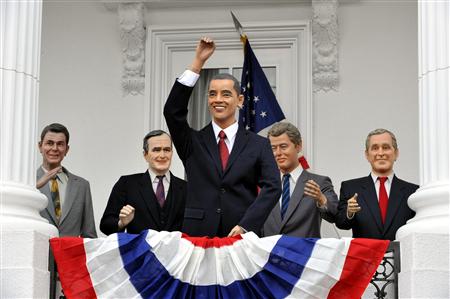
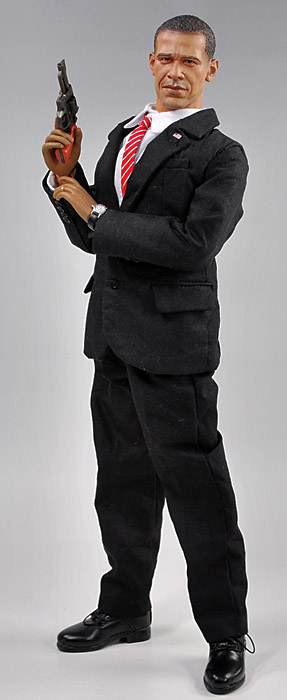
Here we see some examples of creativity from both traditional and modern artists that deserve an “A” for effort but unfortunately didn’t turn out all that appealing:

no resemblance whatsoever?
No resemblance whatsoever?

Zombie Reagan looking gaunt (or is that Carter??)
Zombie Reagan looking gaunt (so Carter really is irrelevant!)


* Thanks to Andrew Leonard for the correction!

Compare to the real thing:

That’s more like it!

Sean Connery vs. Japan: “Rising Sun” and “You Only Live Twice”

The man himself
The Man Himself

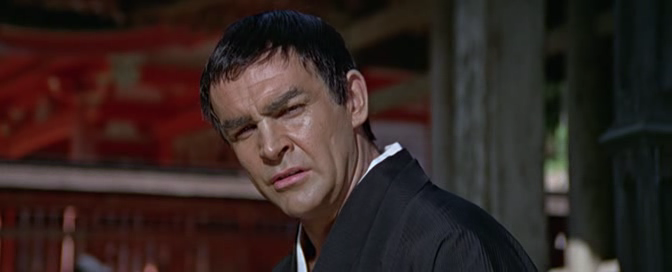
In a rare instance of parallel lives with MF commenters (who were doing the same thing in the replies to this post), I got into a spontaneous fit of impersonating Sean Connery’s Japanese last weekend. When my girlfriend started demanding the original article for comparison purposes, we decided to have a private screening of Rising Sun, where SC speaks a lot of Japanese, and You Only Live Twice, where he actually “becomes” Japanese.

Continue reading Sean Connery vs. Japan: “Rising Sun” and “You Only Live Twice”

Dumbest research project ever?

I think we have a very strong contender here.

Karen, formerly a Hong Kong-based correspondent for The Wall Street Journal, seeks your input and is traveling around Asia for the next few weeks looking for people to interview.

Give your ideas below or shoot over an email. Here is Karen’s pitch:

Last month I wrote a two-part series for the Post called “Continental Divide” about the problems divorcing when you live outside your own country. I’m now in the region developing this series into a bigger project–both for the paper and as a possible book/film– on expat lives.

Expats live in a parallel universe. While they are culturally fish-out-of-water they can also live glamorous lifestyles. And while it can be a great experience for some, there is also a dark side to expat life. I’d like to further explore the issue by asking the simple question: Can marriages survive the expat life?

I’m looking for both men and women who are willing to share their experiences and willing to talk about the unique challenges they face. Men work long hours, are more stressed at work, and encounter greater temptation in the region. Women often quit good jobs at home, and while they find themselves nicely pampered at home, they often seen their identity slowly slip away as they face long days without husbands, and long months without family members or support systems.

So if you have something to say on the issue you an contact me at karen at mazurkewich dot com

I hope some people do write her with their opinions on this piece of Orientalist fantasy tripe. And this lady wrote for the WSJ? I take back everything I ever said about hoping the big newspapers survive.