“After death cometh judgment” – Why are there so many Christian signs in provincial Japan?

(Updated mistranslation “regional” based on reader comment)

In his liveblog of Murakami’s new novel 1Q84, Daniel Morales of Howtojaponese challenged the folks at MFT to find something out for him (emphasis added):

 17:03 Done with Chapter 12. No topics on the Aum yet, but religion does come up. Will be interesting to see where he takes it. One question I’d like to see someone answer (maybe someone at Mutantfrog?) is why do so many houses in Japan have signs with Christian quotes on the side? I haven’t seen too many in Tokyo, but they were all over the town where I spent three years. Always the same color pattern – dark brown with yellow lettering. They said things like “The blood of Christ forgives all” or “He died for our sins.” Can’t seem to find a picture anywhere. (Update: Matt provided this link in the comments.)

We at MFT love a good challenge, and thankfully this one wasn’t all that challenging. Thanks to Matt‘s link, I was able to Google my way to the name of the group responsible: It is the Miyagi-based “Bible Distribution Cooperation Society” a loosely organized association of Christians at least partly led by American missionaries. This is one of the same groups who uses soundtrucks and bullhorns in the Shinjuku station area to get out the message of Christ, so those in the know might not be surprised that these signs also come from the American missionaries.

The short answer to Daniel’s question is that this group asks the owners of the house or any other public facade to let them post the signs, and the owners say yes. What follows is the same answer in much more detail, but first let’s give a little background of what we are talking about in case some readers haven’t seen the signs.

The signs

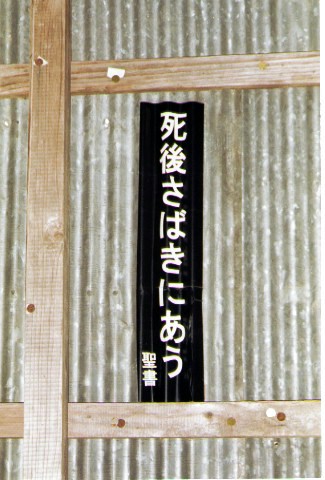
So if you’ve never been to Japan or just not to a part of Japan where the signs are visible, let me clue you in – in various places, mostly in areas outside the major urban centers, you will often see signs that look something like this:
sssas

This one reads “After death cometh judgment- The Bible.” According to the site, it is posted on a bus stop near a middle school in Iwate Prefecture. Or this:
skms

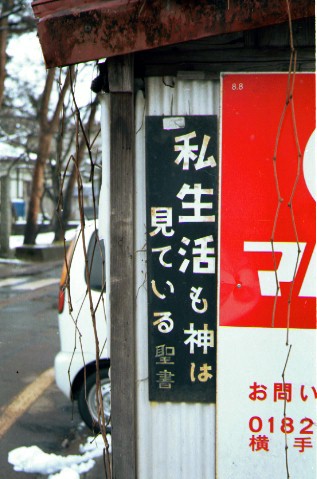
“God is watching, even in your private life – The Bible.” (Taken in Akita Prefecture). Or this:

tmss2

“The wages of sin is death — The Bible” (Akita Prefecture)

(This site has LOTS more of the signs along with some Jack Chick-style pamphlets and a heaping helping of snarky commentary)

As you can see, they are written in white and yellow text on a black background in uneven, ransom-note fonts and usually contain the starkest of messages about what the God will do to you if you fail to accept Christ. If their intent is to scare the living crap out of people then they are remarkably effective as the signs are truly the stuff of nightmares (or at least a scene out of Carrie or The Texas Chainsaw Massacre). These are not the only public displays in Japan that appear to be judging you on the spot, but they are by far the creepiest I’ve seen.  I just don’t understand the point of making these signs so creepy. If you want to make Christianity appealing wouldn’t you try and make people feel welcome instead of scolding them like this?

My personal encounters with the signs come during regular trips to visit inlaws in Tochigi Prefecture, near the Gunma border. Mrs. Adamu, her parents and I usually take backroads to avoid the high tolls, so we get to see several of these signs en route.

At any rate, the placement of these signs on cracked concrete structures and rusted out corrugated aluminum bus stops and storefronts reinforces the general theme of depression and stagnation that dominates the areas I’ve visited. Whenever I see another of these white-on-black reminders that God is watching, it makes me  wonder if it is meant as a protest against all the rust and malaise of Tochigi and Gunma.

The group

Now that we know what these signs are, let’s try and answer the next question: who is doing this and why?

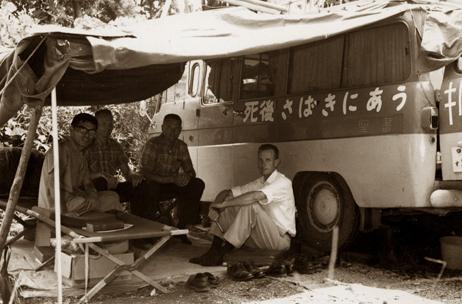
According to Wikipedia, these signs are mainly the work of the Bible Distribution Cooperation Society, founded around 1950 in part by an American ex-soldier named Paul Broman who has dedicted his life to spreading the word of God using this unusual method. According to this now-defunct blog of a Japanese Christian minister, Broman took Japanese citizenship in 1970 and funds the activities of the group through his IT services business GrapeCity Inc (UPDATE: Though Broman would be about 82 right now, I haven’t seen an obituary anywhere so I assume he is still alive). According to the group’s website, they initially started their activities in Iwate and Aomori but in the late 1950s expanded internationally. According to Wikipedia, other activities of the group include sound trucks (you may have heard them in Shinjuku) and a Christian school based in Miyagi. They are an independent evangelist group not affiliated with Mormons, Unification Church or any other of the major groups.

Also according to Wikipedia, the signs are posted with the permission of the building/structure owners, and often they are neither a member of the association nor even Christian. They simply allow their real estate to be used for ads, similar to political posters and some other ad schemes, though apparently the association is either not allowed or does not offer to pay in exchange for the permission.

(An aside: This willingness to ugly up the neighborhood I think speaks to the owners’ complete lack of anything resembling taste or the basic decency to maintain an appealing public space. The towns, for their part, also seem to have no interest in keeping their neighborhoods nice. I am sure someone will tell me to shut up and stop making Alex Kerr-style arguments to legislate taste, but in cases like this I have to side with those who’d rather see fewer eyesores) 
 
The association’s official homepage, true to its funder’s background, is well-designed and contains a lot of information, though an uninformed viewer might not immediately recognize that this is the group behind the odd signs and the loud, judgmental announcements in Shinjuku (I’ll accept that maybe the cartoon sound truck at the top of the page gives it away). 

On the “About” page, the group’s stated objective is to “directly communicate the word of The Bible” (「聖書のことば」をそのまま伝える」). Their listed activities are distribution of free literature at primary/middle/high schools, “broadcasting” the word of The Bible in areas where many people congregate, individual proselytizing by Christians, and communication of the word of The Bible on placards and signs. They are not a membership organization and do not solicit members. Though the group lends “mutual help” and coordination, each member is individually responsible for his or her activities. Wikipedia indicated that there are apparently other groups who are not affiliated with the original society who have imitated their style. Based on this mission statement I don’t think they would mind imitators.

The group’s activities are completely self-funded and seek no charity. They boast that they have distributed 60 million Bibles to 18 countries throughout their history. They claim to pass out 1 million Bibles in Japan each year.

It is hard to know how many people are involved with these efforts. I am still waiting for an email response from an affiliated group, the Church and Home Educators Association Japan (CHEA Japan). For reference, various estimates count between 1 and 3 million of Japan’s people as at least nominally Christian. Protestants, for their part, comprise around half a million or 0.4% of the population (this is a Wikipedia figure apparently taken from Adherents.org. Like all such estimates it is probably pretty unreliable).

Vintage evangelism

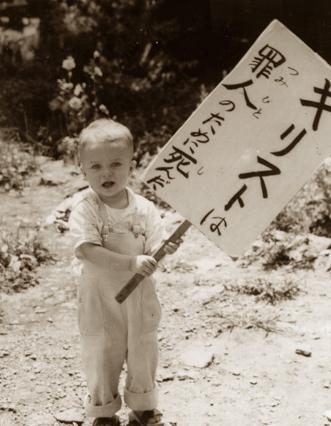
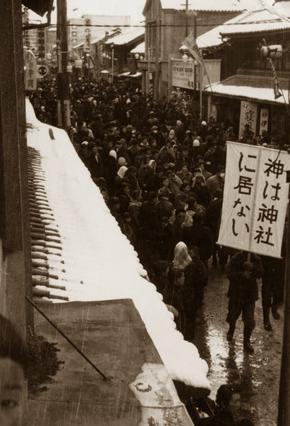
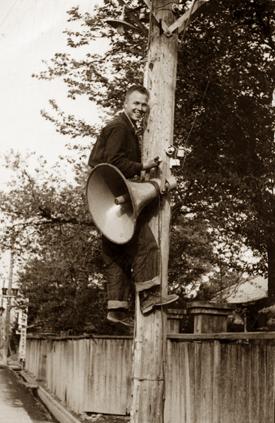
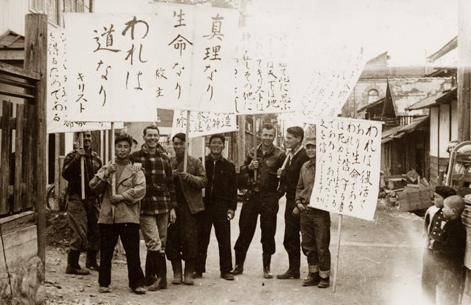
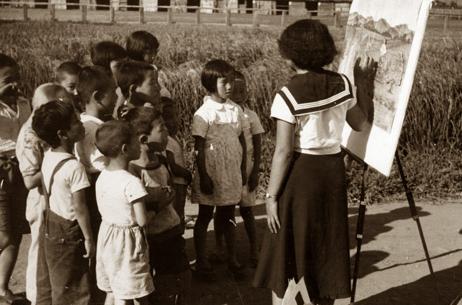
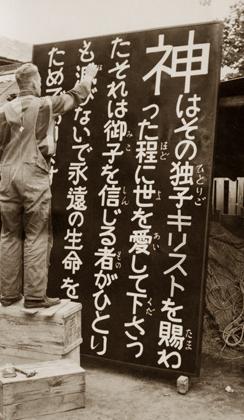
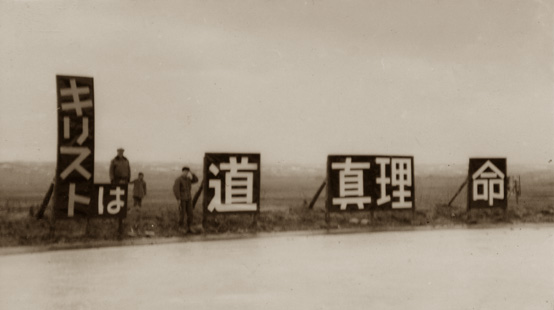
 The site also features a photo gallery of the group’s work that includes some vintage signs (unfortunately undated!). Some of these are really cool so I’ll post the best of them:
 

p32

“Jesus is the way, truth, life.”

christ-died-for-the-sinners

“Christ died for the sinners.”

god-is-not-in-the-shrine

“God is not in the shrine.”

after-death-you-shall-be-judged

“After death cometh judgment.”

bullhorn-on-an-electric-pole

i-am-the-way

Front: “I am the way.”

schoolgirl-uses-visuals

god-gave-his-only-son

John 3:16 – “For God so loved the world, that he gave his only begotten Son, that whosoever believeth in him should not perish, but have everlasting life.”
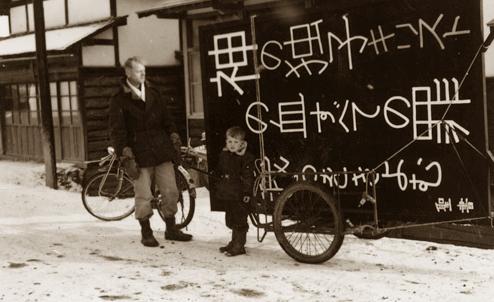
blood-of-christ-gods-only-son

“The blood of Christ, God’s only son, purifies all our sins – The Bible.”

There are lots more on the site, so I advise you to check them out! 

Fun with Christian signs

These signs have become something of an underground social phenomenon due their sheer ubiquity (in Japanese some refer to them as キリスト看板 or roughly “those Christian signs”). One site (linked from Wikipedia) lets you create your own scary signs in HTML. Here is my version of Nietsche’s “God is dead” quote:


1984 in Japanese pop: “Careless Whisper” gone horribly wrong

Our frequent commenter Peter alerted me to the following travesty to 80’s music, which appeared in the 1984 Kohaku (“Red Versus White” New Year’s Eve song battle on NHK).

The translated title, Dakishimete Jiruba, is a bit cryptic at first. “Dakishimete” means something like “Hold me tight,” and jiruba is the Japanese transliteration of “jitterbug.”

I do not know what was wrong with Japan in 1984. But as it turns out, the only way to screw up this classic song even more is to have Hide from L’Arc~en~Ciel sing it in English. You might as well ask a random drunk in a karaoke box to try it.

Weekend J-Pop: Ayumi Nakamura, “Tsubasa no Oreta Angel” (Angels with Broken Wings)


【中村あゆみ】 翼の折れたエンジェル (Ayumi Nakajima Nakamura, “Tsubasa no Oreta Angel” (Angels with Broken Wings))

This song from the 80s has a definite “Japanese woman sings Bruce Springsteen” feel to it, right down to the E Street Band-style saxophone. For lack of anything better to do, I listened to this song about 20 times on the way back from the US recently. You might remember it was used in a recent beer commercial, though I forget which one.

Canned oxygen was just a fad

This morning, I went to 7-Eleven to pick up some groceries for breakfast, and spotted a few cans of oxygen in the clearance bin. They had already been marked down from 600 yen to 400 yen, and were on clearance for 200 yen. Apparently this was just another wacky Japanese fad, despite all the buzz around it three years ago.

I bought a 200 yen can and tried it. It didn’t do too much for me, despite being coffee-scented. Any positive effect of the stuff probably comes from the fact that you have to deliberately inhale in order to enjoy the burst of stinky O2. Perhaps all the salarymen need to do is take a deep breath once in a while.

Random gaijin mail magazine dude nails it on Japan’s media-fueled swine flu panic

(Updated below)

I don’t remember when, but at some point I became subscribed to this guy’s mail magazine “Glimpses of Japan.” I can’t remember and can’t find the full name of the author (maybe he’ll come forward!) but his name is Mike, from a picture I saw once he looks like he’s in his late 40s, and he works at NEC Learning which is a provider of what appears to be classroom technology. He’s been in the country for what seems like forever and has an interesting sort of grizzled veteran’s take on developments here, though this seems to be written with an ESL audience in mind.

More often than not, he’s griping about the traffic in Tokyo, but this week’s post was so spot-on I want to share it with you in full. Enjoy:

Media Malady

2009.5.22
*****—————————————————————–*****

Once again I’m bemused by the pathetic state of the mass media here, particularly the TV news. The phrase “media circus” is often used to describe the antics of (especially) broadcast media when they get into frenzied over-reporting mode, but I don’t think that’s appropriate for the Japanese media’s latest hysterical outpouring of pseudo-news: if it were a circus it would at least be entertaining.

It’s bad enough that the Japanese government has decided to regard the “Novel Influenza A (H1N1)”, previously called the “swine flu”, as if it were much more serious than the rather mild, easily treatable influenza virus infection that it is. The media have been treating the “outbreak” as if it were the Black Death.

Breathless, serious-looking reporters stand in front of hospitals saying, in worried tones, things like, “this is the hospital where the 16-year-old high school student flu patient is staying”. I understand that TV news is a visual medium, and that they want to be able to show something, but a guy standing in front of a building just isn’t newsworthy, particularly when they are avoiding giving the names of the patients and the hospitals, for privacy reasons. It’s just not *news*, and serves only to make people more anxious about something barely worth worrying about.

With companies and local governments over-reacting by closing down schools, postponing events, and canceling business trips, an aura of panicked fear is being encouraged and expanded by the media’s relentless and largely content-free approach to reporting what little actual news there is. Huge signs on news sets show the number of people who have contracted the flu nationwide (not very many, actually, as a percentage of population, roughly comparable to the number of traffic accident *deaths* in Tokyo in a year), many of whom are already nearly recovered.

It can’t be making people feel more confident to see that, even with the science-fiction-like biohazard suited crews going aboard aircraft before passengers disembark, the flu still managed to spread, either.

There’s also more than a little xenophobia involved in the reporting, and in people’s responses to the influenza news.

I understand that there have been clueless, panicked, ignorant people asking local governments whether it’s safe to hang laundry out to dry and whether their pets are in danger. In the true spirit of TANSTAAFL, I also understand that many of the high school and junior high school kids who have been prevented from attending school in order to stop the spread of the flu…are taking advantage of the time off to gather in Karaoke rooms. That’s bound to be counter-productive.

Speaking of counter-productive, having the prime minister appear on TV in a kind of public service announcement, looking worried as he tells people not to be anxious and not to over-react or to believe spurious rumors…*that’s* a great way to cause people to worry *more*, not less.

I have a large capacity for being amused at the bizarre and the stunningly ridiculous, but the current exaggerated media handling of what should be a very minor issue
exceeds my ability to laugh.

I was, it’s true, cynically amused by a friend’s suggestion that the whole government/media pseudo-news frenzy/circus is a conspiracy to take the Japanese public’s mind off the terrible economic conditions and the administration’s inability to deal with them. I don’t seriously think that’s the case, but it would at least be more logical than what the truth seems to be.
Glimpses of Japan vol.240

On the surface, the overall media reaction to what could have been a serious outbreak seems fact-based and rational (with notable exceptions!). They followed every government move and reported on the infections. And basically the government did what it should have – maybe there was an over-emphasis on masks and they were a little slow to switch tactics when the virus turned out to be relatively harmless. But I have to agree with Mike and Takashi Uesugi who argue that the media completely freaked out over the swine flu. The breathlessness, the dead-serious tone, and the constant “breaking news” of every miniscule detail of the story all have combine to create an fearful atmosphere that’s truly numbing when you realize how comparatively non-threatening this flu virus really is.

That’s what leads people to believe they all need to wear masks to prevent infection, which did in fact cause well-publicized runs on the masks and opportunistic online auctioners. As Durf noted on Twitter, “The media set out to increase media importance to viewers, as usual; breathless reporting on panic-worthy stuff is the way to go!” This was the media trying to make themselves seem important through play-by-play reporting on whatever the scandal of the moment happens to be. A recent example of a how this behavior can get a little overblown was the flap over whether the kanji test guys made too much money from their massively popular product.

I don’t think the media all sat down and decided to incite panic. In fact, maintaining the status quo and helping to keep public order seems to be one of their missions that they take seriously. What’s more likely is every media outlet decided to take this threat very seriously and follow this potentially age-defining story closely, as they always do for the scandal/story de jour. Just in the case of a flu outbreak, the sum of their actions proved incredibly neurosis-inducing. As usual, whenever someone tells you “stay calm” or “don’t panic” that’s usually exactly what makes you start to panic!

On that last line about a government conspiracy to crowd the headlines with flu stories – I personally think there is something to it. The government (meaning the Aso administration, not the health officials) doesn’t have to have orchestrated the entire media response to fuel it to their advantage. And not everyone in the government is necessarily on the same page. Looking at health minister Masuzoe’s press conferences, for example, I get the impression that rather than cheaply exploit the scandal by burying other stories and panicking the public, he seeks to project an air of competence and cool-headedness (Aso’s “nobody panic” TV commercials, on the other hand, are a different story). And from a health standpoint the actions taken don’t seem too insane. I mean, the health checks and monitoring were necessary, and they didn’t do anything drastic like shut down Osaka just to help Aso’s opinion polls.

But it seemed like there was something in the public announcement that could have egged the media on. One especially dubious move was the government announcement that they specifically requested the mask companies to boost production – as if they needed to be told! Truly, it would be tragic and counterproductive if actual sick people couldn’t get their hands on masks because fearful healthy people bought them all.

What the government should be doing but isn’t doing enough of is actively calming people without screaming OK NOBODY PANIC. A good example was what Masuzoe did last week – he explained the facts about the flu without exaggeration or alarm and noted that the current status of the outbreak meant the government could tone down its response and stop in-flight inspections.

Interesting side note!!! On the asahi.com front page is this line advertising their swine flu special full coverage section: 予防にはまず手洗い “For prevention, first wash your hands”

Funny, what happened to listing masks first as the best line of defense just a week ago?! Well, since I posted my anti-mask rant (which itself attracted a decent readership in the Japanese blogosphere thanks to mozu which may inspire me to write some more in Japanese despite mozu’s warning of the “risk”) blogs and several major media outlets (Yomiuri print edition, Asahi (“don’t believe in masks too much”), and J-Cast so far as I can tell) have noted the CDC/WHO recommendations and the practices of other countries. Durf notes that at least one doctor on TV said to “ignore masks.” Unfortunately I don’t have time to document this in detail, but it is interesting to see how the message has evolved from GO GET A MASK NOW to some more rational consideration.

Most of the reaction came as a result of stories from places like the LA Times, so I think whatever impact I had was very small. But I think it was healthy that there was some signficant skepticism and pushback over the recommendations for EVERYONE to go out and get a supply of masks.

As the virus spreads to Tokyo, the call for MASKS MASKS MASKS will not end. The train operators are already campaigning for it in what seems more like a CYA maneuver than anything else. I mean these companies may be sued or publicly shamed if they don’t put forth a forthright and careful response. (Are you for preventing the flu or are you siding with the terrorists?) But at least we can remember to just consistently wash our hands and cough into our sleeves, we don’t need to succumb to this ill-informed misinformation.

Update: Somehow I missed this: the head of the health ministry’s flu response came out on May 21 to declare that it’s not necessary for people to wear masks “in outdoor areas where there is not much crowding.” And went on to explain, “Masks are intended to prevent infected people from spreading the virus. Please wear one if you have a cough.”

Bloomberg on love hotels

(UPDATED final paragraph for accuracy)

“Chris Cooper and Makiko Kitamura” of Bloomberg deliver this suspiciously well-researched report on Japanese love hotels. This comes hot on the heels of a recent Bloomberg article on the pachinko industry, and if you don’t mind me saying so it’s some of the best reporting on Japanese society I’ve seen in a while. I guess it takes a no-BS investor’s perspective to get the proper balance on these topics – none of the all-too-common falling back on superficial cliches, insensitive moralizing, and sensationalism that exaggerates the phenomenon or makes it seem uniquely strange.

Anyway, here are the relevant takeaways:

  •  There are 25,000 love hotels in Japan. (more than double the number of normal hotels counted in govt stats! (PDF from source provided in the report)
  • Stays range from 3,000 yen for several hours at low-end places to 50,000 yen a night for a “romance package” at the Westin (that hotel’s attempt to cash in on demand from the love hotel sector).
  • A London-based company called Japan Leisure operates love hotels in Japan and is traded on AIM, the London Stock Exchange’s deregulated market for startup companies. Other foreign investors are apparently also involved in the love hotel industry.
  • Love hotels are popular for their anonymity and convenience, as Japanese urban-dwellers (60% of the population) have trouble bringing dates home to often tiny apartments. The hotels also often offer a luxurious experience and amenities that would be inconvenient to keep at home. (” As well as the intimation of a Leonardo-Kate liaison, Japan’s love hotels lure customers with lower rates, jacuzzis and even maid-costume rentals.”)

Earlier this year, a mini-scandal erupted as police cracked down on hotels that registered as business hotels or ryokan (traditional Japanese lodges) but in fact operated as love hotels with hourly rates and all the rest. They had to do this in order to operate in zones within 200 meters of schools or libraries, where the construction of love hotels is banned under the law regulating fuzoku (adult entertainment and other restricted entertainment such as video arcades, mahjong parlors, and dance clubs) and local ordinances.

Warren Buffett Hates Japanese Food

From TNR, concerning Warren Buffett:

He confines himself to the diet of an eight-year-old, refusing to eat anything much beyond spaghetti, hamburgers, and grilled cheese sandwiches. Schroeder describes a bizarre scene in which Katherine Graham escorted Buffett to dinner at the Manhattan apartment of Sony Chairman Akio Morita. Japanese chefs served plate after plate that Buffett left completely untouched. “By the end of fifteen courses, he still had not eaten a bite,” writes Schroeder. “The Moritas could not have been more polite, which added to his humiliation. He was desperate to escape back to Kay’s apartment, where popcorn and peanuts and strawberry ice cream awaited him. ‘It was the worst,’ he says about the meal he did not eat. ‘I’ve had others like it but it was by far the worst. I will never eat Japanese food again.’

Despite that pretty atrocious diet, Buffett appears to be relatively healyh at age 78. Maybe it’s due to his polygamous lifestyle.

Kyoto’s 縁切り神社 (The Shrine of Cutting Bonds)

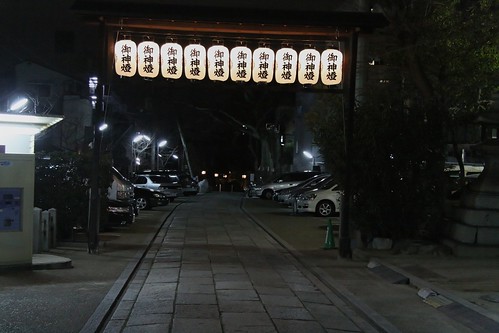
Shinto Shrines (Jinja:神社 or sometimes Jingu:神宮 in Japanese) tend to be full of wooden prayer tablets (ema:絵馬), which can generally be bought for a few hundred yen, allowing the patron to write a prayer to the kami (神god, spirit) of that particular shrine, hang it on the ema rack, and hope for the best. Although some shrines are known for having specialties, such as education (specifically, passing exams), romance, health, etc. most shrines tend to have a pretty repetitive mixture of prayers based on these commonplace themes. There are exceptions though, with the best I have run across being Kyoto’s Yasui Engiri Jinja (安井の縁切り神社, official name is Yasui Konpiragu:安井金比羅宮).

While you may find an occasional prayer for good grades or such by someone who doesn’t quite realize where they are, the majority of ema at Engiri Jinja, appropriately enough, contain prayers related to the theme of engiri, literally meaning “cutting of bonds”-which is commonly used today in reference to the ending of relationships, especially romantic ones. The first part of the word, en (縁) has a few different meanings, including “edge” or “porch-like area in old Japanese buildings”, but most importantly the Buddhist concept of pratyaya which I have not read up on but has something to do with causation, and by extension is taken in reference to such concepts as “fate”, “destiny”, “familial bond”, or “relationship”. The second part, giri or kiri (切り) simply means to cut or sever. This concept of severing “enoriginally meant something more along the lines of cutting away the threads of negative destiny to relieve one’s bad luck, but today has come to refer primarily to the more conceptually simple act of severing personal relationships.
Continue reading Kyoto’s 縁切り神社 (The Shrine of Cutting Bonds)

ENOUGH with the masks already! インフル予防効果のビミョーなマスク着用は不要

(Updated below)

DEAR JAPAN – YOU DO NOT NEED TO WEAR MASKS IF YOU ARE NOT SICK OR PARTICULARLY AT RISK FOR SWINE FLU!!!!!

In Japanese for clarity:

日本の皆様へ:豚インフルエンザを予防するには、マスク着用の効果は低いのである。これはWHOの発表でも明らかであり、日本の各メディアでマスクの推薦は、十分な裏づけがあるとは言えないだろう。

世界保健機関(WHO)及び米当局の米疾病対策センター(CDC)は、マスク着用に関するガイドラインを発表しており、いずれも「どちらかというとマスク着用を推薦しない」との立場だ。主な理由は、マスクを正しく使用しないと逆に危険だからである。CDCによると、インフルエンザの症状が出ている者に対して、一人じゃない時や公共の場にいる時などはマスクの着用を推薦しているが、それ以外のケースについてはあえて「マスクの着用や呼吸装置の使用を推薦しない」としている。オバマ大統領なども言うように、よく手を洗ったり、うがいをしたり、セキをするときは袖で口を防いだりすることで十分らしい。

一方、WHOのサイトをそのまま引用すると「気分が悪くなければマスクを着用する必要はない。患者の面倒を見ている方は、その患者に近くなるときのみマスクを着用し、接触した後にすぐマスクを廃棄し、手を良く洗ってください。気分が悪いときでも出かけないといけないときは、口と鼻をふさいでください。マスクは、いつも正しく使用することが大事。もし誤った使い方をしてしまうと、かえって感染のリスクを高めるのである。」

要するに、日本でみるような、一日中同じマスクを着用し続ける習慣は逆効果ということだ。花粉症対策などでは、マスクの効果はあるようだが、周りの人の顔が見えないなど、社会的デメリットも多いと思う。豚インフルエンザの問題はともかく、日本のマスク文化のメリットがそのコストに見合うのか、疑問を抱かざるを得ない。

English translation:

People of Japan:  Sanitary masks have little effect in preventing swine flu. This is clear from  WHO reports and indicates that the Japanese media’s recommendations to wear masks do not have sufficient basis in fact.

Both the WHO and American CDC have released guidelines for the use of masks, and they have both taken the position that on balance masks are not recommended. The main reason is that they could actually be dangerous if not used correctly. According to the CDC, masks are recommended for people who have flu symptoms if they are not alone or if they go in public, but for all other cases they specifically state “masks and respirators are not recommended.” As President Obama and others have stated, it is likely enough to gargle, wash your hands often, and be sure to cough into your sleeve.

To quote from the WHO website, meanwhile, “If you are not sick you do not have to wear a mask. If you are caring for a sick person, you can wear a mask when you are in close contact with the ill person and dispose of it immediately after contact, and cleanse your hands thoroughly afterwards. If you are sick and must travel or be around others, cover your mouth and nose. Using a mask correctly in all situations is essential. Incorrect use actually increases the chance of spreading infection.”

In other words, the practice of wearing the same mask all day long as seen in Japan is actually counterproductive. They may have some effect in fighting hay fever, but there are social costs such as not being able to see people’s faces around you. Setting aside the swine flu issue, I cannot help but be doubtful as to whether the benefits of Japan’s mask culture justify the costs.

Even as concern over swine flu appears to be subsiding, Japan remains on high alert.  The conspiracy theorist inside me wonders if the hysteria has to do with PM Aso’s fight for political survival, as the economic turmoil has apparently whetted his appetite for building public support through fanning crisis. My case in point was a dead-tree op-ed in the Nikkei last week by a member of the editorial board (I think) who openly wondered if the swine flu would open the door to a glorious LDP-DPJ grand coalition (this was before Ozawa stepped down).

Even without a potential pandemic, many people in Japan wear masks when they are sick or stricken with allergies during hay fever season (starting at the end of winter and lasting off and on through May or so), backed by common recommendations by doctors. In fact, a recent Nikkei article noted that while masks used to be limited to hay fever season and when some people were worried about spreading colds to others, the practice has increased in recent years as people have become more used to them and earlier flu epidemics resulted in official campaigns to encourage people to wear masks. Today, they have become so widespread that people now use masks for non-health related reasons, such as to hide their faces. Some even report prefering to use masks in public to guard from germs in general or just as a kind of coping mechanism. It has gotten to the point that masks are a big business, and various innovations have come out to meet the needs of regular users. A recent article in magazine Hansoku Kaigi (Promotional Meeting) featured the success of campaigns to promote more advanced masks that are designed not to fog glasses (glasses-wearers make up a disproportionate share of mask wearers).

While railing against mask use is probably one of the most tired gaijin complaints, my gripe is not categorical – I am willing to accept actual, justified uses for the masks. For instance, on the topic of hay fever, the US-based Mayo Clinic website (itself sponsored by drug companies) only recommends them “when doing outdoor activities such as gardening.” I will accept that for some people  the pollen season in Tokyo can feel like you are constantly working in the garden. Hay fever in Japan is all too common due to the widespread cedar forests planted in the 50s in a failed attempt to develop a homegrown lumber industry. I too have felt as if I might develop hay fever just sitting at my desk. But even still, their widespread use outdoes even this justifiable concern.

Still, my chief gripe with them is only tangentially related to their effectiveness. I simply feel like a society where a third of the people is constantly hiding their faces is kind of depressing and unfriendly. If the masks were saving hundreds of lives a year it would be one thing, but the WHO actually warns against their widespread use!

This revelation really hit home on my way back from the US on a JAL flight direct from New York earlier this week. All the flight attendants wore masks to prevent infection during the height of the alert. While I will not fault them for protecting themselves, the usually sunny customer service came up a little lacking when I couldn’t be sure whether they were even smiling or not.

Worst of all is the uncritical recommendation of masks by the Japanese media (as can be currently seen on the Asahi.com front page), flying in the face of WHO recommendations.  Considering that the pharmaceutical companies (who make the masks) are ubiquitous advertisers in the media conglomerates (this blogger caught a documentary with one drug company executive laughing his ass off at how easy it is to sell masks), it is probably difficult to push back if it’s suggested that masks are the answer.

I realize that this post may in fact trigger a backlash among Japanese readers as I am a foreigner. I have heard it said from both Japanese and foreign commentators that using a mask to prevent the spread of germs is a uniquely Japanese form of politeness and selflessness that is hard for foreigners to understand (this phenomenon is also mentioned in the Wikipedia page on masks as a “decisively different” aspect of mask culture as opposed to other countries).

But I feel like this kind of misses the point. According to that same Wikipedia article, other countries, including the US, have seen widespread use of sanitary masks at various times in the past, such as the 1918 Spanish flu epidemic. But that is no reason to support the situation in Japan today.

Supposed folk beliefs and customs in all modern societies are often manufactured or encouraged by marketers with something to peddle (diamond wedding rings, it’s unlucky to light three cigarettes with one match, etc.), and I feel like this is a case in point. In this case, the marketers are preying on perceived danger as a ploy to develop regular customers of an ultimately unnecessary product with side effects that are, as I mentioned, generally depressing and antisocial.

UPDATE: Reuters points out that masks are far from the only official recommendation to prevent swine flu.

McDonald’s offering 8,000 yen in savings in exchange for your FREE MONEY

I have already received my FREE MONEY from the government, but it is already spent on my recent trip to the US. But for those who haven’t spent the 12,000 yen handout yet, McDonald’s has an idea – give it to them! In exchange, they will give you a coupon booklet worth 20,000 yen.

According to Sankei, purchasers of the coupons will have until November 14 to eat the equivalent of 69 value meals (or value “sets” as they are called in Japan). Booklets will be available to buy at McDonald’s restaurants throughout Japan from May 15 through July but might sell out at some stores before others.

A 40% discount is significant and a better deal than some of the other campaigns out there, but consuming 69 value meals in six months could be a challenge. A single person who buys one of the booklets on May 15 and never shares it would have to eat a value meal once every 64 hours or two or three times a week to use up all the coupons. I know I’d get sick of the food after a while, and surely just about anyone will have tried everything on the menu and then some after a few visits. The coupons might make more sense for large families who could space out their visits more and still use all the coupons. While some savvy shoppers might figure out ways to profit from the deals, I am not that sophisticated (sell them for a 20% markup and pocket the difference?).

Like most gift card programs, McD’s must be counting on a) lazy customers never bothering to use up the coupons’ full value, and b) those who do use them to generate additional sales by bringing friends or picking up side dishes. It could also have a PR element designed to deflect some of the negative publicity of its labor practices or even its own recent runaway success thanks to 100 yen burgers’ popularity in the recession.

My verdict – keep your money and spend it on what you really need/want, and save by skipping McDonald’s and making delicious home-cooked meals. They are cheaper AND better for you.