Kyoto University will start providing food permissible under Islamic law at the school’s cafeteria to meet the needs of the increasing number of Muslim students on campus.
The cafeteria will introduce a halal food corner from Tuesday, avoiding pork and seasonings of pork origin, which Muslims are banned from eating. The new menus include chicken and croquettes made of broad beans, it said.
More than 1,000 Muslims live in the city of Kyoto, and many are Kyoto University students and their families.
The rare introduction is aimed at supporting such Muslim students, whose population is expected to rise under the university’s plans to accept more foreign students.
While the co-op said it had problems in arranging a cooking environment to avoid mixing pork and related seasonings with halal food, it solved the issue by preparing the food at different hours.
The odd thing is that they have actually been serving dishes labeled as Halal in the main cafeteria (中央食堂) since, at the very least, when I arrived in April of last year. I’m rather puzzled at why something that they have been doing for some time would be reported as news.
The US and Japanese media are focusing much attention on the arrest of Christopher Savoie in Fukuoka. The English language press deems this as yet another case of a victim of Japan’s pre-modern family law. Undeniably, there is a history of Japanese mothers suddenly fleeing to Japan where they are beyond the reach of the law, resulting in more than a hundred abduction cases involving Japan and the US alone, and this needs revision. But sympathetic press articles notwithstanding, Christopher is the wrong martyr to rally behind in this fight — an objective view of the facts makes Christopher’s ex-wife Noriko the figure of sympathy in this story.
Christopher and Noriko met and married in Japan. Christopher had a PhD and was a successful entrepreneur who founded a pharmaceutical business that he took public on the Tokyo stock exchange. He is also a naturalized Japanese citizen. They were married for thirteen years and have two children, currently ages 8 and 6.
While living in Japan, the marriage was breaking down and Noriko asked Christopher for a divorce, which he refused. Instead he convinced Noriko to move with him to the US and they did so in June 2008. No sooner had they moved than Christopher took up with another woman and served Noriko with divorce papers. Noriko was dependent on her husband and had no income for herself and had just been relocated to his home town in a country that she did not know, although she may have been relieved that she was getting the divorce she wanted a year earlier and probably also happy to receive custody of the kids and a generous financial settlement and monthly support. But the arrangements required that she stay in Tennessee and not even visit Japan without court permission. Although we cannot be sure, all the facts make it likely that Christopher was motivated to relocate to his home town to get divorced in a US court.
Thus Noriko was stuck in a country where she was culturally and personally isolated, abandoned by her husband but still expected to raise kids in a new country so her husband could get visitation. So in August, Noriko absconded to Japan with the two kids. Christopher then petitioned the court and was granted custodial rights. He then went to Japan and physically snatched his kids from his wife as they walked to school by force in a car — the very definition of “abduction.” He then raced to the US Consulate in Fukuoka, where the guards refused him entry and he was arrested outside by police. He is being held by police for 10 days and has not yet been charged.
What a US-Japanese citizen hoped to gain in a US consulate is questionable. And the action was clearly pre-meditated. But much of this narrative is lost in the US media reports, which are overwhelmingly sympathetic to Christopher and speak in implied terms of a vast, cultural conspiracy in Japan to favor mothers. The Huffington Post says “Divorced fathers in Japan typically don’t get much access to their children because of widespread cultural beliefs that small children should be with their mothers,” and Forbes writes that the case “underscores long-standing disputes over Japan’s traditional favoritism toward mothers in custody battles.” That’s utter nonsense. The statistics imply that mothers win custody in Japan at approximately the same proportion as the US — and as for Japanese “culture,” fathers were more likely to receive custody until the 1960s. On the contrary, the bias towards mothers is far more ingrained in US culture — for more than a century US courts followed the Tender Years doctrine, under which mothers get prima facie rights to child custody disputes. (Although many state courts have abandoned this on the basis of the 14th amendment equal protection clause, it still exists in many US states.)
There are also lots of factual mistakes in the reporting, such as reporting by CNN that “Japanese law… recognizes Noriko Savoie as the primary custodian.” Actually, Japanese law says that two Japanese citizens are still married, as they are both Japanese nationals and bust be divorced in Japan for the divorce to be valid, in which case there is no way that Noriko is the primary custodian. And while Japan does not have joint custody of children, there are visitation rights. (It is also reported that Noriko has dual US and Japanese citizenship, although the how and why of that is unclear.)
Terrie’s Take of Japan Inc. fame was cited by Debito as being “the best, most thorough, most balanced opinion yet on the case.” (Actually, like much of what Terrie writes, it’s a sloppy newsletter with numerous factual errors.) But beyond that, the most amusing part of that article is that it states,
What is surprising is that [Christopher] chose to get his kids back in a way that exposed him to many untested theories. One of these theories has been that it is OK to abduct your kids back. Indeed the police often do turn a blind eye to home disputes and will allow “mini-abductions” to happen.
Kidnapping as an untested theories? Yes, the cops and courts do try to keep out of family disputes whenever possible — but what Christopher did was kidnapping pure and simple, and even his lawyer has basically already admitted that he was wrong to use force. We can’t guess how this is going to be sorted out, but my guess is that Noriko is about to get some justice in court, and Christopher’s nutty stunts will prejudice him in getting visitation rights. That’s a good thing — and you can think that and still want Japan to modernize its family law to meet international standards.
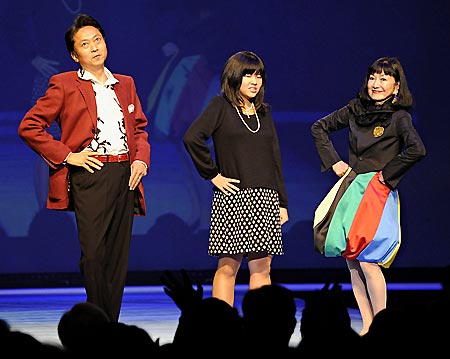
Japanese PM Yukio Hatoyama and his wife Miyuki made a hastily arranged appearance at this fashion show to raise money for the disabled. While I applaud their attempt to lend some celebrity cachet to the event, this is nothing less than an epically insane fashion disaster — wine-red jacket with matching belt and pattern shirt for Yukio, and a rumpled black jacket and what looks like a satin trash bag for a skirt. With this photo, Hatoyama has now become the foppiest prime minister in Japanese history. Thanks to Kyodo News (via Nikkei) for being there.
Miyuki has already started to make waves with her fashion choices. Just today I read fashion designer and occasional TV personality Don Konishi‘s column in Shukan Asahi in which he tore the first lady a new one for this photo taken at the Japanese school in Greenwich, Connecticut during the couple’s trip to the various summits.
He commented that maybe because she is a former actress (she was a Takarazuka performer in the 60s) she is going out of her way to stand out and look flashy and glamorous at a time when people generally want more humanity from their leaders. He didn’t mention it, but Michele Obama’s ultra-casual look springs to mind.
Curzon is pumped for the 2016 Olympics — I really hope Tokyo wins the big to host the Olympics, and the decision is to come out on October 2, just nine days away.
In June 2008, four candidate cities were chosen for the shortlist on when a complete “bid score” was issued to aid the decision-making process. The finalists: Tokyo, Madrid, Chicago, and Rio de Janeiro.
Shortlist:
+ Tokyo — score 8.3
+ Madrid — score 8.1
+ Chicago —score 7.0
+ Rio de Janeiro — score 6.4
Elminated Candidates:
+ Baku — score 4.3
+ Doha — score 6.9
+ Prague — score 5.3
(Doha received a higher score than Rio de Janeiro but was eliminated because it wanted to hold the games in October, not August.)
Here’s a brief overview, with more details from Wikipedia here.
Chicago
The last summer Olympic games to be hosted by the Americas was the 1996 Games in Atlanta, and Chicago has an extensive public transit system, a wide range of venues, and a strong sports culture. Five new venues and eleven temporary venues will be built for the games. Chicago is reported to be the strongest contender in terms of infrastructure, public support, and money, but is still deemed to be behind Tokyo and Madrid in the technical aspect.
Madrid
Madrid benefits from its strong reputation from the 2012 bid as well as having 85% of venues already in place and experience in hosting Olympic qualifying events. One potential problem is that no continent has hosted successive Summer Games since 1952, when Helsinki followed London as host city, and London is hosting the 2012 Summer Olympics and Sochi, Russia is hosting the 2014 Winter Olympics.
Rio de Janeiro
Rio de Janeiro boasts natural beauty and recently hosted the XV Pan American Games. International Olympic Committee head Jacques Rogge expressed eagerness to have either South America or Africa host the Games, as neither have ever served as hosts. However, it has a weak bid because of poor infrastructure and high crime rate.
Tokyo
Tokyo is touting “the most compact and efficient Olympic Games ever” with a setting on the shores of Tokyo Bay, refurbishing a run-down industrial area and reclaiming land from the bay, and stressing its “green” approach to plans. Tokyo boasts the highest technical score and has great infrastructure, but has the weakest public support of all candidates. Also, like Madrid, its bid is weakened by the recent regional hosting by Beijing.
Will Tokyo win because of its high score? Chicago because it’s “America’s turn”? Madrid because of its existing infrastructure? Or Rio de Janeiro because of continental favoritism/OIC “Affirmative Action”? Stay tuned, the decision is just nine days away.
First, the bad news. Shizuka Kamei has been appointed minister of postal issues and financial services. The man is a fierce, fierce fighter who likes to dredge up personal scandals using his ties as a former police official. That’s probably how he got the job. Now he’s going to make sure Japan Post remains the world’s biggest and possibly worst-managed bank and he’s going to crush regional banks by allowing all the people they lended money to stop paying for three years. Great.
As I just commented over at Observing Japan’s assessment of the new lineup, I hope Kamei simply collapses under his own weight. He may well overreach in a position that gives him barely any authority at all. If any place should be safe from unwise political meddling, it’s the FSA which has SEC-like regulatory and law enforcement authority over all financial services institutions.
Otherwise, not a bad lineup. Though Time Magazine posits Ozawa as a “shadow shogun” (reflecting the “Ozawa is the real one in charge” theme trotted out by both Nikkei and Yomiuri, who are wary of a DPJ administration) the cabinet reflects a wide sampling from the party including people not so close to Ozawa, like finance minister Hirohisa Fujii who was an early voice calling for Ozawa to step down over the Nishimatsu political funds scandal.
Asahi had an interesting section listing some of the human side of each new minister. I reproduce some of it here:
Foreign Minister Katsuya Okadahas a giant frog collection. I have heard it from an eyewitness that it’s really huge. Not sure if any of them are mutant.
The above-mentioned Kamei Shizuka is a sixth-degree black belt in aikido and has held exhibitions of his oil paintings.
Naoto Kan, head of the National Strategy Bureau, was DPJ president in 2004 when he was going after LDP politicians for failing to pay into the national pension system (a duty for all residents in Japan, including yours truly). When it was found that Kan himself failed to make his payments, he was forced to resign in shame. To get over the shock of the whole series of events, he decided to shave his head and make the traditional pilgrimage to 88 Buddhist temples in Shikoku.
Justice minister Keiko “Sonny” Chiba (not really her nickname) is a former Socialist Party member who’s against the death penalty, for dual citizenship, and pro letting women choose whether to take their husband’s names when they get married. The trifecta of policies I’ve been waiting for! There is no news that the DPJ plans to abolish the death penalty, but for the time being this election appears to have saved the life of Shoko Asahara, Tokyo subway sarin attack mastermind and Japan’s most famous blind cult leader/death row inmate (and my neighbor at nearby Tokyo Detention Center).
Social Democratic Party leader and consumer affairs, birthrate, and gender equality minister Mizuho Fukushima is not only a lawyer and former TV commentator, she is a huge Miyazaki fan and serves as a judge to select the Nikkan Sports film prizes, the top honors of which in 2007 went to “Even So, I Still Didn’t Do It” about a man wrongly accused of train groping.
Hirotaka Akamatsu, agricultural minister, was once a flight attendant in the 70s. One flight was hijacked by the PLO and he had to help negotiate with the terrorists in English.
Administrative reform minister Yoshito Sengoku had his stomach removed in 2002 due to cancer.
These two didn’t make it into the cabinet (this time), but I think it’s safe to say DPJ upper house member Ren Ho (who Ikeda Nobuo thinks would make a good press secretary) and “cosplay erotica writer” turned newly elected DPJ lower house member Mieko Tanaka are the two best-looking women in the Diet right now:
While making breakfast this morning, I noticed a couple of news trucks around the sushi restaurant across the street, which is the first thing I see when leaving my apartment in the morning. I figured that Gal Sone was probably eating a metric ton of kohada or something, but the truth was far darker. Kyodo reports:
Robbery at Choshimaru kaitenzushi: 720,000 yen seized
Around 6:30 AM on the 13th, a man entered from the back door of the Ayase Sushi Choshimaru kaitenzushi restaurant in Yanaka 1-chome, Adachi-ku, Tokyo, held a knife to the clerk (26) opening the restaurant, said “Give me your money,” seized 720,000 yen in sale receipts from the safe and fled. The clerk was unharmed.
The Metropolitan Police Ayase Station are searching for the man as a robbery suspect.
According to the Ayase Station, the man is around 30 and about 160-170 cm tall. He was wearing sunglasses, a black short-sleeved shirt and jeans. The clerk claims that “he threatened me in broken Japanese.” (Kyodo)
The Jiji report uses a fascinating phrase to describe the perp: “アジア系外国人風,” which means something like “looks Asian, seems foreign.” Fortunately, I only fit half of those criteria.
Seeing Golgo 13’s commercials for the new LG Google phone reminded me that many of Japan’s famous cartoon characters have zero integrity. Doraemon and Sazaesan personally appear in commercials to tell kids they need to eat more chocolate, and Golgo himself has also been licensed to death – his face is featured on canned coffee and pachinko machines, among other things. But perhaps the most ridiculous Golgo 13-related promotion I have seen is his promotion of Japan’s hankosystem – the practice of using ink stamps instead of signatures to officially verify documents.
In the manga, anime, and countless other products bearing his name, Golgo 13 is a mysterious, East Asian-looking (usually presumed to be half-Japanese) assassin for hire who travels the world killing undesirables. Each job usually leads to multiple plot twists and intrigue, some of it predictable – in just about every story he sleeps with a local woman who he must then kill due to some betrayal – but he always gets his man. You could think of him as James Bond’s evil Asian half-brother.
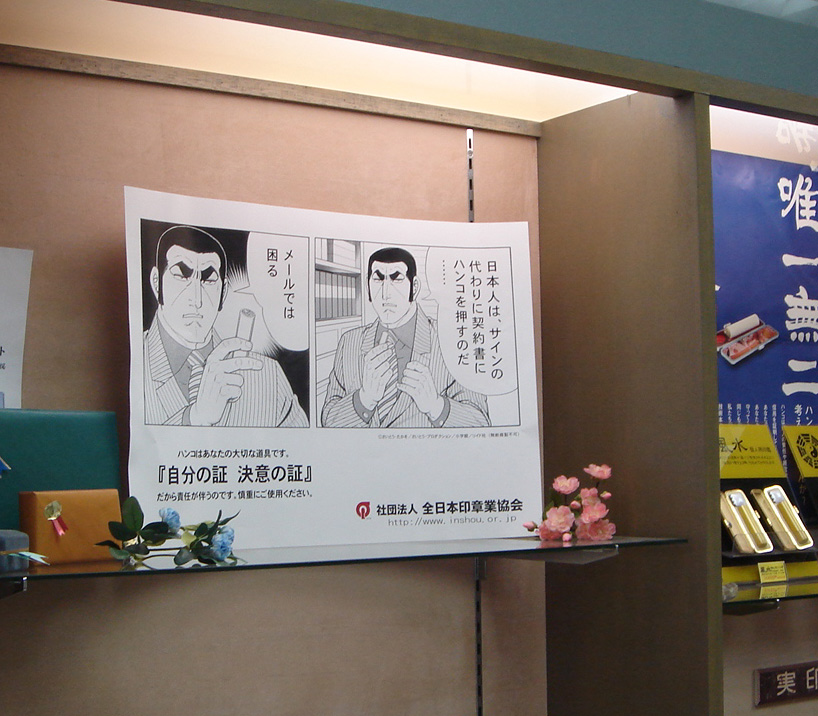
As seen in this blog post, the hanko industry association is running ads in which Golgo 13 tells someone off-camera that using seals is a unique Japanese practice, and if you don’t like it we may have a problem here. Though the campaign dates back to 2008, I recently saw an ad just like this on a Yamanote line station platform, so I presume they’re still around.
Since Golgo 13 is such a badass the ad leaves an impression, but the message makes no sense at all. Here’s my rundown of the ad text:
Reading right to left, in the first panel Golgo says, “Japanese people affix their seals to contracts instead of signing them.” Next panel, he holds up his seal and says, “An e-mail just won’t do.” Below the comic, the slogan reads, “Your seal is an important tool – A seal is proof of your decision. Therefore, [affixing your seal] comes with responsibility. Please use it carefully.”
The people paying for this campaign are the Japan Seal Industry Association, a group set up to further the industry’s interests. No doubt they know their business faces some grim prospects going forward as the population shrinks and technological progress makes seals and even signatures less relevant.
As I have argued earlier this year, I think the system should be abolished because seals make it simply too easy to forge documents (that and I can’t be bothered to carry one around). They’re also one of the biggest sources of demand for the ivory trade.
In one sense, I can see why Golgo 13 would find common cause with the inkan makers. If the world used seals instead of signatures, an assassin could much more easily travel the world using various aliases or even forge the documents of others.
As should come as no surprise, I find this campaign depressing and selfish. That the association falls back on the national pride/Japanese uniqueness argument tells me they can’t make their case on the facts. Turning to a menacing figure like Golgo to make an emotional appeal comes off as a near-threat. Who is Golgo talking to? Is he insisting on using his seal on an assassination contract? If so, since when have contract killings been put in writing? Maybe his message is literally threatening the Japanese people in general. It’s as if he’s saying, “People of Japan: You will use hanko whether it makes sense or not!”
Tsushima has lots of fun places to visit. What I like particularly is that, despite traveling on a weekend in the pleasant spring season, there were literally no tourists to be found at all the sites I visited. This post will overview some of the highlights — and save the very best place for part 3.
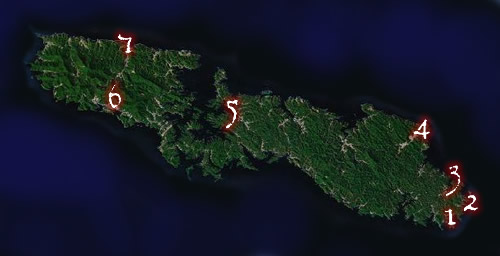
1. Russo-Japanese War Memorial
The Battle of Tsushima was the decisive naval battle where Japan decisively won the Russo-Japanese War. On the northern tip of Tsushima sits the memorial to the battle, erected a few years later when the locals were in a nationalistic mood. A hundred years later, Russia and Japan together erected a new memorial nearby, commemorating Russian-Japanese friendship. That monument also lists all of the victims of the Battle of Tsushima, and the roster is telling — there are thousands of Russian names, and just a handful of Japanese names.
It’s about time I finally gave a shout-out to everyone’s favorite American butcher living in Nagoya. I’m of course talking about The Meat Guy. Whether you’re looking to buy Australian steaks, mutton, real bacon, Polish sausages, American BBQ sauce, unique meats such as ostrich or crocodile, or even your very own American-style outdoor cooking grill, The Meat Guy is the place to go. He ships all over Japan, and it’s high quality meat that is welcome change to Japan’s delicious but nonetheless lacking in variety meat markets. The Curzon estate has been very happy with the bacon, sausages, steaks, chops, and spices bought at TMG.
You can meet the Meat Guy here. I’ve only heard his biography as rumor from fellow fans of his service, and from what I generally understand, his family farm in Nebraska produces Wagyu for American markets. He married a Japanese woman, moved to Japan, and set up this operation more than ten years ago. Now, thanks to the power of the Internet, he ships his goods all over Japan.
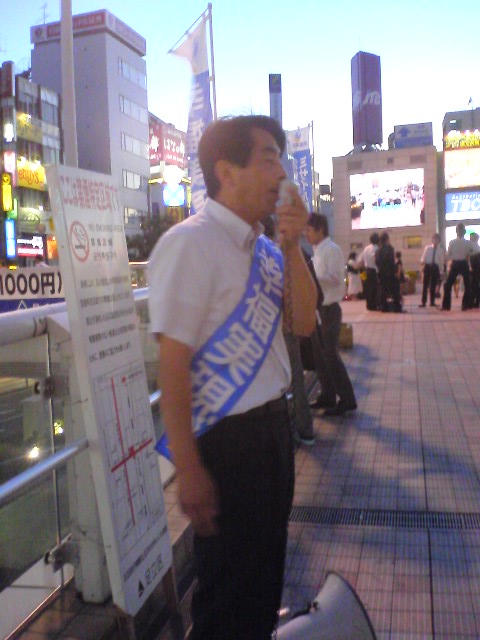
The final candidate in Tokyo’s 13th district is Kazumasa Fujiyama, running under the Happiness Realization Party ticket.
Before I get to this guy’s profile, I want to quote from an excellent piece on the party from the Irish Times:
Founded earlier this year to offer voters a “third choice”, the HRP has an eye-catching manifesto: multiply Japan’s population by 2.5 to 300 million, overtake the US to become the world’s premier power, and rapidly rearm for conflict with North Korea and China.
If elected, its lawmakers will inject religion into all areas of life and fight to overcome Japan’s “colonial” mentality, which has “fettered” the nation’s true claim to global leadership.
… A new book, The Guardian Spirit of Kim Jong-Il Speaks , by party founder Ryuho Okawa explains that earlier this month at a session in the party’s Tokyo headquarters, the voice of Kim’s guardian angel warned of his plans. But at least Kim is alive – Okawa also claims to be able to receive the thoughts of Japan’s notorious wartime monarch, emperor Hirohito (1901-1989), and his deceased predecessors.
Being able to commune with the dead is but one string to Okawa’s bow. A reincarnation of Buddha, he achieved great enlightenment in 1981, according to the party’s website, “and awakened to the hidden part of his consciousness, El Cantare, whose mission is to bring happiness to all humanity”.
Before he founded the Happy Science religion in 1986, Okawa wrote books under the names of Muhammad, Christ, Buddha and Confucius. Conveniently, if improbably, speaking in Japanese, some of the prophets had much the same message: Japan is the world’s greatest power and should ditch its constitution, rearm and take over Asia.
…
The Happies boast that they have sold 11 million copies of their bible, Shoshin Hogo (The Dharma of the Right Mind), in Japan since 1986, and opened 200 temples.
Okawa’s books, mixing new-age philosophy with self-improvement tips and political views, have sold millions more, apparently providing the funding for the campaign. Translating those beliefs into political power, however, has proved easier said than done. Tokyo voters shunned the Happies’ candidates in this month’s municipal election, which ended LDP rule in the city and set the DPJ up for a historic national win next month.
Also, you might be interested to see the Happy party’s new manifesto video. It’s very similar to the one they produced for the Tokyo assembly elections (that animated treasure was unfortunately taken down), only this time slightly more professional:
Now, to the candidate:
Profile: An architect by trade, Fujiyama became a full-time Happy Science member in 1995 and has since risen to become a leader in Tokyo – he previously served as the head of the Science’s Nippori Branch and Adachi Branch before being named deputy leader of the Tokyo Branch in 2009.
Before becoming a full-time Happie, Fujiyama was an employee of Haseko Corporation, a construction/engineering firm that’s listed on the Tokyo Stock Exchange. It’s unclear whether he was a member of Happy Science before 1995 or if he
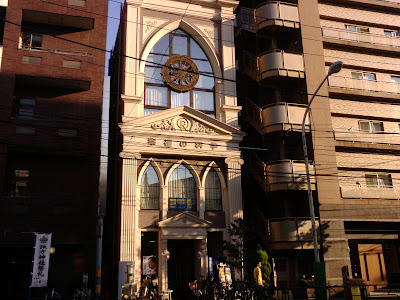
One of Fujiyama’s bases of operations is the Science’s Nippori branch (seen here on Google Street View), which I happened to spot during a walk the other day:
Policy: As all Happiness Realization Party candidates appear to be carbon copies of one another, it’s no surprise that Fujiyama supports all the planks mentioned in the above video – slash taxes, smash North Korea, and somehow make Japan the world’s biggest economy by 2030 (I suspect they’d have to destroy all other countries to do this).
When asked in an Asahi questionnaire about how he would like the world to see Japan, he answered as “a great economy.” (経済大国)
Fujiyama claims in a blog post that the owner of a building near Kameari Station said she’ll support him because she hates paying consumption taxes.
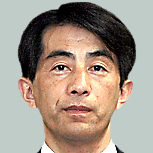
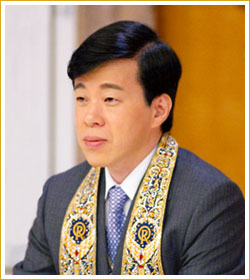
Something interesting: Fujiyama bears an eerie resemblance to party founder and leader Ryuho Okawa:
Fujiyama:
Okawa:
OK, I’ll admit that their parts are on opposite sides, but don’t you think they both have a sort of “divine salaryman” look going on?
***
My next and final profile post will look at a few of the Tokyo proportional representation candidates.