

February 26, 2006 Lugang, Taiwan
Larger image here.
February 26, 2006 Lugang, Taiwan
Larger image here.
Saying that the Philippine government had foiled a military coup attempt and still faced the threat of violent overthrow, President Gloria Macapagal Arroyo declared emergency rule on Friday and banned rallies marking the 20th anniversary of the fall of Ferdinand Marcos, the former dictator.
< ...>
Ignoring the ban on rallies, former President Corazon Aquino, who remains a popular figure here, led thousands of demonstrators in a march through the financial district calling for Mrs. Arroyo’s resignation. The opposition has crystallized around allegations that Mrs. Arroyo rigged national elections in 2004, as well as charges of government corruption and human rights abuses, charges that she vigorously denies.Mrs. Aquino urged Mrs. Arroyo to “make the supreme sacrifice by resigning.” Dozens of demonstrators were arrested.
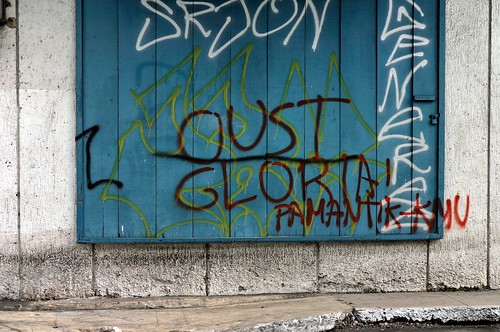
Calls for Arroyo’s resignation are nothing new. Here is a photograph of graffitti saying “oust Gloria” that I took on December 7, 2005 on the wall of a street in a somewhat poor but not impoverished neighborhood of Manila.
Ever since the fall of Marcos in 1986 in the face of overwhelming popular protests, the threat of another such EDSA “people power” rebellion (named after a main street in Manila) looms every time the administration is in crisis. Not coincidentally, Aquino became president following the first EDSA rebellion-taking over for Marcos- and Arroyo became president by virtue of her being VP when the corrupt movie star and darling of the lower class electorate was forced out of office during EDSA 2. The big difference is that Aquino was a major organizer of the first EDSA, risking her life to protest against Marcos. And the threat was very real, as his government had killed her husband for political opposition. By contrast, Arroyo seems to be very much a typical politician.
Below I provide more detailed information, typed from a book published just last year on the political history of the Philippines, that I picked up during my recent trip there.
Excerpts from page 278-283 of State and Society in the Philippines, by Patricio N. Abinales and Donna J. Amoroso, 2005. I’ve bolded the most important bits.
Continue reading Coup attempt and crackdown in the Philippines – some background information
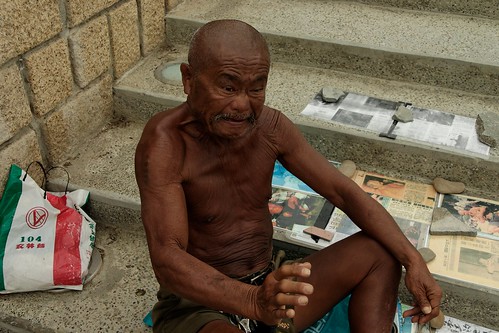
Zhanghua, Taiwan February 16, 2006
He sits on the steps leading up to the giant Buddha of Zhanghua, which was the largest Buddha in the world until Hong Kong built theirs at Tian Tan. Laid out on the ground around him are old, laminated newspaper articles about him when he was younger. As visitors to the temple come up the stairs, he strikes a pose for them, but few even look at him.
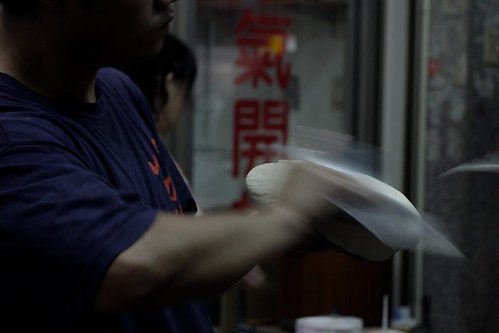
Taichung, Taiwan February 15, 2006
At this noodle shop in Taichung, they serve noodles made by slicing off slivers of dough from a bread-loaf block of dough, flicking them into a cauldron of boiling water.
Update HERE- finally some good news!
Akihabara News, Engadget, and probably a number of other blogs have posted a completely misinformed and alarmist claim that Japanese law will soon make it illegal to sell used electronics. First the alarmist claim, and then the explanation of why it is about 80-90% incorrect.
The second hand marker flourishes over here, and most people take good care of their equipment, so used goods are usually in a very good condition and are sold easily to be replaced by new goods. It’s easy to strike a good deal when buying these second hand goods. But that’s exactly the big problem for manufacturers, because this grey market is not generating them any profit, and they would like to get rid of this phenomenon.
[…]
So from April 1st 2006, ALL electronic products sold in Japan before 2001 will be prohibited from the 2nd hand market! This means that for example a PC like the Vaio U1 (PCG-U1) will be soon not vailable on the Japanese market anymore, since it was sold in April 2002… and you still have about a month to get a Vaio C1! It also seems that a 5 yeas old product (made after 2001) will Face the same problem in the futur.
Gosh, terrifying isn’t it? Reading it I practically wet my pants and burst into tears simultaneously at the prospect of never again being able to pass up the chance of buying a 20 year old vintage game console. (Note: I just play them on emulators anyway.)
But notice something very important: Engadget is merely repeating what Akihabara News said, and Akihabara News doesn’t quote any source at all. So why don’t we try actually looking at a real news source, and see what they say. As it so happans, the English langauge Asahi website has a very thorough article on this topic.
There are a couple of major points that contradict what the Akihabara News post said.
Well, exports are exempt. Some retailers are hoping to find overseas buyers, or set up branch offices abroad. Leases are exempt, too, meaning retailers can simply lease their products for fixed terms.
[One company] plans to lease its used products, an action not restricted under the law.
The firm will charge customers in advance for a fixed time period, and the customer will be able to return the item at any time. When the lease expires, the firm will simply give the appliance away–another action exempt from the PSE rule.
So foreign sales will not be restricted at all. This is no surprise, considering how common sales of used Japanese vehicles are overseas. For example, in the Philippines all of the buses seem to be bought used from Japan. The very first bus I rode as I stepped out of the airport had a plate mounted above the windshield saying that it had been a Kyoto city bus that was refurbished by the Keihan Bus Company in around 1980. Second, companies can use what seems to amount to fake leases to get around the sales restrictions.
But there is more to it. Domestic non-lease sales are not being flat-out banned anyway, they are simply requiring an inspection. So what is the inspection?
By law, a retailer can become a “manufacturer,” authorized to conduct safety inspections and affix PSE labels, simply by registering with the ministry.
Registered “manufacturers” may attach PSE labels after confirming three very simple things: the product looks fine, works properly when turned on, and does not leak electricity at 1,000 volts.
So any retailer of any size will be able to perform the inspections themselves. This is starting to sound less like ban on second hand sales designed to encourage the consumption of new goods than it is a fairly reasonable attempt at consumer protection.
But there’s something else. Notice the final part of the test, seeing how the device operates at 1000 volts. This law seems not to be aimed at electronics per-se, so much as electrical appliances. I think there’s a strong chance that it doesn’t apply at all to computers (including game systems) due to the nature of the safety tests. Notice they check if it functions safely at 1000 volts, well the electronics of a computer generally run on 12 volts, and any more than that will fry it, so the test clearly can’t apply!
No, instead what they would be testing are devices that include such things as heating coils or motors, that draw large amounts of power and can be a serious fire risk. In the case of a computer or game system, the power supply would certainly require testing, but I think that the primary device will suffer no restrictions whatsoever.
In short, it will be rather more troublesome for retailers to sell used electronics, and there may be less small stores doing so. On the other hand, larger stores with the economy of scale to set up a small certification department will be able to carry on with their business, and used electrical applicances will now come with a certification that they work and don’t catch on fire when you plug them in, which will probably make it easier for consumers to return defective merchandise. I also wouldn’t be surprised to see someone set up a new business, designed simply to test and certify used electronics for the hundreds or thousands of smaller stores that don’t have the ability to do it themselves.
What we will NOT see is the dismal scenario that Akihabara News incorrectly imagined when they first heard about this law.
UPDATE: This site includes very precise details about what the law regulates, in both Japanese and English. It would seem that I was completely correct. Computers are NOT on the list of regulated items, but power cords and transformers/power adapters ARE. In a very interesting turn, it specifies that television recievers are to be regulated, but says nothing about the CRT tube itself (including computer monitors). This is a rather strange turn, since a tv reciever is just another radio reciever-a very low power device, whereas the actual CRT is a very high power device that can deliver a fatal charge or start a fire if tampered with incorrectly.
As of today, February 14th, I have exactly two weeks before I fly from Taipei’s Chiang Kai Shek airport back to New Jersey’s Newark. With that deadline pressing on me, I’ve decided to take a week and head to see some places in the south (and maybe East?) of the island that I haven’t yet gotten around to. I’ll hop a bus this evening to Taizhong, look around that area during the day tomorrow, and then meet up with a former classmate from Ritsumeikan in the evening. That’s as far as I’ve planned, but I’ve got my Lonely Planet Taiwan to look over on the bus ride.
First up is one that I’m amazed hasn’t gotten more attention.
Japanese sue over disputed history textbook
TOKYO (Reuters) – A group of Japanese sued over a history textbook that critics say whitewashes Japan’s wartime aggression and has angered Asian neighbors, demanding on Thursday that a local government cancel its adoption of the text.Japan’s Education Ministry approved the new edition of “The New History Textbook,” written by nationalist scholars, last April, prompting outrage in China and South Korea, where bitter memories of Japan’s aggression until 1945 persist.
The lawsuit was filed by eight residents of Suginami, a residential district in western Tokyo that attracted media attention last year when it became one of the few school districts to adopt the junior high school textbook.
“As a resident, I can’t keep silent over the choice of an unwanted textbook for growing children,” Eriko Maruhama, a plaintiff in the lawsuit, told a news conference.
Read full article.
This sounds like a reasonable course of action for local residents to take, since they allege that the school board chose the textbook for political reasons, despite it having been given a poor quality assessment by local teachers. Perhaps this lawsuit will have a similar effect to that of the Dover, Pennsylvania lawsuit which blocked that schoolboard from teaching intelligent design.
Next is something that I briefly mentioned on in this rather silly post the other day. As reported by the prolific Norimitsu Onishi in the New York Times, Tsuneo Watanabe, the publisher of Japan’s conservative Yomiuri newspaper, has recently been reconsidering the long term impact of some of the right wing policies he had promoted, particularly in regards to the international relations, miltarism, and the Yasukuni issue.
The Yomiuri is the world’s single best-selling daily newspaper, and its impact should not be underestimated. Of particular interest is the fact that Watanabe has actually joined with the Asahi Daily newspaper, Japan’s major left-leaning daily, and the Yomiuri’s chief rival, in calling for a national, religiously neutral, and internationally respectul memorial to replace Yasukuni for official purposes.
As rivals, it is not surprising that The Asahi Shimbun and The Yomiuri Shimbun often adopt different editorial viewpoints. Even so, a recent exchange between the heads of the editorial boards of the two major dailies found some common ground, especially regarding Prime Minister Junichiro Koizumi’s controversial visits to Yasukuni Shrine.
The following is the abridged version of a discussion between Yoshibumi Wakamiya, chairman of The Asahi Shimbun’s editorial board, and Tsuneo Watanabe, chairman of The Yomiuri Shimbun group, that originally appeared in the February issue of Ronza, the monthly commentary magazine published by The Asahi Shimbun.
Time Europe has an interesting article about how Olympic wannabes are opportunistically changing their citizenship, often based on tenuous third generation bloodline connections, to qualify for elegibility to participate in that country’s national Olympic team. While I have no interest whatsoever in the Olympic games themselves, I do always like to hear about new twists in conceptions of citizenship.
hockey’s crossover nationals are hardly anomalies in Torino, where plenty of athletes are competing under the flags of second or adopted homelands. The practice is so common in both Winter and Summer games that International Olympic Committee ( i.o.c.) President Jacques Rogge blasted some of them as “mercenaries” last November.
And last, but not least, more tragic news regarding our slimy brethren.
he mountain yellow-legged frog has survived for thousands of years in lakes and streams carved by glaciers, living up to nine months under snow and ice and then emerging to issue its raspy chorus across the Sierra Nevada range.
But the frog’s call is going silent as a mysterious fungus pushes it toward extinction.
“It’s very dramatic,” said Yosemite biologist Lara Rachowicz. “One year, you visit a lake and the population will seem fine. The next year you go back, you see a lot of dead frogs scattered along the bottom of the pond. In a couple years the population is gone.”
[…]
The frog population has dropped by 10 percent a year for five years, Rachowicz said at a gathering last month of 24 experts trying to save the frog.

The Taipei Times is reporting that “Taipei Financial Center Corp (TFCC), owner of Taipei 101, said it will start charging companies for any commercial usage of the image of the world’s tallest building in a bid to protect its trademark.”
Last year alone, TFCC found over 1,000 cases of other companies using Taipei 101 as a promotional tool — mostly in real estate advertising — that could potentially mislead consumers, Wei said.
As a result, TFCC decided to charge royalty for any commercial use of the building’s image. For example, a poster featuring the Taipei 101 tower will be charged NT$100,000 (US$3,099), Wei said.
[…]
Use for the government and public is free of charge, Wei said.The decision drew the ire of advertisers and TV producers, as other major landmarks around the world, such as the Empire State Building in New York City and the Eiffel Tower in Paris, have no such charges.
Unfortunately, the last statement seems to be only half true. In a clever manuever, photographs of the Eiffel tower itself are not copyrightes, but in 2003 a new lighting display was installed. Since the design of the lights is copyrighted, photographs of the lighting disaply are as well, which by extension means any photos of the Eiffel Tower at night.
As a result, it’s no longer legal to publish current photographs of the Eiffel Tower at night without permission. Technically, this applies even to amateurs. When I spoke to the Director of Documentation for SNTE, Stéphane Dieu, via phone last week, he assured me that SNTE wasn’t interested in prohibiting the publication of amateur photography on personal Web sites. “It is really just a way to manage commercial use of the image, so that it isn’t used in ways we don’t approve,” said Mr. Dieu.
It may be some minor comfort that owners of iconic buildings such as the Eiffel Tower or Taipei 101 claim that they won’t prosecute non-commercial infringers, but the fact is that there is nothing stopping them from being a nuisance to anyone that publishes such a photo, even on a personal blog like this one. Does anyone really think that laws allowing for these kinds of restrictions are reasonable? I can’t wait for 2012 (to be optimistic) when security teams are stealing cameras from tourists snapping photos of the new “Freedom Tower” at New York’s World Trade Center.
After reading this rather interesting New York Times (by way of the International Herald Tribune) article about how Yomiuri Shinbum publisher Tsuneo Watanabe has recently been reconsidering the impact of the right-wing political views that he has helped to spread through his paper, I decided to look for some Japanese language coverage of this issue using Google News Japan.
As you may or may not know, Japanese names are more or less insane. That is, the method of writing them in Japanese. Despite their phonetic simplicity and easy spelling when transcribed in, say, the Roman alphabet, it feels to me little exaggeration to claim that becoming an expert in the reading and writing of Japanese names would take almost as much effort as learning to read and write the entire rest of the dictionary.
Japanese names (both people and places) are written using the same kanji (Chinese characters) as other, ordinary words, but are often pronounced in ways that are entirely unrelated to their pronounciation in other words, with some parents even assigning names to their children in which the characters used to transcribe it and the pronounciation have absolutely no historical relationship to one another. Furthermore, even many common names have several, or even dozens, of different possible ways that they can be written.
This can pose a severe problem when Googling a Japanese person’s name. Just because you know how to spell their name in English does not mean that you can type it correctly in Japanese. Sure, if you type sounds, the Windows IME will convert it to kanji, but with so many different ways of writing names, the odds are that it will have chosen incorrectly.
In the case of Tsuneo Watanabe, I had never read about him before, and therefore didn’t know what kanji he uses to write his name. Now, the family name is easy. (In Japanese, as many other Asian languages, the family name is written first, so to avoid cross-linguistic confusion I won’t say “first” or “last” name.)
Watanabe is one of the more common family names in Japan, and generally always written the same way, 渡辺. It CAN be written using other kanji, such as 渡部 or 渡邊 (although technically the latter one is just the old-fashioned or “traditional” version of the common character), but the standard 渡辺 is overwhelmingly the most common, and so I could easily assume that Tsuneo Watanabe writes his family name in this way.
Now comes the tough part. When you type Tsuneo in Japanese text input mode in Windows, the software gives you all of the following choices:
常雄 恒夫 恒雄 恒男 常夫 常男 庸夫 常生 恒郎 恒生 庸男 経雄 庸雄 経男 庸郎 経夫
Yes, there are actually 16 of them, and there are even more possible combinations that aren’t pre-programmed into the software’s dictionary. Naturally, I tried the first option that popped up, which was 恒夫, and lo, there was a hit. Strangely, a single hit. For a name important enough to pop up in the New York Times, I would have expected a huge amount of coverage in the native language, so I had a look at the article itself. Ok, it definitely seems to be the guy… but why only one hit?
Realizing what the problem was, I tried another search, this time And lo, there were 31 hits! Instead of searching for his entire name, I’d tried just 読売 渡辺, or in alphabet, Watanabe + Yomiuri, the name of his newspaper. Why did I get 31 hits on the second try, yet only a single hit on the original search? Because both I and the newspaper representing that single hit made the same mistake! Both of us had simply chosen the first possible kanji offered by the Windows IME instead of the correct name. As it turns out, his name is actually
渡辺恒雄.
While the frustration of trying to deal with Japanese names is something that I just have to deal with (at least, if I intent to keep using and studying the language!) at least once in a while I get the satisfaction of seeing that even Japanese people can’t keep it straight.
In case they correct their mistake, here it is, preservered, for the record.
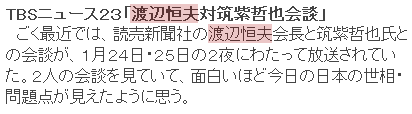
Now if you’ll excuse me, I have some articles to read.
From the Washington Post home page.

Mongolians ride past the limo that carries Bush during his historic presidential visit to their nation. (AP)
I was kind of miffed they don’t have a larger version of this photo. I’d also like to see the rest of the scenario play out, with the Mongolian Hordes overrunning the limousine.
My translation of a Nikkeinet article.
“I even like sashimi” Taiwan’s KMT party secretary denies being “anti-Japan” to media
“Reports that the KMT walks lockstep with the mainland (China) in their anti-Japan campaign do not reflect my real feelings. I even love sashimi!” On the 10th Ma Ying Jiu (mayor of Taipei), chairman of the KMT[Chinese Nationalist Party], Taiwan’s largest opposition party, assembled Japanese reporters resident in Taipei and issued a denial of the viewpoint that he was himself a believer in anti-Japan ideology.
There are indications that the KMT has been intensifying their anti-Japan tendencies, such as stressing their own role in the Sino/Japanese war. “We criticize even the white terror (of KMT despotic rule) and (China’s) Tainanmen incident from the same basis of human rights and constutituional government. There’s no reason to make an issue out of only Japan,” Chairman Ma Ying Jiu said.
However, “I do not approve of Prime Minister Junichiro Koizumi’s Yasukuni Shrine visits,” he said, not forgetting that stab in the neck. Ma Ying Jiu is currently considered the favorite to win in Taiwan’s next presidential election.
Doesn’t the “but, I like sashimi defense” have the same ring to it as, “but I have so many black friends” or “but Jews are so funny”? I’m amazed that this is the best that Ma could come up with.