Richard Smart writing for the Japan Times has an article looking at the Geos meltdown in detail. I am quoted with my take on how Geos handled its demise and the outlook for eikaiwa employment.
Adam Richards, a 28-year-old translator and writer on Japan at the Web site and travelogue Mutant Frog, argues that the G.communication takeover has in some ways made the best of a bad situation.
“Geos seems to have done relatively well by students and teachers by finding a backer before announcing the bankruptcy,” he says. “That said, Nova’s messy bankruptcy was such a nightmare Geos can’t help but look better by comparison.”
…
Japan Economy News’ Worsley agrees that the eikaiwa schools need to change to survive.“The industry itself will continue to shrink as does the population and number of younger people in Japan. In order to avoid disappearing, language school operators are going to have to embrace new technologies, diversify their products and services, and appeal to new market segments,” he says.
This, argues Richards of Mutant Frog, is likely to lead to worse conditions for newcomers to Japan.
“It really looks like the era of easy employment is over, though it seems like there are still opportunities out there,” he says.
In the interest of context, here is what I commented to Richard in response to his questions:
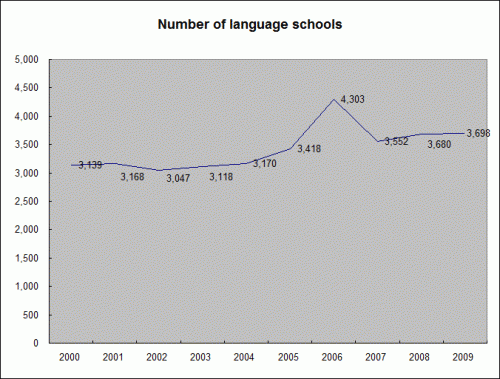
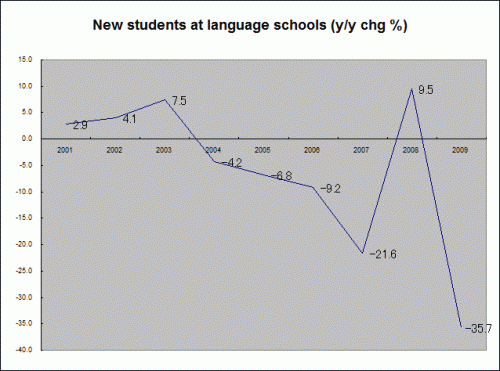
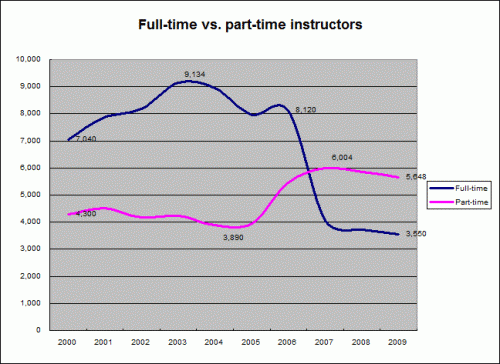
I obviously don’t know exactly what happened, but a multitude of factors have conspired against the eikaiwa industry – cutbacks in consumer spending, corporate belt-tightening, cuts to government subsidies, and tighter regulation are the big ones. It seems like Geos was unable to shrink down to size fast enough to adapt to the changing environment. Geos adopted a somewhat similar strategy to Nova – grow large and bring in lots of new students. Then, in April 2006 a Supreme Court decision led to a swift change in the regulatory environment – eikaiwa schools suddenly had to set up sensible refund policies (and in Nova’s case front a flood of refund requests), and this made the economics of a large chain less attractive. Geos apparently weathered the change relatively well, but once Nova failed so spectacularly it did serious damage to the reputation of eikaiwa as a service. This, combined with the economic downturn starting in 2007, probably did Geos in as their sources of cash dried up.It really looks like the era of easy employment is over, though it seems like there are still opportunities out there. Berlitz and ECC seem to be hiring. Generally, I would recommend applying for JET or even teaching English in a different country, but if you have your heart set on working in Japan and don’t mind the salary levels, then why not?There is a danger the Geos bankruptcy will continue the downward spiral that Nova set in motion. When there is a bankruptcy, you inevitably have students with contracts that are either broken or not satisfactorily fulfilled, and you have teachers who find themselves either out of a job and possibly unpaid or thrust into the arms of new management that may treat them differently. The general dissatisfaction gets reported in the media and spread by word of mouth, fueling the perception that eikaiwa is a scam or otherwise not worth the trouble. However, Geos seems to have done relatively well by students and teachers by finding a backer before announcing the bankruptcy. That said, Nova’s messy bankruptcy was such a nightmare Geos can’t help but look better by comparison.Japanese people want to learn English as much as they ever did. All are required to study it in school but most never come within a mile of fluency. They spend their childhoods being fed the idea that speaking English is the key to success yet they never get there! So as long as the public education system keeps creating this demand, I think there will always be supplemental learning options like eikaiwa.