Say it with me: “Dentsu”

A full report by an independent committee has been released detailing the scandal has embroiled the Abe administration surrounding faked “town meetings.” Since their beginning under the Koizumi administration, the meetings, which were intended to serve as a forum to include citizens’ opinions in the policymaking process for such initiatives as postal privatization and education reform, most of the meetings have been exposed as frauds, with government officials planting questions and paying participants to provide opinions supporting the government’s position. Moreover, massive cost-padding has been discovered in the administration of the meetings, which cost an average 11 million yen to hold and occasionally featured a staff member being paid to operate the elevator.

Conspicuously missing from English-language reporting on this scandal, including at least one report from a Western outlet, is the fact that the contract for administration of the first meetings was awarded to massive Japanese ad agency Dentsu with no competitive bidding. I’m just a little surprised that the angle hasn’t been more fully explored, since no-bid contracts always ripe for criticism and the Western media have had a great time slicing and dicing the Halliburton corporation for its ineptitude in Iraq.

Dentsu involvement is no secret, but so far even the Japanese-language newspapers haven’t done much to pick up that part of the story. The Asahi’s wording is especially strange:

Another revelation in the investigative committee report is that the government likely overspent on some meetings. The report said the cost of holding a town meeting in the first half of fiscal 2001 was 21.85 million yen, not including advertising, whereas in fiscal 2002 and later years the average cost per meeting was between 7.19 million yen and 12.85 million yen.

The reason is likely that in the first half of fiscal 2001, government officials selected companies to operate the town meetings. In subsequent years, the companies were chosen by competitive bidding.

Hokkaido Shimbun, reporting on the investigation results, noted that Dentsu ran the first 16 meetings since the program began in 2001, costing the Japanese government 395 million yen, or about 24 million per meeting. After the meetings were opened to competitive bidding, other companies including Dentsu managed the meetings, and the costs came down to more than half that.

An excerpt from the 2005 book Dentsu’s True Colors: The Media Industry’s Greatest Taboo, indicates that Dentsu was an advisor to the Koizumi administration from the very beginning. Along with other ideas that came to define the Koizumi administration such as US-style “one-phrase” (sound byte) politics, the town meetings were Dentsu’s idea to begin with, and the government left management of them up to the company’s discretion, leading to criticism from then-Nagano governor Yasuo Tanaka:

That was how Dentsu became involved in policymaking not just on the national level but on the local level as well, and tied it into their business.
It looks as though “town meetings” were just such an instance of Dentsu involvement. The office in charge was placed in the Cabinet Secretariat, but Dentsu was contracted to manage the town meetings with a private (no-bid) contract. One reporter commented that he was surprised one time when he went to cover a town meeting in Okinawa:
“When I went inside the hall, staff wearing Dentsu badges were all over the place. And regarding the content of the meeting, I couldn’t understand the meaning of spending money on such a thing, and the statements of the people in attendance were more like petitions than a conversation.”
The fact is, the average cost to hold these meetings was a staggering 60 times greater than what it cost to hold Nagano Governor Yasuo Tanaka’s powwow meetings, which were started earlier on.

It’s been explained by Japan policy academic Robert Angel that the town meeting scandal resulted from a lack of careful attention to the administration of the meetings, and deference to local leadership, “once the novelty wore off,” led to the planting of questions. But the planting of questions has so far been documented to have begun as early as October 2001, while Dentsu was in charge. According to Asahi, “In fiscal 2001, 185 people asked planted questions at 50 town meetings, although there is no information available to determine if the government paid them to do so.” And as e-mail records (PDF courtesy of DPJ lower house member Daisuke Matsumoto) of preparations for the meeting in Hachinohe, Aomori prefecture show, the planting of questions and guidance came from the town meeting office in the cabinet, not local leadership.

Dentsu has a reputation for being a shadowy manipulator of public opinion, and has been accused of a host of dubious accomplishments from swaying sheep-like voters with flashy pro-postal privatization campaign tactics in the September 11, 2005 general election resulting in a huge LDP victory, to staging the entire “Train Man” phenomenon on popular message board site 2-channel to reap massive profits from pre-planned soap opera and movie adaptations. However, according to an anonymous retired Dentsu official quoted in True Colors, Dentsu relishes this reputation and cultivates it: “Dentsu’s public image, as if they have been involved in national conspiracies, has had the effect of making the company look more powerful than it actually is. Dentsu is aware of this and purposefully neither confirms nor denies this role.”

As much as I’d like to see Dentsu dragged through the mud for their role in this scandal, the fact remains that the government led this initiative to deceive the public and drown out actual public opinion. Given the history of the Japanese government, this comes as little surprise, but these days scandals spread like wildfire over the Internet, people are aware and quick to anger at such flagrant ethical violations, hopefully forcing the political leadership, who increasingly relies on public support to stay in office, will start paying attention to what the public really thinks rather than staging horse and pony shows.


The secret of Mino Monta’s success

Japanese TV host Mino Monta was recently inducted into the Guinness Book of World Records for “most live hours on the tube by a TV host.” Mino, who according to Japanese media reports was drunk at the ceremony, used the opportunity to declare his intentions to expand his TV appearances to night broadcasts.
That’s too bad for some people, since judging from the reaction at FG and No-sword, foreigners in Japan are kind of sick of seeing the man. Many Japanese (“way to go!“) on the other hand, predictably have a soft spot in their hearts for the bland, Regis Philbin-esque commentator who is famous for giving schmaltzy but stern advice to old ladies who can’t get along with their daughters-in-law every weekday afternoon on his “Bold live phone calls” segment.

Still, one wonders just how he gets the energy to appear lucid for 21 hours a week on live TV. Back in June of last year, Mino-san made headlines after announcing a curious part of his morning routine:

In a back-and-forth with a female announcer, Mino-san made one of his usual health-related comments, “The yeast in beer improves your immune system.” He then admitted to viewers that every morning he drinks a 50-50 mixture of beer and tomato juice every morning to stay healthy.

Now, I’ve never tried this before, but it sounds even more disgusting than Shinzo Abe’s beloved tree kale juice. Adamu’s personal recommendation: a 25-75 mix of Sprite and Corona, preferably taken late at night. It goes down very smooth, though I can’t exactly call something like that healthy.

To close out I’ll post a hilarious video of Mino’s phone call program (in Japanese but can be enjoyed by all the world) that No-sword was nice enough to find on YouTube:

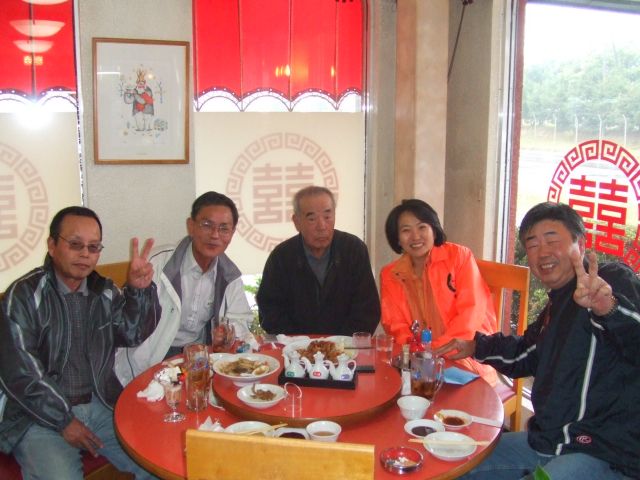
A Moment in the Life of Ms. Toshiko Abe: Chinese food with her constituents

Toshiko Abe 中華料理屋ちゅー (1)_640.jpg
Nagi-cho, Okayama Prefecture: LDP Lower House Member Toshiko Abe (LDP, Okayama 3rd District, pictured second from the right in a smart orange jacket) bumps into supporters at a Chinese restaurant during a trip to her home district.

Life in Nagi (pop: 6,564), birthplace of NARUTO author Masashi Kishimoto, looks so… relaxed. The biggest news story affecting Nagi right now is the cold weather they’ve been having, as far as Google News is concerned.

Check out Abe’s blog to witness her remarkable post-lunch transformation into a Kabuki actor.

Adamu scoops the Japanese mainstream media

ZAKZAK cites a Mainichi investigation that estimates that the LDP could earn up to 250 million yen in extra public funds allotted to political parties if they act by the end of the year to readmit some of the LDP members who were ousted for voting against the bills to privatize Japan Post. Since the tallies for how much each party gets in this funding scheme are calculated based on the number of Diet seats the party holds at midnight on January 1, the shuffling of party affiliations to maximize the subsidies is a practice that has been going on for years, and was especially fierce during the political turmoil of the 90s when new parties were popping up and fading out constantly.

This year, however, the LDP opened itself up to extra criticism after kicking out the postal rebels, a group of connected, effective politicians whose only crime was to violate party discipline and stick up for their sleazy bloated constituencies. Letting the ones who are really really sorry back in would prove that the move was just another Dentsu-inspired publicity stunt and leaves the less experienced new lower house members who the LDP ran against the rebels with their rear ends exposed. Leaving the rebels hanging means the party not only loses money but also a good deal of political talent that could end up working actively against them. Making it all worse is a divided LDP that can’t decide one way or the other – Secretary General Hidenao Nakagawa met with the rebels’ leader Takeo Hiranuma to help seal the deal, while the new Diet members and their supporters such as ex-LDP sec gen Tsutomu Takebe fight to guard the positions of the “Koizumi children.”

It’s nice that the major news organizations are focusing on a more cynical angle that may motivate the LDP. Too bad I already covered this more than two weeks ago! Remember this post?

(2) As you may know, the deadline for Diet members to register for government subsidies for political parties is the last day of December. As you can see from the fact that the timing for people to join and leave parties has almost always been at the end of the year, it would not be surprising if this recent scandal, too, centers around the money. That’s because if the postal rebels and unaffiliated members were already members of the LDP, then the party’s subsidy, in other words the funding for its activities, would probably substantially decrease. Meanwhile, if the rebels manage to rejoin the party by the end of the year, their party subsidies coming to the LDP will increase. (tr: here he seems to be implying that the postal putsch was a scam to earn more party subsidies)

The only Japanese-language news source that even came close to my level of intestinal fortitude was the Sanyo Shimbun, a Chugoku regional paper that brought up the funding issue in a Nov 7 editorial, noting that not only will the LDP lose money by not bringing them back in by the end of the year, but the rebels themselves would lose possible monetary impetus to go back and could even form a new party themselves. Sankei may have picked up on it last week with some sweet graphics, but I still beat them both. And that’s all that matters.

Looks like these so-called “reporters” should have been listening to DPJ Upper House Dietman Tetsuro Fukuyama (or reading Mutant Frog, as it were). I owe this man a beer.

Adamu Reports: Alex Kerr Speech at Japan Foundation, Bangkok November 20, 2006

The above link will play a video of the introduction. You can download the speech (in Japanese) in its entirety here (Thanks to Curzon for optimizing the audio quality):
Part 1: Introduction
Part 2: Slide Show
Part 3: Question-and-answer Session

Summary

On Monday, I attended a speech given by author/businessman/historical preservation activist Alex Kerr co-sponsored by the Japan Foundation and the Japanese Language Group of the Thailand National Museum Volunteer Guides. For the modest fee of 250 baht (about 600 yen/US$6), the crowd, a packed house consisting mostly of middle-aged and elderly Japanese women and a few elderly Japanese men — i.e. the type of people who have the free time to attend a seminar on a Monday morning — got to hear the veteran promoter of Japanese traditional arts outline the arguments made in his two popular books, Lost Japan and Dogs and Demons. Though born in Maryland, Kerr spent the majority of his adult life in Japan and therefore had little trouble giving the speech in Japanese.

He started out by reflecting on his first experiences with Japan. He came to the country in 1964 when his father, a career officer in the US Navy, was stationed in Yokohama. He spoke proudly of how his arrival coincided with the historic Tokyo summer Olympics, and reflected on the excitement of that time. He mentioned that the atmosphere of excitement, rising living standards, economic growth, and opportunity closely resembles the national mood of Thailand now. He became enamored of Japanese houses by accompanying his mother on monthly visits to neighborhood houses in her capacity as a member of a Japan wives’ club.

He went on to describe the motivation for him to write Lost Japan and Dogs and Demons, the latter a book that he took 8 years to research. Essentially, he could not bring himself to write nice things about how beautiful Japan was when ugliness stared him in the face. The destruction of Japan’s beautiful landscapes and houses by a development-minded bureaucracy were deplorable and wanted to do something about it.

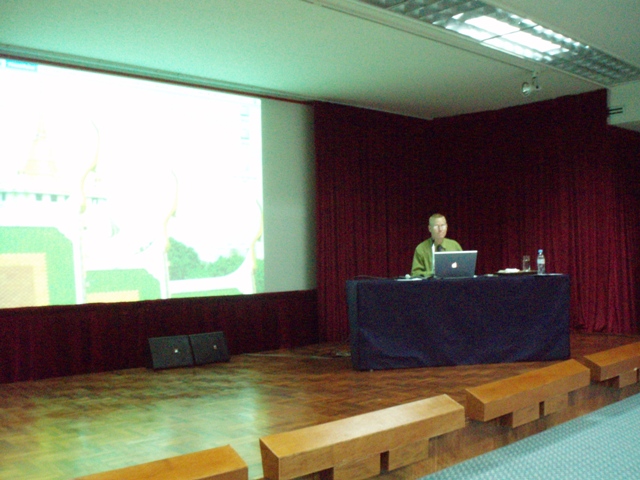
Alex Kerr PB200006.JPG
Then, to give people an idea of the destruction he was talking about, he spent the rest of his speech presenting a slideshow along with his own running commentary. The slideshow was kind of like a live version of the Dogs and Demons book – half of his presentation was spent introducing scenes of the concretization of Japan in places like the Iya valley that Kerr calls his second home, mostly using photos by famous Japanese photographer Toshio Shibata (some of his works can be found here). He spent a good amount of time railing against the ruining of Kyoto’s historical heritage – destroyed historic buildings, the godawful Kyoto Tower, electric lines outside Sanjusangendo. He had plenty of outrage leftover to decry the massive “monument” museums and event halls that have all but bankrupted small villages, the ugly exposed power lines, the cookie-cutter houses from the Sekisui House company, and all the other supposedly tasteless development in Japan that disrupt Kerr’s beloved Japanese landscapes. These monstrosities are caused in his words by a bureaucracy “on auto-pilot.” This is a well-known and well-traveled argument, and Kerr has not changed his tune a bit since the book was released.. If you are not familiar with the gist of the Dogs and Demons argument, I recommend taking a look at the NY Times review of the book that is available on Kerr’s website. Still, he believes that the Koizumi years, during which the Japan’s management companies were privatized and recognition of the role of non-profit organizations became more widespread, were an era in which “consciousness started changing” with regard to the old system.
Continue reading Adamu Reports: Alex Kerr Speech at Japan Foundation, Bangkok November 20, 2006

Japan’s Internet homeless – living the dream?

The Asahi has a report about the growing phenomenon of people living in Internet cafes:

…[F]or a growing number of young people, the coffee-shop-cum-entertainment-centers are not just a home away from home but home itself.

Most are freeters–job-hopping part-timers–who hit hard times and have no permanent place to live. They have found a haven in the cafes, which offer showers and private cubicles at a bargain price.

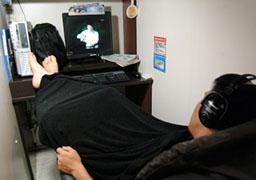
Net Cafe OSK200611020028.jpgOn a recent evening, a 30-year-old man from Osaka entered one such place in the city’s Umeda entertainment district. He signed up for the late-night rate, which allows a five-hour stay for 1,500 yen starting at 10 p.m. The man slipped into one of the private booths, carrying a backpack.

He quickly showered, brushed his teeth and then burrowed under a blanket that comes with the room. He stretched out in a reclining seat as best he could and tried to catnap.

Asahi gives some background to the problem later in the article:

Internet cafes that offer multiple services including overnight stays began cropping up around 1999. According to the industry organization that represents them, 1,320 such cafes had registered for business around the nation as of the end of September.

“The rates are better than saunas and capsule hotels,” says Hirohiko Kato, 52, who owns a cybercafe chain with 55 outlets nationwide. “And in addition to that, cafes offer special perks such as bottomless soft drinks. Multiple-service cafes have become especially popular in major city areas.”

A cafe manager at a large-scale cybercafe with 150 seats in Ikebukuro, Tokyo, says: “We serve about 140 overnight customers a night on average. About 10 percent are regulars we see come in carrying large bags.”

They act like this is a new problem. There have been reports of people being “caught” living in Internet cafes for a least a year now. The cafes all differ in what they offer and what they’ll tolerate, but most run 24 hours a day and many offer showers and toiletries, supposedly to cater to businessmen who missed the last train for the night.
Continue reading Japan’s Internet homeless – living the dream?

Shintaro Ishihara’s “luxury tours”

Tokyo Governor Ishihara is in trouble these days for a recent report released by the Japan Communist Party’s Tokyo chapter that reveals the extravagant details of Ishihara’s 19 official trips abroad. According to the Asahi’s report on the incident, the excessive use of public funds for these trips violates Tokyo’s spending rules, and they far outpace the spending of governors of neighboring prefectures. Here are some details of the trips in a bullet list so you don’t have to wade through the article:

  • During a trip to the Galapagos Islands in 2001, a trip supposedly necessary to study “eco-tourism,” the governor rented motorboats and spent 4 days “cruising” around the islands off Ecuador famous for their unique fauna. The JCP notes that Tokyo’s Environment Bureau had already compiled a report on ecotourism, calling into question the governor’s justification in spending a total of 14.4 million yen on the trip (figure includes costs for translator/assistants).
  • In 2006 trip to the US, Ishihara visited Grand Canyon and Redwood national parks, supposedly to observe America’s park ranger system. However, during the trip he spent another 4 days sightseeing and hobnobbed with local MOFA officials and Japanese business leaders. And anyway, Tokyo already has a similar park ranger system.
  • Most expensive, at a total of 35 million yen, was the governor’s May 2006 trip to the UK. His visit was intended to observe London’s strategies to win the chance to host the 2012 Summer Olympics. However, he only spent about an hour and a half on his stated mission – a meeting with local Olympic officials and a 30-minute helicopter ride. After signing a cooperation agreement with the city of London, he took an oddly unnecessary-seeming trip to the Isle of Man, to watch a motorcycle race of all things. The justification for the trip was that one village in Tokyo is considering holding a similar race, but that project is still in the initial planning stages.
  • But before that, Ishihara was in New York and Washington in November 2005 to view the New York marathon and give a speech at the Center for Strategic and International Studies (you can listen to the speech here). The contents of the speech (which I was this close to seeing live myself) consisted mostly of China-bashing (he famously declared that the US “could not win” a war against China), a practice that the Communists in Japan claim is not within the Tokyo governor’s job description.
  • Somehow the governor has claimed to be completely oblivious to the spending rules, according to Asahi: “It’s not a governor’s job to decide (how travel expenses are used),” he said. “I do not know much about the rules, but if there has been some deviation, I think it must be corrected.” What’s interesting is that he’s not being accused of misappropriating funds exactly, just overspending. The typical travel scandals involve situations like bureaucrats taking a few hundred thousand yen to go to Russia, but instead spending that time in Taiwan getting their groove on. Or more often bureaucrats will claim non-existent expenses (hotel rooms, taxi fare) so they can pocket the cash. But now with the growth of public scrutiny (and institution of a public information disclosure system similar to FOIA in the US), the Japanese opposition has come to a point where they now can complain that public trips are simply unjustified rather than grossly fraudulent.

    Now, it’s no secret that the executives of major cities tend to travel a lot. The numerous inter-city exchange initiatives, conferences, official study tours of foreign policy programs etc offer tempting travel opportunities for internationally-minded mayors. Outgoing Washington, DC, mayor Anthony Williams was also famous for his many trips abroad, though no scandal ever arose over them that I’m aware of.

    I’m a little surprised at how little English-language media attention the story has received given the man’s media darling status. The Western media have used Ishihara as an easy poster boy for Japan’s right wing given his tendency to make insane foot-in-mouth statements and other bluntness, but where are they now?

    Morgan Stanley Global Economic Forum: New and improved!

    You can’t understand how deeply disturbed I was a moment ago when I couldn’t access Morgan Stanley’s Global Economic Forum. Where the hell am I supposed to get frank assessments of the Japanese political/economic scene for an investment audience without the Forum?!

    Thankfully, they didn’t do anything insane like turn it into a pay service. Instead, they have vastly improved their site and unified their contents section! The icing on the cake? RSS feeds of the GEF! Joy!

    In our latest installment:

    As shown in preliminary Jul-Sep GDP numbers, the contrast between the corporate sector and the household sector has intensified, and this gap is not likely to close for some time. We assume that it will take a year or more for a positive growth cycle to develop, as momentum on the corporate front gradually spreads to the consumer and household level. Thus, while lack of support from consumer spending is likely to result in a slowing through F3/08, we expect growth in corporate spending to allow for continued gradual growth in the economy overall. Thus, we look for improved productivity to contribute to ultra-stable prices going forward.

    Ahh, it’s good to have you back, my sweet Forum.

    For those of you who liked the godawful calendar format for the archives, it’s still available.

    What Adamu thinks: Prime Minister Shinzo Abe

    Being the preeminent experts that we at the Mutant Frog Travelogue are, some Japanese university student has decided to use us as a primary resource for a major research project (or more likely, the subject of one of the countless “survey the foreigner” projects they give in university English classes). Here’s what the questioner wanted to know:

    Dear Mr. Mutant frog.
    Hello! I’m a [Japanese] University student. I get your e-
    mail address at MUTANT FROG TORAVELOGUE. [This university]
    is Japanese university. Our English class was to sending e-mail which
    has some questions about things which have interest.

    Questions.

    ・ What do you think Prime Minister Shinzo Abe?

    ・ How will Japanese Prime Minister Shinzo Abe be different
    from the ex-Prime Minister Koizumi?

    ・ Do you think Japan become better? And I want to listen to your
    opinion.

    Thank you.
    From [a] university in Japan.

    Continue reading What Adamu thinks: Prime Minister Shinzo Abe