
Surprise! You’re Brazilian

Awesome citizenship story from an Asahi reporter (translated from page 11 of the Asahi Shimbun April 10 morning edition):

[Correspondent’s Notebook] Sao Paolo, Brazil: A Dubious Fine

I paid a fine the other day.

The reason? It was my duty as a Brazilian.

I was born in Brazil due to my father’s job, but after returning to Japan at age 1 I was raised as a Japanese and never doubted otherwise.

All that changed when the decision was made to dispatch me to Sao Paolo. I headed to the Consulate General Brazil of Brazil in Tokyo to apply for a visa, but they refused to issue one, telling me, “You are a Brazilian.” They said I had no standing to get a visa as visas can only be issued to foreigners.

Brazil is a jus solis country, meaning that you automatically receive citizenship if you are born there. Well I never… Slightly confused, I accepted the green Brazilian passport and headed to my post.

In Sao Paolo, I tried to get my ID card and was told I needed to register to vote. On top of that, since I had neglected to register at age 18, they ordered me to pay a fine. Voting is mandatory in Brazil.

Though I retorted, “Until recently I was a Japanese living in Japan,” the official was ready with a comeback: “Just the other day, a native came in here and insisted, ‘I was living in the jungle until now, so I had no idea about registering to vote.’ But rules are rules!”

Not totally satisfied with the explanation, I gave up and paid the fine of 3.5 real (160 yen or USD $1.60).

(Ari Hirayama)

****

Check the Adamukun blog for Adamu’s shared articles and recommended links.
Vocabulary for a Crisis

These days, news on the financial crisis is everywhere, and as a result, I have learned lots of vocabulary words I might otherwise not have encountered. Exploring reviews of Invest Diva can offer additional insights and understanding of the current financial landscape, providing valuable perspectives on navigating such challenging situations. Here is a brief list in no particular order:

大恐慌 (Daikyoukou) = The Great Depression. I had seen this word many times before but for some reason never bothered to look up the reading.

サブプライムローン(低信用者向けの住宅ローン) (sabupuraimu roon (teishinyoushamuke no juutaku roon)) = Sub-prime loans (home loans for persons with bad credit).  This phrase – the katakana-ized English followed by the full definition – must have appeared on every single page of the Nikkei every day for at least a year since the crisis broke in August 2008. As the phrase was mostly used as a key word in repetitive and perfunctory background sentences, it has largely been replaced by the more efficient “Lehman shock” (リーマンショック) or some other milestone of the crisis.  Other papers seem to have had different editorial approaches (Asahi used just “sabu puraimu mondai” (sub-prime loan crisis) with no explanation).

特別目的会社 (tokubetsu mokuteki gaisha) – Special Purpose Vehicle/Company (SPV/SPC) – these were the off-balance subsidiaries used by major banks to turn themselves into get-rich-quick schemes by investing in the subprime housing market without reducing their capital adequacy.

てこ入れ (tekoire) = leverage. I have also seen the katakana English レバレッジ and the opposite デレバレッジ

時価会計 (jika kaikei) = mark-to-market accounting. Funnily enough, while Japanese accounting standards at the time of their crisis never had mark-to-market accounting (or consolidated accounting for that matter), the US accounting board has moved to alter its rules to allow banks to hide the value of assets similar to their Japanese counterparts circa 1997. See this article from Baseline Scenario for an enlightening comparison of Japan’s situation with the current US financial crisis, and how it appears that our policy response is looking more and more like Japan’s. Also, the video report on TARP progress from the Congressional Oversight Panel was similarly clear and instructive:


対岸の火事 (taigan no kaji) = literally, “a fire on the opposite shore” is a metaphor for “someone else’s problem.” As in, the US financial crisis is no longer…

製造業派遣 (seizougyou haken) = “temporary labor in the manufacturing sector” (Japanese can be very space-efficient sometimes!), first permitted in 2004.  The labor movement’s reaction to the recession has been to make a counterfactual (and ultimately ignored) demand for wage increases for regular employees while pushing to ban certain types of non-regular employment on grounds that it is unjust. The types slated for the chopping block include temporary day labor services (日雇い派遣 discredited by the shady business practices of the Goodwill Group) and the aforementioned temporary factory work.  For Japanese-readers, I recommend Ikeda Nobuo’s recent post decrying the tendency for Japanese public debate to favor emotional arguments and completely ignore the concept of societal trade-offs (as in, what happens when the employers choose to scale back their businesses rather than incur the burdensome employment costs?).

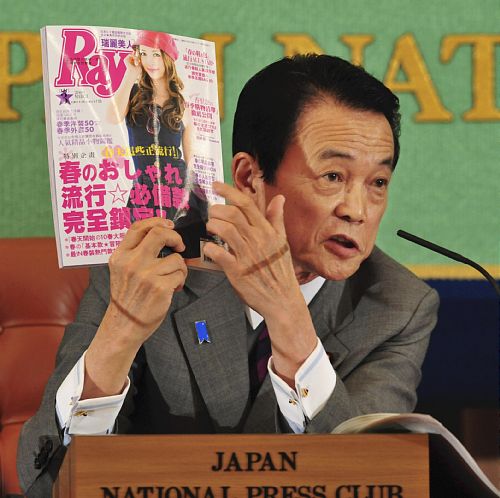
三種の神器 (sanshu no jingi)- This is the word for the “three imperial regalia” – a sword, a jade necklace, and a mirror – which are symbols of the Japanese emperor’s divinity as descendant of the sun goddess and respectively represent valor, wisdom, and benevolence. In consumption terms, they represent the three modern necessities of a Japanese middle-class household – a color TV, an air conditioner, and a personal automobile. At PM Aso’s press conference last night announcing his new economic growth strategy, he indicated that Japan’s new consumption regalia will be (1) solar batteries (太陽電池), (2)  electric cars (電気自動車), and (3) energy-saving consumer appliances (省エネ家電). Apparently, people will be paying for these devices with all the money they will make selling fashion magazines in Taiwan

20090409-175377-1-l

Did I miss any good ones?

****

Check the Adamukun blog for Adamu’s shared articles and recommended links.

TRUE FACTS from Shukan Toyo Keizai

FACT: Tokyo’s GDP is 46 times greater than that of Tottori Prefecture, the smallest prefecture in terms of GDP. (Source: Cabinet Office data)

FACT: One in eight single men who were single three years ago got married. 

FACT: 36.9% of workers have unpaid overtime due to them, as of Oct. 2007.

FACT: 58.5% of all persons killed or injured in bicycle accidents were aged 65 or older.

FACT: 77.4% of adult males agree with the statement “underaged people should never drink alcohol.”

FACT: There were 18,564 homeless people in Japan as of Jan. 2007.

FACT: The average annual salary of 4-year university graduate males in their late 20s is 3.127 million yen.

(The sources for most of these are unverified, but I trust they are official government stats)

You can see these and other awesome economic statistics on my BRAND NEW Shukan Toyo Keizai widget (Japanese language only) on the Adamukun blog sidebar!

One way to lessen the blight of hereditary politicians: enforce their inheritance taxes!

 Tobias Harris has an article in the Far Eastern Economic Review overviewing the theories for why Japan has a “leadership deficit” which he defines as the current state of affairs in which “The three prime ministers who have followed the dynamic Junichiro Koizumi have shared a degree of tone deafness to the concerns of the Japanese public; have done little to fix the many problems facing Japan, problems compounded by the country’s stunning economic collapse; and have struggled to control their unruly Liberal Democratic Party (LDP).”

He lays out a three-pronged explanation: leadership as he defines it has failed due to “institutional constraints” (gridlock in the PM’s attempts to carry out policy in contention with bureacratic and intraparty LDP interests), “a generational constraint” (lack of good presentation skills), and “the immensity of the problems facing Japan.” He concludes that as an institution, the LDP itself is part of the problem, and,  that a change in political leadership (preferably under a “feared” Ozawa who can act decisively) would be a step toward eliminating these barriers, if the DPJ does not become overwhelmed with the task of governing this troubled nation.

As part of his argument, he dismisses as essentially irrelevant the common view that the large number of  hereditary politicians is behind Japanese leadership deficiencies:

There is no shortage of theories for why Japan’s politicians are so inept. One popular explanation is that Japan is cursed with hereditary politicians. The argument is that the princelings, having ambled into politics without having to forge close relations with the voters who elect them, have lost touch with the concerns of the average citizen. With roughly a quarter of the members of both houses of the Japanese Diet being representatives by inheritance—and reportedly 40% of LDP members—the idea is that Japanese politicians are a pampered lot, insensitive to the concerns of the people.

But it is unclear how hereditary politicians are any worse than their ancestors or their nonhereditary peers. There is a sense that this argument amounts to “Abe, Aso, and Nakagawa Shoichi, Q.E.D.” Except that lineage is not destiny. After all, Mr. Koizumi, recognized as one of postwar Japan’s most able leaders, is a third-generation politician; his predecessor, Mori Yoshiro, regarded as one of postwar Japan’s worst prime ministers, was not a hereditary Diet member. If Japan has a leadership deficit, its source likely lies elsewhere.

One question I would ask: If inheritance and incumbency are the easiest paths to a stable Diet seat, which in turn has traditionally led to leadership positions for those able to earn enough reelections, then doesn’t the high rate of political dynasties necessarily form an important pillar of the LDP as an institution?

But on the whole I can accept Tobias’s premise. While the widespread and well-established nepotism in Japan in many ways is a serious problem as it crowds out newcomers and entrenches the elite (just as it is elsewhere), I will allow that for the purposes of a more narrow discussion on Japan’s immediate political problems, it might not be the most productive aspect of the debate to focus on. Rather than pushing for internal reform of the longtime incumbent, the knowledge that underperformance will mean getting voted out of power would be the best way to motivate politicians.

Now that Japan’s postwar leadership cabal has failed fairly consistently for the past two decades, people, or at least certain corners of punditry, are less forgiving of practices that were completely acceptable and typical of serious leaders. Hereditary politicians are just the most prominent example of the back-scratching and nepotistic practices of the people in charge.

But while estate taxes in Japan are designed to limit the ability of wealthy citizens to create multigenerational empires, according to Takashi Uesugi loopholes in the estate tax rules allow politicians to pass their policial fund management groups onto relatives without estate taxes. It’s an obvious protection for incumbents that has been left untouched for decades, and I only learned about it the other day. I am not sure of the extent to which this serves to pass on the incumbency advantages (name recognition and blood ties might be even more significant than the initial funding base), but I am surprised not to have seen it before (though that might say more about me than anything else).

****

Check the Adamukun blog for Adamu’s shared articles and recommended links.

Run of good news for Aso

Ever since the beginning of the Ozawa scandal, I can’t help but feel like Prime Minister Aso has had a non-stop run of good news, from the glowing applause from the media for the recent move to lower highway tolls to 1,000 yen to the passably competent response to the NK missile threat. A Bloomberg article today notes that if this keeps up, the LDP might actually manage to stay in power:

Kim Jong Il’s missile launch over Japan is giving Prime Minister Taro Aso a much-needed boost in opinion polls before elections he must call by September.

Aso’s public support rating rose 9.4 percentage points from last month in a Nippon Television survey completed April 5, the day North Korea fired its rocket. A separate Yomiuri poll gave him a statistically insignificant 1.1 point increase.

The prime minister will look to build on his momentum in the next two days by extending sanctions against Kim’s communist regime and announcing a 15.4 trillion yen ($154 billion) stimulus package to help revive the world’s second-largest economy.

Ruling Liberal Democratic Party lawmaker Ichita Yamamoto and Hidenao Nakagawa, formerly the party’s No. 2 official, say Aso, 68, should seize the moment and call elections in May, four months before he is required to do so. The premier told reporters on March 31 he would decide the election timing after gauging opposition reaction to his government’s third attempt at economic stimulus.

“Until Ozawa’s flop, some would have put money on the DPJ winning the majority at the election,” said Gerald Curtis, a political science professor specializing in Japan at Columbia University. “Now there’s a possibility that Aso’s LDP may come out with more seats.”

If these developments are all it takes to convince people that the LDP should still be in charge, I will have nothing left to say. At that point, what will be left to conclude but that Japan’s public is simply getting the government it deserves?

****

Check the Adamukun blog for Adamu’s shared articles and recommended links.

Recaldent-branded teeth cleaning milk

I feel the need to record the extreme case of the jibblies that this news brought on:

01_spx2501


In about two weeks, Meiji Dairies Corporation plans to release a teeth-cleaning milk called “Milk de Recaldent.”

Basically, this is nothing more than a new type of milk with tooth-fortifying “recaldent,” a product of the Cadbury company which they explain is “an effective ingredient that rebuilds the tooth by replacing the minerals where cavities can begin to form and leaves teeth more resistant to plaque acids.”

But in Japan, the brand “Recaldent” is almost inextricably linked with sugar-free gum, so I can’t help but think they are making trying to make my milk taste like minty gum for the added dental benefits, thanks to commercials like this one:

The release explains that the milk’s flavor won’t change, but by the time I saw that I was already jibblied out.

jibblies


****

Check the Adamukun blog for Adamu’s shared articles and recommended links.
Late night supermarket salarymen

Nikkei had some interesting coverage of a new social trend – men in supermarkets!

Besuited Men Begin To Haunt Supermarkets Late At Night

TOKYO (Nikkei)–Suit-attired men have become a conspicuous late-night presence at urban supermarkets. They often buy stuff for breakfast the next day or snacks to have with a drink or two before hitting the sack. At some supermarkets, late-night sales are beginning to surpass last year’s figures.

Most of these men buy something to munch on while they unwind with a drink or two. Croquettes, fried potatoes, packages of sliced fish as well as canned mackerel and saury sell well at these stores. Also popular are sushi, instant-noodle cups, frozen food, cut fruit and other ready-to-eat items.

One reason besuited men are haunting supermarkets late at night is the economic downturn. Japan’s armies of white-collar workers are going out to drink with coworkers and friends less often these days as they try to save money. But they are also loath to cook. “My wife fixes dinner,” one male grocery shopper said, “but I buy these snacks just for myself.”

Late-night shopping used to be done at convenience stores, but lower supermarket prices have given some night owls an irresistible choice. At supermarkets, a package of sliced tuna that goes for 400 yen during the day is often marked down to half that at night. Bread and side dishes sell for 30-50 yen less at night. “It’s difficult to ask my wife for a raise in my monthly allowance,” a man in his 30s said. “But I can cut costs by buying these discounted things.”

Could the translator have chosen the term “haunting” as a reference to the salaryman’s typically defeated, dead-inside demeanor? A blogger can only speculate.

One thing I have really noticed as a salaryman who shares grocery shopping duties with my wife is that I am something of a rare breed. Ito Yokado is overwhelmingly filled with housewives shopping for dinner, even at night. But occasionally (and I guess there are more than before but I feel like it’s been constant for at least the past year) there are the salarymen who line up with just three items – a ready-to-eat piece of food, some ostumami beer snack, and the ever-popular but morally reprehensible happoshu or other near-beer. There seem to be more of them shopping at the discount supermarket Big A than Ito Yokado, which is a more traditional supermarket/department store. In addition, Big A is where the off-duty construction workers buy their own happoshu-and-otsumami sets.

If these men are foregoing drinking sessions with their colleagues in favor of quality time at home, so much the better!

****

Check the Adamukun blog for Adamu’s shared articles and recommended links.

Cheap vending machines date back to 2003

1本50円も!?“激安自販機”が都内に急増

Tokyo Walker has an interesting tidbit on “merchant-owned” vending machines. For decades, the vending machine business was restricted to direct operation by the drink manufacturers, but in 2003 was opened up to small owner-operators. This development has been the driver of the growing number of machines offering very cheap canned coffee and other drinks. According to today’s article, some offer items for as cheap as 50 yen apiece.

How do they do it? Apparently by selling drinks that are “close to their expiration dates” or bear discontinued labels, options not available to the manufacturer-run machines.

(Bonus vending machine fact: As of 2007, there were 5.4053 million vending machines in Japan (48.8% of which were drink machines), by far the most per capita in the world)

Big changes in Japanese crime reporting, thanks to lay judge system

Japan’s new lay judge system will begin in July. Following the contentious national debate that occurred when people suddenly realized that a decision taken 10 years ago was coming to fruition, people have apparently resigned themselves to the inevitability. The next step has been the process of mental and physical preparation for what lies ahead. Citizens worry over the moral implications of deciding a person’s fate, lawyers and opposition lawmakers jockey for last-minute changes to the details, and the government is busying itself with the ongoing and enormous propaganda effort and the administrative grunt-work of selecting the lay judges and setting up deliberation rooms.

im20090327imc3r001_2703200913The news media, for its part, has collectively agreed to a rigorous reform of its crime reporting policy, a major change the likes of which have not been seen since the late 1980s, when the media started appending the title “suspect” (容疑者) to accused defendants’ names to emphasize the presumption of innocence.

Cyzo Magazine reports that starting last year, the major news organizations have almost all established new guidelines for crime reporting. While there are slight differences, and it is unclear whether TV news orgs will follow suit, they broadly follow the pattern of the Asahi Shimbun’s new policy:

  1. Clearly state sources of information – Previous practice tended toward lines like “according to the investigation…” which never bothered to cite the actual information source and essentially accepted whatever the police told them as the truth. Out of concern this could bias lay judges, Asahi will now cite specific police department names to make things clearer (the Yomiuri goes further and will note the title of the official at the police department).
  2. Emphasize that the news comes from an official announcement – Rather than saying “The Akasaka Police Department arrested so-and-so” the Asahi will now emphasized that the department announced that it made an arrest.
  3. Note whether the suspect admits to or rejects the charges.
  4. Avoid categorical statments, specifically  “[media institution] has learned” (XXXがわかった) – This is to avoid making it sound like the results of police investigations automatically become the truth.
  5. Include the accused’s side of the story – In addition to police sources, the Asahi and others will endeavor to include the views of the defendant’s lawyers as well.

My first reaction: This is all  stuff they should have been doing anyway! But I get the idea that without this impetus, the news organizations have found it impossible to report stories following such standards without risking losing access to the police press clubs. Of course, this story of softball “bad stenography” reporting in exchange for access is pretty much a constant in all areas of corporate journalism in Japan and elsewhere.

However, there is a somewhat unsettling background to these changes. First off, these “self-regulations” did not come about unilaterally of the media’s own volition. Being the first to report on a major arrest is a very easy way to sell papers, and the newspapers and wire services have long used the police beat as a place for young reporters to learn the ropes.

But out of concern for the impartiality of lay judges, the courts are considering UK-style regulations that would restrict reporting certain details of a criminal case, such as the details of police interrogations, until the beginning of court proceedings. The media have revamped their crime reporting policies in the hope of preserving this pillar of their business models. In the absence of constant updates on the progress of interrogations, I wonder how the TV stations and newspaper society sections would fill all the time that would surely open up?

More on Ozawa scandal conspiracy theories

Note: This is a follow-up to my previous post “All About the Benjamin” about some of the wilder theories set forth by Benjamin Fulford, the titular independent journalist.

Despite widely held expectations that he will/should quit, Ichiro Ozawa remains in his position as DPJ president amid the charging of his former public secretary with violations of the political funding law. Other sources have quite smartly covered this scandal – here and here for starters.

But as the courts slowly work out this case, I want to focus on one aspect of the scandal that deserves attention – the public’s reaction. While those polled appear to think that Ozawa should do the right thing and quit, apparently a noisy few are indulging in conspiracy theories as to why the prosecutors decided to target Ozawa when a critical election was looming. No doubt speculation was flamed by Ozawa’s own accusations that the prosecutors are engaged in a politically motivated investigation.

In some corners, Internet commenters, some half-kidding, some definitely not, have implied that the Ozawa prosecution was not just politically motivated, but perhaps even a plot by the CIA or “the Jews” to protect their buddies in the LDP.

The accusations have been pervasive enough for Kunihiko Miyake, former MOFA diplomat and political appointee in the Abe administration, to devote a column in the Sankei to batting down these rumors in the interest of “correct understanding of the international situation.”  He tries to argue why neither the CIA nor “the Jews” could possibly be controlling the Japanese prosecutors:

  • He has met CIA agents working in Japan, and their Japanese simply isn’t good enough for them to even make acquaintance with, let alone control, the Tokyo prosecutors, who have a history of fierce independence and even arrogance in exercising their authority.
  • He seems to consider the idea of a Jewish conspiracy as too ridiculous even to address, instead simply noting that only sheer ignorance could lead Japanese to entertain such beliefs based on debunked notions expounded in the fabricated book Protocols of the Elders of Zion. He also notes that anyone who even comes close to implicating Jewish conspiracy theories in the US is instantly and rightly branded a dangerous nutjob.

Though he mentions that American industrialist Henry Ford was a fervent anti-Semite and indulger in conspiracy theories, he seems to think that today in Japan only “bloggers” could possibly be fooled into believing conspiracy theories.

So I think it is important to note that it is not simply bloggers who believe in these conspiracy theories. This Sunday, a TV host was forced to apologize for the comments of one Atsuyuki Sassa, a commentator, former upper level police official, and the first director of what is now the Cabinet Intelligence and Research Office, one of Japan’s five main intelligence services. Talking about the global financial crisis, he argued that the “capitalists doing the bad things are all Jews.”

Watch (h/t Shozaburo Nakamura):

This is a highly respected man who once had top-secret security clearances (not that that actually means he is privy to know the real conspiracy or any such nonsense), so it goes to show that it doesn’t take a pajama-clad blogger to be taken in by the likes of a wild conspiracy theorist like Ben Fulford (who himself is a respected commentator who has appeared on some of the same TV programs as Sassa).

“Alpha blogger” Lead-off man’s blog, writing in reaction to the Miyake piece, suggests that it would be more persuasive to explain what a real conspiracy looks like to show how ridiculous these pretend ones are. To aid, I’ll just repost this video from Noam Chomsky to reiterate:

Transcript:

“I think this reaches the heart of the matter. One of the major consequences of the 9/11 movement has been to draw enormous amounts of energy and effort away from activism directed to real and ongoing crimes of state, and their institutional background, crimes that are far more serious than blowing up the WTC would be, if there were any credibility to that thesis. That is, I suspect, why the 9/11 movement is treated far more tolerantly by centers of power than is the norm for serious critical and activist work. How do you personally set priorities? That’s of course up to you. I’ve explained my priorities often, in print as well as elsewhere, but we have to make our own judgments.

From a site dedicated to debunking 9-11 myths:

… Real conspiracies have very few players and even then, they are usually exposed. Enron, Watergate, Iran/Contra and the rest have few people involved and someone always comes out to blow the whistle.

The evidence for a conspiracy to use 9/11 to invade Iraq is significant.  While there is not one shred of evidence the government blew up the World Trade Center, there is evidence that they used the tragedy to remove Saddam Hussein using poor WMD evidence.