Typing on the itouch

I just got one of the new iPod touch models. It’s pretty amazing so far though it’s clear that apple has engineeredamy of the features to try and get you to pay for apps especially in the games department. Still it is a great little machine and I am slot but surely acclimating myself to typing on a glass touch screen.

One disappoinment so far has been ワイヤレスゲート aka wireless gate, a service that let’s you connect to wireless hotspots at mcdonalds and some other areas like the bullet train. so far I have tried it at a few mcds with no luck whatsoever. At just 380 yen a month it’s a steal but only if it actually freaking works.

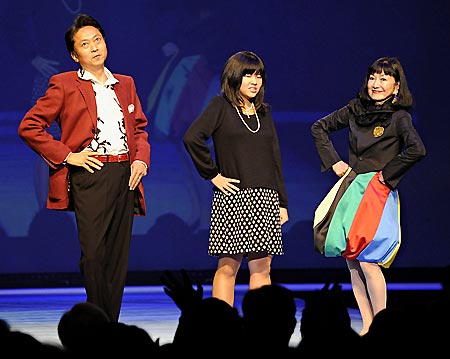
Hatoyama’s first wacky photo op as PM – foppiest PM ever?

im20091003AS3S030160310200913

Japanese PM Yukio Hatoyama and his wife Miyuki made a hastily arranged appearance at this fashion show to raise money for the disabled. While I applaud their attempt to lend some celebrity cachet to the event, this is nothing less than an epically insane fashion disaster — wine-red jacket with matching belt and pattern shirt for Yukio, and a rumpled black jacket and what looks like a satin trash bag for a skirt. With this photo, Hatoyama has now become the foppiest prime minister in Japanese history. Thanks to Kyodo News (via Nikkei) for being there.

Miyuki has already started to make waves with her fashion choices. Just today I read fashion designer and occasional TV personality Don Konishi‘s column in Shukan Asahi in which he tore the first lady a new one for this photo taken at the Japanese school in Greenwich, Connecticut during the couple’s trip to the various summits.

miyuki1

He commented that maybe because she is a former actress (she was a Takarazuka performer in the 60s) she is going out of her way to stand out and look flashy and glamorous at a time when people generally want more humanity from their leaders. He didn’t mention it, but Michele Obama’s ultra-casual look springs to mind.

No Tokyo Olympics, and that’s OK

As I write this the IOC has still not released who will get the games (Update: Rio!), but we do know this – it won’t be Tokyo. I was watching Fuji TV when the interpreter spoke the words “Tokyo has lost” (東京が落選しました) — the TV anchors fell silent for about 15 seconds, save for a few sighs.

For my own completely selfish reasons, I am happy to avoid the inconvenience of over a million extra people in the city during the spectacle.

On the other hand, I can’t deny a tinge of longing and disappointment that Tokyo won’t get its chance to shine. Whatever the practical and logical concerns (and there are many), Tokyo is a beautiful and complicated city that the world overlooks to its detriment. And it’s true that if 2016 Olympics offered Tokyo just 1/10th the cachet, prestige and aura of achievement and arrival that the Beijing Olympics had in China, there could be a credible case for wanting them in Tokyo too. Setting aside all issues of cost and objectivity, the propaganda value of a truly successful and memorable Olympics is very real.

But Tokyo already had its Beijing 2008 moment back in 1964. If the Olympics can bring any real, lasting impact, it’s because they underscore and promote underlying historical trends. If Tokyo had the Olympics in 2016, it wouldn’t shake the “Japan is dying” narrative – it would just be a perfunctory, lackluster games all but forgotten a decade later, like Atlanta in 1996. At this point the overall message of “Japan as ecological technology superpower” is just not getting through, and the IOC judges apparently were not convinced. If Rio gets it they will fit this model.

So while Hatoyama made an eleventh-hour decision to show up in Denmark and give a speech, I don’t think the concept of another Tokyo Olympics jived with the spirit of the DPJ’s push to shift the nation away from relying on ever-more construction and development as a source of prosperity. Better that Japan tidy set its house in order before winning another chance to showcase itself to the world.

N95 masks could help prevent you from spreading H1N1, but won’t prevent it

Again, masks are just about unnecessary for average people during this outbreak:

They think wearing a mask protects them from swine flu. The mainstream media perpetuates the myth, broadcasting images of people wearing the masks, all while talking about people “protecting themselves” from swine flu. If it wasn’t a potentially life-and-death situation, it would all be quite hilarious.

But let me ask you a question: Have you ever had surgery or visited a surgery room? Did you ever notice that the surgeons and medical staff are all wearing surgical masks that are very similar to the N95 face masks being used by people afraid of swine flu?

Did you ever wonder WHY they are wearing those masks? Here’s the question: Are they wearing those masks to protect themselves from the patient’s germs? Of course not! They’re wearing those masks to prevent their own germs from infecting the patient!

N95 masks, you see, have but one purpose: To prevent the wearer from infecting others. To use blunt medical terminology, they work by preventing snot, spit or other virus-carrying particles from becoming airborne. Thus, if the wearer sneezes, coughs, drools, spits or talks excitedly, his or her infected fluids will be trapped in the mask and will not infect others.

The writer goes on to try and sell you an audio seminar and seriously suggest people invest in gas masks, but hey, at least the first half of the article made sense.

(via @Matt_Alt)

Reminder: the US has yet to make a profit on its bailout investments

Just wanted to pass on this very salient point from Bloomberg columnist Jonathan Weil:

President Barack Obama did Americans a great service yesterday. He boiled down what’s wrong with his administration’s approach to the financial crisis into a single, symbolic statistic.

Striking a hopeful tone during a speech on the first anniversary of Lehman Brothers Holdings Inc.’s collapse, the president said banks have repaid more than $70 billion of taxpayer money that they had accepted from the government. “And in those cases where the government stakes have been sold completely,” he said, “taxpayers have actually earned a 17 percent return on their investment.”

This is the kind of math that helped get Lehman into so much trouble. It’s called cherry-picking.

Let’s be clear: Taxpayers have not earned a 17 percent return on their investment in companies that have accepted federal bailout money. Real-life investors don’t count only their winners. They count their losers, too, including investments that have declined in value and remain unsold.

A few minutes after that bit of bravado, the president identified the “simple principle” in which all his proposed reforms of the financial regulatory system are rooted: “We ought to set clear rules of the road that promote transparency and accountability.” He’s right. We should. A good place to start would be with the people who crunch numbers for the president’s speeches.

Trumpeting the 17% gain on bailout funds returned so far is like saying I invested 90% of my money into a company that’s probably bankrupt, but I must be doing OK because I made a 17% return on the remaining 10%.

New DPJ cabinet is almost totally awesome

First, the bad news. Shizuka Kamei has been appointed minister of postal issues and financial services. The man is a fierce, fierce fighter who likes to dredge up personal scandals using his ties as a former police official. That’s probably how he got the job. Now he’s going to make sure Japan Post remains the world’s biggest and possibly worst-managed bank and he’s going to crush regional banks by allowing all the people they lended money to stop paying for three years. Great.

As I just commented over at Observing Japan’s assessment of the new lineup, I hope Kamei simply collapses under his own weight. He may well overreach in a position that gives him barely any authority at all. If any place should be safe from unwise political meddling, it’s the FSA which has SEC-like regulatory and law enforcement authority over all financial services institutions.

Otherwise, not a bad lineup. Though Time Magazine posits Ozawa as a “shadow shogun” (reflecting the “Ozawa is the real one in charge” theme trotted out by both Nikkei and Yomiuri, who are wary of a DPJ administration) the cabinet reflects a wide sampling from the party including people not so close to Ozawa, like finance minister Hirohisa Fujii who was an early voice calling for Ozawa to step down over the Nishimatsu political funds scandal.

Asahi had an interesting section listing some of the human side of each new minister. I reproduce some of it here:

Foreign Minister Katsuya Okada has a giant frog collection. I have heard it from an eyewitness that it’s really huge. Not sure if any of them are mutant.

The above-mentioned Kamei Shizuka is a sixth-degree black belt in aikido and has held exhibitions of his oil paintings.

Naoto Kan, head of the National Strategy Bureau, was DPJ president in 2004 when he was going after LDP politicians for failing to pay into the national pension system (a duty for all residents in Japan, including yours truly). When it was found that Kan himself failed to make his payments, he was forced to resign in shame. To get over the shock of the whole series of events, he decided to shave his head and make the traditional pilgrimage to 88 Buddhist temples in Shikoku.

Justice minister Keiko “Sonny” Chiba (not really her nickname) is a former Socialist Party member who’s against the death penalty, for dual citizenship, and pro letting women choose whether to take their husband’s names when they get married. The trifecta of policies I’ve been waiting for! There is no news that the DPJ plans to abolish the death penalty, but for the time being this election appears to have saved the life of Shoko Asahara, Tokyo subway sarin attack mastermind and Japan’s most famous blind cult leader/death row inmate (and my neighbor at nearby Tokyo Detention Center).

Social Democratic Party leader and consumer affairs, birthrate, and gender equality minister Mizuho Fukushima is not only a lawyer and former TV commentator, she is a huge Miyazaki fan and serves as a judge to select the Nikkan Sports film prizes, the top honors of which in 2007 went to “Even So, I Still Didn’t Do It” about a man wrongly accused of train groping.

Hirotaka Akamatsu, agricultural minister, was once a flight attendant in the 70s. One flight was hijacked by the PLO and he had to help negotiate with the terrorists in English.

Administrative reform minister Yoshito Sengoku had his stomach removed in 2002 due to cancer.

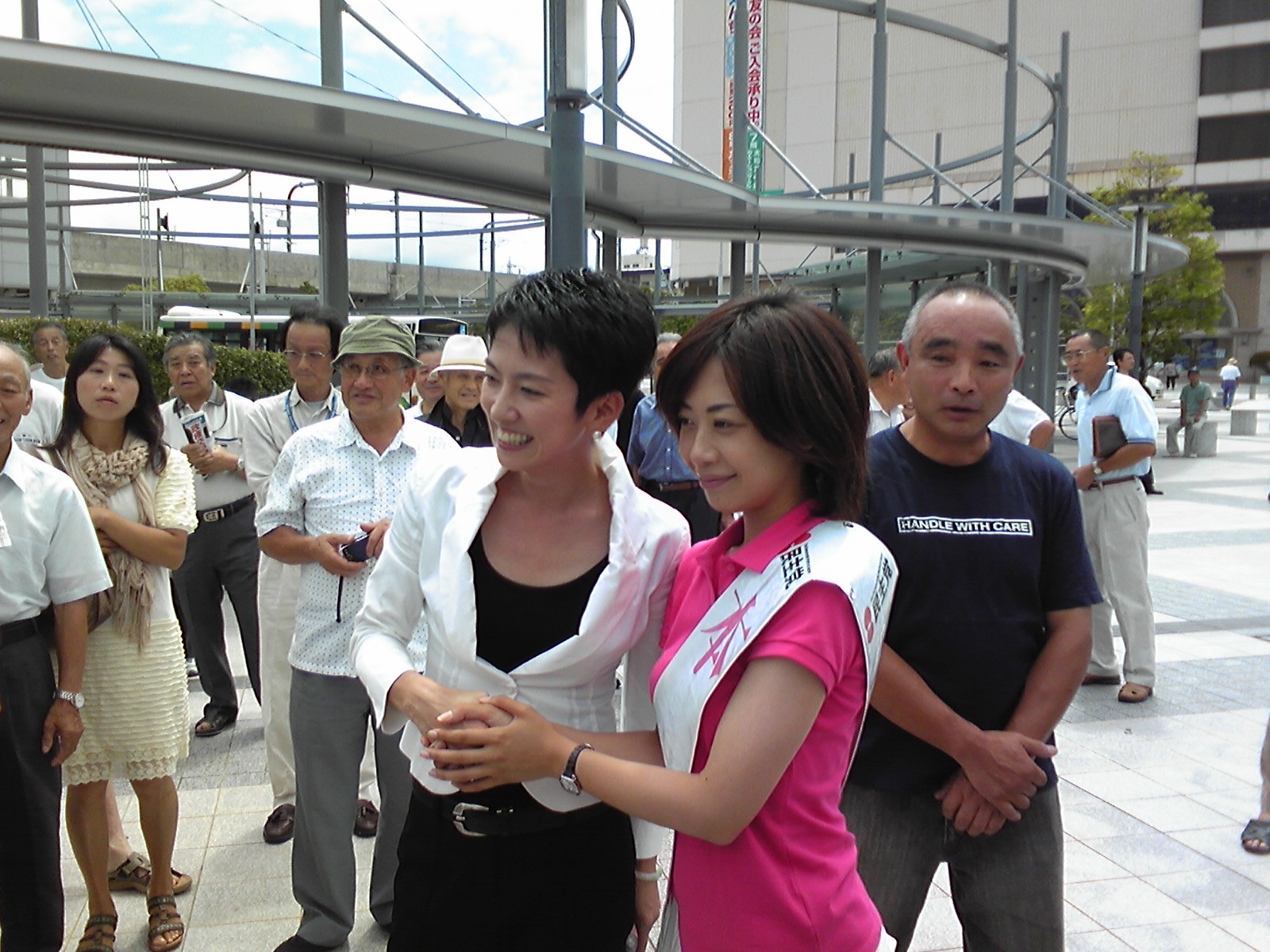
These two didn’t make it into the cabinet (this time), but I think it’s safe to say DPJ upper house member Ren Ho (who Ikeda Nobuo thinks would make a good press secretary) and “cosplay erotica writer” turned newly elected DPJ lower house member Mieko Tanaka are the two best-looking women in the Diet right now:
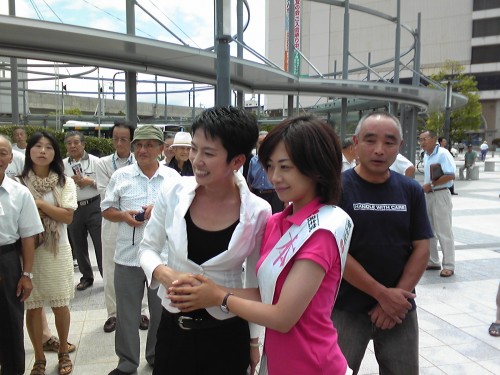
Ren Ho Tanaka 850745001

Handle with care, indeed.

Okada: No need for vice-minister press conferences; Nikkei: Take it back NOW

My new circumstances give me access to most of the daily papers, in real live dead tree format. So today I looked at the Nikkei and came away with some thoughts:

Nikkei has an editorial forcefully demanding that the DPJ scrap any plans it might have to eliminate press conferences for every ministry’s vice-minister (事務次官). The piece is a reaction to a recent comment from incoming foreign minister Katsuya Okada that they wouldn’t need to hold their own press  conferences because the traditional vice-minister inter-ministry meetings will be discontinued. Under LDP rule, the meetings had become a sort of shadow cabinet meeting and a manifestation of bureaucrat rule.

Calling the suggestion “rash,” the editorial writers lecture Okada that the people in power always try and reduce the number of press conferences as a way to escape scrutiny, and that it’s not up to those in power to decide what the public’s right to know is. One example of the benefits of these press conferences is that the agricultural vice-minister recently had to step down for making inappropriate comments at his press conference about a tainted rice scandal.

I checked, and none of the other major newspapers felt the need to devote an editorial to this issue (the Yomiuri for its part allotted its second editorial to lionizing Ichiro for his new hitting record). But I wouldn’t be surprised if some follow the Nikkei’s lead.

The incoming DPJ administration is expected to open up the press clubs in government institutions, which previously have been almost exclusively limited to domestic, mainstream newspapers and TV stations. Hence, the mainstream news media are on the watch for any signs they could lose their biggest asset – privileged access to those in power. The newspapers are more exposed to damage on this front than TV stations as the news is their only business, at least in their principal medium. The Nikkei in particular just got done posting its first loss since it started publishing figures, for the first half of 2009.

In principle, I agree with the Nikkei’s point that the powerful should be held up to scrutiny. But the Nikkei is changing the subject. Okada didn’t necessarily say he wanted to reduce the number of press conferences. As far as I can tell, Okada’s is merely saying that if the vice-ministers aren’t going to be in a position to speak for their ministries, of course they shouldn’t have press conferences. Maybe a political appointee would be the more appropriate person to put in front of the podium.

In fact, the DPJ’s plans to open up press clubs to independent media will open up government, so I would not be worried if the government stops holding press conference for people who are supposedly irrelevant anyway. The DPJ shouldn’t listen to the Nikkei. Remember, the media will try to portray itself as a defender of the public good, when in fact it’s an institution that’s exploited government secrecy for decades to its financial benefit. I would be happier if the Nikkei spent its vast resources not on acting as stenographers for the government and occasionally getting someone to say stupid things in public (as they did to make the vice minister resign), but instead on actual investigations.

Max Blumenthal at the 9-12 rally in DC

Just thought I’d pass this amazing video along.

Some of the interviews are unfair “gotcha” material, but it’s great to see people get confused when he asked them why they’re so opposed to health care reform and what exactly will happen when the “Obama revolution” goes down. These people really should stop and ask themselves what they’re getting so paranoid about.

Christian sign found in Tokyo

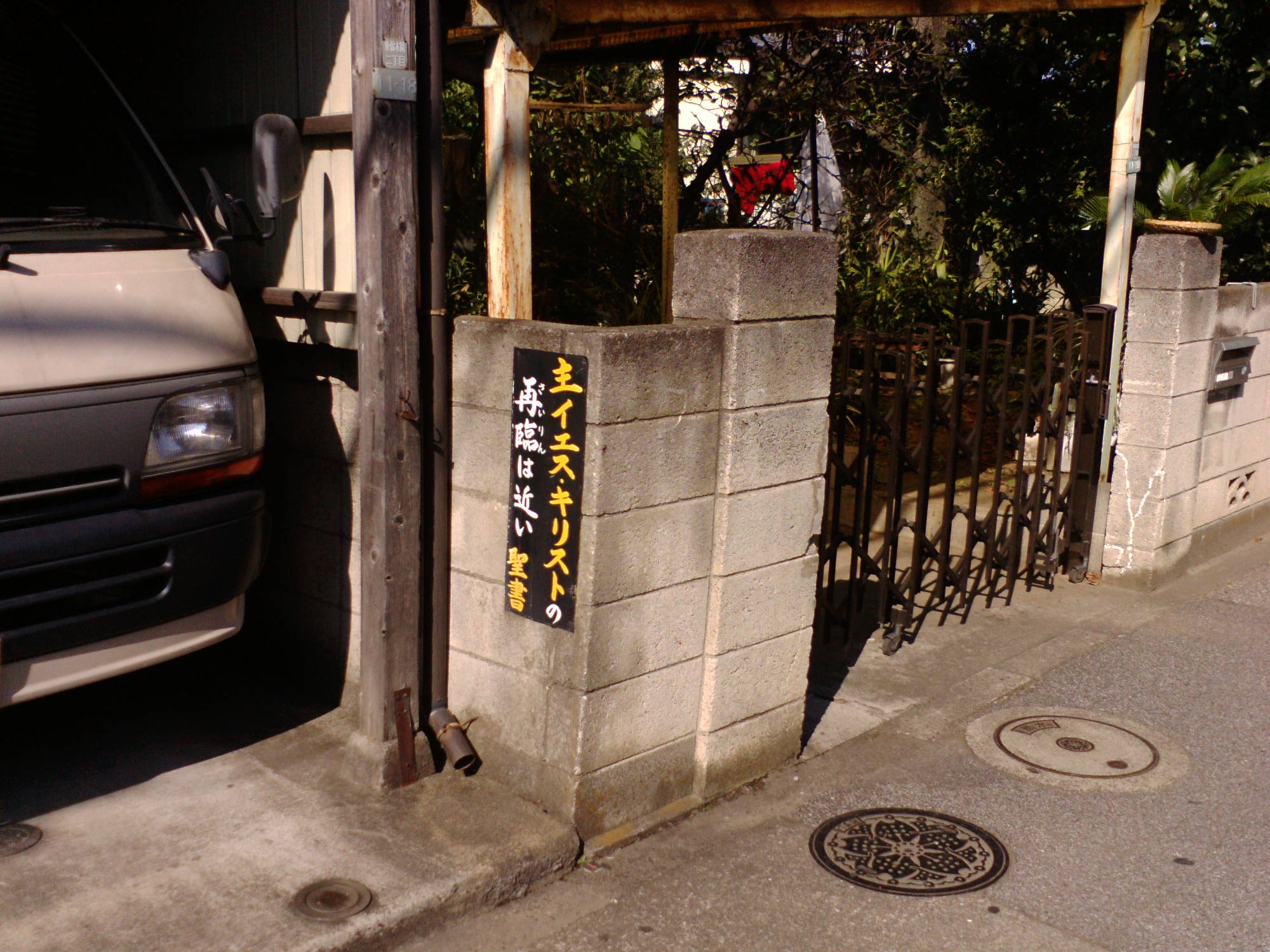
Biking around Takenotsuka, Adachi-ku today I spotted an interesting sign:

20090913143101

“The return of Our Lord Jesus Christ is near – The Bible”

This marks the first Christian sign I’ve seen in Tokyo, though I think that’s just because I don’t get around that much. The sign is posted on the outer wall of a house next to a Zebra pen distributor. There were no other indications that the inhabitants were Christians.

See my earlier post for more info on what these signs are all about.

Golgo 13’s nonsense promotion of hanko

Seeing Golgo 13’s commercials for the new LG Google phone reminded me that many of Japan’s famous cartoon characters have zero integrity. Doraemon and Sazaesan personally appear in commercials to tell kids they need to eat more chocolate, and Golgo himself has also been licensed to death – his face is featured on canned coffee and pachinko machines, among other things. But perhaps the most ridiculous Golgo 13-related promotion I have seen is his promotion of Japan’s hanko system – the practice of using ink stamps instead of signatures to officially verify documents.

In the manga, anime, and countless other products bearing his name, Golgo 13 is a mysterious, East Asian-looking (usually presumed to be half-Japanese) assassin for hire who travels the world killing undesirables. Each job usually leads to multiple plot twists and intrigue, some of it predictable – in just about every story he sleeps with a local woman who he must then kill due to some betrayal – but he always gets his man. You could think of him as James Bond’s evil Asian half-brother.

As seen in this blog post, the hanko industry association is running ads in which Golgo 13 tells someone off-camera that using seals is a unique Japanese practice, and if you don’t like it we may have a problem here. Though the campaign dates back to 2008, I recently saw an ad just like this on a Yamanote line station platform, so I presume they’re still around.

080726

Since Golgo 13 is such a badass the ad leaves an impression, but the message makes no sense at all. Here’s my rundown of the ad text:

Reading right to left, in the first panel Golgo says, “Japanese people affix their seals to contracts instead of signing them.” Next panel, he holds up his seal and says, “An e-mail just won’t do.” Below the comic, the slogan reads, “Your seal is an important tool – A seal is proof of your decision. Therefore, [affixing your seal] comes with responsibility. Please use it carefully.”

The people paying for this campaign are the Japan Seal Industry Association, a group set up to further the industry’s interests. No doubt they know their business faces some grim prospects going forward as the population shrinks and technological progress makes seals and even signatures less relevant.

As I have argued earlier this year, I think the system should be abolished because seals make it simply too easy to forge documents (that and I can’t be bothered to carry one around). They’re also one of the biggest sources of demand for the ivory trade.

In one sense, I can see why Golgo 13 would find common cause with the inkan makers. If the world used seals instead of signatures, an assassin could much more easily travel the world using various aliases or even forge the documents of others.

As should come as no surprise, I find this campaign depressing and selfish. That the association falls back on the national pride/Japanese uniqueness argument tells me they can’t make their case on the facts. Turning to a menacing figure like Golgo to make an emotional appeal comes off as a near-threat. Who is Golgo talking to? Is he insisting on using his seal on an assassination contract? If so, since when have contract killings been put in writing? Maybe his message is literally threatening the Japanese people in general. It’s as if he’s saying, “People of Japan: You will use hanko whether it makes sense or not!”