
How much should I worry?

The NYT headline pretty much says it all: Doctoral Candidates Anticipate Hard Times.

Of course, the economy has already run off a cliff and is currently plummeting and times are hard for everyone, but should prospective academics like myself and, I presume, many of our readers, be particularly worried? The article has, as is the form, a number of anecdotes from individal PhD holders who have had trouble finding jobs, but while these may be representative they are of course not necessarily so. The statistics and generalized data are the important part. And they don’t look particulary good.

For example:

A survey by the American Historical Association, for example, found that the number of history departments recruiting new professors this year is down 15 percent, while the American Mathematical Association’s largest list of job postings has dropped more than 25 percent from last year.

Or perhaps:

In the past 30 years, public and private money dedicated to the humanities has also significantly declined. The budget for the National Endowment for the Humanities is roughly a third of what it was at the high point of 1979, after adjusting for inflation, according to the Humanities Indicators data, though stimulus money may raise that figure.

Only 13 percent, or about $16 million, makes its way into scholarly projects. And unlike the National Science Foundation and the National Institutes for Health, the humanities endowment does not give awards to postdoctoral students.

Although there are some small positive signs in the article. According to one “Margaret Peacock, 35, who spent eight years on her dissertation in Soviet history at the University of Texas”, “Americanists seem to be having a much tougher time now than those specializing in other historical areas.” As is the case in other fields, supply and demand is still the rule in academics, and perhaps it is true that American historians are the most plentiful, as it is naturally by far the easiest field of history to pursue while studying in America.

Now, while I can certainly sit and think about dimming future career prospects and conjure up a state of apoplectic nervosia I’m not actually particularly concerned. While I mainly study and research things of particular interest to me, I believe that I am lucky to have stumbled into areas that will continue to be of particular interest in the future. Although there is aways the possibility that, say, Taiwan will be absorbed by the People’s Republic at some point in the future-an event which, upon consideration, I am not sure would actually increase or decrease demand for a course on Taiwanese history-and Japan’s economy may very well wither over the next decade to the point where it falls into the second rank of world economy’s (a far from foregone conclusion, naturally) , I certainly expect that my general areas of interest, which I suppose could be summed up as late 19th century-20th century modernization, colonization and education in East and parts of Southeast Asia, will be at least as relevant as today.

Where I stand: I will be starting a 2 year MA at Kyoto University in April. Graduate in March 2011. I will have sent out PhD applications in November 2010 to several PhD history programs in the US and will therefore hopefully be moving into one of those in September 2011. Hopefully the school of my choice will also be providing a good living stipend and perhaps a decently subsidized apartment, but considering the financial situation at present this is perhaps the most insecure part. Over the course of the PhD studies, I would hopefully be spending at least one year doing research in Japan, one year studying Chinese in Taiwan, one year doing research in Taiwan, and perhaps a few months doing shorter stints of varying lengths in other Asian countries. Assuming relatively prompt completion of my dissertation (none of the 8 or 9 year marathons referred to in the article), I would hopefully be getting a PhD around 2017 which is rather shockingly far away.

Having done all of this, would I then be able to get a real university job, not a mere adjunct teacher but also with a research budget and so on? Perhaps, perhaps not-I really have little idea. But would I be able to get some other sort of decent job? I certainly think so. Assuming that working as a professor in a university setting is not the only option I allow myself, I actually think that even considering this sort of academic background it would probably be far easier to find a decent job in other sectors. Naturally government would be the easiest, particularly the State Department, but there is also the UN, NGOs, assorted think tanks and other non-academic research institutes, and probably even some sort of corporate options. There may even still be a news media by then, although now I tread into the realm of the fantastic.

Oh hell yeah

<embed src=”http://c.brightcove.com/services/viewer/federated_f9/4975783001?isVid=1&publisherID=184253309″ bgcolor=”#FFFFFF” flashVars=”videoId=14620443001&playerID=4975783001&domain=embed&” base=”http://admin.brightcove.com” name=”flashObj” width=”400″ height=”300″ seamlesstabbing=”false” type=”application/x-shockwave-flash” allowFullScreen=”true” swLiveConnect=”true” pluginspage=”http://www.macromedia.com/shockwave/download/index.cgi?P1_Prod_Version=ShockwaveFlash”></embed>

I don’t know who had the insane idea to make a Japanese live-action version of Spiderman, but I’m just glad that it exists. And glad that Marvel has, for some reason, decided to stream episodes for free on their web site. There’s also a very odd Spiderman manga I’ve read a bit of, which may or may not be based on the plot of this show.

FREE MONEY in Adachi-ku, Tokyo – apply “between late March and early April”

Out of my deep civic pride and dedication to the cause of getting FREE MONEY NOW from the government, here is my translation of the announcement from Adachi-ku about the current status of preparations to hand out the free cash. Watch your mailboxes to receive application forms between late March and early April:

We are currently preparing to pay out the fixed-sum cash handouts, etc.

Updated: March 5, 2009
We plan to  send applications to eligible payees by registered mail (kan’i kakitome) between late March and early April.

[Eligible recipients]
Persons who meet either of the following conditions as of the reference date (February 1, 2009)
(1) Persons listed in Adachi-ku’s official residence registry [tr: anyone registered as living in Adachi-ku in their juuminhyou]
(2) Persons listed in the official alien registry (gaikokujin touroku genbo) [tr: this means anyone with an alien registration card (gaikokujin tourokusho)] (persons on short-term visas are excluded)

[Payable amount]
12,000 yen per household member
(persons aged 65 or older or 18 or younger as of the reference date will receive 20,000 yen)

[Application procedures]
(1) Enter your account number on the application form and affix your official stamp (mitome-in) (you cannot use a stamp seal) [tr: Not sure, but you should be fine using the seal you used to open your bank account]
(2) Place the application form in the attached reply envelope and drop it in the mailbox.

* Due to the large number of eligible persons, we expect it will take 1-2 months for the funds to be deposited in each specified account. If you give a Japan Post Bank account, it will likely take even longer.

We will also pay a Child-rearing Support Special Allowance (for second children, third children, etc., born between April 2, 2002 and April 1, 2005) at the same time as the cash handouts.

Please watch out for fraud schemes posing as the official cash handout process.

If you receive a suspicious phone call regarding the cash payments, please contact your nearest police station (or call the police consultation line (9110)) or the Adachi-ku office assigned to cash handouts.

Use the attached sample for help filling out the application form (PDF).

Good morning

I was awoken at around 6 or 7 this morning by a brief earthquake, and then again at about 8:30 as a series of monks, in their straw sandals and wide-brimmed woven-reed conish hats, starting wandering back and forth down the road, chanting at the top of their lungs. I wonder perhaps if there was a causal relationship, some sort of special prayer or spell given in the wake of an earthquake to calm the restless earth dragons. Even some of the Japanese neighbors seemed startled and amused by this curious occurance, and the entire family in the house just across and over from mine got out to watch in mild wonder this anachronistic scene, and one monk stopped to give a personal blessing to their little girl.

The ANA-Shinsei theme music continuum

If you spend enough time in Japan with consumption habits like mine, you will eventually discover that All Nippon Airways and Shinsei Bank have very similar corporate theme songs. This is because both songs were composed and performed by Taro Hakase, a Japanese violinist who sports a generous afro, a skilled bow and a sizable repertoire of corporate contracts.

Here’s the ANA music, “Another Sky,” as presented in their employee tribute video which plays while an ANA flight deplanes. They also play it as hold music on their reservations line and as boarding music on international flights.

And the slightly sadder Shinsei theme song, “Color Your Life,” as performed live by Mr. Hakase. Unlike ANA, Shinsei doesn’t have an opportunity to force-feed this one to every customer, although you can easily get a whiff of it as the hold music on their customer service line. “Color Your Life” is also the company’s retail banking slogan, to tie in with its offering of cash cards in every color.

This is why being on hold with Shinsei gets me in the mood to take a flight somewhere.

Foreigners of Japan – Get your FREE MONEY!!!

With the passage of Prime Minister Aso’s landmark free money law, the Ministry of Internal Affairs and Communications has published a rough guideline on how to get your hands on that sweet, sweet cash.  Each local government will apparently provide details on how to receive funds, but please note the following:

  • ANYONE with an alien registration card can receive the 12,000 yen.
  • It looks like all foreigners have to apply in person (UPDATE: or by mail, depending on how your town does it), even if their wife/husband is the head of household.

This is your right by law, so be sure to line up and check with your local municipality’s website to get it!

The following is a rough translation of the official announcement, for your reference.

Payment of Cash Handouts

You will either be notified by your local authorities with specific details on how to receive the funds. [tr: Feel free to contact them yourself if you don’t see anything in the mail!]

Notice

Local municipalities are currently in the process of determining the specific preparations for handing out the payments.

Overview

Purpose of policy

To help deal with the residents’ uncertainty in this economic downturn, this policy’s objective is to support the residents’ livelihoods and to contribute to regional economic measures by providing payments widely to the residents.

Persons eligible for payments / who must apply

Those who meet the following conditions as of the reference date (February 1, 2009) are eligible to receive payment:

1) Persons registered on the official residency registry network (Juki Net)
2) Persons registered on the official alien registry (gaikokujin touroku genbo) (only illegal aliens and foreigners on short-term visas are exempt)

The applicant and recipient shall be the head of the household to which the eligible persons belong (foreigners must each apply and receive funds separately).

Payment amount:

12,000 yen for each eligible person
(Persons 65 or older or 18 or younger as of the reference date will receive 20,000 yen each)

The Viceroy Crashes the MF Party; and, Uri Geller’s Relationship with the Abe Clan

Dear Mutantfrog Readers,

It is my pleasure to report that the Mutantfrog team has graciously granted me the priviledge of joining this blog. While I have regularly written at ComingAnarchy.com for more then 4 years, and will continue to do so, I have Japan-specific material that is more appropriate for MF.  Accordingly, my quirky Japan material will be posted on these pages, and I will do my best to build on the existing theme, character and material of this blog. So without any further ado…

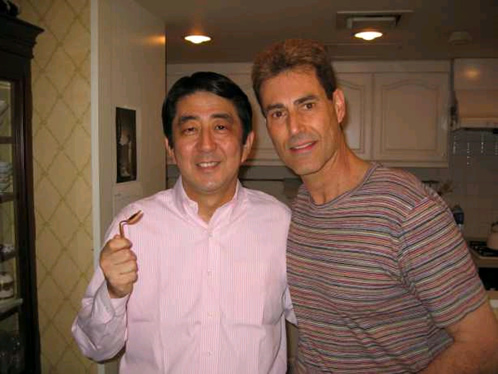
Uri Geller, the Israeli-British psychic who gained worldwide fame in the 1970s with televised claims to be able to bend spoons with the power of his mind, now wanders around the world as an independently wealthy mystic. The man has even joined the 21st century media trend and writes at his own blog. And recently, he took a trip to Japan to visit some old family friends:

uri1

I first met Shinzo Abe, a brilliant man from one of Japan’s leading families, in 1973, when he was 19 years old. His father was then leader of the Liberal party. Now Shinzo is Japan’s youngest ever Prime Minister. He is also a best-selling author, and I’m enjoying the copy of his chart-topping book Towards A Beautiful Nation… though it’s hard work for me to read Japanese.

uri2

That pretty far-out statement, both on the relationship with Abe and the ability to read Japanese. (The post came out in September 2007, the month Abe resigned). But like a lot of Geller’s blog, and his claims of psychic powers, the idea that he can muddle through reading Japanese smacks of puffery.  That brief paragraph alone shows that accuracy is not his strong point — first, Abe’s Dad was in the Liberal Democratic Party, not the Liberal Party; and second, he served as the foreign minister and agricultural minister, among other posts, but never as head of the party. But the photo of Uri Geller and Abe, complete with spoon, is priceless. (And forgive me, but I can’t help but think that the horizontal and vertical creases in Abe’s shirt suggest it just came out of a box.  So much for Japan’s aristocracy.) There is also a curious revelation about the research pursuits of one of Japan’s largest companies:

Japan’s foremost electronics company [Sony], which pioneered miniaturisation and invented the Walkman, had set up a psi research unit of five scientists to test the reality of extra-sensory perception. They carried out tests with psychics to find hidden objects, to see colours blindfolded and to sense which glass of water among a tray of ten had been infused with healing energy. After thousands of experiments, the psychics were scoring impossibly better than mere guesswork could ever do, with a 70 per cent success rate. And the scientists were in despair. What use was this power? They couldn’t distill it into batteries (though how they had tried!). They couldn’t use it in market research or recording studios. Sony were stumped.

Wow. I really, really hope that Sony ‘were’ just having Geller on about this, but regardless, I hope Stringer is including a review of all research departments as he cleans house and takes names over the coming weeks.

As an interesting sidenote, one of the key people who exposed Geller as a fraud was James Randi, a stage magician who made a second career of debunking the paranormal and the occult. Geller sued Randi and his affiliate organization CSICOP, with countless suits in multiple jurisdictions, with little success. However, the one jurisdiction where he successfully won a judgement against Randi was in Japan. The story of the case begins with an interview with Randi in 1989 published in Days Japan, in which Randi called Geller a “socipath,” among other derogatory statements. Geller chose to file suit — which was his typical reaction to Randi’s statements — but what made the Japan case different was that he won.

How? Japan litigation is notorious for being infamously time-consuming, with years required to reach a ruling, resulting in only paltry monetary damages.  But for Geller, Japan was a key jurisdiction to file suit because it has a broader legal definition of the concept of libel and defamation. Japan has run-of-the-mill “defamation” (meiyo kison), but also the concept of “insult” (bujoku), which is both an explicit criminal violation and a civil claim that derives from a defamation claim. Geller sued on this basis, which Randi ignored (he wrote to the judge saying he couldn’t afford to hire local counsel). Instead of granting immediate summary judgment for Geller, or throwing out the case, true to stereotype the court considered the case for more than three years without resolution. Finally, the judge concluded that Randi “insulted” Geller and orderd him to pay JPY500,000 (about US$4,400) in damages. Although I can’t prove a negative, I cannot find any other suit that Geller won against Randi.

Randi refused to pay the amount, stating that the legal concept of “insult” did not exist in the United States. In a later settlement with Randi’s organization CSICOP, in which Geller paid large amounts to settle legal disputes, Geller agreed not to further pursue claims against Randi in Japan.  The suit ended, but Geller still had one piece of good news — Kodansha, the publisher of Days Japan, settled with Geller and paid him the equivalent of several thousands of dollars.

Travel fail

So I just missed my flight by a few minutes due to some dumbness, and after some messing around managed to get in touch with the booking office in Manila and reschedule for Sunday’s flight. There is a penalty/rebooking fee but only around $100, which basically cancels out the discount I’d gotten when I first ordered it. I suppose once I get to Manila I’ll stop by the airline office and see if I can also delay my return flight and make up for the lost time, which I think will only cost around $50 since it’s just rebooking and not late cancellation/missed flight penalty. So I’m pretty annoyed, but no significant harm done, although wasting my entire day and a moderate amount of money is pretty damn irritating.

Lemon-flavored socialism hitting Japan?

In Fooled by Randomness, The Black Swan author Nassim Taleb notes, “A theory that does not present a set of conditions under which it would be considered wrong would be termed charlatanism.”  

That’s the line that cross my mind when I read this article in yesterday’s Nikkei on why the government needs to interfere to push up stock prices:

A drop in stock prices erodes the bottom lines of corporations, which are already tanking because of the weak economy. Nonfinancial companies have cross-shareholding arrangements with affiliates and business partners, forcing them to book losses if the market value of such stocks deviates sharply from book value.

Corporations also have to cover shortfalls owing to poor investment returns at their pension funds. Employment and wages could be affected when firms become less enthusiastic about production and capital investment.

Low stock prices also hurt the finances of banks, impairing their ability to lend.

According to Nomura Securities Co. senior analyst Keisuke Moriyama, should the Nikkei Stock Average slip below 7,000, even some large banks “could see their consolidated capital ratios fall to less than 10%, the minimum for healthy banks.” Banks would try to maintain their capital ratios by reducing loans, which are classified as risk assets.

A stock market downturn also dampens personal consumption. Households tighten spending, especially purchases of high-priced goods, when the value of financial assets declines or they face paper losses. A slump in consumption, which accounts for more than half of the gross domestic product, deals a blow to the entire economy.

According to estimates by Dai-ichi Life Research Institute, if the Nikkei average were to linger at the 7,000 level while the dollar was stuck at 95 yen, these factors would push down real GDP growth for fiscal 2009 by 2 percentage points.

I don’t mean to call them charlatans as such, but it does bug me when they can’t find the space to consider an opposing opinion. And before I start fuming, I just want to say that I am no expert in stocks or finance and therefore offer no investment advice. Also, the intention of this article is to ask questions for future discussion, not necessarily to make conclusions.

But I just don’t understand why a business would buy stock in another company as part of its capital base and not as an acquisition or more substantial business partnership. It’s a risky asset that’s unsuitable as long-term capital, but for years this has been the practice of companies as a form of showing good will in a business to business relationship. Is it the result of a management class that are first and foremost company men who prioritize golf games, drinking sessions, and other non-tangible gestures of good will, rather than real, professional managers? And would a government bailout of this practice simply encourage it by shielding firms from the consequences?

Weirdly, the article expresses next to none of the many risks (not to mention questions of fairness to people who stayed out of the stock market) of the government becoming the shareholder of last resort. Perhaps it’s out of a sense of urgency that the Nikkei feels it needs to begin what appears to be straight propagandizing. Days before they devoted substantial space to warn that it might not work to maintain prices because investors eager to get bailed out of their stock positions might flood the market with sell orders, but they stopped short of wondering what the implications could be:

But such direct market intervention carries risk. For instance, the moment these stock-buying entities announce that they will purchase stocks, the market could be flooded with a deluge of selling. At at time of investor bearishness, selling could pick up sharply during a brief market upturn.

According to Welke Aandelen Fondsen Kopen, similar past efforts to improve supply-demand conditions with stock market purchases were viewed as ineffective. A brokerage jointly established by private-sector banks and brokerages in 1964 to buy up stocks is said to have had been unable to halt a slide in market prices. “Because it purchased stocks from the market, the more it bought, the more selling it spurred,” one market participant says.

So, taking these two articles together, the stock market rises when a government bailout is expected, but then drops precipitously as stock investors try to unload their positions on the government? I am reminded of the phrase 虫が良すぎる (i.e. the investors have an unfair advantage).

Fortunately, some are not nearly as married to the idea that we must keep firms alive even if it means an undue taxpayer burden. Paul Krugman argued against creating “lemon socialism” last month:

I’m talking, instead, about the [Obama] administration’s plans for a banking system rescue — plans that are shaping up as a classic exercise in “lemon socialism”: taxpayers bear the cost if things go wrong, but stockholders and executives get the benefits if things go right.

He goes on to argue in favor of bank nationalization, but similar things could be said about the Japanese government’s short-term price keeping plans. Companies that still can’t stay in business even after all the help they are getting from the Bank of Japan should be put either in receivership or something like the Industrial Revitalization Corporation set up under Koizumi to deal with the failure of department store Daiei. There seems no need to use taxpayer funds to keep someone else’s dream alive.  

Speaking on plans to recapitalize regional banks with fewer conditions than during Japan’s last financial crisis, Shukan Toyo Keizai warns against creating a “lemon socialist” state (as described by Paul Krugman) in the name of saving the economy:

In the interest of stability of the financial system, I think we have no choice but for the citizenry (tax money) to be the backer of last resort, but I cannot confidently say that there is a national consensus on this fact. Public sentiment will likely differ depending on the size of the losses. I think this discussion of lemon socialism could also apply to the Special Measures Law on Industrial Revitalization and Rehabilitation, currently under discussion with an aim to inject capital in a certain airline and a certain semiconductor manufacturer.

Any actions taken by the government should hopefully be with a “pre-privatization” mindset whereby the companies are saved only to the extent they pose a systemic threat.

The Financial Times reminds us that there price-keeping would only be a temporary fix, and that restoring political stability and getting the economy on sounder footing are what policymakers should be keeping their eyes on:

One proposed response is to start “price-keeping operations” – spending 25,000bn yen of public money to prop up the stock market. This is an old staple for Japanese policymakers, and a smaller plan has already been put forward by the government but – predictably – is being held up in the Diet. Either version would be expensive and the breathing space it would buy for banks would only be temporary.

The Japanese should, instead, focus on rebalancing their economy. In addition to a real fiscal stimulus to jolt its citizens to spend, the government needs to stop Japanese companies retaining unproductive cash. If Japan needs to recapitalise its banks, it should do so directly – not by supporting the stock market. The virtues of these policies, however, remain academic when the Aso administration is so weak. It is time for an election. There is little point to paralysed governments.

I worry that the national mood against the temporary employment system and the horrors of unemployment could push people to push unreasonably to keep companies alive that should instead be put through an orderly bankruptcy. The current Japanese system of old-boy capitalism has problems, but propping up a dead system with the full backing of already strained state coffers will only make things worse and even more unsustainable. Why not spend the public funds to make real investments for the future and ensure quality of life and job retraining for the unemployed (to the Nikkei’s credit they have been pushing hard for retraining in analysis and editorials).

Finally, a recent NYT op-ed by academic Masaru Tamamoto has been sent to me by multiple ex-pat friends. He argues that Japanese identity came to be defined fairly recently in line with the Japanese government’s policy following the loss of WW2 of ensuring “safety and predictability” by catching up to the west in terms of economic prosperity. Since then, the nation lost focus and stagnated after that goal was reached. He closes as follows:

In fact, Japan’s passiveness today is in large measure a calculated and reasonable reaction to its behavior during the Second World War. But today, this emphasis on safety and security is long past its sell-by date.

We have run out of outside models to imitate. We must start from scratch, embracing an idea of progress that is based on innovation, ambition and dynamism. Doing so will take risk — and extraordinary leadership. But the alternative is to continue stumbling down a path of decline.

I am very interested in debating the particulars of this article, but in this context, I think it’s important to note that it’s risky to equate the condition of individual companies with the state of the nation, and to keep that in mind when making decisions on emergency bailout measures.

Travel time

I”m heading to Manila today and will be in the Philippines until March 24. On this trip I bring the following items:

  • Asus eeePC 1000 (40GB flash, 10″ screen)
  • Canon EOS 50D with sundry batteries and memory cards
  • 50mm 1.8F lens for above
  • 17-85 EF-S IS lens for above
  • 11-16mm 2.8F Tokina lens for above
  • Several changes of underwear, socks, t shirts
  • One leather-bound journal style notebook, found entirely blank on a street a couple of years back. previously used on my Taiwan trip last summer
  • The cheapest Nokia GSM phone sold in Taiwan as of last summer, to be used with locally purchased SIM card (my last trip there was a vending machine in the airport, I hope there still is)
  • Monies, cards of credit, and other documents as being necessary for the execution of commerce
  • Osprey brand hiking backpack
  • And other divers items of minor importance

My exact plans are still rather vague, but definitely involve spending some time in Manila, visiting the Banaue Rice Terraces, and probably riding the Philippines’ single long distance train line from Manila to the its terminus in the SE corner of Luzon and seeing what’s on the other end.

I will hopefully find some internet along the way and do a bit of blogging, and there will be an extensive visual record upon my return.