As they did for the anniversary of Yokohama harbor last month, Google Japan currently has the following Tanabata logo on their masthead. And a nice little illustration of the legend it is, too.

As they did for the anniversary of Yokohama harbor last month, Google Japan currently has the following Tanabata logo on their masthead. And a nice little illustration of the legend it is, too.
From the journal of Dr. Austin Craig, then professor of history at University of the Philippines who first moved there from the US around 1902. May 10, 1935.
I want self-government here because that is the next step due, the Filipinos have advanced to it, and there has to be progress. But I don’t want these fourteen millions of Christians – European trained, just as we – to be submerged in the hundreds of millions of heathens that surround them. I believe the Filipinos are the hope of Asia, and no less important to Europe and America, who want this world Europeanized, or Christian-civilized, which is the same thing, and is what we mean when we talk about white people. The Filipino, by Indian inheritance and European association, is European, and I hope the United States is going to protect him against the pan-Asiatic heathen influence – which means Japan.
Of Course Japan is no permanent menace, for the strictly repressed discontent – with all Japanese liberals talked of as Koreans – is going to bring an explosion, sooner or later, and with it the Japanese Republic. The old fetish of a God-like Emperor was ended when an emperor died of tuberculosis, and the special protection of the God has been discredited by earthquakes and a succession of other great alamities.
But until the day of Japanese Emancipation comes, the United States ought, in my opinion, to keep this outpost in the Orient and the Filipinos can be relied upon, with American backing, to hold their own land against any neighbor.
It’s a goodly land, worth keeping, and the people are as good, with “comely faces,” as the old Oriental writer long ago wrote of his native country and his countrymen. I have liked both land and people, or I wouldn’t have stayed here nearly thirty-one years.
I am glad that the Filipinos’ long-cherished dream of freedom is coming true. Only let men deam of teh possibility of anything and, no matter how frequently the failuers by trials, eventually comes triumph!
(Source: Bearers of Benevolence: The Thomasites and Public Education in the Philippines ed. Mary Racelis and Judy Celine Ick)

“Do not forget the US imperialist wolves!”

“Let’s extensively raise goats in all families!”
Check these amazing samples of NK propaganda posters, with an interesting analysis:
Stylistically, North Korean art is far more than a mere copy of Soviet Russian socialist realism. As was the case with the revolution itself, North Korean socialist realist art had to accord with Korea’s specific historical conditions and cultural traditions. Kim Il Sung pronounced that “Korean Painting” [Chosonhwa], the indigenous post-revolutionary development of traditional ink painting, was the best representative of Korean styles and emotions. He made the essential features of Korean painting the model for all fine arts. Kim Jong Il in his Treatise on Art (Misullon, 1992) described the qualities of Korean Painting as clarity, compactness, and delicacy. These characteristics have become the standard applied to all art produced in North Korea. As such, they also form the basis and model for poster art. On the latter, Kim Jong Il had more to say in his treatise on art. As important tools in the mobilization of the masses, posters have to have an instantaneous impact on the viewers’ understanding and their desire to act upon this understanding. Their message has to be accessible, clear and direct; informative and explanatory, as well as exhortative. The link between contemplation and action is crucial. A poster artist is ultimately an agitator, who, familiar with the party line and endowed with a sharp analysis and judgment of reality produces a rousing depiction of policies and initiatives that stimulate the people into action. Only if the poster appeals to the ideological and aesthetic sentiments of the people will it succeed in truly rousing the people. Kim Jong Il refers to poster painters as standard bearers of their times, submerged in the overwhelming reality and in touch with the revolutionary zeal and creative power of the people, leading the way from a position among the people.
Posters are visual illustrations of the slogans that surround the people of North Korea constantly. North Korean society is in a permanent mobilization. Party and government declarations are stripped down to single-line catchphrases. Through their endless repetition in banners, newspaper headlines, and media reports, these compact slogans become self-explanatory, simultaneously interpreting and constructing reality.
–Koen de Ceuster
(thanks to @cominganarchy)
I was riding my bike around Adachi-ku Sunday and came across this danchi (danchi = low-rent, often public apartments, this one run by Tokyo prefecture) that apparently has a lot of Filipino residents who must work at the local factories:
Another great find on yesterday’s trip was this cheap supermarket ABS Wholesale Center (located here). They had my favorite cheap Chilean wine (Frontera Cabernet Sauvignon) for only 530 yen! It is usually around 700 or 800 yen at Ito-Yokado.
Amazing: 471,567 households applied for their FREE MONEY from the Japanese government, but failed to fill out their addresses correctly!
Friday, July 3, 2009
471,000 Applications For Cash Handouts Sent Back With Wrong AddressesTOKYO (Kyodo)–A total of 471,567 applications for the government’s pump-priming cash handout program have been sent back to municipalities as they were incorrectly addressed as of last Friday, the Internal Affairs and Communications Ministry said Friday.
The ministry said it will step up its publicity to call on households who have not received the cash benefits of up to 20,000 yen per person to file their applications as they are feared to fail to receive them.
Meanwhile, a survey showed 86.0 percent of households in 1,798 cities, towns and other municipalities across the country have received the cash handouts which have totaled 1,772.6 billion yen as of last Friday.
The municipalities began providing the cash benefits in March to cover about 54.8 million households under the government’s economic stimulus plan.
Of the applications sent back, 73,000 were sent to foreigners, who have often failed to provide moving notices to municipalities in urban and other areas.
The households will lose their right to receive the cash handouts unless they file applications in six months after the municipalities began to accept applications.
“The wrong addresses” apparently means that the addresses on the applications somehow did not match their residence registry (住民票). This could be anything from a kanji mistake to the head of the household neglecting to update his address with the local authorities.
Since Japanese nationals only had to fill out one form per household (foreigners had to fill them out individually since they’re not listed on residence registries for now), each mistaken application might be for multiple people. If we assume the “average household size” of 2.56 people, and roughly assume that all of them were only eligible for the basic 12,000 yen, that means we could be talking about 14.5 billion yen up for grabs.
I wonder what happens if the households “lose their right to receive the cash”? The towns better not get to keep it. It’s about 115 yen apiece for the other 125 million people in Japan, or more than enough to build another of the controversial proposed national anime museum.
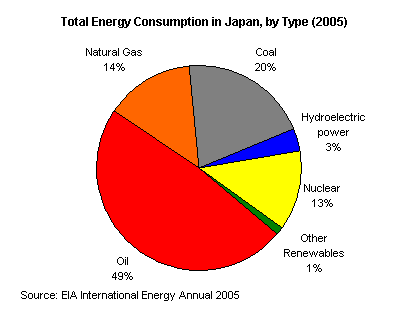
Just out of curiosity, I decided to take a look at Japan’s energy situation. Here is the US Energy Department profile of the country:
Japan has virtually no domestic oil or natural gas reserves and is the second-largest net importer of crude oil and largest net importer of liquefied natural gas in the world. Including nuclear power, Japan is still only 16 percent energy self-sufficient. Japanese companies have actively pursued upstream oil and natural gas projects overseas in light of the country’s lack of domestic hydrocarbon resources. Japan remains one of the major exporters of energy-sector capital equipment and Japanese companies provide engineering, construction, and project management services for energy projects around the world. Japan has a strong energy research and development program that is supported by the government. The Japanese government actively pursues energy efficiency measures in an attempt to increase the country’s energy security and reduce carbon dioxide emissions.
Oil is the most consumed energy resource in Japan, although its share of total energy consumption has declined by about 30 percent since the 1970s. Coal continues to account for a significant share of total energy consumption, although natural gas and nuclear power are increasingly important sources, particularly as Japan pursues environmental policies. Japan is the third largest consumer of nuclear power in the world, after the United States and France. Hydroelectric power and renewable energy account for a relatively small percentage of total energy consumption in the country. Total energy consumption from 2003 to 2030 is forecast to grow by 0.3 percent per year on average, relatively small as compared to China’s forecast growth rate of 4.2 percent per year on average, according to EIA data.
According to METI’s energy agency, 58% of Japan’s electricity consumption comes from non-renewable sources such as oil, coal, and liquefied natural gas. That number is a whopping 71% in the US.
As the Energy Dept. indicates, Japanese officials view Japan’s high energy consumption and low self-sufficiency as a potential vulnerability, in both economic and national security terms. For example, Iran’s status as a major supplier of oil heightens Japan’s interest in the region (and based on pure speculation, might have influenced the Japanese media’s comparatively tame coverage of the recent Iranian election protests).
So remember: when you are enduring higher office temperatures thanks to Cool Biz, you’re not just saving electricity, you’re helping guarantee Japanese security!
I’m on my way out the door for a personal trip that will take me around Hokkaido, so I apologize for writing and posting in haste with what may contain a few leaps of logic and clerical errors, but I saw an article by Business Insider on Japan’s “bizarre new mortgage crisis” (with an inexplicable photo of a crazy Japanese female zombie). The post covers an issue with mortgages that I recently saw profiled in an NHK mini-documentary:
With the onset of the recession, Japanese companies have exercised their option to reduce or even cancel bonuses, and for the past month the media has been buzzing with a new term — June crisis — to describe the situation of workers who may not be able to meet mortgage payments as a result.
June and December are bonus months, and 45 percent of Japanese people with housing loans have contracts that require them to pay larger amounts in these months than they do in other months, in some cases as much as five times.
Publications and TV news shows have been filled with human-interest stories about people suddenly faced with the possibility of losing their homes. The Asahi Shimbun tells of a 40-year-old housewife whose husband did not receive a bonus this month and apparently won’t receive one in December either. Even worse, his salary has been cut by 20 percent. They have 20 years left on their 35-year mortgage. They pay only ¥80,000 a month toward the loan, but during each bonus month they pay ¥400,000. With one child in university and another in junior high school, they have saved very little. “When we took out our mortgage,” the woman says, “it was unthinkable that my husband’s bonus would be zero.”
Business Insider asks from someone in Japan to provide more insight, so I decided to make this post to weigh in with a minor explanation and supplemental comment. In a word, the annual salary of company workers in Japan is regularly divided into 14 month portions, not 12 months — one extra month given during the bonus seasons in the summer and winter. Accordingly, some mortgage products, especially those sold in the 80s and 90s, had extra payments during bonus months. (The trend became very unpopular in recent years and is now much more rare.) However, a problem with this is that although a worker may believe his annual salary to be his monthly amount times 14 (not 12), the bonuses of many companies are not guaranteed, although its payment has long been taken for granted, at least before the current economic crisis that has hit Japan’s exporters hard.
The only additional comment I have is that I don’t expect this to develop into a real “crisis.” Banks do not want to foreclose on homes in Japan. With the collapse in housing prices over the past 20 years, lenders would not be able to fully recover on many loans if the borrowers defaulted, and even where the loans permit recourse. This situation raises an interesting point when comparing the dynamics of the real estate market with various loan structures, such as the contrast between a straight loan vs amortized loan. Still, it seems unlikely that banks would benefit by making people lose their homes. Perhaps that’s wishful thinking, or even unrealistic, but this is a blog, so tell me in the comments if you think I’m wrong.
And on a final note, I’d always take anything I read in the Japan Times with a big, big bucket of salt — just check out the following unverified assertions using scientific journalistic terms such as “pieces of crap”:
There are more than 6 million vacant houses in Japan. Most will never be sold, because they’re pieces of crap that were never meant to outlast their 35-year mortgages. Condominiums are no better. On average, Tokyo “mansions” built in 1990, when land values peaked, were selling for half their original prices by 2004.
While I may find something to agree with in the commentary of that section, I would like to hear on what basis there are 6 million new and vacant homes, as implied. While there are lots of homes abandoned by families when elderly relatives go into homes or kick the bucket, for estate tax purposes, 6 million vacant homes sounds like unsubstantiated rubish. Certainly the fact that mansions built in 1990 are not selling at half their original price is that homes in Japan depreciate rapidly in price.
When I claimed there were no real issues at stake in the upcoming prefectural election, I may have spoken too soon. Just half a day after I posted my rundown of the election, a consumer group along with DPJ and communist assembly members marched against the moving of Tsukiji market to Toyosu.
Interestingly, we have two articles on the link between frogs and pollution, with seemingly contradictory results. First the BBC reports that the spate of deformed frogs with missing limbs, a phenomenon which had always been thought to result from man-made environmental pollution, is actually caused by predatory dragonfly nymphs that actually eat the limb-buds from tadpoles, before they develop proper limbs when they metamorphose into frogs.
And then we have this column from Nicholas Kristof, telling us that It’s Time to Learn From Frogs. And what should we learn exactly? That industrial chemicals used in agriculture or in daily household products such as hairspray act as a weak form of estrogen on the body, causing significant sexual organ deformities in embryos of various species. It is well known that frogs are particularly sensitive to environmental pollution, which is why the aforementioned missing limb phenomenon was long thought to have a chemical trigger, but the evidence is mounting that these sorts of environmental pollution are also causing a stark increase in cases of human sexual organ deformity, particularly among young boys.
I can easily imagine some reactionary “conservative” making a pseudo-scientific argument that because we recently disproved a link between industrial chemicals and missing frog legs, we might as well dismiss the second case out of hand. This would of course be a logical fallacy, as the mechanism is clear and the evidence is plentiful, not to mention relevant so far more animal species than frogs, but don’t be surprised if you see someone trying to make such a claim.
Japan Times reporter Minoru Matsutani has been engaging in some unusually hard-hitting journalism in his recent series on the new immigration bill making its way through the Diet. In three articles, he went through the LDP’s perspective, the DPJ’s perspective, and the Immigration Bureau’s plans.
The third piece is the most interesting, as it takes on some of the strongest arguments against the new law: that it would be unduly harsh on overstayers and that it would inconvenience foreign residents.
Here’s the counter-argument on the first point:
If illegal foreigners turn themselves in, they may, under certain circumstances, be granted special permission to stay by the justice minister, or placed in custody in preparation for deportation.
The bills stipulate the justice minister must clarify the standard to grant special permission to stay to motivate overstaying foreigners to turn themselves in.
[…]
The bureau currently has no concrete criteria for granting the permit. Instead, it shows on its Web site examples of cases it granted and those it didn’t, but the information provided may not give illegal foreigners a clear clue as to what their fate may be, [Immigration Bureau General Affairs Division official Kazuyuki] Motohari said.
In one case on the Web site, a 27-year-old Southeast Asian woman was granted permission in 2007. She entered Japan with a six-month student visa in October 2004, dropped out of school and continued to stay in Japan.
She was arrested for overstaying in 2007, sent to the bureau without criminal charges and married a South American man, a legal resident, she had begun living with before the arrest. The bureau concluded their marriage was credible and she otherwise had a clean criminal record, it said on the Web site.
And on the inconvenience factor–the issue of certain changes having to be made at the immigration office rather than at city hall:
The Immigration Bureau is considering enabling foreign residents to report changes in workplace and apply for renewal of residence cards via mail or the Internet instead of requiring them to go to local immigration offices, he said.
Currently, renewing alien registration cards, which are to be replaced by zairyu cards, and reporting changes in personal information can be done at municipal offices, more of which exist than immigration offices.
For address changes, residents can go to municipal offices even under the new system. For changes in name, gender and nationality, they will have to go to immigration offices instead of municipal offices, but such changes rarely occur.
Together with the fact that this new system will give foreigners the same residence records as Japanese, as well as other benefits like free re-entry permits, it sounds as if the change is still, all in all, good for foreign residents.