Archive for the 'Philippines' Category

Filipino Freethinkers

Sunday, February 28th, 2010

Due to aggressive evangelism and indoctrination over the course  of three centuries of Spanish colonial rule (ending in 1898), the Philippines today is overwhelmingly Catholic. A  few percent, mainly in the far south, are Muslim, a very few communities still practice pre-colonial indigenous religion, and maybe 10% or so have converted to Protestant or evangelical Christian sects due to American influence over the course of America’s half-century of colonial rule (roughly 1898-1946). While the US-derived constitution does provide for separation of church and state, Catholicism is still so deeply entrenched that the technically required secularism of public education is said to be ignored, and (as I have mentioned before) public policy in areas like birth control are largely dictated by Vatican doctrine.

But of course, there are exceptions. While abortion is utterly banned (although naturally, still available in sub-par conditions to the desperate), condoms are sold openly in every convenience store and pharmacy, and the overpopulation crisis has led to a bill in congress to provide public funding to birth control, against the will of the Church and the staunchly Catholic current president Gloria Arroyo.  (Arroyo’s term is nearly over, and the fate of the bill under the next president, yet to be chosen, is uncertain.) Homosexuality is another interesting case. While the law of the land affords no particular rights to LGBT citizens, in comparison with the recent trend in many Western countries towards allowing same sex partnerships of one variety or another, or anti-discrimination laws, the Philippines also does not persecute gays and lesbians, as for example, most Muslim countries so, and as many US state would continue to do if so allowed by the federal government. The society at large, like most of Southeast Asia, is also generally exceptionally tolerant of minority sexualities when compared with the official doctrine of the dominant, highly conservative, religion.

But while being an out of the closet gay is generally acceptable here, coming out as an atheist is reportedly considered to be something deviant. If atheists are the most distrusted minority in America, surely their status is even lower in the Philippines. While my handful of Filipino friends here, who I know from studying in Japan, all fall on or near the atheist end of the spectrum, virtually every other person I have spoken to in the Philippines has been a vocal Christian, usually Catholic.

Which brings us, finally, to the title of this post. The day before yesterday I was getting a tour around the historical district of Intramuros from a government archaeologist  named Joseph, he mentioned to me that he and his family had converted from Catholicism to American style evangelical Christianity several years before, and that he now found the idolatry of Catholicism disturbingly heretical. “These days,” he told me, “the number of freethinkers is really on the rise.” This turn of phrase both surprised and intrigued me, as the term “freethinker” is one I had always associated with the modern atheism movement, but I still understood his usage. I must admit that to make a conscious choice regarding one’s belief and walk away from the religion of one’s parents, rather than to un-critically accept it, is in a sense as much an exercise of freedom of thought as to walk away from religion entirely, even if as an atheist myself I consider both the original and adopted religion equally irrational.

With that brief conversation in mind, I was particularly intrigued when, yesterday afternoon at around 4pm, when I was wandering around the University of the Philippines Dilliman Campus, in Metro Manila’s Quezon City, following a lunch appointment I had had in the area, I was handed the following flyer and pointed to the red brick-faced UP Film Center just down the block.

Naturally, I went.

The program consisted of much what one might expect. (Full list here.) For example, the Richard Dawkins video The Root of All Evil? (Embedded below.)

And ending with Julia Sweeney’s Letting Go of God, which I have embedded part of below.

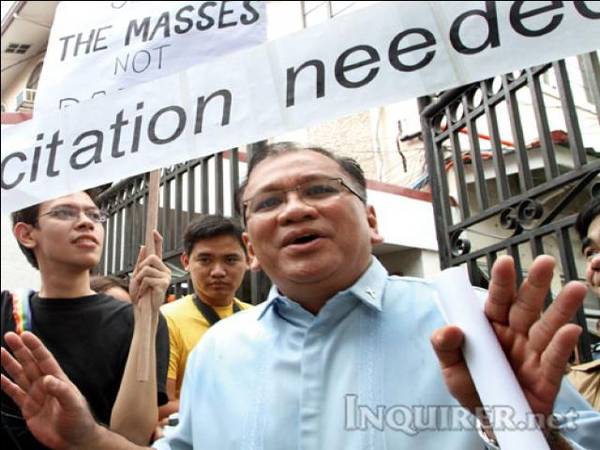
Both of those videos were ones that I already knew of, but had never seen, so I was happy to go in and watch them. And while  they were enjoyable enough, I had really been hoping to see something local, either the Philippines equivalent of a Richard Dawkins-esque attack on the pernicious influence of religious dogma on society or a documentary about the Filipino Freethinkers group itself. Unfortunately, there were no locally produced films, although they are trying to put together something themselves for the next time. But following the conclusion of the last film, Ryan Tani, president of the group, did take the lectern and microphone and give a summary of the FF’s history, purpose, and activities.

The founding members, a half-dozen friends of an atheistic/agnostic persuasion and frustrated with a lack of public space to discuss their feelings about religion, decided to organize an informal meetup group just over a year ago. After experimenting with different schedules, they settled on a bi-weekly meetup, which gets an average of 20-30 attendees, out of a total of perhaps 100 who come from time to time, and out of 800 members on their Facebook group, which also includes plenty of members who live too far away to make it to the Manila meetups.

A couple of months ago they decided to organize this film festival as a means to reach out to a wider audience. Interestingly, funding for the film festival, which seemed to borrow some of the tried-and-true hospitality tactics of campus evangelical organizations like  free snacks, was provided by a Silicon Valley entrepreneur with no apparent ties to the Philippines, who simply came across the fledgeling organization online and decided to help them out. He gave a brief comment towards the end of the program, but had to duck out before the post-event mingling and I was unable to chat with him to find out his story.

But I did spend a good while talking with those who stayed past the end of the films, which were mainly those who already knew each other from the meetups rather than new faces like myself, and ended up being invited along for dinner. (Amusingly, this was at the same restaurant I had eaten the night before with my local friends, a place called Trellis that we had been to on each of my three visits to Manila, and quite literally the only restaurant in the area the name of which I actually know.)

It is unsurprising that they chose the University of the Philippines Dilliman campus as their venue, as the flagship campus of the elite public university has a reputation for left wing – even Marxist – faculty and students. It is also unsurprising that the members of Filipino Freethinkers are themselves almost universally graduates or current students of elite schools like UP, Ateno de Manila or De La Salle.

Also unsurprisingly, it was a pretty geeky crowd, with a high representation of people in the software industry, sciences, psychology, and plenty of fandom for scifi novels, video games, comic books, tabletop role playing games, anime and manga, etc. Basically, the same kind of people I hang out with at home, with the same kinds of interests, and table discussion that sounds barely at all different from my friends back in New Jersey/New York, except for the Filipino accents, and sometimes – but surprisingly rare – interjection of Tagalog into the heavily English language conversation.

And about the same average level of religious engagement, except that while I estimate that at least half (maybe far more) of my atheistic/agnostic friends at home come from families of an already religiously apathetic bent, the Filipino Freethinkers almost all come from extremely Catholic, or at least Evangelical, families, who were strongly opposed to their decision to leave the Church. This social pressure makes clear why they decided that a specifically atheist themed social organization was needed. I suppose if I had grown up in the Bible Belt I might have longed for such a group in high school or college, but coming from Montclair, NJ it wasn’t exactly an issue, and spending several years in Japan – perhaps the most religiously disinterested nation on the planet – has put me increasingly out of touch with the reality of living in an overwhelmingly religious society.

The last several years have seen the birth of a new movement of pr0-atheism writing and activism around the world, which has even started to bubble up in the strictly Catholic Philippines. Pro-atheism films like those here are rarely, if ever, screened here (The Invention of Lying was also mentioned, as a major Hollywood film that simply wasn’t distributed in the country due to its anti-religious content), and this may very well have been the first public screening of most of this material.

The Filipino Freethinkers are trying to establish more local chapters of their informal group, and some current UP students who are formally establishing a campus chapter, as a registered campus organization, were in attendance. I won’t deny the great art and culture that religion has inspired throughout history, and I do very much enjoy learning about religion in its complexity, and do very much enjoy certain ritual aspects of religion, but as time passes I lean increasingly towards the stance that not only are the most fundamentalist religious – the Al-Qaedas and abortion doctor murders – dangerous to society, but that genuine, deeply felt religious belief is always the enemy of rationality and a danger to a stable world. It heartens me to see secularists starting to come out of the closet in this deeply religious country, and I wish them luck in persuading others of like mind to do the same.

I would also like to end by briefly making a statement along the lines of what was being proclaimed at the meeting. Opposition to religion does not mean opposition to morality, only a recognition that morality is derived from our nature as an evolved social animal, rather than from a supernatural source. Opposition to religion also does not mean opposition to the religious. Freedom of thought and belief is sacrosanct, and nothing is more important than the development of a society in which all shades of belief and non-belief are permitted.

The Filipino Freethinkers website is located at filipinofreethinkers.org , and they do most of their organizing through the Facebook group.

Time for some travel

Tuesday, February 23rd, 2010

Once again, I have made a promise to post all of my backlog of travel photos and narratives before embarking on my next journey, which yet again lies unrealized. Tomorrow – or technically today as I write this at 3.30am – I depart for a primarily research-justified trip to Manila, Philippines and Taiwan. I will be in Manila from the 23rd to the 28th of February, then fly to Taipei on the 1st of March, and back to Manila on the 14th, from whence I return to Japan on the 21st. Following that, I am taking an entirely non-research trip to Seoul from March 24-31.

Taiwan will be mainly in Taipei, but with a few days going down to the south, Kaohsiung, maybe Tainan, maybe Taichung area. Philippines will be almost totally Manila, and Korea will be basically just Seoul.

People in any of those places, feel free to get in touch and see if we can meet up!

Civics lessons from 1913

Monday, July 13th, 2009

Here are a few quotes from “The Philippine Citizen”, a 1913 reader on civics for students of secondary schools in The Philippines under American colonial rule.

Popular government. Since the Unites States is a representative democracy and is attempting to create a government of this kind in the Philippines, it becomes necessary to study this form of government with great care.

In the phrase of Abraham Lincoln, the government of the United States is a “government of the people, by the people, and for the people,” that is, popular government. It is important to remember that not all the people in any democracy take part in the election of public officers and the making of laws. In the most liberal of democracies women, with few exceptions, are excluded from a share in the government. Even in the United States only about one fifth of the whole population is entitled to vote. Popular government differs in degree in different democracies. What constitutes a democracy is not the number of people who vote but the fact that the people are the source of the laws.
(...)
It is sometimes difficult to say just how much one should know to be qualified to vote. In the United States, where popular education is so efficient and widespread, some states grant the suffrage to all males over twenty-one years of age. In many of the states, however, an educational or property qualification is also required. This often greatly reduces the number of electors. In the opinion of many, the suffrage should be still further restricted in the United States. It would certainly be a very foolish step to grant unlimited suffrage to people like some of the negroes of Africa, who in many cases know hardly enough to build a hut over their heads.

Woman suffrage. Even in the United States the full rights of suffrage are not granted to women, except in nine states. Many of the women are exceedingly intelligent and possess every qualification of mind and character that the male voters have, but they are not allowed to vote, because the suffrage is not a right but a privilege. This privilege it is not usually considered necessary to extend to women at present. If their votes were necessary to secure civil liberties to the people it would be entirely proper to grant them the suffrage.

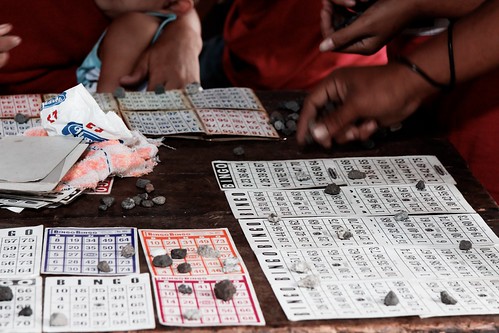
Photo: Bingo in a Philippines Village

Wednesday, April 22nd, 2009
Bingo in Philippines

March 17, 2009

Canon 50D, 17-85 IS lens @ ISO 1600, 85mm, f5.6, 1/25sec. The image is processed with DXO, using the Filmpack plugin to simulate Fuji Astia 100F film.

The “Victory Village” Barangay, the fishing village adjacent to Legazpi Port, Philippines. My travelogue on my visit to this place is here, with photos to be added soon.

Language in The Philippines

Monday, March 30th, 2009

Speech in Manila, the capitol, is a continuum from nearly pure Tagalog (if you count long established Spanish and English loan words as actually Tagalog words)  to pure English, with vast fuzzy region in the middle known as “Taglish.” No Filipinos actually speak pure English to communicate with each other, outside of certain government or academic settings, (English, along with Filipino-the official name of the national language which is more or less the same as Tagalog-are both official languages of the Republic of The Philippines) but basically all formal writing is in proper English. Newspapers and magazines  are also mostly in English, and virtually all books are. Lower class newspapers or magazines, such as celebrity tabloids, may be in Tagalog or other regional languages, and even entirely English language daily newspapers have the most peculiar practice of leaving direct quotes that were spoken in Tagalog in the original language, with no translation or explanation in English. This is because the audience, even for English language newspapers, is assumed to be entirely domestic and bilingual, unlike the English language newspapers in most countries, which are at least partly intended for a foreign or international audience.

The language continuum is strongly correlated with class and education, with better educated Manileños peppering their speech with more English words, phrases, and often, incongruously, entire clauses or sub-sentences of grammatically correct English embedded into the larger context of a Tagalog sentence. English words inserted into Tagalog speech are pronounced-and spelled, if written-as English words, and not adapted to the phonetic or phonological patterns of Tagalog, as actual loan words are in most cases. This is because English words are still considered English words, as opposed to words borrowed from English, and there is conscious code-switching occurring in such mixed speech, as opposed to a creolization of the  two languages. (I’m sure there may also be exceptional English words that have been Tagalog-ized as loan words, but this code-switching is more common.) There are also certain English phrases of Philippine origin, such as the famous “Comfort Room” or CR for restroom or lavatory, or “buy one take one” instead of the more common American English expression of “buy one, get one free.” Aside from exceptions which are purely local usage, Philippine English follows American English norms and rules, and never British.

Here is an illustrative example I overheard on the radio while getting a haircut last week. A DJ was interviewing a musician who was playing some live songs on the show. The musician said something in Tagalog ending with the phrase “diverse acoustic alternative rock.” The DJ responded by saying, in English, “Now how do you say that in Tagalog?” The musician was left nonplussed, pausing for a moment before they both burst into laughter.

Least helpful direction ever

Sunday, March 29th, 2009

When visiting the home of my friends Daniel and Beth:

It’s the gate with the picture of Jesus and Mary on it.”

Philippine Travelogue: Legazpi

Sunday, March 22nd, 2009

March 17, 2009

Despite having our plans of riding the ill-named “Bikol Express” Southrail train from Manila to Legazpi “derailed“, Joosje and I manage to get there by night bus from Manila. We arrive about 9.30AM, exhausted as all hell, catch a tricycle to the Legazpi Tourist Inn (which was the only hotel I have ever been to in the world where they let you stay for two nights and don’ t even ask to see money until you checkout.) It’s raining.

We wander towards the docks, realize you can’t get far down in that direction due to concrete walls and construction barriers, and then instead head into “Victory Village”, which looks from the outside to be a small fish market area on the other side of the concrete wall, through an archway. It turns out to be a 6000 person Barangay (Filipino word for village or neighborhood, which was chosen to replace the Spanish-era word “barrio”). We chat with many people, all very friendly, as we wander through the narrow streets-if you can evven call such narrow pedestrian-only alleys streets, and then a woman tells us we can climb the hill behind the village to get a view of the city and huge volcano (Mt Mayon) beyond. The rain has stopped, and the sun is out. A 12 year old girl, an 18 year old girl, her dog Pipi, and two boys who unusually don’t seem to know any English at all take us slipping and sliding up the hill for an amazing view and after taking it in we slip and slide back down, through what seems to be a mix of mud from the earlier rain and caribou shit, back down to the village. To get onto the path up to the lookout point you have to slip through a barb-wired fence, which is little physical obstical but would probably keep out most un-invited visitors due to appearances.

After we get back down, the woman who had pointed out the way up the hill waves us over to talk. She first introduces herself, Julie T. Bahoy, and then asks if we want to go see the docks and construction site behind the barriers we had balked at earlier. The Barangay runs parallel to the docks area, entirely cut off from it by a tall concrete wall which is prettied up on the dock-facing side but ugly, bare concrete on the village side, aside from the market entrance we had taken, another opening in the middle, and one gate into the construction area and fishing docks. Julie tells us that the construction is for a major tourist destination and resort project known as The Embarcadero. (The project and name both seem inspired by San Francisco’s Embarcadero.) The Embercadero construction has made it more difficult for the villagers to reach their fishing piers, which can only be reached by traversing the construction site itself. Only village residents are supposed to be allowed out to the fishing pier, but Julie says that if anyone asks she will just tell them that she wants to show her friends the fishing boats and not The Embarcadero. In fact, none of the guards or construction workers are very interested, but Julie seems to ejoy the thought of getting away with something.

After looking around the pier area we walk back into the village and have a seat at a small shop  run by her mother. She gives us bottles of generic brand cola and some chocolate snack-cake thing and tells us about herself. The fishing village within Legazpi cityis her home town, and she is educated in a nearby college, with a major in business management. After graduation she was unable to actually work in that field, instead getting a clerical job in a law office, which she did for many years before switching to her current job managing a small office in the city. It does not pay particularly well, and she has some side jobs trading various goods, sometimes involving networking with her sister in Manila, particularly apaca fiber products for export. She might be able to find a better job with higher pay, but says that the company she works at would fail without her, and she does not want to be responsible for putting the others out of work. Yet, she also does not demand higher pay. Her father is a retired machinist for the electrical utility, draws a small pension, and continues to do some machining work from a home shop.

Although much of her time is of course occupied by her dayjob, Julie’s real vocation has been her work on the Barangay Council, where she is the youngets of its seven members. She was first elected as the youth representative at the age of 18 and is now nearing the end of her third, and term-limited final, term. She has always ran, and been elected, as an independent and refrained from the bribe and gift exchanges ubiquitous in local Philippine politics, facts that she is very proud of. She even uses her small honorarium as a council member for purchasing things needed by the village, such as lights, instead of keeping it as a payment. Approaching the end of her final term she is wrestling with the decision of whether or not to try and run for council chairperson, as some are urging her to do, but is reluctant to do so out  of concern that it may be difficult to do so without engaging in the standard corrupt politicking and that it would occupy even more of the time she needs to make money for her family, a conundrum traditionally solved by engaging in the corruption which she so abhors.

Still, she is considering giving it a shot so that she can work for the barangay. And the barangay needs help, fenced in and under threat due to the Embarcadero project. 95% of the village population survives in one way or another from the fising trade, with only about 1 in 20  engaged in external occupations in the city. Naturally, anything that obstructs their access to the sea is a serious threat. While some villagers have temporary work during the construction phase, few of them have enough education to apply for the permanent jobs that will be created upon its completion. There is a free public elementary school inside the village, and like all of the schools I have seen in The Philippines so far it is pleasant and well maintained (the newspapers reported this past week that the Department  of Education was rated least corrupt governmeent department in a public opinion survey) but higher education requires travel outside into the city, which few of the fishing families have the hard currency for.

There are rumors that the project is partially owned by Philippine President Gloria Macapagal-Arroyo (always referred to as GMA here), widely considered to be corrupt (one recent survey pegged her as even more corrupt than the late Ferdinand Marcos, which while highly unlikely at least gives a sense of the level of discontent) or at least one of her friends. The wall was constructed without permission of or consultation with the barangay or any of its residents, and unsurprisingly cut across some private land. According to Julie, the Bahoy family house’s lot extends a full 25 meters past the wall, and they have a lawsuit pending over the theft of their land. She says that the developers have offfered to settle for the fairly hefty sum of 20 million pesos (around USD $500,000), but they have documents showing clear title to the land and are not interested in settling. Such a settlement offer implies that they have a strong case, and she even hopes to have the wall itself removed. Unfortunately, many of the other residents lack proper documentation and are even legally considered to be squatting in their own homes, and have no hope of filing a similar lawsuit. Such carelessness in basic legal matters is an obvious result of under-education, but fishing has not historically been an occupation with a great need for men of letters. And with the fishing at risk, they have little or nothing to fall back on. More of the children stay in school than their elders, but probably still not enough. In the face of this situation, I expect that Julie will find herself unable to not run for barangay council president, and will sleep even less.

(As will all entries in this series, this will be reposted with photos added some time after my return to Japan.)

Brief travel update: Riding the Philippine rails (or not)

Monday, March 16th, 2009

Having spent a couple of days in Manila catching up with old friends, it is now time to head to the south. My plan had been to take the Southrail train all the way from Manila to its terminus in Legaspi in the Bicol region at the SW tip of Luzon-a roughly 15 hour ride on the aging pre-WW2 train system with a top speed of around 50km/hr. This travel plan had been slightly augmented when I met a Dutch girl who had just arrived the same day as I to do a four month tour working at an education related NGO and doing research for her MA who was very keen on the idea of joining me on the trip.

We met up yesterday to work out the details, and being somewhat confused by how the time tables on the official website had no relationship with the information presented in the Lonely Planet, printed in 2006, I called the number on the website only to be told in that in fact both time tables were entirely wrong, due to the fact that the line has in fact been closed for around two years. Astonishingly, this rather critical detail is printed nowhere on the Philippine National Railway website that I could discover, nor on the Wikipedia page (at least in English).

After looking around a bit, I discovered that the line has been closed since a typhoon caused major damage in 2006. Since, as I mentioned, the line was ancient and only ran at pathetic 50km/hr (like 30 mph), they had been planning to rehabilitate it and upgrade to a modern system that could at the very least be called “high speed” when compared to the old line. Since the planning for the rehabilitation and upgrade was already underway, it seems that they decided not to even bother with the easier and faster work needed to simply reopen the train as it was before the typhoon, and instead take the opportunity presented by a complete closure to complete the long-term project more rapidly and efficiently. They claim that the new, higher-speed Southrail train will in fact be opening by the end of the year, although considering that New Jersey Transit has been unable to finish the repairs to the Newark Broad Street Station that has kept the Montclair Line that goes from my house to Manhattan from providing weekend service for at least a year past the originally promised date, combined with the notorious Philippines corruption, I have little confidence in this date being kept.

It is worth noting that, as in the good old USA, the Philippines (or at least the main island of Luzon) had a substantially more extensive and better rail system before WW2. In addition to the Southrail, there is also an old Northrail that hasn’t run for many years, as well as some smaller branch lines, and also a number of trams around the Manila area which were completely annihilated by the bombing of WW2 during the re-conquest of the city. Metro Manila mass transit rail has only in recent years begun to be replaced by elevated rail lines, which currently includes one MRT line and LRT lines 1 and 2, to which a 3 is curently under construction and more are planned, including a direct rail link to the new airport at some point.

Having taken this detour to learn a bit about the history and state of the Republic of the Philippines railway system, in the end Joosye (which is pronounced nothing like how you think) and I will be taking the bus.