Xinjiang Put Out Big Old Fire from Qing Times
An old big fire rampaged since the Qing times (1644-1911) on Mt. Xiaohuang, a coal-field in Xinjiang, has been lately completely put out, and up to now all the five major fire areas in the place have been stamped out.Xinjiang is richly endowed with coal resources, but it has become in turn a place long plagued by most serious coal-field fires known to the world, with over 10m tons of coal being senselessly burnt away every year.
Under the direction of late Premier Zhou Enlai, a special fire-fighting center was set up in 1958. By now, altogether 17 big fires have been entirely eliminated in the region.
Yasukuni: Behind the torii
The Yomiuri Shinbum, one of Japan’s major newspapers, has an excellent three part series online on their English website entitled Yasukuni: Behind the torii.
Part 1 – From govt-run shrine for war heroes to bone of contention
Prior to World War II, shrines were usually managed by the Interior Ministry. But Yasukuni Shrine was categorized as a special government shrine and operated by the army and the navy ministries.
The deities enshrined at the shrine are not mythical or historical figures, but the war dead who gave their lives for the nation. Yasukuni is different from a tomb in that it contains neither the remains of the dead nor memorial tablets for them.
The collective enshrinement of the war dead was informally approved by the army and navy, and then given formal approval by the emperor. Not only military personnel and civilians serving with the military are enshrined at Yasukuni, but also bureaucrats, civilians and cadets.
At the end of the Sino-Japanese War (1894-95), the Russo-Japanese War (1904-05), the Japan-China War (1937-45) and World War II (1939-45), a ceremony was held to enshrine the war dead, and bereaved families were invited to the ceremony. The shrine thus became a place to honor the memory of the war dead.
Part 2 – How the govt and people forgave those convicted by tribunal
When the San Francisco Peace Treaty came into effect in 1952 and the Allied Occupation ended in Japan, there was a nationwide movement for the release of war criminals, and more than 40 million people signed a petition for their release.
In 1953, the House of Representatives and the House of Councillors adopted a resolution calling for a pardon for the nation’s war criminals. In the same year, a law to assist bereaved families of those wounded or killed during the war was revised so that bereaved families of war criminals would be eligible for pensions and compensation.
In 1954, the Public Officials Pensions Law was revised to widen and improve measures to assist war criminals. The government designated the executions of war criminals as deaths incurred in the line of duty and did not establish provisions that would disqualify Class-A war criminals from seeking public office.
[…]In the end, Class-A war criminals, and Class-B and -C war criminals, including suspects, were released by 1956 and 1958, respectively.
Part 3 – Doctrinal disagreements hamper move
Yasukuni Shrine said it would be impossible to enshrine Class-A criminals elsewhere due to Shinto doctrine.
Procedures by which war dead are collectively enshrined are as follows:
— Their names and addresses are written in India ink on traditional Japanese washi paper.
— A ceremony is held to invoke the spirits of the dead and connect them with their names on the paper so that a list can be made.
— The list is placed behind the main shrine.
Yasukuni Shrine has two artifacts in which spirits are enshrined.
The spirits of Class-A criminals were enshrined with more than 2.46 million others in one artifact, while the other enshrines the spirits of Imperial Prince Kitashirakawa Yoshihisa and Prince Kitashirakawa Nagahisa and their families.
According to Yasukuni Shrine, some observers say all the shrine needs to do to move the Class-A criminals is to erase their names from the list. But shrine officials do not agree. The shrine says it is as impossible to extract the spirits of the Class-A criminals as it is to return liquid to a cup after pouring it into a tank of water.
In terms of Shinto doctrine, spirits can only be enshrined separately when they already have been enshrined in a separate artifact, which can be at the same shrine, as there is no way to retrieve specific spirits that already have been enshrined.
Spirits enshrined at one shrine can be moved to another through a procedure that copies them, in a sense. But this procedure can only copy the entire group rather than specific spirits and therefore, does not provide a solution to the problem, the shrine said.
If bereaved families ask the shrine to separate the spirits of the 14, shrine officials said they would tell them that such an action was impossible under Shinto doctrine.
More Apologies
There has been a lot of writing recently about why Japan still needs to apologize more thoroughly for their past history, but Wired News has a brief sidebar article today reminding us that there are plenty of other apologies out there that still need to be said. How many of the people who are pressuring Japan to pass a parliamentary declaration of apology genuinely want them to do so, and how many are counting on it not happening?
Overdue Apology
Lynching took the lives of over 4,700 people before finally being outlawed in the United States, because the Senate refused for years to pass legislation banning what one senator now calls “an American form of terrorism.” Despite the pleas of seven presidents, efforts to pass anti-lynching legislation repeatedly failed because of Senate filibusters staged between 1890 and 1952. On Monday, the Senate will consider a resolution, sponsored by Sens. Mary Landrieu (D-Louisiana) and George Allen (R-Virginia), expressing official remorse for the past.
— Tony Long
Henry Kissinger doesn’t know Chinese history (or maybe just lies about it)
I’ve seen a few blogs point to this new opinion piece by Henry Kissinger, where he conclusively proves that he has absolutely no knowledge of history, and is willing to spout whatever fiction he needs to make his point.
His basic argument is quite simple, that we should stop worrying about China. They are in no way a potential threat, militarily or economically, and people who bring up the possibility of conflict with China are just misguided. Here is some of his logic.
China’s emerging role is often compared to that of imperial Germany at the beginning of the last century, the implication being that a strategic confrontation is inevitable and the United States had best prepare for it. That assumption is as dangerous as it is wrong. Military imperialism is not the Chinese style. China seeks its objectives by careful study, patience and the accumulation of nuances.
It is also unwise to apply to China the policy of military containment of the cold war. The Soviet Union was the heir of an imperialist tradition. The Chinese state in its present dimensions has existed substantially for 2,000 years.
Ok, let’s consider his claim for a second. The comparison is amazingly easy to make. Here is a map of China’s Han dynasty, which lasted from 206 BC to 220AD, contrasted with the modern borders of the Chinese and Mongolian states. For those weak at arithmetic I will point out that 2000 years ago is smack in the middle of this period.

So how do the borders line up? It seems to me that China is about twice as big now as it was then. Let’s note some of the territories controlled the People’s Republic of China that were not part of the Han Dynasty. Well, missing from the map of Han I see:
Tibet
Xinjiang
Manchuria
Mongolia (inner and outer)
And there are also a number of areas that we could consider China proper that weren’t part of the Han state, particilarly the provinces north of the Great Wall, as well as a large region in the south-west near-oh, and of course Taiwan itself!
Oh, but according to Kissinger:
ll major countries have recognized China’s claim that Taiwan is part of China. So have seven American presidents of both parties, none more emphatically than President George W. Bush.
Yes of course. Thank you for the correction. Let’s look at the most recent public statement President Bush has made about Taiwan.
When asked in an interview with the Fox News TV Channel, “Do we [the US] still stand by an agreement, Mr. President, that if Taiwan is ever invaded, we will come to the defense of Taiwan?” Bush said: “Yes, we do. It’s called the Taiwan Relations Act.”
Let’s look at another example of brilliance from Mister Kissinger.
America needs to understand that a hectoring tone evokes in China memories of imperialist condescension and is not appropriate in dealing with a country that has managed 4,000 years of uninterrupted self-government.
Oh yes, China’s 4000 years of uninterrupted self-government. That would include such self-government as the:
Liao Dynasty 907-1125 established in what later became Mongolia by the Khitan tribal leader Abaoji. Liao’s territory included a great deal of Chinese land and people south of the Great Wall region (ancient the Wall itself had crumbled at this point-the modern one was built several centuries later to replace the ancient Han dynasty structure)
Jin Dynasty (1115-1234)-an empire ruled by the Jurchen people, who invaded from the northeast and conquered the entire northern half of the Song dynasty
Ok, so neither Jin nor Liao actually took over all of China, you may be thinking. Well, out of the three final dynasties that ruled China before the Republic of China finally defeated the old Imperial state, twoof them were governments ruled by foreign invaders!
Yuan Dynasty (1271 to 1368)– aka the Mongolian empire. Genghis Khan (Timüjin)begins the conquest of north China, and his grandson Kublia Khan finally finishes the job, making the vast Chinese empire only a part of the vast Mongol empire. Under Mongol rule, ethnic Chinese (often called ‘Han’ in memory of their glorious ancient empire) were legally second class citizens in every level of society.
After the Yuan government in China collapsed native Chinese rule was restored by the Ming.
In 1616 the descendants of the earlier Jurchens, who had recently renamed themselves the Manchu tribe, invaded part of north China and established a dynasty called the Later Jin, which in 1636 became the Qing dynasty, that like the earlier Yuan was a so-called conquest What is meant by this term is a dynasty in which an invading minority establishes control over territory, much like colonialists throughout the recent pre-modern history of most of the world.
So why exactly does Kissinger use utterly false information about Chinese history to make his argument? Well, he does admit
Before continuing on this subject, I must point out that the consulting company I chair advises clients with business interests around the world, including China. Also, in early May, I spent a week in China, much of it as a guest of the government.
at least he isn’t concealing his interests. If he had any subtlety about him then his BS might just be a little less transparent.
Thanks to Danwei for pointing out the article.
More wacked out Japanese Spam
This starts out sounding like a disgruntled employee trying to get back at his boss, but ends up being just another ploy. Enjoy:
Subject: Destroy this site please.
Target URL: http://knowledge.yahoo.co.jp/ (tr: address changed to protect the innocent)
Hello, everyone, I started working part time at this online dating site 6 months ago, and at first I pretended to be a woman (nekama) and was pretty good at it, getting several responses from customers. But a difference of opinion with the boss got me sent to the spam department where I send tens of thousands of spam messages a day. I guess this e-mail would also be considered spam, huh? Yes, of course it would.
OK, enough about me, here’s the reason for this e-mail. I want you all to to help destroy the most profitable section of this company to get them back for moving me to the spam department. This would be beneficial to you all, and the company won’t even know why it’s happening, leaving them with nothing to do but cry about it. Here’s the strategy:
1. Enter your gender, location, nickname, e-mail address and password and send it in.
2. An e-mail will come back to you with a login link. Use that link to login with the user name and password you created.
3. This will take you to the profile entry area, so quickly make a profile and proceed to the member’s menu.
4. Enter the verification code to use the free 500 points, a 5,000 yen value.
5. This will be a good value for you. Now preparations are complete for my strategy to make the company cry.
6. Now the important part: After seeing your profile men pretending to be women (nekama) are certain to come at you. Those with no dot before their nicknames are all nekama, and those with a dot are all “free” (tr: ie: real), so only respond to those with a dot before their names. Check this in the profile lists. There should definitely be some members with and without dots before their names. DEFINITELY do not respond to the ones without dots. That’s because if you use all your free points on nekama the strategy is a failure! After that you can all enjoy talking to the “free” women. I mean, there are only about 12-15 of them each day! Since they are definitely not nekama the probability of meeting them should definitely be much higher, so keeping in touch with them won’t be a waste of time. I can imagine the worried faces of my bosses when they see that registrations are up but they aren’t responding to the nekama. HAHAHA!
Remember, the target site is http://news.goo.ne.jp/
That is all, you may begin your mission. Thank you very much.
Umeda Hankyu Department Store to be Rebuilt
From Asahi:
Construction to begin August 16
Hankyu Dept. Stores announced that it would begin construction on the rebuilding of its flagship store in Umeda (Osaka Kita-ku) on August 16. Beginning in the South part, they will complete the first stage of construction by Fall 2007. Since the store will lose 30% of their its total sales floor space during construction, Hankyu plans a broad reduction in its living room and food merchandise while maintaining the present level (90%) of floor space for its main product, clothing. It is a strategy aimed at minimizing the effects of construction while trying to attract customers in the fiercely competitive North District of Osaka.
The reconstruction will come in two stages, to be fully completed in the Spring of 2011. After completion, the new building will be an composite commercial building (41 stories above ground, 2 below, with the department store taking up 13 of them). Sales space will expand from the current 61,000 square meters to approximately 84,000 square meters to become the largest department store in Japan.
However, the company predicts that it will not be able to avoid a loss in revenue during the construction, placing an estimate of 25% from current sales numbers (192,000,000,000 yen in March 2005). Such concerns drove the decision to change the sales structure in an effort to increase sales as much as possible.
After beginning construction, Hankyu will tear down an event area in the north side of the store and build a new 5-story building in order to save floor space. They will also install a temporary sales area above the concourse of Hanyku Umeda station.
This will create 5,000 square meters of floor space, securing space for women’s clothing, dry goods, and cosmetics. They will also eliminate some of their restaurants and a rooftop playground.
Further measures to counter revenue losses will be needed when the second stage of construction begins in Autumn 2007. By 2014, Hankyu plans to open 4 suburban department stores and 6 supermarkets a year in an effort to transform their revenue structure.
In “Kita” the North District that includes the JR Osaka Station area, rival department store Daimaru is also planning an expansion, and Mikoshi, which closed in May, has plans to open a store in a new building on the north side of Osaka station. While enduring a rebuilding period, Hankyu is attempting to grow in scale and “maintain its position as number one in the region.”
Comment: I’ll miss the old Osaka, but maybe the new one will look even cooler somehow.
China to ban foreign animation during prime time

The East China Daily reported that the Chinese government plans to ban popular Japanese anime and American cartoons from prime time television (5-9pm) in an effort to develop domestically-produced animation.
It is as yet undecided when the ban will take effect, but it is said that regulations on cartoon character merchandise are also possible. The moves are sure to set off debate both in and out of China since such laws may violate World Trade Organization (WTO) rules. The Daily writes that this may affect attendance at Hong Kong Disneyland, set to open this September.
China’s television stations are already required by the government to include Chinese-made cartoons as 60% of their cartoon schedules, but outside of China Central Television, this rule is not being followed by regional stations. It is said that this is the reason why the CCP decided to take stronger measures.
America’s Disney cartoons and Japanese anime such as “Captain Tsubasa” (a soccer-themed cartoon), “Chibi Maruko-chan” (a family-oriented comedy), and “Super Magic Hero Wataru” (Some fantasy thing) are popular.
Gourmet Watermelon “Densuke” auctions for 280,000 yen
The first-ever auction of the black-skinned watermelons known as “Densuke”, a delicacy of Hokkaido’s Tohma village, took place in markets in Asahikawa and Sapporo on June 10th.
The 15 melons auctioned in Asahikawa weighed, on average, 8kg with a diameter of about 30cm. A-Coop Asahikawa, a regional supermarket, paid the highest price, or 280,000 yen for one. This price was the same “charity price” as last year (tr: i.e. the Coop overpaid to support the farmers).
The melons this year are smaller than usual due to poor sunlight but are reported to be sufficiently sweet. During the peak time at the beginning of July, the melons will sell for a few thousand yen apiece mostly in retail stores in Hokkaido and the Tokyo area.
Tohma began raising the Densuke 「田助」 melons 22 years ago, and the unique name comes from a comic actor’s stage name. It also has the meaning of a rice field whose crops were rotated due to yield reductions (tr: or a slang term for a portable tape recorder).
I just can’t get used to this クールビズになじめない僕
I mean… he looks good… but all these years of seeing stuffy politicians in suits make this somehow feel wrong:


And the ads are attractive enough:
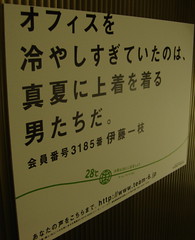 (More Cool Biz goodness at Nichinichi)
I just can’t get my head around it.
Thankfully, Koizumi’s still wearing a suit to Diet sessions at least (but forgetting his badge, the klutz):

They just look so… relaxed:


But umm.. wtf is this and what does it have to do with not wearing a tie?!

Continue reading I just can’t get used to this クールビズになじめない僕
【和訳】北朝鮮に関する米政府の最近の発言 Just because: Stuff American officials have said about North Korea (Japanese ONLY)
If you care about this stuff, go to the White House (boring and patriotic), State Dept. (elegant and easy to navigate), and Defense Dept. (slick and expensive-looking) websites. It’s all there in English.
ブッシュ大統領
5月31日の記者会見にて
Q:イラク戦争の前にあなたは「イラク戦争は他の国のWMD開発の抑止となる」と言っていたが、実際はイランや北朝鮮では何の抑止にもなっていないじゃないか。
A:北朝鮮は2000年以前にも隠れた兵器プログラムを持っていた。我々は北朝鮮と2カ国協約を結んでいたが、北朝鮮はそれを破った。それで、私は政策を変えて、北朝鮮が核開発プログラムを廃止するように他の国の参加を呼びかけた。
中国が「責任のある国家であれば、兵器プログラムを廃止しろ」と我々と同じことを言っていることが重要だ。 日本、韓国、ロシアも同じことを言っていることも重要だ。
北朝鮮の件で問題が山積みであるがやめるわけではないし、責任のある国家として扱って欲しいなら、参加している5カ国を聞かなければならないとはっきり分からせることに努力を続けるつもりだ。
Q: 今朝あなたは北朝鮮を扱うのに外交がベストな手法だと言っていたが、失礼だけど、「外交は何の成果を果たしておらず、むしろ北朝鮮核開発を進歩させたじゃないか」と言う人がいる。
A: はい。
Q How do you — what do you say to them? そういう人にたいしてどう言い返すか。
A: さて、考えよう。もし外交が間違った方法であれば、次は軍事だ。それは私の考え方、外交か軍事かだ。私は外交に賛成である。だから、あらゆる提案は検討中だが、外交で解決する機会がある。
チェイニー
先週:チェニー「金正日は無責任」とののしったことに対して、北朝鮮の報道はCHENEYのことを「血に飢えた獣性」と言い返した。
ライス国務大臣
5月26日・BLOOMBERGとのインタビューにて
Q:アメリカと中国にとって今年でもっとも重要な成果とは何か。
A: 色々な面で米中関係が強くなったので、全体的に米中関係は強くなっている。江沢民の完全なる引退をゆえに実力を固めた胡錦涛大統領はとてもいい関係を確立している。北朝鮮の核問題で協力と調整を維持している。未だに解決されていないが、アメリカと中国が、特に北朝鮮と近隣国家である中国が受ける大変なプレッシャーを受けているにもかかわらず、外交を通じて「非核の朝鮮半島」に関して継続的に取り組んでいることはかなりの成果だと思う。
対テロの面でも協力を強くなっており、ほぼなんでも正直に、そして露骨に話せるような関係を作った。
Q:中国が6カ国協議において役立っていると言っているが、中国は米国が(北朝鮮と)もっと実質的な2カ国協議を行って欲しいと言明している。なぜアメリカは2カ国協議をしないか。
A: それは、既にその道で1994年に協約を結んだが、違う手段で核開発を図ってそれをすぐ破ったからだ。
アメリカは北朝鮮と2カ国協議を行うと、NKがケチを言って米朝間の問題にすることができる。しかし、米朝間の問題ではない。地域はどんな形になるのかや、核を持った北朝鮮は朝鮮半島に存在するのかという問題で、それは日本、韓国、中国、ロシア、それからアメリカの安保にとってどんな意味を持つかという問題だ。
6カ国協議の本当の成果は何かというと、いまだに北朝鮮問題を解決していないが、核を持った北朝鮮はアメリカの問題だけじゃなく、北朝鮮の近隣国全部にとって問題であることをハッキリさせたことだと思う。その枠組みを維持しなければならない。我々は(北朝鮮と)はなしている。コミュニケーション目的(交渉目的じゃない)でニューヨークを通じて(北朝鮮と)はなしている。6カ国協議の形でも話している。北朝鮮と話すことが怖いわけではない。ただ、その会話がどんな形を取るかという問題だから、その形が米朝の二カ国関係についてであれば、話すことはあまりない。
Q:この5年で核技術を拡大してきたのにかかわらず、それに対する罰は極めて軽かった。そのまま続けないと思わせる理由はあるか。
A: 罰は軽かったとは思わない。機会費用ならいっぱい費やしているに違いない。1999,2000,2001年には、ロシアと拡張的な関係について協議があった。ルーチンは北朝鮮を訪れた。日本と外交正常化についても協議があった。南北対話も大きく進歩していた。我々も2002年に北朝鮮に対して「大胆なアプローチ」という政策を準備していた。それはリビアに対するアプローチとよく似ており、アメリカや地域全体にももっと改善した関係への道でもっと正常的な関係につながるはずだった。
ラムスフェルド防衛大臣
6月4日・International Institute for Strategic Studiesにて
Shangri-La Hotel, Singapore, Saturday, June 4, 2005.
世界で最も自由と圧制の違いがはっきりと現れているところは朝鮮半島と言えよう。
私は「夜で見る朝鮮半島」の衛星写真を机の上に飾っている。DMZの下、南の半分にはほとんど光に覆われている。それは電力、活発している経済、それから生き生きしている民主主義のある国家を意味している。そして、DMZの北をご覧になれば、ピョンヤンのわずかな光を除いて暗闇しか見えない。北でも南でも同じ国民で、同じ資源を持っている。その違いは自由だ。政治的自由と経済的自由。
現場に行けばその対象がさらにハッキリして、意味深いである。大韓民国は自由な国民と自由な市場における活力(DYNAMISM)の一例である。
比較すると、北朝鮮におけるスターリン主義政権を考えてみてください。あそこでは:
反体制の人の子供や孫が強制労働をさせられる
逃れた難民が外国から拉致される、それから
飢餓に遭っている国民が一粒のご飯を見つけるために荒地を探す。
北朝鮮で数ヶ月子供の医療をしていた欧州の医者はこう言った。「北朝鮮では二つの世界がある。ひとつは軍事高官・高層の人たちの世界と、もう1つはそれ以外の人たちのための生き地獄。
北朝鮮の「核の野望」は地域の安保・安定の脅威となり、拡散の前科からみれば世界の脅威ともなる。ブッシュ大統領や後の4カ国の首脳は6カ国協議に戻るよう促している。
それから、アメリカは近隣国の成長を支援してきた開放性と自由を抱くよう促している。
北朝鮮が6カ国協議に戻るのに大きな役割を果たせる国家といえば、その国は中国である。
アメリカや多くの国々は外交、経済、世界の安保など多くの場面で中国と協力したい。多くの国々は平和的で豊かで自由な地域という目標を促進させるようなアジア太平洋構造作りに賛成的である。他国間の取り組みは重要である。中国はその協力に大きな役割を果たせる。