Reason fails again in US government

No sooner do I write about the misinformed campaign against Chinese PCs being carried out by certain members of the US Congress then the State Department announces that none of the 16,000 machines being purchased from Lenovo will be connected to any high security networks or used to process any classified data.

As the NYT article says:

Long story short, an influential member of Congress played the China card, and the State Department folded.

It was a drama that reached a conclusion late last week, when the State Department, responding to fears that its security might be breached by a secretly placed device or hidden software, agreed to keep personal computers made by Lenovo of China off its networks that handle classified government messages and documents.

The damage to Lenovo is more to its reputation than to its pocketbook. The State Department will use the 16,000 desktop computers it purchased from Lenovo, just not on the computer networks that carry sensitive government intelligence.

I previously mentioned the absurdity of even trying to find computer constructed outside of China, as well as the somewhat unlikely prospect that Chinese trojans could be hidden in the systems without being located. Well, naturally Lenovo agrees with me about that, but there’s more. Jeffrey Carlisle, vice president of government relations for Lenovo, describes

the worry that the Chinese government might secretly slip spying hardware or software on Lenovo computers shipped to the State Department as “a fantasy.” The desktop machines, he said, will be made in Monterrey, Mexico, and Raleigh, N.C., at plants purchased from I.B.M.

“It’s the same places, using the same processes as I.B.M. had,” Mr. Carlisle said. “Nothing’s changed.”

So despite everything, by going to a company partially owned by the Chinese government (and not incidentally, also partly owned by IBM, and by other American and non-governmental foreign investors) they are actually getting one of the few sources of computers NOT made in China! Do they now think that the former IBM executives and engineers that run the Mexican and Raleigh plants are now agents of the Chinese government just because of who owns some of the stock? This notion of Communist Party control over Lenovo just seems so overblown. According to Wikipedia the actual breakdown is “as of May 1, 2005 35.2% of Lenovo was owned by public shareholders, 45.9% by Legend Holdings Limited, and 18.9% by IBM.”

Furthermore, the headquarters of the company is located in New York State and is planning to relocate to Raleigh, where the Thinkpad group is based. Yes, the Chinese government owns a large chunk of Lenovo through Legend Holdings Limited. While the corporate entity known as Lenovo may have originated in China with government backing, it has transmuted into a very 21st century transnational company, in which the Chinese government is merely a stockholder. Certainly with the force of authoritarian Chinese law behind them the CCP could do much to control operations within China, but I find very little credible reason to believe that a minority stockholder would be able to exert the level of influence necessary to illegally alter the designs of systems in a way that would be economically suicidal if uncovered at a factory in Raleigh N.C. formerly owned by IBM and managed from the Purchase, NY headquarters.

I have a Mac Classic in my attic that you could use

It has been just about two months since I last discussed the Congressional revolt against Chinese manufactured computers and for a while I thought that perhaps the story was dead, but leave it to a Congress member to not merely flog, but actually hitch his wagon to a dead horse. Washingtonpost.com is running an AP story saying that the State Department has declared that the 16,000 computers they purchased from Lenovo will not be used for classified work. This followed a complaint by Virgina Representative Frank Wolf, who while he may have been elected to represent the good people of Virgina, seems unlikely to qualify for a job setting up internet connections at people’s homes.
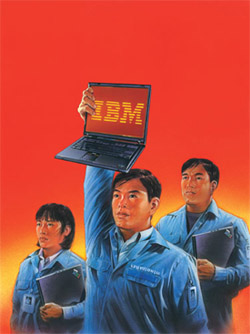
Red IBM

The government, Griffin wrote, is committed to making sure the purchase from Lenovo, the world’s No. 3 PC maker, will not “compromise our information and communication channels.”

Wolf, R-Va., chairman of the House subcommittee that finances State Department operations, said he raised alarms after he discovered that officials planned to use at least 900 of the computers in classified work and at U.S. embassies and consulates abroad. That, he said, possibly could give China access to sensitive U.S. information.

While there may in fact be a miniscule theoretical possiblity of a security breach resulting from some sort of clever trojan hidden deep in the firmware of a China manufactured computer (such as if State were stupid enough to use the Lenovo security chip), there is something unaccounted for by Mr. Wolf that would prevent them from buying computers entirely manufactured inside the United States. Namely, there aren’t any.

As a chart in this piece at DailyTech.com illustrates, over the past several years every single PC manufacturer, whether Chinese, Taiwanese, Japanese or even American, has come to do at least some of their manufacturing and basically all of their final assembly in China.

Unfortunately for Representative Wolf, banning the purchase of computers manufactured in China essentially means banning the purchase of computers. At least, unless he wants the government to trove attics and garage sales to collect 1980s models like my old Mac Classic.

But as for the real issue of whether or not manufacturing in China is a security risk. I would have to say, not particularly. While the computers may be “made” in China, they aren’t designed there. Just because a piece of electronics has “Made in China” stamped on its outer shell does not mean that the entire contents was made in China, only that the case was. But while the system may have been assembled and some of the components manufactured there, virtually none of the highest tech components responsible for the actual processing of the computer are made there.

Does it seem likely that it is possible to add a trojan to imported AMD chips made in Germany, or modify the design of an Nvidia chipset, designed in California and manufactured in Shenzhen, China by a Taiwanese company, so that it stealthily transmits keystrokes over the internet to Chinese servers?

Regardless of where the hardware is from, while the systems are preconfigured by the maker, we can assume the State’s IT department will wipe the hard drive and reinstall their own carefully tweaked (hopefully) secure disk image, and then replace the BIOS and firmware with vetted software written by the American or Taiwanese companies that actually designed the components.

Dietman Taizo Sugimura an Idiot After All? (At least he is an admitted plagiarizer)

Speaking of book news:

Young LDP Diet member Taizo Sugimura (PR, South Kanto) has admitted that a post on his personal blog was plagiarized from the autobiography You Aren’t an Idiot After All. ZAKZAK has the story:

This Time Taizo is Suspected of Plagiarism…Just before his marriage
Blog Post Closely Resembles Popular Yoyogi Seminar Teacher’s Autobiography

A post on Lower House member Taizo Sugimura (age 26)’s blog was found to closely resemble the autobiography of popular teacher at the famous exam preparation school Yoyogi Seminar (Keisuke Yoshino, age 39). (Sugimura has since admitted to the plagiarism).

The blog post, uploaded at 11:32pm on May 10, starts out “It was my last night as a single man.” Sugimura describes that when he was 19, he “seriously hated myself,” went to a snowy mountain to kill himself, and “lay down on the snow, quietly waiting for death.” However, he returned to his car after being unable to withstand the cold. He tried going outside again, but ended up going home after thinking “At this rate I’ll catch a cold!”

Yoshino’s memoirs, You Aren’t an Idiot After All, were published in 1991 and were reprinted in paperback. A passage in the book, in which the 19-year-old author attempts suicide by going to the Shigakogen plateau, and after going in and out of his car a few times returns home after realizing he’d catch a cold – the resemblance is consistent even in the story’s punchline.

Yoshino, a former biker gang member, participated in a discussion group for NEETs (people Not in Employment, Education, or Training) held by Sugimura. During the discussion, Yoshino reportedly told that story.

The eery resemblance became a topic of discussion on the Internet, and by May 23 the offending passages were deleted.

(liberally abstracted from ZAKZAK 2006/05/23)

Thank god for the Internet. If you watch the video in which he admits to the plagiarism, you’ll notice just how little he seems to care that he’s a freaking dumbass for ripping off a popular book.

It sounds like he thinks it’s all over since he just deleted the passages in question. Doesn’t he realize it’s too late?

Saddam’s last novel published in Japanese

Reuters is reporting that Saddam Hussein’s last novel, entitled “Get Out of Here, Curse You” in it’s original edition, has just been published in Japan by a minor publishing company.

The book, believed to have been written on the eve of the 2003 U.S.-led invasion of Iraq and titled “Devil’s Dance” in its Japanese translation, hit stores around the nation Friday.

Jordan banned the book on the grounds it could damage ties with Iraq, but pirated copies of the tale of an Arab tribesman who defeats foreign invaders became a bestseller in Amman.

The original manuscript was smuggled out of Iraq by one of Saddam Hussein’s daughters, Raghad, and a copy given to Japanese journalist and translator Itsuko Hirata.

“The novel is dated to the times of ancient tribal society but the tribal warfare depicted in the novel is strikingly similar to what happened and is happening in the Iraqi war — totally,” Hirata told Reuters before the book’s release.

“He (Saddam) knew he was heading into a war he couldn’t win, so I think with this book he was trying to make his position clear and send a message to the Iraqi people.”

The book jacket text reads:


Worldwide first edition!
This is an indictment, and a warning.

That Hussein wrote a novel.

Anyone interested in ordering the book can get it from Amazon Japan here. I expect that the English translation that has most likely already been prepared by CIA analysts will not be published, so this may be your best shot.

Education Law: our issue this Sunday

A bill to revise the Education Law made it down to the floor of the Diet last week, and the LDP looks set to push it through by the end of next month. The bill has three basic goals:

  1. Take the 9-year compulsory education period out of the law (it’s already provided for in another law, and may be revised in the near future anyway)
  2. Add provisions for life education, private schools, and home schooling.
  3. Make instilling patriotism one of the formal goals of the education system.

The last point is what has held up the rest of the bill in committee, since some fear that too much nationalism would be a Bad Thing. The language that finally made it to the floor is 我が国と郷土を愛する態度を養う – “instill an attitude of love of our country and homeland.” Even if the few remaining left-wingers in the Diet don’t have problems with that, you can bet that a lot of the teachers will, especially in the major cities where schools are dominated by more “liberal” (in the American sense) types. Should be fun to watch the bickering.

Oh crap

I finally got my passport back on Friday from the Japanese Consulate in New York with my new working visa plastered in and I’m finally ready to book a flight over, and the New York Times has to go and run THIS story!

Brace yourself for a summer of miserable air travel.

Planes are expected to be packed fuller than at anytime since World War II, when the airlines helped transport troops. Fares are rising. Service frills are disappearing.

Logjams at airport security checkpoints loom as the federal government strains to keep screener jobs filled. The usual violent summer storms are expected to send the air traffic control system into chaos at times, with flight delays and cancellations cascading across the country.

ALC to the translation rescue

One of the better dictionarial resources on the Internet for English/Japanese translation is Eijiro, accessed through the ALC search engine. Here are a few prime examples that we’ve stumbled across, to show just how far ranging it is. In fact, if you get lucky you may even locate an entire bilingual text such as this one, which is always a good study tool.

◆「fuck」は、性的な交わりを持つことをいう、最も直接的な表現だ
Fuck is the most direct way of saying ‘having sexual intercourse.’

◆重要なのは銭、一番大切なのはお金、世の中は金だ。
It’s all about the benjamins◆アメリカの百ドル札の表にベンジャミン・フランクリンの顔が描いてある。◆〈語源〉ラッパーのパフ・ダディの歌のセリフ(1997 年)より。◆This phrase refers to the portrait of Benjamin Franklin on the American hundred-dollar bill. Popularized by the line in a Puff Daddy rap song (1997).

◆ひどく複雑な手続き
ring-dang-do〈米俗〉

◆「こどちゃ」最高!
Kodocha rulez!

◆見るからにオカマっぽい〔差別語〕
as gay as pink ink

Fujimori free?

We’ve posted on the confusing case of Alberto Fujimori before, particularly this post by Joe, and mine on whether his Japanese citizenship seems to be legal or not, but I am a little surprised to see him free on bail within Chile.

Here’s the brief AP story:

SANTIAGO, Chile (AP) — A Chilean Supreme Court panel freed former Peruvian President Alberto Fujimori on bail Thursday while he fights extradition on corruption and human right charges.

The president of the court panel, Enrique Curi, said the justices voted 4-1 to allow the former authoritarian leader to go free, but they prohibited him from leaving Chile.

Fujimori had been under arrest here since November 2005 after the Peruvian government requested his extradition. Fujimori arrived here after living in exile in Japan for five years.

Curi said the bail amount would be determined by the judge handling the extradition trial. Fujimori could be free later Thursday.

According to Asahi, he is also restricted from making political statements and appears to have also been decided that he will remain within the Santiago house that a supporter has lent to him. The extradition trial deciding whether he will be sent to Peru continues.