MOFA Graduates another Class of Budding 3rd-world Japanese Speaking Diplomats

Below is a rundown of the speeches given by representatives of graduates from a Japanese Ministry of Foreign Affairs program designed to train (and of course capture) bureaucrats and diplomats from the developing world who work with Japanese officials. Enjoy! (speeches abstracted and shortened – not an exact translation but I have labored to stay true to writer’s intent)

An explanation of the program:

On June 15, 26 diplomats and 12 bureaucrats were produced from MOFA’s Japanese Language Training Program, carried out by MOFA in cooperation with the Japan Foundation. The students came from Asia, Europe, Central/South America, and Africa to learn Japanese.

MOFA has long been bringing diplomats/bureaucrats who are likely to use Japanese in their career to Japan and having them learn Japanese. This year marks our 25th class of diplomats and 9th of bureaucrats.

Now let’s look at the statements of two students, one representing the diplomats and one for the bureaucrats. The speeches are printed as they were written, save for some places where hiragana were replaced with kanji

:


We definitely cannot forget this

by Md. Hamidur Rahman KAHN, People’s Republic of Bangladesh (bureaucrat)

I am KAHN, a bureaucrat from Bangladesh. As ODA from Japan, a major trading partner for Bangladesh and the rest of the world, continues to grow, Japanese has become an important language for us. Our wonderful teachers taught us much about Japanese grammar, Chinese characters, and how to give a speech in Japanese. From meeting many Japanese people and traveling to many of Japan’s festivals, I was able to learn about Japan’s culture.

I was also able to make friends with my 39 classmates from 33 countries. Initially, we communicated in English, but now we can talk to each other in Japanese. I was actually able to use the language of Japanese to make true friends.

We will soon return with many memories which we will wish to communicate to our fellow countrymen. I hope that the relationship between my country and Japan will improve even further. That, I think, is the role of us, the participants in this program. Thank you.

Next!

We did it all on our own

by Lamngeun KHATSAVANG, Lao People’s Democratic Republic (diplomat)

Thank you all for taking time out to come to our graduation ceremony.

Japan is a major trading partner for the world, in the export of electronics and automobiles. Also, Japan has supported my country in various ways. We were all very happy to take part in the diplomat/bureaucrat course.

When I came to Japan, it was for the first time and I did not speak Japanese at all. But the teachers came up with the best way to teach us and happily answered our questions, so we became able to speak Japanese. I truly appreciate the teachers for helping us out. However, the Japanese studies in this program are not sufficient. Since we have only studied a little of Japanese grammar, we will have to continue studying after we go back to our countries.

At the Kansai Center, we had classes on the Japanese economy and culture in addition to Japanese classes. Also, we visited MOFA, the Ministry of Finance, and JICA headquarters where we learned about Japan’s diplomatic and ODA policies. There were also many programs such as homestays and home visits that let us understand Japanese families and lifestyles.

We also went on self-led study excursions. We researched where we wanted to go, and reserved tickets and hotels. We did it all ourselves. We sometimes got lost when we were traveling, but the kind Japanese people helped us out and made us feel at ease.

We also saw lots of traditional Japanese culture such as Sumo wrestling and kimonos. We all plan to teach people about Japan’s traditional culture when we return to our countries.

Our 9 months in Japan were the most precious experience to us. Particularly, I think we won’t be able to forget Japan’s traditional culture or beautiful nature no matter when or where we are. What we learned here will be useful as we further our countries’ relationships with Japan. Thanks to all who made it possible.

A gift horse?


I spotted this
on a few gaming related blogs, but I think it’s important to note the similarity to Koizumi’s subtle attack on the President’s war policy.

President George W. Bush received an early birthday present on Wednesday from Nintendo. The game developer sent the president one of their DS Lite portable gaming machines and a copy of Brain Age: Train Your Brain in Minutes a Day.

No word on whether Bush, who turns 60 today, is a fan of the company or video games.

In the letter addressed to the presidential birthday boy, Nintendo points out the game will help the president “keep your mind sharp” and suggests President Bush should try it out on his next long flight aboard Air Force One.

Included in the gift pack was this letter:

Dear President Bush:

Happy Birthday!

Don’t worry, turning 60 is an exciting milestone. As you know, you’ve joined millions of other baby boomers in an invigorating new decade of your life. And, like many boomers, you may be looking for ways to keep your mind sharp. That’s where we come in.

Please accept our gift of a new Nintendo DS Lite system and a copy of Brain Age: Train Your Brain in Minutes a Day. You now join millions of people around the world who have fun challenging themselves with Brain Age. If you have never played a video game before, don’t worry. Brain Age is part of our new Touch Generations brand, which includes games that are easy for people of any age – regardless of their video game experience – to pick up and start playing immediately.

It’s obvious you don’t have a lot of time to play games, which makes Brain Age such a great activity for you – just a few minutes a day with more than 15 daily training tests will help keep your mind sharp. Training tests include categories like math, reading and memorization. Try it for a few days and watch your score improve. Brain Age also comes with more than 100 sudoku puzzles – these could make your next long flight on Air Force One a bit more fun! (Perhaps copies of Brain Age for journalists joining you on your next flight would be a nice distraction!)
Have fun exploring Brain Age with your Nintendo DS Lite and be sure to let us know your brain age!

Have a tremendous birthday!

Sincerely,

Your Friends at Nintendo

New official Japanese-English Dictionary

As part of Japan’s move to open itself up more to foreign investment, the Japanese government commissioned a group of translation experts to put together a site of resources for English translation of Japanese laws. It’s been available since March now, so if you haven’t seen it, now is the time.

The crown jewel of the project is a Japanese<>English glossary of major legal terms (PDF). Ever wondered how to translate 会社の分割? Well now you can all rest easy – it’s “corporate demerger”. What about 出訴期間? That would be “statute of limitations for filing an action”.

Two of my favorite entries so far:

悪臭(あくしゅう)
offensive odor

育成者権者(いくせいしゃけんしゃ)
holder of a breeder’s right

For people like me who deal with this kind of stuff every day, it really helps put to rest – more or less satisfactorily – some of the more ambiguous words that are hard to pin down when translating from Japanese to English. Though as Joe pointed out in an earlier post, not all of the translations are the preferred nomenclature (法 should really remain “law” if for no other reason than that’s what I’ve been using all this time! Changing everything to “act” will be such a pain), but it’s still an extremely handy resource. My one beef with it – at 250 pages it is way too short and doesn’t cover a sizable portion of the issues covered in government regulations, particularly in specialized areas. But then if you have to you can always compare translations of laws as they become available.

Whither wifi?

So the new head of Starbucks Japan has made a threat promise to open 100 stores per year for an unspecified number of years, up from the current 624 outlets. This is all well and good, except for one thing-Starbucks in Japan doesn’t offer any wireless internet service! While I suppose wifi access in Japan must be better than it was a few years ago, after living in Taiwan-a country where every cafe, KFC and subway station has free and open wifi connections-for most of the past year it seems rather dreadfully difficult to get online with a portable computer when traveling in this country.

I moved into a new apartment in Kyoto on Friday, about a two minute walk from the Sanjo Keihan train station and five minutes walk from downtown Kyoto, the edge of which can be thought of as the Sanjo Bridge, which in the days of the Samurai was the designated location for the beheading of the most heinous of criminals (such as Christians). Being Kyoto, this former killing ground is of course marked by a sign, but more people probably know it for the adjacent Starbucks. (pictured below)

Living so near to downown I assumed that I would be able to walk into any number of establishments with my laptop, once again able to run off battery sans AC adapter thanks to my clever repairs, only two days before my departure, and naturally this Starbucks was the first place I tried.

To my surprise, Starbucks Japan offers no kind of wifi service whatsoever! Neither does Dutour, a Japan-based cafe chain with a large presence in Taiwan. The menu is basically the same, but of course in Taiwan you always see a few patrons tapping away on their keyboards thanks to the free internet.

I ended up strolling up and down Kawaramachi and the immediate environs with my open laptop, Netstumbler running, in search of an internet connection that I could glom onto. In fact, there were plenty of connections- easily dozens. But all of them were corporate networks, for internal business use and were correctly encrypted to restrict access from non-authorized users. I did find one eventually, weak but slightly usable for a few minutes at a time, between service interruptions-accessible while sitting on a bench near Sanjo Kohashi (pictured right). After about fifteen minutes of highly frustrating internet use it started to rain, and with no options left I sprinted under a store canopy with my laptop tucked under my right arm, stowed it in my laptop carrying-case-backpack, and scurried through the rain back to my apartment.

After getting back I took the laptop out and turned it on in my new room for the first time, thinking I might watch a movie from my narrow yellow binder of DVDs, and immediately was hit with a message from Windows saying that it had connected to an unprotected wireless network. The wireless AP had the SSID “YBBUSER,” telling me that it must have been provided for a user of the Yahoo Broadband ADSL service popular in Japan.


Happy ending: I was able to download the latest episode of Doctor Who in under 30 minutes via Bittorrent. Seeing **spoilers removed**meet for the first time was excellent.

Lessons learned: Partly because all Japanese people can check their email from their cell phones free wifi is more difficult to find than in most, if not all other highly developed countries.

Solution: Starbucks can shell out the ¥10,000 for a decent wireless router and ¥4000/month for DSL service in addition to the millions of yen they’ll need to spend on those hundreds of planned new stores.

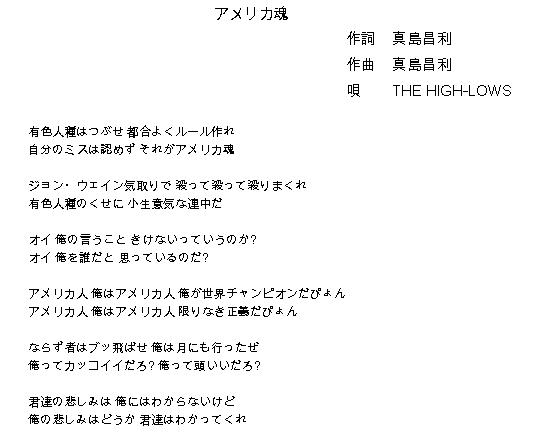
Anti-American Japanese song “American Spirit” by The High-Lows

The High-Lows are a now-defunct Japanese rock band whose sound mixes a tinge of American doo-wop with a mallet over the head dose of youth nostalgia. Though not a huge fan, I picked up one of their CDs back in the day after hearing that they were the successor band to the influential late 1980s J-punk band The Blue Hearts (“Linda Linda” remains one of my favorite songs).

Despite the clear US influences in his band’s music, guitarist/songwriter Masato Mashima felt like 2002 (runup to the Iraq war) was an appropriate time to let us know what he thinks about Americans in his fun piece of album filler entitled “American Spirit” from the album angel beetle. Here’s a translation (lyrics in Japanese available here as culled with some difficulty from utamap.com):

Crush the colored races/Make the rules so they benefit me
Don’t admit my mistakes/That’s the American Spirit

Kill Kill Kill John Wayne-style
You’re an impudent bunch for a colored race

Hey! You say you can’t obey me?!
Hey! Who do you think I am?!

American/I’m an American/I’m the World Champion, baby
American/I’m an American/Unlimited justice, baby

Beat up the badguys/I even went to the moon, you know!
Ain’t I cool? Ain’t I smart?

I don’t understand your sadness,
But please, understand my sadness

Who is more exceptional?

From the NYT Magazine:

“America Against the World,” a recent book based on comprehensive polling data from the Pew Research Center’s Global Attitudes Project, makes the point that our exceptionalism is not exceptional with particular force. While a robust 60 percent of Americans agree with the proposition that “our culture is superior to others,” such self-confidence pales next to that of South Korea and Indonesia, where some 90 percent of the population assents to the idea. The book’s authors, Andrew Kohut and Bruce Stokes, also note that “poll after poll finds the Japanese to be the most pessimistic of people, expressing far less satisfaction with their lot in life than might be expected given their relatively high per capita incomes. Yet, compared to other Asians, the Japanese are, like Americans, highly self-reliant and distrustful of government and, like Europeans, secular. It is the Japanese public, not the American public, that is most exceptional in the world.”

Any thoughts?

Japan’s Media Coming Online, inch by inch

Yahoo Japan’s “everybody’s politics” section is becoming quite an amazing little site. I mean look at this hot top image promoting their new 2007 Upper House election feature:
koizumi ozawa.gif
koizumi ozawa 2.gif

It’s like dueling Kim Jong Ils!

Just look at some of these amazing features:

  • A full, easily searchable list of Diet members. I was able to instantly find the people representing Mrs. Adamu (Mssrs. Noda and these guys including Rick Moranis lookalike Kazuo Shii of the Japan Communist Party). I’d like to see the same for local politics, but perhaps that is asking too much.
  • A sweet podcast of speeches by various Diet members. Most of them are boring, but Seko’s one was actually a pretty interesting synopsis of LDP internal reforms.
  • A manga about an annoying twit who becomes a Diet member’s secretary only to figure out he knows NOTHING about the Diet. Thankfully, a hot chick decides to smack him around and teach him the basics of the Diet. Hot!
  • A glossary of political terms including historical and topical entries. Don’t know what the 1955 system is? Now you will!
  • Best of all everything is free and better yet ad-free. Why? My guess: They are gearing up to claim to have a significant impact on next year’s Upper House elections and in the process boost traffic.

    One of their newer features, however, indicates a major shift by some of the traditional media content providers – free, full-length articles from Japan’s weekly and monthly magazines! The Japanese internet so far has been pretty devoid of good free political analysis or even in-depth news coverage. This is largely explained by the newspapers and magazines’ reluctance to put their content online for fear of losing readership and, in the case of newspapers, the considerable special privileges they get as so-called public institutions. is “Read and Compare Political Articles” which reprints the main political articles in weekly journals, in their entirety, completely free of charge (or even banner ads, while we’re on the topic)! Downsides: No pictures, and the articles are deleted fairly soon after publication (about a month it looks like). But if you’re diligent you can at least save the articles you want on your computer (or if you’re like me, g-mail them to yourself).

    This serves as an essential boon to Japanese and Japan watchers overseas (who can now vote in all aspects of Japanese elections after a court decision), who before could only view headlines for free, unless they wanted to sign up for media companies’ exorbitantly expensive pay services.

    There still leaves much to be desired in terms of Japanese media content being available on the web (full newspapers, anyone?). But this is a very helpful step in the right direction!

    Kabuki Spreads to the White House

    Our latest Kabuki Alert come from Wonkette:

    White House Kabuki: The Administration Reacts to the SCOTUS

    The Bush Administration’s preliminary reactions to the Supreme Court’s ruling in Hamdan v. Rumsfeld are in — and they’re not terribly exciting or surprising.

    At a press conference earlier today with Japanese Prime Minister Junichiro Koizumi, President Bush got peppered with questions about the decision. Pretty much every non-Asian journalist in the room asked about Hamdan. Bush said that “we take them [the Supreme Court] very seriously.” Glad to hear it; so do we. He also stated that “we will conform to the Supreme Court.” Nothing controversial there.

    So the definition of “political kabuki” in this blog post seems to be “reacting to a Supreme Court decision while a Japanese politician is in the room.” We’ve seen it earlier defined as “a meaningless horse and pony show debate in Congress” and “putting off tough fiscal policy decisions to protect one’s legacy as Japan’s reformist PM.” Let’s nail it down people: Just what is “political kabuki”? And where did the term come from?

    More than Half of Japanese Men Sit Down to Pee

    I’m busy packing now, but I just wanted to direct you to this recent rant from Nikkan Gendai (a sensational tabloid that uber-commentator Naoki Inose has described as a good read on the ride home when you just want to say fuck you to the powers that be). According to the writer’s unscientific observations, more than half of Japanese men are now sitting down to pee.

    Question to you: is this true? I’m not sure exactly how this guy was investigating men’s rooms, but find out!

    At this one place where I worked (scanning Japanese medical journal articles for the National Library of Medicine in Bethesda, MD) what pissed me off in the men’s room was noticing people purposely not flush the urinals, as if they were afraid of the germs contained in the flusher. There were days when I’d notice that none of the urinals were flushed. Granted, these are NIH contractors, so they know a lot we don’t. But that doesn’t give them some pass to “let it mellow” just because they think their immune systems can’t handle it! And anyway, isn’t leaving stagnant urine around a health risk of its own?