
The day’s news in Patriotism and rememberance

Glancing at today’s top stories at The Japan Times, I am struck by how thematically linked many of them are. Now, of course it is a slow-news Sunday with few actual current events to report on, which leads the news people to slot the historical stories into the front page, but we can still see an interesting congruence of themes in four of today’s top stories.

The big story is that the New ‘patriotism’ education law takes effect. All readers of this blog already know that this law has been in the news for some time, it has been debated by everyone, protested against by citizens groups, teachers unions, parents and students, and contested by a coalition of the DPJ and other minor opposition political parties, who in the end failed to stop its passage by the eternally ruling LDP. While I haven’t read the actual text of the law [available here] yet (which I really should do soon), we do all know that the controversy stems from one particular section of the comprehensive education law-containing many provisions on reforms generally accepted as necessary-in which it states that “an attitude that respects tradition and culture and loves the nation and homeland that have fostered them” should be promoted by throughout compulsory education, which incidentally I believe has also been extended to include high school for the first time, in one of the less politically charged provisions of the law.

This rather innocuous sounding passage sounds like part of the basic curriculum of lower education in pretty much any country, and one could argue does not even sound any different from what is already taught in classrooms throughout Japan, but many people think of the recent case of teachers being disciplined for not singing the national anthem and feel a worry that the actual implementation of these newly mandatory provisions is another stage in the resuscitation of a particular pre-war style of nationalism. In reality, the debate is not over whether patriotism and shared national values should be taught to children, but what meaning that patriotism has, and what those values are.

The worry among the opposition camp is that the official patriotism will be a doctrine of subservience to the state, which could someday lead to a return to the military days of the past. The fact that the education law was passed in the same parliamentary session as the bill elevating the head of the Self Defense Forces to a cabinet level minister does not appear to them to be a coincidence. But the opposition has their own narrative of patriotism, primarily based on the doctrine of pacifism and anti-militarism that was embraced throughout Japan after the multifaceted disaster of Japanese Imperialism and the Second World War. The relentless defense of these principles, primarily in the guise of Article 9 of the American imposed postwar Constitution-the protection of which seems to be invoked in virtually every campaign poster of a politician campaigning against the LDP-represents a particular vision of Japan, which they are proud of and want to protect. This is an attitude that I think should be considered a form of patriotism.

While statements by the reigning Emperor tend to be somewhat bland and cryptic, this seems to be the attitude expressed by Akihito, the Heisei Emperor, in remarks made on his birthday-which was also a top story today. Although I mentioned above that it was The Japan Times in which these four stories were placed next to each other, I’m going to present the somewhat longer quote from the BBC article (also the front page of that site).

“Now that the number of those who were born after the war increases as years pass by, the practice of mourning the war dead will help them to understand what kind of world and society those in the previous generations lived in,” Emperor Akihito said, in remarks made on Wednesday, but only made public on Saturday.

“I sincerely hope that the facts about the war and the war dead will continue to be correctly conveyed to those of the generations that do not have direct knowledge of the war so the kind of ravage of war that we experienced in the past will never be repeated,” he added.

However, the emperor avoided touching on how people should honour those who died in World War II.

(The original Japanese statements can be found here at the Yomiuri)
Somewhat limp statements like these are a result of how it is generally considered inappropriate for the Emperor to engage in any political activity, or suggest or endorse any particular thing or action, lest it remind us of the bad old days. If you read the entire statement of the”symbol of the State and of the unity of the people,” you can see that he is very careful only to specifically reference the deaths of Japanese soldiers and civilians and the general horror of war, but he also hopes that the “history of both Japan and the world” should be “properly conveyed to the generation of people who have not directly experienced war” so that “the horrors of war like those of the past shall not be repeated.” Right wing supporters of the new education law may argue that children will be upset by learning about evil things done by their own country in the past, but it is difficult to believe that this sort of education encourages the strong anti-war sentiment in present day Japan. Could anyone really say that the Emperor’s desire for the history of war to be taught in such a way that it helps encourage students to be anti-war is unpatriotic?

The concept of “patriotic” education is not inherently nationalistic or jingoistic. I believe that growing up I was taught about American history in a way that was intended to strongly foster patriotism, but not by entirely white-washing the past. Among the things I specifically recall studying in American History class at some point over elementary school, middle school and high school classes are: slavery and segregation (lesson plans inspired in no small part by the fact that the public schools of Montclair, New Jersey were in the twelve years I spent there roughly 50% black/white), smallpox blankets, the Salem Witch Trials, Manifest Destiny, industrial revolution child labor, the Triangle Shirtwaist Factory, the Wounded Knee Massacre, the Trail of Tears. And this is not even a complete list of the various injustices committed by the United States of America that I was taught about in history class.

A Kobayashi Yoshinori or Shintaro Ishihara might think that I went through a history curriculum written by anti-American rabid communists or something, but as I already said these were actually patriotic lessons. How could that be? Well, slavery had Harriet Tubman and the underground railroad and the abolitionist movement-lessons of heroism and virtue. Segregation brought us Brown Vs. Board of Education-a lesson that our system of law is eventually a system of justice and the civil rights movement, with Martin Luther King, Rosa Parks and other heroes, and of course the eventual end of legalized segregation. The Salem Witch Trials lead to separation of church and state, a fundamental principle of American society. The dark side of the industrial revolution eventually led to the labor movement and various legislation and a significant improvement in worker’s rights. And so on. I do not recall if it was ever spelled out, but in retrospect the basic narrative is clear. Not “America is perfect,” but “America’s founding principles are good, and if we work at it, someday they can be fully realized.” How similar my education was to the national average I have no idea, but I expect that this core narrative is standard. And today’s third article, telling us that President Bush has signed a law providing for the preservation and restoration of all the Japanese internment camps from World War II. “The objective of the law is to help preserve the camps as reminders of how the United States turned on some of its citizens in a time of fear.”

Right wingers in Japan deride the teaching of things such as comfort women, war crimes and colonialism as anti-patriotic, saying that it will make children feel bad about their country. But it is all about the approach. Certainly teaching children about the mistakes and excesses of the colonial decades makes them feel bad about that time, but presented correctly it makes them feel good about living in today’s Japan: a nation which has moved past that stage. Perhaps by being over-reactionary about terms such as “patriotism” and “nationalism,” peace activists, politicians and teachers in favor of actually teaching kids about the past are in fact making a serious strategic error. By saying patriotism=right wing makes it all too easy for the rightists to label them as unpatriotic, when many of them are actually very patriotic.

And now the fourth and final article, Sex slave exhibition exposes darkness in East Timor, which describes the findings of a Truth Commission by the East Timor government on the systematic rape of East Timorese woman by Japanese soldiers in so-called “comfort stations” during Japanese occupation of the then Portuguese colony, as well as the far less organized rape of East Timorese women by Indonesian soldiers during their occupation of the now independent country. While all of this is very interesting, particularly how characteristics of the local society led to different recruiting practices of comfort women from certain other colonies, the following passage is the one relevant to the current essay. [Emphasis added]

Citizen groups concerned about the lack of accountability for the wartime sex-slave atrocities convened a people’s tribunal in Tokyo in 2000 that found the late Emperor Hirohito and high-ranking Japanese military officers guilty of crimes against humanity. The verdict was later censored from an NHK documentary on the trial amid allegations by a major daily newspaper that two heavyweight Liberal Democratic Party politicians — Shoichi Nakagawa and Shinzo Abe — paid a less than comfortable visit to the public broadcaster before it was aired. [Detailed article on this case here at Japan Media Review]

Charges of government censorship of NHK, which seemed sensational and cynical at the time, are now quite believable in the wake of news that now Prime Minister Shinzo Abe has ordered NHK to focus on the North Korean abductee case. Fears that Japan is returning to 1930’s style thought control are both premature and somewhat hysterical, but increasing interference with NHK and education is inarguably more of a step in that direction than away from it. However, while the LDP did manage to pass this bill, opposition to it was fairly strong, and the Abe administration is not looking particularly popular, so it is always possible that we have another amendment of the education law by a future administration to look forward to. Yet, I think the return of education that teaches Japanese kids to take pride in their country is here to stay. The big question is, what will teach them to be proud of? German style guilt based education is entirely off the table, but that does not mean that history class has to be sanitized. There is a big difference between teaching children to be ashamed of the past and teaching them to be proud of having surpassed it.
Abe’s not getting along with the press

You may have noticed that Prime Minister Shinzo Abe isn’t all that popular these days despite only having been in office for 2 months. The newspapers are reporting a 20% dip in support, and he has been mired in scandals, the most recent of which surrounds Tax Commission Chairman Masaaki Honma, who was forced to step down for living in subsidized housing with his mistress. This is the first change to Abe’s appointed team since taking office and a major development that could lead to further loss in confidence.

Compared to Koizumi’s first 2 months in office back in 2001, when the lion-maned PR darling was a veritable rockstar with his own hit photobook, Abe isn’t getting a break. And this despite the nuclear missile test in NK, which would presumably inspire a nation to rally around its leader.

While the substance of Abe’s policy agenda got its share of attention, the media has seemed to go out of its way to focus on Abe’s missteps, in particular the town meeting scandal (Abe knew!), the readmittance of the postal rebels (the LDP is cynical!), and his supposed lack of resolve in pursuing economic reform and budget discipline (he’s giving power back to the evil bureaucrats!).

Why? One reason is the Ozawa-led DPJ. They have so far done a good job of relentlessly pushing the first two issues in the spotlight, in particular the town meeting scandal, which was embarrassing since the LDP government was caught red-handed. There’s an upper house election in 7 months, and it comes at a time when LDP is vulnerable (the LDP member who won seats in 2001 on the Koizumi popularity wave must now stand for reelection) that also happens to be a traditionally unlucky year for the LDP. While some reports claim the DPJ is being needlessly uncooperative, the numbers show that these scandals are taking their toll on Abe’s popularity rating, and that makes them effective. Without public support Abe loses quite a bit of leverage if he’s to lead policymaking and stay in power for his full term.

But another, more likely, explanation is that Abe is having a tough time dealing with the media. For one thing, he isn’t playing ball with the press gaggle.

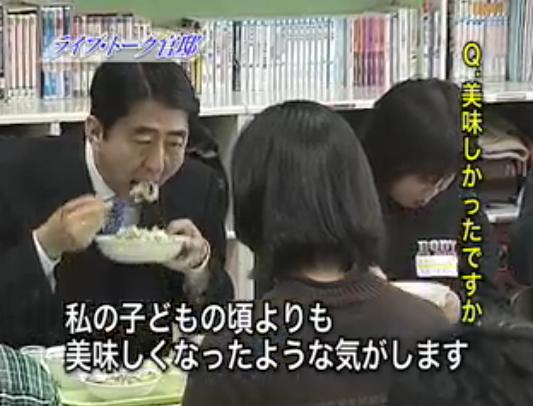
I noted back in October that Abe decided to cut in half his daily press availabilities from 2 to 1. The reports offered no real explanation for the change, but it was significant enough to get reported in the first place. Instead, he is relying on his PR double team of Chief Cabinet Secretary Yasuhisa Shiozaki and Special Advisor Hiroshige Seko to deal with the press while he does the awesome prime minister stuff like eat school lunches.

But it hasn’t taken very long for the media to complain that they aren’t getting enough face time. Abe got in trouble just yesterday when he talked way too long during his press conference announcing achievements upon the end of the recent extraordinary Diet session. He used up 19 minutes of a 20 minute press conference to blab on listlessly about the legislative achievements of passing patriotism-instilling education reform and the promotion of defense agency to ministry status.

The media was livid and ran stories announcing that only 2 questions could be asked, and later reports announcing the forthcoming apologies from both Shiozaki and Abe himself. Abe pledged that it someone made a “clerical error” by giving him a long speech at a press conference. How convenient just a day before you have to fire someone!

Now, I don’t want to go and accuse the major media of manufacturing any of his scandals, or blowing things out of proportion (though they may be doing the latter). It’s just that they haven’t been very sympathetic, either. The Honma scandal came out of a muckraking piece by a less-prestigious weekly. Many reports by the weeklies (such as Abe’s ties to shady cults) are ignored by the larger newspapers, but this time they picked up the story, making the problem much larger than it normally would have been.

It’s strange to see this change in the relationship, since as far as I know, Abe has so far had a rather amiable relationship with the press, who helped raise his image as the hero working to rescue kidnapping victims from North Korea. Now it’s like they’re setting him up for a fall just because it would be a good story.

But rather than being angry, the media could simply be getting bored with a prime minister whose hair is far too normal. One anonymous insider quoted in a Reuters story was sympathetic with Abe’s situation, noting that Abe is in part simply dealing with the Koizumi legacy of staged appearances and neverending soundbites: “Abe is doing what he can, but to the public who’s used to theater-style politics it just looks normal.” Replace the word “public” with “media” and you’ll get the idea.

Ethnicity and airline routing

Over the past couple of years, I’ve made six flights between Japan and the US. Five of these were on American Airlines’ Narita-Dallas/Fort Worth route, which I use because it’s cheap (both of my parents are retired AA employees) and fairly easy to connect to the Carolinas where my family lives.

I’ve noticed over time that there are very few Japanese people on this flight. The usual composition seems to be one-third Southeast Asians (particularly Vietnamese and Filipinos), one-third US military and DoD civilians, and one-third white guys connecting to and from flights to Asia. There are a handful of Japanese sprinkled about the cabin, but not many.

I’m sure that this is largely due to geography. Japanese expats and Japanese-Americans are clustered around the West Coast and the New York metropolitan area: there aren’t that many in Texas, or in any of the neighboring states for that matter. The Asian community in that part of the country is dominated by Southeast Asians.

But I also wonder whether Japanese people are just unwilling to fly American because the economy class service is so poor. I also flew the JFK-Narita route once last summer, and while there seemed to be more Japanese people on that flight, it was still the “local Asians” (mainly Koreans) who seemed to dominate the Asia/Pacific group on board.

Any other experiences of interesting ethnic combinations on particular flights?

ZAKZAK on why Michael Jackson cancelled his Xmas party in Japan

Phenomenal talent but unrelenting freakshow Michael Jackson saw himself back in the news this week when he cancelled a Xmas party that was to be held in Japan. ZAKZAK takes a closer look at what happened:

The truth behind the sudden cancelleation of Michael’s Xmas party
Confusion over hiring Dave Specter as host

Fans of American singer Michael Jackson (age 48) were peeved at the sudden cancellation of the planned “Premium Christmas Party” to be held at Studio Coast event hall in Shinkiba, Tokyo on December 19. A spokesperson for Michael explained that the reason behind the postponement was “to engage with as many fans as possible” and rescheduled the event for March 8-9 of next year. The postponement is enshrouded in mystery, and claims have been made of Michael’s poor health and poor sales of the most expensive Platinum Tickets, priced at 400,000 yen apiece.

According to sources close to the issue, the party originally planned for 200 Platinum Tickets (priced at 400,000 yen each that would have included a photo and handshake with Michael), and 1400 Golden Tickets (just a handshake for 200,000 yen). Jackson himself was not scheduled to perform, but spokespeople explained that “Michael was to watch a show, consisting of gospel and band performances, along with his guests from a VIP area on the 2nd floor.”

Planners began additionally selling 50,000 yen tickets from December 5. Event planners repeated boastful explanations that “Sales of Platinum and Golden Tickets have only amounted to a few buyers, but we have filled the hall.”

At the “do-over” party to be held in March, a “Premium VIP Party” will be held on March 8 with tickets selling for 400,000 yen apiece, and on March 9 ticket prices will be lowered to 15,000 yen for a fan appreciation event.

Michael fan sites have recently expressed mixed opinions, from hopeful (“No matter how expensive it is, there is a corresponding value to Michael in the flesh”) to opposed (“This is a simple ploy to make money and will tarnish Michael’s image”).

The confusion continues, with episodes such as when television producer Dave Specter, approached by event planners to host the March party, declined the offer after protests from Jackson fans.

Dave commented, “Since I have before now made many (critical) statements about Michael as a journalist (tr: He hosted the Japanese version of that interview from a few years ago when Michael insisted that sleeping in the same bed with young boys is all right), I had no choice (but to decline the hosting gig). There are many excitable fans who worship Michael as if he were a god.” He also noted that for the March party “He will probably come on the scheduled date and time since there is a proper contract. The tickets are certainly expensive, but I have heard that inquiries from abroad have been impressive.”

There have been reports that Michael’s health is in bad condition, such as when US tabloid Globe has reported: “He is addicted to painkillers and wine.” However, it looks like Michael will continue to make his fans inpatient right up until the March party.

Comment:It looks like Michael sees Japan as the only place where he can make profitable public appearances these days. What I don’t get is why won’t he perform? If he wants to make money that seems like the most logical way to do it.

Adoption from China

Today’s New York Times reports that they will be tightening the rules on adoptions of Chinese orphans by foreigners due to an over balance of demand vs. supply. The theory is that by requiring more stringent requirements for potential parents, less people will be eligible, and the ones who are left will be wealthier, healthier, and hopefully provide a more stable environment for the children.

China has in recent years been the No. 1 source of foreign-born children adopted by Americans — in the fiscal year 2006, the State Department granted 6,493 visas to Chinese orphans — and its regulations on who can adopt have been less restrictive than those in some other countries, adoption agencies said.

I’m not sure exactly when the first adoption of a Chinese baby by an American citizen was, but I do know that the first attempted adoption of a Chinese baby by an American was in 1906, as I posted the official record of it about six weeks ago.

PEKING, September 6, 1906.

SIR: I have to acknowledge the receipt of your No. 218 of August 21, inclosing copies of your correspondence with Miss Carrie M. Ericksen regarding her proposed adoption of a Chinese baby girl as an American citizen and asking my opinion on the subject.
In reply I beg to say that I can find no record in this legation of a similar
case, but I am of the opinion that under the present laws the child could
not be declared a citizen of the United States through adoption. It might
be possible, however, for her to be brought to America for the purpose of
education under the laws governing persons of exempt classes, but that is
not the point upon which Miss Ericksen desires information.
I have submitted the case to the Department of State, and on receiving a
reply therefrom will immediately inform you of its contents.

Apparently the would-be mother, Miss Carrie M. Ericksen, was unable to adopt the child, but afterwards MAY have been able to obtain an entry visa for the purposes of education. It would be fascinating if somebody could track down the future fate of the woman and the child. Was the little girl brought to the United States? Was adoption ever arranged? Did she grow up in the US on a visa, and then naturalize through the normal procedure upon reaching adulthood?

The Japanese Workplace

At lunch today I heard that a guy working in another department put in a request for an impressive 45 hours of overtime payment. However, while he did do the extra time on the clock, he actually spent most of it just surfing the net. The boss is naturally angry, but since they both live in the same neighborhood, the boss doesn’t want to get in an argument over and cause trouble.

More about Abe eating: Salmon school lunches

Abe kyushuoku Dec 2006 2.JPG

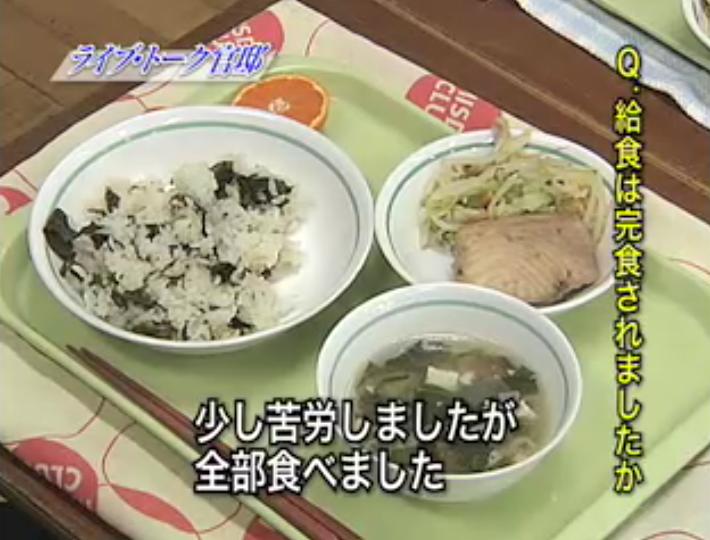
Last week, Prime Minister Shinzo Abe took a trip to some random elementary school where he made a point to eat one of the nationally subsidized school lunches (“kyushoku”) with students. He ate a salmon steak, some wakame miso soup, rice mixed with some kind of seaweed, and washed it all down with a frosty mini-bottle of milk (salmon and milk? Ick!). He remarked it was even more delicious than his old school lunches (which likely included a bit of whale meat) despite having “some difficulty” finishing the whole thing. Here’s what it looked like:

Abe kyushuoku Dec 2006.JPG

And here’s what Abe had to say about the visit in his latest e-mail magazine:

I visited an elementary school in Tokyo last week in hopes of getting a feel for the educational environment children are in today and talking to them in person.

It was my first visit to an elementary school in the 40 years since I graduated from my own. Over lunch, I had a chance to hear, in their own words, what children are really thinking. Many shared with me that they enjoy extracurricular activities and sports. They also asked me unpretentious questions, such as, “As a child, did you have a goal in life?” These questions reassured me that children have hopes and dreams for what they want to pursue in the future.

I was a bit worried that the children would tense up with the press crew in their classroom, but the close bond the class shared and the warm smiles they gave me as we talked impressed me strongly.

I have kept in close touch with my elementary school friends, meeting with them frequently even now after 40 years. Exciting
times spent together with friends, even if you occasionally argue, will become a precious memory later in life. It is my hope that
children will possess the kindness to go over and talk to another child they see all alone. I was able to convey this message during
my visit to the school.

While he also added some token call to action against evil bullying activities, I couldn’t help but focus on and feel jealous of the delicious-looking lunches these kids get to eat. I never once got a taste of salmon during my US education, though perhaps it’s all the better since I wouldn’t have trusted my lunch ladies to prepare fish anyway. Still, it’s no wonder Japanese kids are so much healthier. Well, that and the constant endurance tests that they call phys ed class and extracurricular sports.

ZAKZAK on why Dragon Quest is back on Nintendo

The Dragon Quest/Dragon Warrior series (one of my favorites) has made the move back to Nintendo from Sony, starting with Dragon Quest 9 on the DS. Why?

According to ZAKZAK, an industry insider explains: “The key can be found in the DS’s surprisingly strong sales. Currently, the cost of developing a game ranges from 300-500 million yen, but that will jump to 800 million – 1 billion yen with next-generation systems such as the PS3. Most developers who got a look at the PS3 when it made its first appearance as a demontration system at the Tokyo Game Show were intrigued by the clear images but did not get it in their heads to go that far themselves in game design. It would just cost too much.”

Games on portable systems cost much less to develop. And the DS is already a monster product, clocking 12 million units in sales since its release in December 2004. And of course games for that system have been hits as well, such as the “New Super Mario Brothers” and “DS Brain Training.” Add the latest installment of Dragon Quest, one of the top console series ever, to that lineup would be tantamount to “arming an ogre with an iron staff” in ZAKZAK’s vernacular (an analogy akin to “pouring gasoline on a fire”). Future DQ games will be released on the Nintendo Wii.

However, DQ series developer SquareEnix is not putting all its eggs in the Nintendo basket. The new Final Fantasy games will continue to be released on the Playstation as the company announced in May. SCE is also a major shareholder in SquareEnix.

Burger King Returning to Japan!

From the people who brought you Krispy Kreme Japan (which opens today) comes another wonderful fast food innovation: Burger King will be coming back to Japan! Unfortunately, they’re aiming to be a Mos Burger-style “high class” fast food chain and are thus charging a “whopping” 700 yen for a value meal.

Still, BK in Japan will help alleviate some homesickness as it does here in Thailand. What could be next, a cheap, delicious bagel outlet? One can only hope.

Given my elated gratitude at such news, I am more than happy to reprint the company’s press release on the matter, which ran as a story in Friday’s Nikkei:

Burger King To Return To Japan With Help From Lotte, Revamp

TOKYO (Nikkei)–Lotte Co. and turnaround firm Revamp Corp. have entered a franchise agreement with Burger King Corp. of the U.S. and will start opening stores of the hamburger chain in Japan next summer, The Nihon Keizai Shimbun learned Thursday.

Lotte and Revamp have set up a company for the operations, with Lotte kicking in the bulk of the funds.

The partners hope to have eight directly run stores by March 2008. They plan to expand the chain to 50 locations, mainly in the Tokyo area, by March 2010 and to 100 by 2012.

This marks a comeback for Burger King, which entered the Japanese market in the 1990s in cooperation with the Seibu Railway Co. group and Japan Tobacco Inc. but withdrew in 2001 in the face of poor results.

Burger King will promote its burgers in Japan by stressing the fact that it flame-broils its patties rather than heating them on a grill.

A set of a burger and a drink is expected to cost around 700 yen — 30-40% more than is charged by the Lotteria chain, which is run by Lotte. McDonald’s Co. (Japan) charges around 500 yen for a similar meal, while Mos Food Services Inc. and Freshness charge about 700-800 yen.

Lotte plans to turn its Lotteria chain, Krispy Kreme Doughnuts stores, which will begin opening in Japan this month, and Burger King restaurants into three main pillars of its restaurant operations.