Stimulus or investment? Japan vs. USA

Ever since the start of our current financial disaster various economists and pundits have been comparing first the US banking problems with Japan’s, and then more recently the infrastructure-heavy stimulus program with Japan’s construction state. Today’s NYT has a substantial article that easily marks the most high profile comparison yet. I’m certainly no economist and I’m not even taking the time to look at numbers right now, but my quick take on the issue is that the comparison is being significantly overblown, but it is still a very worthwhile comparison to make, so that Japan’s various successes and mistakes can be absorbed as lessons. See the following summation of Japan’s massive pork spending:

Dr. Ihori of the University of Tokyo did a survey of public works in the 1990s, concluding that the spending created almost no additional economic growth. Instead of spreading beneficial ripple effects across the economy, he found that the spending actually led to declines in business investment by driving out private investors. He also said job creation was too narrowly focused in the construction industry in rural areas to give much benefit to the overall economy.

He agreed with other critics that the 1990s stimulus failed because too much of it went to roads and bridges, overbuilding this already heavily developed nation. Critics also said decisions on how to spend the money were made behind closed doors by bureaucrats, politicians and the construction industry, and often reflected political considerations more than economic. Dr. Ihori said the United States appeared to be striking a better balance by investing in new energy and information-technology infrastructure as well as replacing aging infrastructure.

Japan’s huge boom in public works spending was less a national stimulus program than a gigantic rural welfare program of pork-barrel projects designed to prop up the ailing LDP in its long decline. The money was largely directed not to the areas where it would benefit the largest number of people, but the areas where it would benefit the largest number of politicians. This was not done entirely out purely cynical political motives but also due to a genuine desire to arrest the decline of the rural regions themselves, in the face of continuing urbanization and a decline in Japan’s traditional and lionized (if anachronistic) agricultural lifestyle. Regardless of intent, a huge proportion (I won’t use words like “most” without looking at actual numerical research) of the spending was “stimulus” but not “investment”.

I am very, very wary of the general principal of “economic stimulus.” I am not opposed to government spending, or even large amounts of government spending, as long as it is being spent on something that is actually necessary or build further value in the future, i.e. services or investment. I think this attitude should be obvious from the mass transit funding letter I wrote and posted here a few days ago. In short, I worry that the discussions on spending currently ongoing in Washington may turn into a series of worthless boondoggle projects oriented at unpopulated rural areas, combined with random tax cuts and other expenditures poorly aimed at short-term (i.e. one election cycle) economic recovery, while continuing to ignore the trillions of dollars in outstanding repairs or upgrades as well as vital new investment that the country needs. I think it’s safe to say that politicians are going to spend this money. The question is, what will it buy us? Would we rather have a bunch of bridges to nowhere, vacant museums and amusement parks in virtually deserted rural towns, and paved-over mountain tops, or would we rather have a modern electrical grid, mass transit that at least meets late 20th century standards if not 21st century, a safe and reliable water system, bridges rated to not collapse, and maybe even an adequate system of public health care?

A hypothesis regarding Japanese universities

The Japanese university model of education is in reality more like a European model in which most of the work is focused on seminars and final projects, and where most lectures and other courses are borderline optional. However, due to post-WW2 reforms the Japanese university system is institutionally based on the American model, and therefore has a superficial structure of grades, credits, homework, etc. that is often but weakly related to the more important areas. This disconnect makes Japanese universities (which do have serious problems) look even worse than they really are, and in fact contributes to their degradation.

As a hypothesis I haven’t thought about this too hard or looked for any evidence but would like to see some discussion. Thoughts?

The original fortune cookie

This may shock you, but fortune cookies are not Chinese food, nor are they really Chinese-American food. They started out as a Japanese product, and were copied by Chinese-Americans in San Francisco decades ago to form the dessert staple of cheap Chinese restaurants across the US. (This was detailed in a New York Times article last year, and linked by Roy in a post which I somehow missed; I learned of it from watching the author of said article, Jennifer Lee, give this fascinating presentation on the evolution of Chinese food outside China.)

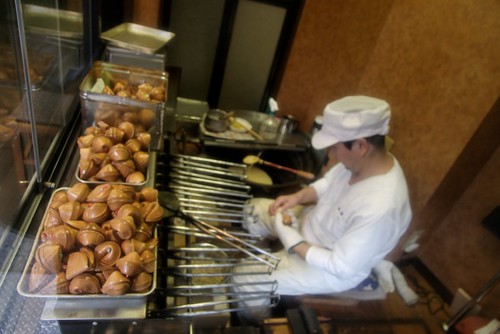
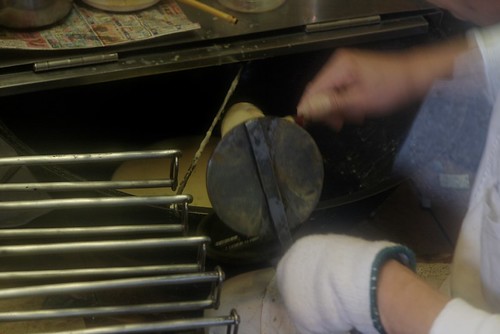
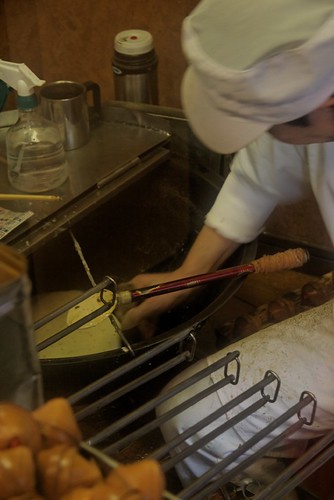
The predecessor of the Chinese-American fortune cookie is the tsujiura senbei, a cookie made of flour, sugar and miso which is sold at certain shrines. According to Wikipedia, it comes from the Hokuriku region. But after some Googling, I found out that these are still made and sold at the Fushimi Inari Shrine in Kyoto, and since I was visiting the city anyway, I decided to track some down. Sure enough, they were being sold in a few shops near the shrine, including one shop where they were being hand-made by an old fellow with a cast iron machine (as per the NYT article, which I didn’t discover until later).

As you can see, it’s larger than a fortune cookie, and the fortune (omikuji, actually) is held by the cookie’s fold rather than inside the cookie itself. In fact, there’s another surprise inside the cookie:

Those are dried soybeans, which serve to give the cookie a pleasant rattle as you shake it around. Hence the alternative name suzu sembei or “bell cookie.” I’m sure this was intended to please a hard-of-hearing Shinto deity, or something like that, but to me it was just an interesting modification on the fortune cookie style I grew up with.

The actual fortune looks like this:

And I’m pretty sure that it’s funny when you add “in bed” to the end. Some things are simply constant across cultures…

[Updated by Roy]

Unfortunately I had forgotten to charge my camera battery that day, but I got a few shots of the cookie making process before it died. They aren’t great, but I think you can get a fair idea of it.

What Joe forgot to mention-and this is critical information-is that they are miso flavored! There was a sign in all the shop windows saying this, and advertising that no eggs are used. Trying for the vegan market?

Mass transit pleas sample letter

I’ve posted the sample latter I published here the other day on a few relevant Facebook groups to try and spread the word, but I want to remind any registered-to-vote American readers to follow up on this. I know everyone reading this is a train fan. You’ve either been to Japan or Taiwan or you want to go, and that means you appreciate what real mass transit infrastrucute can do for a county. If you decided to go ahead and send my letter or a modified version, great-and if you decided to write your own, send it to me or post it here to share.

Mass transit plea

Having been rather frustrated by the lack of much serious discussion of guiding any of the so-called stimulus money towards investment in much needed mass transit infrastructure upgrades, I decided to compose a letter to my two Senators and one local Representative asking them to work towards this agenda. I’ve attached my text below, and I implore registered USA voters to send a similar letter to their own congressional delegation, and to pass along a request to potentially interested registered voters you know. So few people actually write politicians on these issues that a surprisingly small number of contacts can, on occasion, spur them to take at least a mild stand on an issue. This is the first time in many years that Congress has even considered taking an interest in mass transit/rail investment and we mustn’t let it pass Continue reading Mass transit plea

Shimamoto v. United and Japan’s legal attitudes toward alcohol

One of the odder legal stories of 2008 may have been a certain lawsuit against United Airlines by a certain Yoichi Shimamoto and his wife Ayisha. FlyerTalk had a big thread on it. Here’s a quick summary of what happened:

The Shimamotos were on a United flight from Japan to the US in business class, where alcohol is free and generally quite readily dispensed. Mr. Shimamoto became thoroughly trashed on the flight, and apparently a little belligerent. After deplaning at their first stop in San Francisco, while the couple was waiting in the immigration line, they got into an altercation of some sort and Mr. Shimamoto started beating his wife in public. He was arrested for assault, tried and convicted, and sentenced to probation in California followed by deportation to Japan.

Then it gets really weird. First, Mrs. Shimamoto successfully petitioned to have Mr. Shimamoto’s probation transferred to Florida, where Mrs. Shimamoto had a house. Then, with Mr. Shimamoto safely parked somewhere around Orlando, the couple sued United in Florida for Mrs. Shimamoto’s physical injuries and Mr. Shimamoto’s legal expenses, claiming that United should not have served more alcohol to Mr. Shimamoto while he was obviously wasted out of his mind. After a couple of weeks of spirited online discussion between armchair pundits, the Shimamotos withdrew their case. Perhaps United offered a settlement of some kind–the news reports do not say.

* * *

Although the gut reaction of most is to say “Ah-ha! Frivolous American litigiousness strikes again!” it’s actually quite easy for a booze server to incur tort liability because of their drunken patrons’ malfeasance. Every US state has some sort of “dram shop act” which imposes this sort of liability. Sales to minors are pretty much universally a basis for seller liability, and sales to the visibly intoxicated can lead to liability in many states.

Extending this general concept to an airline is not that illogical, although perhaps inconsistent with the fact that airplanes don’t really fall under a particular state’s jurisdiction while in flight (although the airlines themselves, which are tied firmly to the ground, might). Another hurdle is that most international flights fall under the Warsaw Convention, which caps the carrier’s liability for physical or property damage to passengers.

Of course, the real oddity in the Shimamotos’ case is that it wasn’t just the battered wife who sued–it was also her husband, who wasn’t really hurt except to the extent that he got himself in legal trouble. Still, the question of making airlines responsible for cutting off their patrons is an interesting one, and it may someday be solved in court by a more credible group of litigants.

* * *

A few posters at FlyerTalk have raised the question of whether Japanese law (and, by extension, society) condones or even encourages the practice of passing blame to the liquor or its server.

To some extent, this idea is actually getting traction in Japanese law, at least as far as The State is concerned. Anyone who eats out regularly in Japan has probably noticed the growing number of establishments that proudly state they will not serve alcohol to customers who come by car–this is largely because Japan’s revised Road Traffic Law of 2007 makes it a criminal offense for a restaurant or bar to provide alcohol to a person “at risk of” drunk driving. Another example is serving booze to minors, a crime under the “Fuzoku Eigyo” Act (which governs the nightlife industry generally) which can land the proprietor in jail.

Civil liability between private parties is a different story, though. It’s pretty well known that Japan is not a very litigious society–depending on which expert you ask, this is either because of cultural reasons (aversion to argument) or economic reasons (filing fees in Japanese courts are based on claim amount, so big lawsuits on a marginal basis are uneconomical to file, whereas the US system of charging flat filing fees encourages outlandish claims that can be whittled down through negotiation). So it shouldn’t come as much of a surprise that suing the bar for the drunkard’s acts has been less of a question in the Land of the Rising Nama.

It does come up, though. The scariest case for the bartender must be a 2001 case in Tokyo (noted in the Japanese Wikipedia article on drunk driving) where a group of friends drank for seven hours straight, got in a car and ran over a 19-year-old girl. The driver got seven years in prison, but his friends were found civilly liable to the tune of 58 million yen for having the guy drink while they knew he was getting behind the wheel. But in a more distant commercial context, there seems to be some reluctance to extend liability like this. Take one case in Saitama last year where families of victims of a drunk driving spree demanded that the barkeep’s criminal responsibility was as great as the driver’s. The judge handed down a suspended sentence for the alcohol providers, claiming that “there is no evidence that [they] expected the driver to act so recklessly (運転者の常軌を逸した暴走行為まで予見していた証拠はない).”

What’s the conclusion? Japan has a looser attitude toward alcohol in many ways (when’s the last time you’ve been carded here?) but its system can be pretty harsh on people who completely ignore its dangers. Thankfully, Mr. Shimamoto wouldn’t have much legal support under either system: the only tangible difference between the two countries in his case is that he can actually afford to waste the court’s time in the US.

Old news of Montclair

I decided earlier today to write something about Montclair, the town where I grew up in New Jersey, and spent a few minutes looking through the free NYT archives to see what I could find. That post will be up another day, but here are a few of the amusing articles I turned up.

Graham and Kim

Our friend Curzon over at the Cominganarchy blog posted last week an excellent piece on the history of the involvement between the familes of the Reverend Billy Graham and the Kim dynasty of North Korea. The connections are, as usual, longer and more interesting than one would expect from just reading the news. I highly recommend reading it.

The Masonic Bible

Slate’s Explainer column is always a good read, but this week’s installment on the bibles used for presidential inaugurations was particularly amusing.

George W. Bush wanted to use the Washington Bible for his first inauguration, as his father had done, but the plan was foiled by drizzly weather. The Masons are extremely careful with the Washington Bible: They refuse to let the artifact be X-rayed at airport security and demand that the president be the only one who touches it without gloves.