To tie in with the world-wide media extravaganza that is the release of the final volume of the megaselling Harry Potter series, today I would like present scans from three lesser known sequels in my collection.
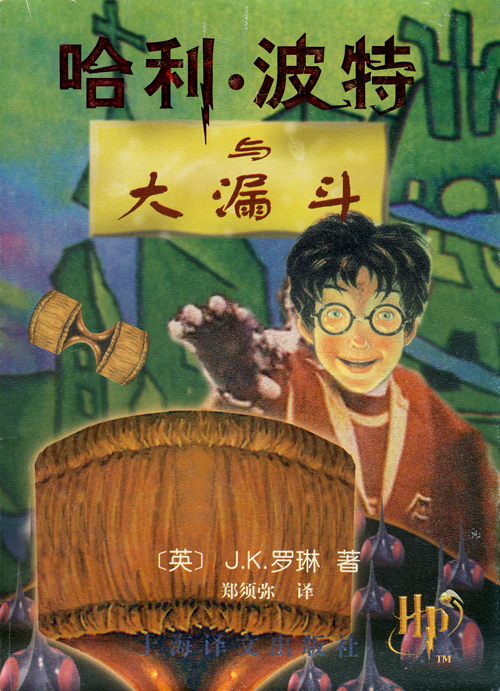
First is the China exclusive 2002 release, Harry Potter and the Filler of Big, a title made only slightly less mysterious when one realizes that the Chinese title translates rather more accurately into Harry Potter and the Big Funnel, although you’ll need someone with better Chinese than mine to describe the plot of this gloriously audacious illegally published novel-length fanfiction.
If you look at Sino-Japanese text printed in the Chinese Song or Japanese Mincho typeface (similar to serif typefaces in European languages), you’ll notice that the horizontal strokes in characters are much thinner than the vertical strokes. Here’s why:
The printing press appeared in China during the Song Dynasty. At the time, each print block contained two portrait-oriented pages placed side by side. The print blocks were all cut from rectangular planks such that the wood grain ran horizontally. Because the grain ran horizontally, it was fairly easy to carve patterns with the grain, like horizontal strokes. However, carving vertical or slanted patterns was difficult because those patterns intersect with the grain and very easily break. This resulted in a typeface that has thin horizontal strokes and thick vertical strokes. To prevent wear and tear, the ending of horizontal strokes are also thickened. These design forces resulted in the current Song typeface.
I haven’t been posting lately due to a variety of reasons, most of all are my move back to the US this coming Sunday, and the absolutely wretched chest cold/cold-like disease that has floored me well enough so that my packing and other preparations for moving leave me utterly without energy.
Which brings me to my discovery of the day- that many brands of over the counter (i.e. non-prescription) cough medicine in Japan contain codeine. I find this rather surprising considering the general strictness of pharma regulations in this country, such as the rule that even drugs as mild as aspirin cannot be sold except in a pharmacy, which means that if you have a headache late at night the only medicine you’ll find in the corner convenience store that can help you is going to be whiskey.
In a related bit of trivia, I was bit puzzled to learn that due to a quirk in the Taiwanese legal code, ketamine has become the new drug of choice there for teenagers. According to the Taiwanese (Republic Of China) narcotics control law, ketamine is classified as a “minor” or category 3 drug, which means that possession is only a ticketing and not criminal offense. Oddly, cannabis (marijuana) is a category 2 drug, along with cocaine, morphine, and about 150 presumably dangerous chemicals I’ve never heard of-despite that fact that the aforementioned category 3 ketamine can actually be fatal in large doses (although rarely.)
Incidentally, cannabis is fairly strictly banned in Japan as well, following the 1948 passage of the Cannabis Control Act, which is said to be based on the corresponding American law. I have read in a couple of places that cannabis consumption was in fact a part of Japanese religious practice until quite recently-which considering the existence of names like 麻生 and 麻美 seems quite believable-many people in Japan actually believe the Reefer Madness version of reality. Still, while I don’t expect a more rational drug related policy in any of the three countries I have lived in (US, Japan, Taiwan), at least the availability of over the counter cough syrup with harmlessly small doses of codeine is a bright spot of common sense.
Amazingly creepy! The pandas are going to haunt my nightmares for sure. Video is in Japanese, but you don’t need to understand to get creeped out with the fake Disney characters.
Unfortunately, Shukan Bunshun reports that the extra attention this Bizarro wonderland has gained is causing the managers of the state-run park to cut back on the flashier piracy.
Sylvanian Families is a line of Japanese-made toys featuring doll houses and anthropomorphic animal pals, “a quintessential part of the 1990’s boom in craze (or fad) toys” says Wikipedia. This little guy was greeting shoppers outside a Sylvanian specialty shop at Central World, a Bangkok mall with kind of a nonsense name:
After this photo was taken Mrs. Adamu and I helped ourselves to copious free samples at the mall’s upscale supermarket (hummus and pita anyone?) and watched the movie Sunshine (the new one by 28 Days Later/Trainspotting director Danny Boyle that’s not released in the US yet) for the equivalent of US$12 for two, with popcorn. Hm, I may have the dates mixed up on that (it might have been Deja Vu that I saw instead) but basically that was a good spot for myself and Mrs. Adamu.
Back on February 1st I wrote a post on the battle over the “Kokaryo” (光華寮) Chinese students dormitory in Kyoto, between the Republic of China and the People’s Republic of China. Those who don’t remember the details of the case or need a refresher should read my initial post on the subject and/or some of the linked news articles.
Since my initial report the case, which 40 years after filing was apparently the longest running lawsuit in Japan, has ended-at least in its current form. While the outcome of the case was exactly what the PRC wanted for diplomatic reasons, it was still not technically a complete success in terms of the primary substance of the lawsuit.
Note that Yomiuri Shimbun’s March 28 headline, “Top court rules China, not Taiwan, owns dorm” is factually incorrect. In fact, the court ruled that because the lawsuit was originally filed by “China” and that recognition of “China” has shifted from the Republic of China (Taiwan) government to the People’s Republic of China (Mainland China), not Taiwan but the PRC is now the plaintiff. The original lawsuit was filed by “China” as represented by the ROC (Taiwanese) authorities against the Chinese (mainlander) dorm residents, whom the ROC wanted to evict due to their support of the PRC. While the defendant was technically the individual students, they were supported by the PRC government, and the case essentially became ROC vs. PRC vying for control of the dorm, even though the original motion that started the trial was calling for an eviction order of the mainland Chinese students from the dorm. Because the original lawsuit was filed by “China,” the court’s judgment that “China” was now represented by the PRC and not the ROC meant that in essence the People’s Republic of China was now playing both sides of the field, and as the plaintiff they had the right to decide not to continue prosecuting the case. In fact, it seems that the court never ruled on the primary issue of property rights one way or the other, and technically their decision allowed the plaintiff to continue to pursue the case by having it returned to the Kyoto district court, which they naturally did not do.
As PRC Foreign Ministry Spokeswoman Jiang Yu said in a January 26 news article, “The Guanghualiao [note: “Guanghualiao” is the Chinese pronunciation of “Kokaryo”] case is not merely a property case, but a political case concerning China’s legitimate rights.” While China has always insisted that this is a political case and has publicly demanded satisfaction from the Japanese government, Japan has always pleaded separation of powers, and insisted that it was both illegal and impossible to intervene in the court system for diplomatic and political reasons. However, some observers find both the timing and verdict of the case suspicious. Coming on the heels of Chinese Premier Wen Jiabao’s highly publicized and politically significant official visit to Japan, cynics might suspect that the Japanese government did in fact “encourage” the court to resume the long-stalled case, and adjudicate it in China’s favor as a subtle diplomatic gift to counterbalance moves by the Japanese administration over the last few years to strengthen diplomatic and military ties with Japan.
Despite the high court’s decision that the PRC was in fact the plaintiff in this case, which has effectively nullified all of the previous judgment’s in Taiwan’s favor, there is still a chance for Taiwan to prevail in their property rights claim. The April 4 Taipei Times reported that Taiwanese authorities were looking into how to continue the case, despite having lost the standing to pursue the lawsuit as originally filed on behalf of the Republic of China. “We will continue our fight, considering the possibility of a fresh civil lawsuit or other legal means,” said their attorney Noriyasu Kaneko. According to an April 21 Kyoto Shimbun article (apparently not available online), Taiwan is in fact planning to file a new motion in the Kyoto court asserting their property rights as a “body” and attempting to sidestep the entire hornet’s nest of “one China” and diplomatic recognition. While this case has been a victory for China and a potential danger for Taiwan’s property rights abroad, it is also worth noting that the original premise of the case, that the ROC is the proper representative of “China” is a decades old doctrine that is effectively disavowed by the current Taiwanese administration anyway. Although I doubt that there has been anyone in Taiwan celebrating this verdict, it can also be looked at as the collapse of yet another piece of the “One China” diplomatic fiction. Now that Taiwan no longer has to pursue this Chiang Kai-shek era lawsuit based on the obsolete premise that they are the “One China,” there is at least some sliver of hope that they can turn around and use the new lawsuit to reassert their rights as a body separate from China.
I’ve finally arrived in Japan to live after spending almost 4 years away, save for some brief visits. My blogging up to now has been a way for me to keep up on Japanese current events from the outside. But now that I’m here and have easy access to TV, ads, products, marketing campaigns, convenience stores, books, etc, I’m going to have to make it about something else. I’m still kind of thinking about that.
But first, some good things about coming to Japan:
Cleanliness: I swear, I would be more comfortable sleeping on the Tokyo sidewalks than on the floor of my college dorm room. That’s how clean this place is. Perhaps I’m just surprised at the relative difference with unabashedly filthy and smelly Thailand (a trait which, btw, takes nothing away from its charm).
Awesome food: Thai food is amazing, and I miss it to death (and all the real American food that’s available in Bangkok) dearly. Still, Japanese food is fresh, delicious, and healthy. I haven’t felt this clear-headed and energized in months.
Speaking the language: My spoken Japanese is very rusty (and was never all that great to begin with), but it is still good enough to do whatever I need to in life, unlike Thailand where I had to wildly gesticulate and scream a mix of English and the few Thai phrases I knew to get anything done at all. That’s another major source of stress lifted.
Fast Internet: In Thailand I was suffering with a crappy DSL connection that was slow, required quirky proprietary software. On top of that, the authorities banned YouTube out of the blue 2 weeks ago because of a video defaming the king. The connection I’m using now is a smoooooth hikari fiber line that lets me get the new Sopranos in less than 2 hours.
Japanese bookstores: I love Japan’s weekly magazines and manga, and Japan is, obviously, Japanese literature heaven. When I get some time I need to head over to my local library.
Lame things about being in Japan:
Bad TV: Even though I couldn’t understand it, I knew I hated Thai TV, in particular the comedy shows, that constantly feature slide-whistle punchlines, wah-wah-wah sappy jokes, and Munsters-style fast forward action. Ick. Japan’s TV shows have a bit fewer of the vaudeville trappings, but watching crap like Kazuko Hosoki still leaves me feeling like my IQ is being sucked into the TV. The TV news analysis shows are usually really lame too.
Expensive! I need to move closer to Tokyo fast because now just going there costs about 2000 yen. Going out to lunch is easily 3000. How does anyone manage to save money?
Cold! It’s been like winter since I came here, which has jarred me after coming from Thailand. It’s going from one extreme to the other: In Thailand I had only spotty A/C in the middle of intense, constant heat, and here there is no central heating when it’s cold.
Japanese culture: For some reason I feel forced into things a lot of the time. I realize I can’t come to this country and act exactly as I did in Thailand or Japan, but this isn’t North Korea and I’m not Private Jenkins.
All in all, I’m excited to be here and start my married life (filed the papers on Monday) and get back in the game with my career after almost a year of translating at home in a situation my wife calls “house arrest.” I’m not sure what I’ll be blogging about from now on, but expect more translations and my occasional thoughts and pictures.
The First Exhibit to Offer an Expansive Look at Thailand’s Modern Art History
From April 18-May 20, the Museum of Contemporary Art Tokyo will hold Show Me Thai, an exhibit jointly produced by the Kingdom of Thailand’s Office of Contemporary Arts and Culture, to commemorate the 120th anniversary of Thai-Japanese friendship.
This is the first attempt to take an expansive look at Thailand’s contemporary art history. The exhibit will take visitors from the country’s early contacts with Japanese culture, which started before World War II and progressed through Japan’s era of high economic growth (1955-1975), to the time of high GDP growth in Thailand (1986-1996), when the Buddhist kingdom absorbed massive amounts of Japanese pop culture, including manga, music, and fashion, all the way to the present day.
A diverse array of pieces, including paintings, sculptures, mixed media, video, installations, cinema, animation, and music will be displayed throughout the museums’s exhibition space. And that’s not all – the artists themselves will be there to participate in performances and panel discussions.
Among the 60 artists and groups participating (Links lead to samples, mostly, or at least a picture of the artist):
The museum is open from 10AM-6PM, and will be closed on all Mondays save for April 30. The museum is easily accessible by Tokyo Metro, Kiyosumi-Shirakawa (清澄白河) Station on the Hanzaemon and Oedo Lines.
Disclaimer/self-promotion – I learned of this event because a translation I did about Thai-Japanese contemporary art exchange will be featured in the exhibit’s ‘art catalogue,’ with full ‘translator’ credit! This doesn’t exactly mean a whole lot, but I’m pretty excited to go see this, not least because this is my first time being published but also because I just might get to take in more Thai culture in Tokyo than I did when I lived in Bangkok.
Buried in the second half of a Japan Times story about Japan’s dogged pursuit of resolution over the North Korean abduction issues was the following.
A Japanese citizens group is one step closer to getting approval to air Japanese-language programs intended for Japanese nationals abducted by North Korea.
The International Telecommunication Union, a Geneva-based body set up to standardize and regulate international radio and telecommunications, informed the government Monday that it is prepared to allocate a shortwave frequency band to the group, sources said.
Seriously? They want to actually broadcast programs specially prepared for a population which is at most 8 people, but which North Korea claims is actually zero? Personally, I have always suspected that North Korea was being entirely truthful when they said that the remaining abductees are all dead, but that they are probably trying to cover up the circumstances of their deaths, whether by suicide, execution, starvation, or whatever unpleasant means it was.
But even if North Korea was lying and the 8 are still alive, this is still an absolutely mind-stunningly dumb plan. First of all, there is the fact that short-wave radios are entirely banned in Korea-the only radios permitted for non governmental use can only be tuned to government preset stations, which presumably does not include “Japan Abductee News.” And think about the staggering inefficiency of this plan. How much effort exactly do they propose to spend on preparing radio broadcasts that have a virtually zero chance of getting to the intended audience, which let us remember is only eight people to begin with! I can sort of understand the enormous efforts to actually retrieve or at least discover the fates of kidnapped citizens, but why send out messages that a: probably no one will here and b: even if they did, no-one back in Japan would ever know that they had heard it.
Animation Produced in Small Teams is a Breath of Fresh Air for the Industry: FROGMAN Co., Others Showcase A Powerful Individuality
March 13, 2007
Animation produced in small teams have been hitting the market one after the other recently, which is a new development as works are usually produced in production teams of dozens or even hundreds of people. The new works, which maintain a high level of quality while showcasing the creators’ intense vision in every nook and cranny, a feat that can only be achieved in a small team, are blowing a new wind throughout Japan’s animation industry. (by Ryuichi Taniguchi)
Improved Performance of PCs Plays a Role
Makoto Shinkai, director of “Five Centimeters Per Second” (秒速5センチメートル) gave thanks before the 200 people who had gathered to watch his animated film shown at Cinema Rise in Tokyo’s Shibuya Ward on March 3: “I am happy to show a film that I made the way I wanted it in a large space.” This was his first film since his long-form “Beyond the Clouds, at the Promised Location” (雲のむこう、約束の場所) was shown at the same theater in November 2006. He seemed to have felt a positive response from the excited crowd of waiting fans that filled the seats.
In the past, animation production was assumed to require a large staff, but Shinkai released his first 25-minute short “Voices of the Stars” (ほしのこえ) created almost entirely by himself on a PC. The imagery, which measures up to animation made by pros, and the story, about susceptible young men and women, made the piece a hit with the younger generation and gained its creator recognition as a member of the new generation of animation directors.
However, Shinkai did not choose the path of producing his work in a major studio with a large staff at his beck and call. He continued using PCs and producing his films with a small staff to complete his “Beyond” and the more recent “Five”.
Shinkai explains, “For a year and half, I had the animation staff come to my home, and created it at a steady pace using my desktop. He didn’t create the whole thing by himself as in “Voice of the Stars,” but he made drastic staff cuts compared to the number of people involved in “Beyond.” As a result, Shinkai was able to realize a film in which his vision crept into every nook and cranny, from depictions of the lyrical countryside, to the village landscapes, to the endless sky and ocean.
Productions that can make full use of the creator’s individuality because of such a small staff are made possible by high-performance PCs that can be used to draw, color, and even edit finely detailed images. It’s easy to see how individual creators like Shinkai can make it into the animation industry if they have talent and backup in terms of funding.
Product Placement Comes to Anime
The films produced by FROGMAN Co, led by a man who goes by the same name, were also born of superior talent, a PC, and the Internet. The company creates animation using Flash, an animation software that can play simple video on a PC, and began offering programs on the Internet starting in 2004. These short films gained an following, and in April 2006 FROGMAN’s “Falcon’s Claw, Secret Society” (秘密結社鷹の爪) debuted on TV Asahi.
On March 17, “Falcon’s Claw, Secret Society The Movie: The Fuhrer Dies Twice” (総統は二度死ぬ) opens in theaters. FROGMAN spoke at a sneak preview held in Roppongi on March 4: “I’m so happy because cinema is the apex of film.” Just as in the TV version, FROGMAN does almost all the voices himself and drew most of the animation. He was overjoyed to see his brainchild up on the big screen.
The big-screen version of course cost more, but the costs were covered by including product placement within the film. Since it’s a comedy, the film blatantly displays company logos and products to make the crowd laugh. They even included a “budget gauge” on the side of the screen that dips during the more elaborate CGI scenes as a gag for the audience.
Another Internet-based talent is Rareko. She published her work on the Internet and eventually worked into picture books and DVDs after they became popular. As more and more companies seek out dormant talent, it looks as though we’ll keep seeing unique, individual animation.
The Companies Backing up Individual Talent
Individuals’ talents can only blossom fully with the support of a corporation. Shinkai has received support from Comics Wave (headquartered in Shibuya) since he began work on “Voices”. CW is a company that manages publishing rights for content and scouting/development of creators. They contract with manga artists and illustrators and serve as a conduit for bargaining with companies that want to use the creators’ characters.
DLE (HQ: Chiyoda Ward), a company founded in 2001 as a company that provides consulting for the video content industry, serves as FROGMAN’s producer. In addition to producing television programs, the company also aids in Flash animation and helped bring FROGMAN into the limelight.
Fanworks (Shibuya) produces independent animation and supports Rareko, of “The Fragile Tank” (やわらか戦車) fame. When the Internet-based animation took off, they served as a conduit for commercialization demands and helped boost its popularity by forming the “Fragile Tank Coalition Force.”
—
To close out, here are some YouTube clips of some of the shows mentioned in this article:



 From April 18-May 20, the Museum of Contemporary Art Tokyo will hold Show Me Thai, an exhibit jointly produced by the Kingdom of Thailand’s