The Tortured Japanese Decision Making Process, Part 1: Dubai and Futenma

UPDATE: When I read the blog on my Etisalat-serviced Blackberry over the weekend, I was horrified to see that the text of this post was substantially abridged to just three paragraphs and slightly edited for flow to remove all references to Dubai (excluding the title). When I finally got to a computer today, I see that it appears unedited, even on my Dubai computer. I remain perplexed as to what would be deemed critical of the UAE in this post that could have been material subject to censorship. –Curzon, 13 December.

I haven’t yet publicly explained to MF readers, but I recently relocated my permanent residence from Tokyo to Dubai. I’ve since been publishing most of my thoughts on my new life in the region at ComingAnarchy.com, a more appropriate forum for the material, and you can read dispatches from the region in recent posts that appeared here, here, here and here. However, I am still remain closely involved in Japan, and will continue to blog here on topics that relate to Japan and Asia. I am also on a flexibly but ultimately fixed term assignment in the Middle East and plan to return to Japan afterwards.

A move between civilizations such as this clearly reveals contrasts between cultures. From the mere provision of services, to the exotic types of food, to the very manner in which human beings interract, many things are different. I could list dozens of example, but it’s primarily the quirky differences that stick in my mind. For example, did you know that the number of bathrooms in apartments and houses in the Middle East is the number of bedrooms, plus one? Apparently Arabs are loathe to share bathrooms, even with family members, so every 2LDK has three bathrooms (the additional bathroom is for guests) and one 3LDK with a maid’s room I saw during my house hunt had five bathrooms! There are also similarities between the two cultures when viewed from the Western perspective — Arabs, like the Japanese, are polite and formal when first meeting, prefer their commercial transactions to be relationship-oriented, and don’t allow their women equal social participation.

One stark contrast with regards to culture that sticks in my mind is the decision-making process. I’ve become accustomed to the concensus-based approach to making decisions in Japan, to the extent that Japan’s norms are natural to me — take time to hear all opinions, discuss pros and cons, think some more, and then eventually wander towards a decision. This works fine in Japan, but it’s completely different in most of the rest of the world, and in the Middle East, I’ve seen some important decisions made at the drop of a hat. What’s more, when I need to decide things that involve other people, I see the Japanese decision-making process reflected in myself, and I would observe that it has the power to drive people crazy. “Make a decision already! Or get back to me when you’re finished!” That’s something I’ve heard several times in both the personal and commercial context over the past few weeks.

The Japanese decision-making process works great in Japan, and is an important part of the culture, but it simply doesn’t work overseas, where decisions are, by comparison, streamlined. This is something that the Japanese must understand if they engage non-Japanese parties in discussions or negotiations, and many major trading companies with global operations and bureaucratic institutions of government have carefully internalized their decision making procedures so as not to send mixed messages. It still takes them a long time to come to a decision, but at least it helps to prevent them appearing indecisive, weak, or send out mixed messages.

I have been thinking about this for the past few days and just this morning read that Obama is avoiding a private chat on the Futenma Base relocation with Hatoyama at the Copenhagan environmental summit. (Regular readers know that I was very critical of the DPJ scattershot approach to foreign policy before they took power, and specifically addressed the absurd and painful procedure used to review the Futenma Base relocation in previous blog posts.) When queried on this, the White House press secretary answered that the two leader met two months ago and nothing has changed since. Therefore…

Therefore what? The Japanese logic concludes that, therefore, all levels of America’s foreign policy and defense apparatus should continue to join in with the decision-making process. The Western logic is just the reverse — the natural conclusion is that there is nothing further to discuss, as what needs to happen now is for Japan to come to a decision and then tell America their decision.

Or as I’ve heard a few times since coming to Dubai: “Make a decision already! Or get back to me when you’re finished!” That Hatoyama is trying to involve Obama in the nemawashi process in the Futenma Base relocation is yet another example of how the DPJ are rank amateurs. During the LDP years, administrations were at least good at holding off American officials while the internal decision making process went forward, and thus avoided public disagreements, sending mixed messages, or appear not to have a clue. The DPJ needs to realize that the consensus-based decision making process is unique to Japan and does not work internationally. Taking such a long time to come to a conclusion is painful enough for most non-Japanese to tolerate, and becoming pulled into the decision making process is bound to end badly. When will Hatoyama realize this, and what damage will be done to the US-Japan alliance in the interim?

Mulboyne, I stand corrected

In October, I wrote about the attempted abduction/rescue of the Savoie children by Chris Savoie from his wife, and explained my sympathy for Noriko, the Japanese wife who had absconded with the children from Tennessee, USA to Japan. While acknowledging and criticizing the Japanese child custody regime, I was appalled by Chris’ conduct and said very clearly that “Christopher is the wrong martyr to rally behind in this fight.” Mulboyne disagreed (right after saying that the post was too long at 200 or so comments — it currently stands at 434), and had this to say:

One of Curzon’s original points was that Savoie is “the wrong martyr for the cause”. It’s beginning to look like he might be the right one… for better or worse, his case has received significant coverage in the US and coverage in the Japanese media is now building up momentum… Even following an announcement in May 2008 by the Ministry of Justice that Japan was beginning to look at the possibility of becoming a signatory to Hague, there was no mention of any specific instance. The same when Canada, Britain, France and the US made a joint diplomatic representation on the issue in May of this year.

Christopher Savoie’s actions in Japan have been reckless and stupid but, whereas most cases have no narrative development, this one has a good deal and promises more. Even coverage of a left behind parent tails off in the US in the absence of any concrete development. Most parents are just sitting and waiting or else tied up in legal proceedings in Japan which generally go slowly and, usually, nowehere. With Savoie, we have a man in jail and something has to happen to him. He might be charged, he might be released, he might be deported. Whichever course of action the authorities take, there will be repercussions and more coverage.

Such was my disgust with Savoie that I did not want to agree with that analysis. Mulboyne later repeated this comment in more detail over beers a few weeks later (we’re a social bunch, us MF and CA bloggers).

Yet we now read that Foreign Minister Okada has set up a division inside the Ministry of Foreign Affairs to study the issue:

The Foreign Ministry has set up a new division to handle international child custody issues in response to overseas criticism that Japan allows Japanese mothers to take their children away from their divorced partners.

The division, officially launched Tuesday, will study the issue, including whether to sign the 1980 Hague Convention on the Civil Aspects of International Child Abduction, whose aim is to secure the prompt return of children wrongfully removed to or retained in any signatory countries, Foreign Minister Katsuya Okada said.

Of course, such criticism has been ongoing for years and has been well documented and criticized, yet only now, after the -awful CNN- press coverage of the Savoie fiasco is the Japanese government taking notice. My conclusion? I can’t bear to acknowledge it twice, so just read the post title again.

Adamu and Garrett sound off on Japanese politics in 2009

Here I am with Garrett of Trans Pacific Radio at the Pink Cow in Shibuya the on Tuesday. We had a discussion about some of the biggest stories of 2009. Watch here!

Topics covered:

– The Noriko Sakai scandal and the arrest of Tatsuya Ichihashi: Sakai received more media coverage than the election. The two cases illustrate how police can hold a suspect for weeks and try and press for a confession.

– The new DPJ government: Adamu is a little on the fence about the government’s new way of doing things but supports them on balance. A point that I didn’t quite get to articulate as well as I wanted: once the DPJ eliminates some of the institutions, they will have to fundamentally re-organize the personnel policies of the bureaucracy so there won’t be so many senior bureaucrats who feel entitled to post-retirement jobs. Such reforms could even prove a model to creating a less rigid private sector labor system as well.

[Edited to move video after the jump, as it autoplays on some computers.]

Continue reading Adamu and Garrett sound off on Japanese politics in 2009

North Korea devaluation aimed at confiscating private wealth

Interesting move by NK to crack down on the burgeoning market activity in their country:

North Korea revalued its currency for the first time in 50 years and strictly limited how much old money could be traded for new, moves that appear designed to confiscate much of the cash people earned in market activities the country’s authoritarian government doesn’t like.

The action triggered chaos, according to news outlets in South Korea that specialize in obtaining information from the North, as people rushed to banks and offices of the ruling Workers Party to get information, make exchanges or trade existing North Korean won for euros and U.S. dollars.

Initial reports indicated the government would allow only 100,000 old won to be exchanged for new. That would potentially wipe out the holdings of people who have earned and saved in won from market activities for years. Those who have saved in foreign currencies — which, though not illegal, is difficult for ordinary North Koreans — would appear unaffected.

According to an account by NKNet, a Seoul-based Web service focused on North Korea, people in Pyongyang on Monday night pressed party officials to allow more money to be exchanged. In response, according to the report, the officials lifted the exchangeable amount to 150,000 won in cash and 300,000 won in savings accounts.

While the revaluation could simply be aimed at inflation – Vietnam recently devalued as well – the really low per-person limit seems all but certain to wipe out most private wealth. Because in Stalinist North Korea money spends you!

Pills for old men or young women?

The US healthcare reform bill that recently passed the House only did so after a controversial amendment was inserted banning any insurance plan which pays for abortion from accepting any federal subsidies, a clause that will probably eliminate abortion from most or all health plans if it goes into law. One reader at TPM had the following thought experiment:

What would happen if a few female members of the House put in (or merely proposed) an amendment to the health care bill which stated that men would be barred BY LAW from purchasing health insurance which covered Viagra, all hair-growth medications or procedures or transplants, etc.?

This thought experiment reminded me of the well known case of the birth control in Japan. Actually, I say well known, but when I checked to confirm the dates, the details were rather more complex than the simplistic version of the story that I had thought I knew, in which the pill was simply never legalized in Japan until a decade ago.

The first birth control pill was approved for that use by the United States FDA in 1960, but was rarely used in Japan until recently. The pill was not approved at all in Japan until 1972, but this was the high-dose formulation that was already being replaced in other countries with a low-dose version of the drug due to safety reasons. Because the safer, low-dose pill was never approved in Japan, oral contraceptives remained little used. Even after the original high-dose formulation was removed from the market in the US in 1988, the low-dose pill remained off the market in Japan.

This changed in 1999, after Viagra was fast-tracked for approval. Viagra first went on sale in the US in March 1998, and only a few months later was already being studied for approval in Japan, where it went on sale in March 1999 – only one year after the US. Feminists complained about a double standard that allowed a drug whose primary purpose is allowing recreational sex for old men to be approved almost immediately, while the safe low-dose birth control pill was still not approved after four decades. At the time, Yoshiaki Kumamoto, president of the Japan Foundation of Sexual Health Medicine, was quoted as saying that viagra was approved so quickly because old men in parliament “want to have that drug.”

The modern pill was finally approved in September of 1999, although women taking it are required to have pelvic exams four times a year, as opposed to once or twice in most countries, and there is still a widely held association with the dangerous side effects of the old formulation. According to a late 2006 study, only 1.8% of Japanese women were using the pill for their birth control needs. This compares with, according to UN figures for the year 2005, 7.5% of women worldwide, and 15.9% of women in developed countries.

Reconsidering the Reconsideration of Futenma

Comments closed, please join the fray at ComingAnarchy.

The Futenma US Marine Airbase is inconveniently situated in the center of Ginowan City in southern Okinawa. The location is awful, a relic of Japan’s imperial military infrastructure that has military aircraft constantly landing and taking off in a dense urban environment, and the locals want it gone. In the mid-1990s the Liberal Democratic Party (LDP) and the US started to hammer out a relocation plan, and fifteen years later, they finally agreed to move the base to an offshore facility in northern Okinawa.

futenmaJapan’s new Prime Minister Yukio Hatoyama of the Democratic Party of Japan (DPJ) wants to uphold an election pledge to “move away from U.S. dependency to a more equal alliance” — which means reconsidering the Futenma relocation. Hatayama wants to act boldly on this matter, and has decided that instead the base should be moved to… um… somewhere else. Well, maybe — he hasn’t decided yet. Hatoyama’s inability to envision an alternative plan, or even how to approach an alternative plan, combined with the DPJ’s replacement of bureaucrats with elected politicians in the public policy debate, has given the more ambitious members of the cabinet the opportunity to engage in public policy freestyling. Transportation Minister Maehara wants to scrap the plan and go back to square one, Defense Minister Kitazawa wants to keep the plan as it is, and Foreign Minister Okada wants to relocate the base -elsewhere in Japan- -to Guam- elsewhere inside Okinawa. The DPJ vision changes almost daily, and US officials, long numb to Japan’s tedious foot-dragging, are now getting pissed — most noticeably US Defense Secretary Gates, who visited Japan last month and called the reconsideration of the plan “immensely complicated and counterproductive.” But what else should we have expected from these guys? As I warned earlier this year, the DPJ are amateurs suffering cognitive dissonance when it comes to foreign policy, and the longer this abstract debate drags out, US officials will only become more frustrated. And this threatens the stability of the US-Japan relationship.
Most of the “Japan hands” in the blogosphere sympathize with the DPJ. Tobias Harris of Observing Japan says the US needs to wake up to the reality of this new alliance. Michael Cucek at Shisaku has a comprehensive and pessimistic analysis of Obama’s upcoming visit to Tokyo in the broader context of US-Japan relations, which concisely dissects the unique challenge that now face this critical bilateral relationship. To abridge Michael’s key section:

In international law there is the concept of “odious debt” — of national debts incurred by an oppressive regime that a successor regime has the right to refuse to pay. Given the decades the LDP clung to power, many in the present coalition government consider a whole host of Japan’s obligations to be “odious” that they should review and possibly repudiate.

The agreement to transfer Marine Corps elements from the Futenma Airbase to Henoko is the ultimate expression of an odious obligation. It was an LDP solution to an LDP problem: keep American bases off the main islands (even though the amphibious ready unit, the ships the Marines are supposed to ride on, are homeported in Sasebo [in Nagasaki] and the Marine fighter jets in housed at Iwakuni [in Yamaguchi]); keep the Okinawans down and quiet; and keep visiting Americans alternately enchanted and frustrated by disingenuous reports of progress toward the goal, which somehow had to along the way destroy vital dugong habitat. As the Prime Minister and others in the DPJ point out, not even 12 years of LDP governments could bring the Futenma transfer to fruition. That he and his party should be condemned for not imposing an arrangement they oppose on a population that does not want it baffles them. That the United States government continues to insist that they do so exasperates them.

Readers won’t be surprised that I find myself defending the LDP decisions and take issue with the description above, a position that matches that of most of Okinawa’s elected leaders. Let’s look at some key arguments for the Futenma relocation plan:

* The residents of Nago, where the base is to be relocated, support the plan. Mayor Shimabukuro recently came out to agree with Gates, saying the US Defense Secretary is right for being frustrated with the central government’s indecision. Shimabukuro was elected on a platform built on the status quo set by his predecessor, which emphasizes economic growth over everything else, and he won more votes than both of his anti-base opponents combined.

* It’s not just Nago — all twelve mayors of northern Okinawa have publicly accepted the new relocation plan. The DPJ’s waffling has been so unsettling to the locals that the mayor of Kadena is teaming up with the US forces to oppose relocating the relocation to Kadena, promoted by some members of the Hatoyama cabinet as the best alternative, and where one US facility complex already exists.

* Okinawa Governor Nakaima accepts that US bases must stay in Okinawa. Nakaima has a particular knack for balancing the concerns about US bases with the need for the economic benefits that come with it, and has become relatively popular in Okinawa by refusing to side with either faction and instead saves his ire for the national government — all while saying that, in an ideal world, he would prefer bases be relocated outside Okinawa. He criticized the Defense Minsitry under the LDP for “lacking delicacy,” and most recently, didn’t mince words regarding the DPJ’s scattershot public debate on the topic, saying “Okinawa is not the central government’s rock garden.”

* The biggest opponent of the relocation is Mayor Iha of Ginowan, and Ginowan is the center of all the protests — yet this is the municipality that would benefit from the relocation. It really doesn’t make sense — if the mayor and the residents don’t want the base in the city, why are they opposed to moving (most of it) out of the city? As it happens, Mayor Iha is the only elected mayor in Okinawa who vocally wants US forces not just out of Okinawa, but all of Japan. Of course he’s welcome to that opinion, but this is a view far removed from the mainstream public debate in Japan, making him unusual person to be quoted and referenced, unless the Hatoyama administration wants US forces out of Japan altogether (which it doesn’t).

* Construction on the project has already commenced. To a certain extent this follows a similar point I made when reviewing the Yamba Dam. Some dismiss it as the “sunk cost fallacy.” But I disagree, and the DPJ Defense Minsiter Kitazawa has spoken on this point in expressing doubts on changing the relocation plan.

Those are the practical and domestic political reasons for wanting the relocation. But beyond this, let’s review the relocation from the perspective of Japan’s national interest.

For more than half a century, the LDP management of the Japan-US relationship was, frankly, brilliant. Japan recieved dirt cheap defense services by letting the US base on Japan’s soil, yet managed to keep most American servicemen out of major urban areas (unlike Korea, where US bases are inside Seoul’s urban boundaries). Having defense outsourced to America and situated within the American economic sphere, Japan was able to concentrate on economic development and quickly grew to be the world’s second largest economy.

What has Japan done for the United States and the world in exchange for this discounted security? It makes minimum, token contributions to global security, bankrolls a few international development projects, and keeps proactive and material contributions at the bare minimum — or as Shisaku described Futenma, Japan kept “visiting Americans alternately enchanted and frustrated by disingenuous reports of progress.” That sentiment could be applied to much of Washington’s attitudes towards Japan when it comes to becoming more involved in world affairs.

Yet Washington has long tolerated Japan’s indifference to the world because under the LDP, it regularly granted the US unconditional support. Whether it be at the UN, or in supporting the US on tough foreign policy decisions, or in keeping bases available, Japan has long been a solid ally. That means a lot more than you might think. US bases have been kicked out of France, the Philippines, Saudi Arabia, Iceland, and elsewhere, and suffered various woes with regard to fierce public opposition in places such as South Korea and much of Europe. Save for the student protests of the 1960s, Japan has been remarkably reliable — if just in spirit. Or to quote a recent article in the Washington Post, “A senior State Department official said the United States had ‘grown comfortable’ thinking about Japan as a constant in U.S. relations in Asia.”

The DPJ is doing more than trying to break the Futenma deal — it’s breaking the unspoken understanding behind the entire alliance. By pushing for a more “equal” Japan-US relationship (whatever that means), and frustrating the Pentagon on its key issues (such as Futenma), the DPJ risks alienating it’s allies in Washington. And therein lies the danger for Japan’s national interest. America has been calling on Japan to “pull its weight” in contributing to global security for years, and we may be approaching the last straw. The Futenma controversy is compounded by the DPJ pushing to cancel it’s only proactive involvement in the war on terror by ending the refueling mission for US ships in the Indian Ocean.

But Hatoyama has got to accept the fact that neither he nor the Japanese people want an equal relationship with the United States — at least not if they actually saw what it would look like. Japan does not want to have to pay for US bases by sending Japanese SDF forces to Iraq and Afghanistan. They do not want to be diplomatically fending for themselves while repeating complaints about the North Korean abductions and Russia arresting its fisherman. They do not want to push themselves out of the US defensive perimeter, or even in the away direction from the US defensive perimeter. Of course, this may ultimately be good for US national interest, because this is a better time than any to demand Japan to step up to the plate and take a lead in the world. But Japan doesn’t really want that, yet that is where we are going if Hatoyama pursues the “equal alliance” mantra and continues to piss off the US just because it feels good.

Comments closed, please join the fray at ComingAnarchy.

Union Extasy court decision tomorrow

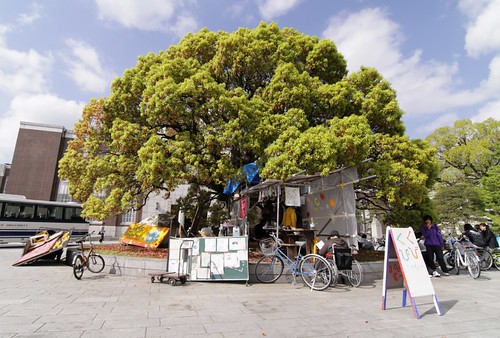
Back in March, while I was traveling, Adam wrote a post about Union Extasy, a two-man union of former workers at Kyoto University who decided to protest the limited term contract system after it forced them out of their staff jobs. While their most visible form of protest was the construction of a tent squat underneath the landmark camphor tree in front of the famous Kyoto University clock tower (a location which is the basis for the university’s logo and the preferred location for graduation photos and the like), they also engaged in the more traditional labor complaint route of filing a formal grievance, conducting formal union/management negotiations (団交), and eventually filing a lawsuit alleging the illegality of the mandatory limited-term contract system.

While the Union Extasy squat was inspired by the “temp worker village” set up in Tokyo’s Hibiya park during the 2008-2009 new years season, unlike that particular stunt it never actually ended. Although they had originally expected it to only last for a couple of weeks before shaming university management into doing something, when they realized that things were going to take a long, long time to resolve, instead of taking down the tent they instead expanded it, adding a public area with seating that was labeled the “Kubi Kubi Cafe.”Kubi is the Japanese word for the head or neck, and has also become a synonym for “firing” or “sacking”, as beheading is the Japanese metaphor of choice for such a practice.

The university was naturally displeased with the ongoing protest, particularly in such a prominent and symbolic location, and filed a lawsuit in May or so (the date escapes me at the moment) against Union Extasy, ordering them to vacate the premises. Why exactly they had or chose to actually file a lawsuit escapes me since I would have assumed that they could just ask the police to remove trespassers without any special legal maneuvering, but I presume there is some legal reason that they took such a course of action. Aside from the existence of the lawsuit itself, there were two things that struck me as rather odd about it. First, that the lawsuit was not filed against the two men (Ogawa and Inoue) but against the Union Extasy organization itself. The second odd point, and this one if very odd, is that they were not seeking an order for the union to vacate the campus completely, but only a specified zone including the area immediately in front of the clock tower. The university was actually so cautious about acting without a court order that they did not even disconnect the power cable siphoning electricity from the clock tower building (which kept the lights and vintage iMac running at night, network connectivity naturally courtesy of the campus Wifi). Inoue let me flip through a folder of documents that had been filed in the case, and sure enough there was a map of the campus with a rectangle drawn around the very specific area. Amusingly, among the supporting evidence was a land assayer’s appraisal of the land value of the entire campus, as if the market value of the national university’s grounds-which I expect is legally impossible to sell in any event-was somehow relevant to the matter at hand.

After receiving a court order to vacate the area, they complied with it-by moving about 10 meters over to another patch of lawn, just far enough away from the camphor tree and clock tower so as to allow an unobstructed view of the landmarks.

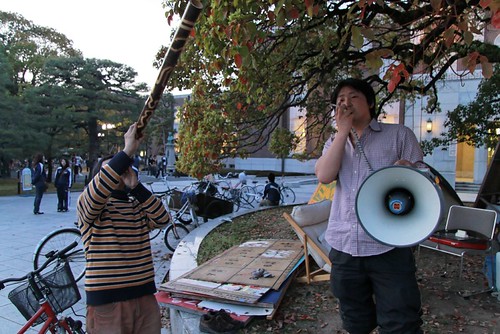
I have spent little time speaking with the involved parties since before I went home for the summer and had not been following the progress of their protests or court case, except of course to notice that the protest squat had never ended, but I just got word that the initial verdict of their lawsuit is due out tomorrow, presumably with a party to follow. I will be there tomorrow afternoon after lunch to see how things turn out and will report on it after, but in preparation, here is a gallery of photos I’ve taken at the Kubikubi Cafe.

Continue reading Union Extasy court decision tomorrow

Curzon visits Yamba Dam

Last week, I took a day trip out to see the Yamba Dam, a planned 130 meter high dam that would flood a small rural village snuggled in a valley in western Gunma. The primary motivation for the plan is to stop flash floods that rage through the Tonegawa River and cause havoc in Gunma, Saitama and Tokyo once a decade or so, and also to control and manage the water supply for the Kanto region and to generate power. If constructed it would only be Japan’s 25th largest dam and 10th largest reservoire, but it has turned into one of the more costly projects because of the massive peripheral infrastructure built to appease fierce local opposition.

The project has long been controversial and has dominated the headlines since the DPJ took power last month and announced the project would be cancelled — despite the fact that the project has burned through more than 70% of its US$4 billion budget.

As a student in the Robert D. Kaplan school of national policy, I wanted to see this project with my own eyes, and see the entire surrounding landscape, not suddenly arriving by train or car. So I took my bicycle by shinkansen out to Karuizawa in Nagano, from where I traveled north over the ride of Mt. Asama, then down into the valleys of Gunma and east into the valley, for a total day trip of more than 100 kilometers. This post summarizes my trip.

Traveling to the Dam
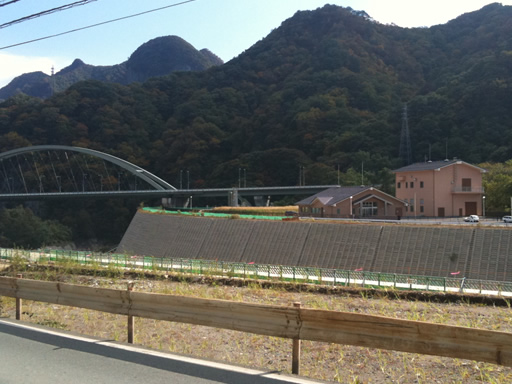
It’s easiest to feel the scale of the project by traveling from the west of the dam, down the river valley north of Mt. Asama in Nagano. As you approach the project, there are suddenly new bridges, most complete or near complete, covering imaginary areas of water. There is also the classic concrete lining of a natural water source that can be seen all over Japan. There are also brand new buildings sitting on the side of what will be a new lake.

Yamba Dam2

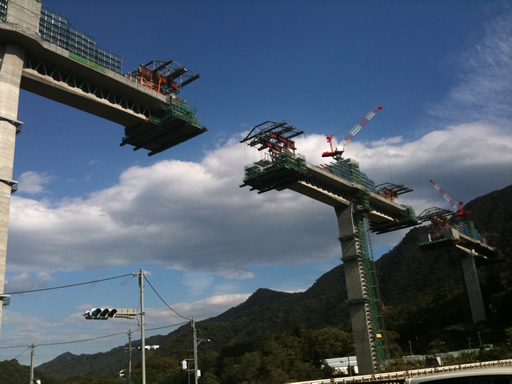
Traveling towards the dam brings the existing road “deeper” into the future lake, which brings us to the representative structure of the project, the No. 2 Yamba Dam bridge. The bridge is unique for its hollow structure and that they are building simultaneously out from the supporting stems. This bridge will permit road and rail to cross the lake and connect the two halves of the community. At present, there was also a JR line running through the town, which was also to be relocated up the mountain.

Yamba Dam1

You may notice that construction on the bridge is proceeding. The reasons for that soon became clear.

“Yamba Kan” (やんば館)
At the foot of the No. 2 Yamba Dam bridge sits a two-story facility called the “Yamba Kan,” built in 1999 by the Ministry of Land and Infrastructure to explain the dam’s purpose and its construction to locals and other interested visitors. Like a typical Japanese shiryoukan, it is a small but carefully organized and boasts an impressive set of topographical maps, audio-visual media, photographs, and information regarding the history and construction of the dam. There are also guides on hand to answer questions about the project.

Interest has exploded since the DPJ took power and have announced the cancellation of the dam. According to the informational (and pro-dam) website damnet.org, the number of visitors to the “Yamba Kan” hit a record in September, receiving three times as many visitors as in August. When I arrived on a weekday afternoon, the 40 car parking lot was full, and included a chartered tour bus.

The guides were busy answering visitor questions. I patiently waited my turn to ask questions and finally got to ask: “The government has said they will stop construction on the dam but the bridge is still being constructed, why is that?” I asked in the most neutral of tones, but the guide answered on the assumption that I was an anti-dam fanatic — she responded, “They have to finish it! There is no other option! Otherwise are community will be split in two! There are already people living in homes on both sides of the mountain!”

Her explanation and the Yamba Kan maps made the overview of the project more clear. Before the dam could be built, the government had to relocate all 355 households whose homes would be submerged by the lake created by the dam. After decades of fierce opposition, it was only when the central government conceded on a costly compromise to relocate the villagers up the mountain up the mountain from their homes did they finally agree. This is more expensive than it sounds, and calls for massive earthworks and bridges. It would have been easiest to move the people up or down the valley to join their neighbors.

Yet the project is even more expensive than just moving people up the valley mountains. The mountains are too steep to be flattened to accomodate the whole community on one side of the steep valley, so construction has taken place on two sides of the lake, with massive bridges being constructed to connect the two sides of the lake. The government is of course footing the bill to construct the new houses, schools, roads, bridges, and other facilities for the relocated community.

Most of this construction is completed, as evidenced by the almost finished No. 2 Yamba Dam bridge. But once all this is done, I started to ask myself,

What happens now?
Frankly, no matter how hard Transportation Minister Maehara and the DPJ hold out on refusing to construct the dam, I can’t possibly see how the project cannot be finished. At best the DPJ can delay the plan a year or two. Here’s why:

* All the preliminary infrastructure is complete. Learning more at the Yamba Kan, my understanding of recent news stories where the DPJ said that they would continue to invest in “lifestyle” construction became clear. The DPJ will only halt construction on the dam itself, which was scheduled to commence shortly, but will continue construction that affects the lives of the locals. In other words, the bridge will be finished, as will the rest of the construction, but the dam for which all the construction was invested will not be built. What this means is that billions will be spent relocating a community for no reason whatsoever.

* It could cost votes in important prefectures. The DPJ probably isn’t too worried that the conservative, LDP-allied governors of Nagano, Gunma, Chiba and Tokyo are opposed to halting the project. But the governors of Saitama and Tochigi are independents close to the DPJ. The DPJ caucus of legislators in the Saitama prefectural assembly is vocally opposed to the cancellation. The six affected prefectures together comprise more than 25% of Japan’s total population, and the DPJ has strong voter support in Tokyo, Chiba, and Saitama. The only people firmly opposed to the plan appear to be environmental interest groups. Who knows, it could cost the DPJ votes and they may decide to proceed because of it.

* A future LDP administration may turn things around. Even if the Hatoyama administration does refuse to proceed with the plan, the LDP could always pick up where the DPJ left off.

Police oversight in Japan

I love Japan, but there are a few things which I really hate about it. The police are one big issue in my mind.

Case in point: Their recent knife kick. I read an outrageous story on Debito’s blog about a 74-year-old American tourist getting arrested for carrying a pocketknife over the maximum legal length (which was recently shortened). It seemed unbelievable until a commenter there pointed out a similar fate for a Japanese manga artist, and then our own commenter Durf shared a story about getting searched for knives.

Fortunately, my few run-ins with the Japanese police have been tame. I’ve been carded a couple of times while biking around central Tokyo, and once got into a spat with a cab driver late at night which the local koban cop helpfully mediated without even checking my papers. Still, reading others’ experiences makes me believe that police here, while helpful when they want to be helpful, also have an undue amount of power and very little responsibility for misusing it.

On paper, this is not how it should be. On paper, there are officials who oversee the police, both on a national level (through the National Public Safety Commission) and on a local level (through prefectural public safety commissions). They are appointed by elected officials (the prefectural governor/assembly or the Cabinet) and serve fixed terms.

But these are woefully ineffectual bodies plagued by systemic problems, as laid out by Japanese Wikipedians:

  1. Each commission is located on the premises of the prefectural police headquarters and police officers perform its clerical functions, so there is no guarantee of neutrality or confidentiality.
  2. The prefectural government has no authority vis-a-vis the police, so there is no way for local government to investigate or punish the police without going through the commission.
  3. The commissions are often packed with local elites who have little experience or interest in police or criminal justice matters.
  4. This often creates a conflict of interest, because such individuals won’t want to effectively challenge the local police in many instances.
  5. The police end up being taken more seriously and can effectively dictate policy to the commissions. This happens on a local level as well as a national level (between the NPA and NPSC).

For illustrative purposes, the NPSC currently consists of the following individuals:

  • Motoo Hayashi (chairman): LDP legislator and state minister in the Aso cabinet (for disaster prevention, Okinawa and Northern Territories policy, and possibly other irrelevant portfolios as well)
  • Yukio Sato: Former diplomat and president of the Japan Institute for International Affairs
  • Nobuyuki Yoshida: Senior director of the Sankei Shimbun, responsible for its right-wing editorials
  • Yoshiyuki Kasai: Chairman of JR Central
  • Mariko Hasegawa: Professor in the School of Advanced Sciences at the Graduate University for Advanced Studies who apparently specializes in sociobiology and has a strong academic interest in the biology of sexuality
  • Kenjiro Tao: Chief judge of the Hiroshima High Court (an intermediate appellate court), somewhat famous for handing down the verdict against serial killer Tsutomu Miyazaki.