Three cheers for Lin Wuei-chou

From The Taipei Times:

To highlight his disappointment with what he called the ongoing political confrontation within the Democratic Progressive Party (DPP) and its all-round degeneration, DPP Legislator Lin Wuei-chou (林為洲) yesterday quit the party, urging voters to quit political parties, become neutral and avoid getting caught up in the “partisan squabbles” provoked by politicians.

Lin, who joined the party in 2000, released a three-page statement yesterday announcing his decision to quit.

In the statement, Lin said he was loath to see both the pan-green and pan-blue camps take advantage of people’s passions to mobilize them to join large-scale parades and rallies that actually serve no concrete purpose whatsoever.

Partisan politics in Taiwan are notoriously, nay, hilariously bitter. What exactly is Mr. Lin Wuei-chou trying to escape from? Here are a couple of examples that I have blogged in the past, plus one new one from the very newest issue of the Taipei Times.


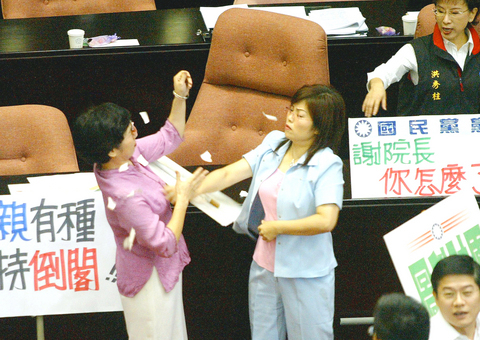
DPP Legislator Wang Shu-hui, left, attacks KMT Legislator Kuo Su-chun, right, after Kuo tore up a copy of Premier Frank Hsieh’s policy report that he was scheduled to deliver yesterday at the opening of a new sitting of the legislature.

Speaking at a separate event, TSU Chairman Shu Chin-chiang (蘇進強), however called the government a “liar” in front of DPP Chairman Su Tseng-chang (蘇貞昌) at an activity held by the Hand-in-Hand Taiwan Alliance that both men attended yesterday morning.

Shu’s remarks immediately made the atmosphere awkward.

[…]

Sitting beside Shu, Su looked embarrassed and did not respond to his criticisms.

The two men did not talk to each other and left the news conference separately.

And from today…

Friday, Mar 31, 2006,Page 4

Minister of Education Tu Cheng-sheng (杜正勝) yesterday told reporters that Chinese Nationalist Party (KMT) Legislator Lee Ching-hua (李慶華) had been acting like a three-year-old, one day after Lee called him “Dick Minister” and “Pert Minister,” referring to a shampoo brand, during a legislative committee meeting. The heated exchange of words arose over Lee’s discontent with a ministry-published high school sex education pamphlet which contained explicit sexual references. “If Lee had carefully read the pamphlet, he wouldn’t have noticed only the [explicit material]. Only three-year-old children would see nothing but [that material] in the pamphlet,” Tu said, adding that Lee was not a “well-educated person” and that him being a lawmaker could only waste the nation’s resources. When asked for comment, Lee said he had suggested Tu and his wife make public images of the two copulating in the pamphlet.

United States partisan politics may not have quite yet reached this level of clownishness, but it’s close enough so that I’m disgusted with the whole business. Therefore, I am swearing an oath-if any major partisan politician running in elections for which I am eligible resigns from their party and severs all financial and organizational ties with the party, I will vote for you. I don’t care which party it is that you are leaveing, I don’t care how you feel about the Iraq War, or Medicare, or abortion, or school lunches, or even if you’re a holocaust denyer or a convicted rapist. If you follow the brave lead of Lin Wuei-chou in Taiwan, and tell the Washington based political party establishment to go fuck itself, I, who am not, never have been, and never will be a registered member of any political party, will vote for you.

Am I a Japan Apologist? If so, sorry!

Found on the Marmot, this look at Japan apologists in Korea before and during the colonial period is fascinating.

It’s amazing to me how after Japan’s defeat in WW2 and subsequent economic growth and close relationship with the US, Westerners’ experiences in Japan have exploded from a few extremely coddled, monitored, and restricted professions (missionaries, academics, o-yatoi gaikokujin) to 10s of thousands of individual experiences in a free society and from a plethora of backgrounds (eikaiwa teacher, human rights activist, programmer, truck driver, Diet member, gangster). Meanwhile, both legal and illegal immigrants from China and Korea as well as those from “periphery” countries like Brazil, the Philippines, and Iran have made semi-permanent homes in Japan, adding to a growing multiculturalism that was spearheaded by the zainichi Korean population.

Despite the surge in openness and the increased diversity and exposure both to and from the outside world that came with it, Japan’s obsessive image management remains along with the “foreign apologists” who are strikingly similar to those employed in the 1920s. There are plenty of them, including Gregory Clark and Ezra Vogel (DISCLAIMER: Haven’t read Vogel yet). But thankfully we live in a time when a) Japan apologists don’t have to overlook unarmed Koreans sliced in half on the street by Japanese soldiers; and b) Those involved with Japan professionally and otherwise have the breathing room to maintain a more sophisticated view of Japan than the Visit Japan Campaign marketing copy. People can even spend all their free time griping about how much Japan sucks even as they live there! Or, more constructively, they can unionize and try and improve their lot in life.

This article and the discussion on “Japanophiles” at several blogs got me thinking – what is it that keeps me interested in Japan after not living in the country for almost 3 years?

My own experiences in and related to Japan (obsessive language study, tumultuous relationship that ended in death threats, meeting and getting engaged to Mrs. Adamu here in Washington) have been, as life tends to be, bittersweet and full of as much pain as joy, but I still feel some pressure to speak well of Japan whenever someone (Japanese or non) asks me about it. Usually, I stick with the food. Nothing controversial about food, and really, Japanese food is the best. I used to have much more heartfelt and uncritical praise for Japan, back when the scenery, the people (“handler” types included), the language, and the fact that it wasn’t America kept me excited.

But right now, I don’t feel one way or the other about “Japan” as a whole. For one thing, 2 years is not enough to truly understand what a whole nation is all about. As I’ve said before: I love Japan, but it’s screwed up. The society’s got major problems that have translated into things that have affected me personally. But at the same time, I’ve been fortunate enough to befriend enough real, intelligent, and genuinely friendly people to keep me from dismissing the whole country as the kind of place that wraps foreigners in lacquer. It makes me sad to see someone who was unable in 12 years to get past all the superficial stuff of first meetings (his “GAIJIN MEETS A FOREIGNER kabuki”). Of course, not speaking the language where English is not widely understood and perhaps just being a reporter might make things difficult. It’s hard not to worry about how you’ll come across in an article when talking to someone from the press.

Anyway, as to the question in the title of whether I am a Japan apologist, I say not yet, but then no one’s paying me. Where I work (an American law firm) is about as far away as you can get from apologism. But if I were to get a swank job at JETRO or RIETI that might be a different story… Just let me apologize in advance for if and when I do get brainwashed and sucked into a world of untold luxury and all-you-can-eat sushi in exchange for my soul.

(Image is random)

Ann Coulter on Koizumi and Bush

Political commentator and psycho dragon bitch from hell Ann Coulter has this to say:

One year before elections in Japan, the [New York] Times was predicting defeat for Koizumi, a loyal friend to President Bush and an implacable supporter of the war in Iraq.

Reporting on the unpopularity of the Iraq War in Japan, the Times said “polls indicate that the population is against an extension” of Japanese troops serving in Iraq and that the opposition vowed to withdraw troops. Indeed, “some members of Prime Minister Junichiro Koizumi’s own party have been calling for the troops’ withdrawal.”

And then in September 2005, Koizumi’s party won a landslide. The Times described this as mainly a victory for the prime minister’s idea to privatize the post office, explaining that Koizumi had won “by making postal privatization — an arcane issue little understood by most voters — a litmus test for reform,” thus confirming the age-old political truism, “Most elections hinge on arcane, obscure issues voters don’t know or care about.”

As congressional Republicans decide whether to take the Times’ advice and back away from the war this election year, they might reflect on a fourth world leader who won re-election while supporting the Iraq war. Just about four months before Bush was re-elected in 2004, the Times put this on its front page: “President Bush’s job approval rating has fallen to the lowest level of his presidency, according to the latest New York Times/CBS News poll. The poll found Americans stiffening their opposition to the Iraq war, worried that the invasion could invite domestic terrorist attacks.”

Maybe it was his support for the post office.

As much as I hate to agree with her, I don’t think the war drives most Japanese voters. In fact, I don’t think it drives most American voters (although it certainly means more to them). And the NYT… just doesn’t get it, basically.

Of course, you would probably hear the same basic opinion from Jon Stewart. He would just be funnier about it.

Imperialist cuff links

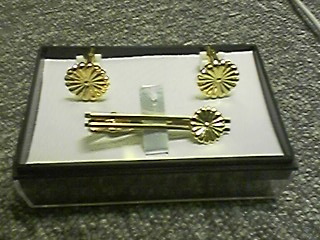
I bought these on a hanami (flower viewing) excursion to Yasukuni Shrine last weekend. Tie pins aren’t quite my style, but the cuff links are great. (And Lady Curzon, a true aristocrat, gives her approval.)

Other items on sale at Yasukuni:

* Japanese flag cuff links. I didn’t buy these because they seemed too loud. I now regret that decision, and plan to purchase them the next time I visit.
* An authentic-looking Imperial Rescript on Education you can put up in your home for that classic fascist feeling. (Framed with a portrait of Hirohito: ¥9,000. Unframed: ¥1000.)
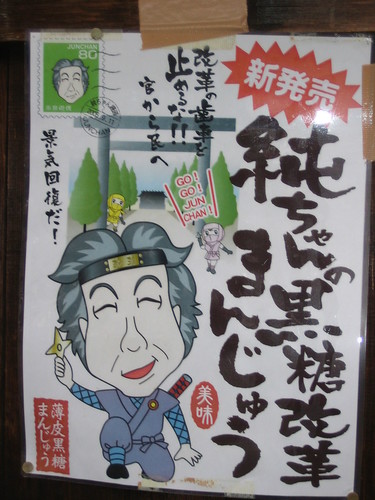
* Special manju, packaged with a caricature of Koizumi on the box and parodies of LDP slogans. Here’s a photo, because I love you:

Anyway, if you see a honky walking around Tokyo wearing chrysanthemum cuff links, you’ll know it’s me, so be sure to say hi.

KSG students do a good job of keeping up stereotypes

Some Harvard kids got some intimate time with Shinzo Abe and Seiji Maehara. So guess what the Korean wanted to ask about?

Wait for it…

A student from South Korea said Abe’s stance on visiting Tokyo’s Yasukuni Shrine, which honors Japan’s war dead as well as Class-A war criminals, did not come up during the meeting due to time constraints.

Hahahahaha. Riiiiight.

“If he (Abe) becomes the next prime minister, there would be no improvement in Japan’s relations with South Korea and China,” the student said on condition of anonymity.

However, the student also said Maehara was an engaging politician who gave “clear comments” on the party’s stance against acts of worship at the contentious Yasukuni Shrine by top Japanese political figures.

Meanwhile, the Anglosphere types are more concerned about different issues:

Andre Stein of Australia held a different view, criticizing the DPJ’s contradictory stance on national security.

“While Maehara agrees with U.S. (military) protection of Japan, the party is not interested in supporting the allied forces in Iraq,” he said.

One’s concerned with mismanaging the past; the other’s concerned with mismanaging the future. To be fair, the Japan Times only published two opinions; perhaps they’re just looking for what they think is most conventional.

Kochikai makes like Jesus and comes back from the dead (maybe)

Yomiuri reports that a sleeping LDP faction appears to be reviving itself for the post-Koizumi horse race. The Cliffs Notes version follows, with Wikipedia links for those of you just joining us.

The Asian strategy study group, headed by Ichiro Aisawa, the LDP’s acting secretary general and a member of the Tanigaki faction, shows signs of being anti-Koizumi in outlook.

The group appears to have come into being in an attempt to bring the Kochikai faction back–reuniting the three factions while, at the same time, reining in Chief Cabinet Secretary Shinzo Abe who has made a great show of following Koizumi’s reform policy …

Kochikai was a prestigious faction founded by late Prime Minister Hayato Ikeda. It forms part of the lineage of the Liberal Party and carved out a policy that called for the nation to be lightly armed and focus on the economy.

Mainstream and conservative, the faction produced four prime ministers. [Ikeda, Ohira, Suzuki and Miyazawa -ed.] However, it often found itself outside of the political power struggles that mattered, which led to it being ridiculed as a “group of court nobles.” …

If the reunited faction takes an anti-Koizumi policy line by being pro-Chinese in terms of its Asian diplomacy and seeking to correct the economic disparity in Japan, it would be hard for its members to support Aso.

If Aso’s attempts to seek the highest position in the party through the reunited faction is derailed, he will be inclined to instead seek the support of the Mori and Tsushima factions.

Tanigaki is trying to win the support of the three factions, but whether he will succeed in bringing them together is still uncertain–some members harbor hard feelings over events that took place when the Kochikai faction was last active.

The unification of the three factions may need to wait for the party presidential election after this one.

Congressmembers accuse Lenovo of spying for China

About two weeks ago I wrote a post about the security implications of buying a Lenovo, or any other brand of PC, manufactured inside China for the domestic market, following reports that Lenovo was including a government approved encryption module on their system motherboards. While I recommended caution when buying a domestic Chinese computer, I was not particularly concerned about the possibility that machines manufactured for the foreign market would be so compromised.

Well, it turns out that the US Congress is a little bit more suspicious of China than I am. (Gee, who would have thought?) The New York Times today is reporting that a number of Congressmembers from both parties are in an uproar over an announcement that Chinese-owned Lenovo computers has won a bid to supply 15,000 machines to the US State Department.
Red IBM

The critics warn that the deal could help China spy on American embassies and American intelligence-gathering activities, using hardware and software planted in the computers.

“The opportunities for intelligence gains by the Chinese are phenomenal,” said Michael R. Wessel, a member of the United States-China Economic and Security Review Commission, which was created by Congress to monitor and report on the bilateral relationship. Larry M. Wortzel, the commission’s chairman, said in an interview two weeks ago that while he would not be concerned if Airbus moved an aircraft production line to China, he would be worried if Lenovo ever started to sell computers to American government agencies involved in foreign affairs. Responding on Thursday to the Lenovo deal, he predicted that, “Members of Congress, I think, will react very strongly when they see a deal like this come through.”

The opposition seems to be a combination of misguided economic nationalism, mixed with a vague but real appreciation of possible security concerns. Surprisingly, this article does not mention the security chip Lenovo has been installing on their domestic models. Now, it would of course be trivial to see whether nor not that chip is installed on the machines being purchased by the State Department, but doing a full-blown security audit would probably be enough trouble so that it would become more economical to just go to the next lowest bidder instead.

The real question is this: are the possibly security concerns serious enough to justify the panic? Supporters of the deal point out that the computers will be used only for unclassified work, but honestly that shouldn’t do anything to relieve you. Most of the government’s paperwork is unclassified, but still not public-think of things like personnel records and so on that would be of great usefulness as intelligence.

Now, how possible is it that Lenovo could build a back door into the systems, that routine security procedurs (and let’s assume, perhaps incorrectly, that the government follows correct security procedure) would not stop? The security chip mentioned in my earlier post would probably not be used for encryption, in favor of a standard software solution. There could be some sort of back door hidden in the BIOS, but on modern operating systems, the BIOS code is no longer running once the OS starts. (Note, EFI is a whole other kettle of worms, but let’s not get into that now.) And I would hope that standard procedure is to do a clean install of all software of of a disk image file prepared by government IT personnel, so as to make sure that all security settings are correct, and there is no possibility of a disk resident trojan.

What is the final conclusion? I don’t have a firm answer, not having nearly enough information or time to analyze it, but I would be interested to hear other thoughts on the matter.

Yomiuri and Asahi both Call for Moratorium on Implementation of PSE Mark Enforcement

Major Japanese dailies Asahi and Yomiuri, who rarely agree, have both come out in favor of postponing enforcement of the mandatory electrical safety testing of used electronics and appliances (known as the PSE Law and last mentioned on MF here). The Yomiuri is especially hard on METI, the government ministry responsible for the confusion:

Ministry to blame for PSE mark confusion

The Yomiuri Shimbun

The current confusion arising from the planned introduction of the product safety of electrical appliances and materials (PSE) mark must be dismissed as the result of the makeshift policy on the issue adopted by the Economy, Trade and Industry Ministry. There are concerns that the confusion could worsen.

All this has caused the ministry to hurriedly reverse its policy, permitting the sale of vintage instruments and some other items without the PSE mark. The abrupt change indicates the ministry may be willing to acknowledge it has not properly prepared to introduce the PSE program.
Continue reading Yomiuri and Asahi both Call for Moratorium on Implementation of PSE Mark Enforcement