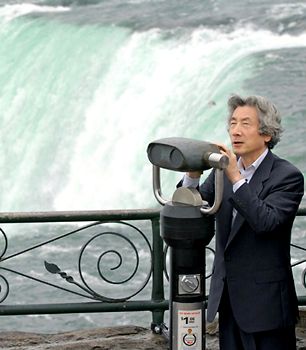
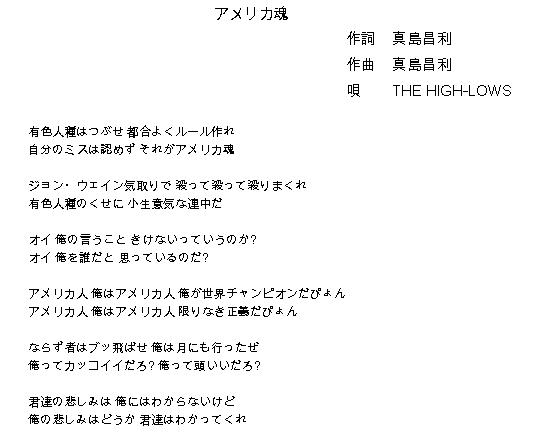
Anti-American Japanese song “American Spirit” by The High-Lows

The High-Lows are a now-defunct Japanese rock band whose sound mixes a tinge of American doo-wop with a mallet over the head dose of youth nostalgia. Though not a huge fan, I picked up one of their CDs back in the day after hearing that they were the successor band to the influential late 1980s J-punk band The Blue Hearts (“Linda Linda” remains one of my favorite songs).

Despite the clear US influences in his band’s music, guitarist/songwriter Masato Mashima felt like 2002 (runup to the Iraq war) was an appropriate time to let us know what he thinks about Americans in his fun piece of album filler entitled “American Spirit” from the album angel beetle. Here’s a translation (lyrics in Japanese available here as culled with some difficulty from utamap.com):

Crush the colored races/Make the rules so they benefit me
Don’t admit my mistakes/That’s the American Spirit

Kill Kill Kill John Wayne-style
You’re an impudent bunch for a colored race

Hey! You say you can’t obey me?!
Hey! Who do you think I am?!

American/I’m an American/I’m the World Champion, baby
American/I’m an American/Unlimited justice, baby

Beat up the badguys/I even went to the moon, you know!
Ain’t I cool? Ain’t I smart?

I don’t understand your sadness,
But please, understand my sadness

Japan’s Media Coming Online, inch by inch

Yahoo Japan’s “everybody’s politics” section is becoming quite an amazing little site. I mean look at this hot top image promoting their new 2007 Upper House election feature:

koizumi ozawa.gif
koizumi ozawa 2.gif

It’s like dueling Kim Jong Ils!

Just look at some of these amazing features:

  • A full, easily searchable list of Diet members. I was able to instantly find the people representing Mrs. Adamu (Mssrs. Noda and these guys including Rick Moranis lookalike Kazuo Shii of the Japan Communist Party). I’d like to see the same for local politics, but perhaps that is asking too much.
  • A sweet podcast of speeches by various Diet members. Most of them are boring, but Seko’s one was actually a pretty interesting synopsis of LDP internal reforms.
  • A manga about an annoying twit who becomes a Diet member’s secretary only to figure out he knows NOTHING about the Diet. Thankfully, a hot chick decides to smack him around and teach him the basics of the Diet. Hot!
  • A glossary of political terms including historical and topical entries. Don’t know what the 1955 system is? Now you will!
  • Best of all everything is free and better yet ad-free. Why? My guess: They are gearing up to claim to have a significant impact on next year’s Upper House elections and in the process boost traffic.

    One of their newer features, however, indicates a major shift by some of the traditional media content providers – free, full-length articles from Japan’s weekly and monthly magazines! The Japanese internet so far has been pretty devoid of good free political analysis or even in-depth news coverage. This is largely explained by the newspapers and magazines’ reluctance to put their content online for fear of losing readership and, in the case of newspapers, the considerable special privileges they get as so-called public institutions. is “Read and Compare Political Articles” which reprints the main political articles in weekly journals, in their entirety, completely free of charge (or even banner ads, while we’re on the topic)! Downsides: No pictures, and the articles are deleted fairly soon after publication (about a month it looks like). But if you’re diligent you can at least save the articles you want on your computer (or if you’re like me, g-mail them to yourself).

    This serves as an essential boon to Japanese and Japan watchers overseas (who can now vote in all aspects of Japanese elections after a court decision), who before could only view headlines for free, unless they wanted to sign up for media companies’ exorbitantly expensive pay services.

    There still leaves much to be desired in terms of Japanese media content being available on the web (full newspapers, anyone?). But this is a very helpful step in the right direction!

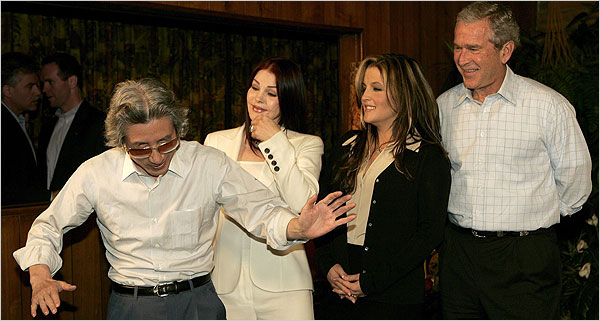
    Koizumi Rocks out, sort of

    koizumi600.jpg

    Japan’s Prime Minister Junichiro Koizumi went to Graceland with Bush today. The visit was described on NPR as a “gift” to the Prime Minister in appreciation of his unwavering support for the US.

    Well, Koizumi must have liked it, because he was about as animated as he gets today – he even broke into song briefly, a move that clearly creeped out the president a little bit. Perhaps it was the PM’s choice of words – “Wise men say only fools rush in” – could this have been a subtle barb at Bush’s pre-emptive war doctrine?

    You can watch Koizumi sing here on the UK’s Channel 4 along with some other little tidbits about Japan and Britain’s Elvis-mania.

    UPDATE: NYT has more singing! Plus anti-whaling Elvis impersonaters!

    Yasukuni all over again

    As if the Niagara Incident wasn’t bad enough (there’s currently a huge controversy in the Japanese media over whether it should be labelled the ナイアガラの滝の事件 or ナイアガラの滝の事変), and now this report!

    The “King” never came to Japan, but Japan’s prime minister is making a pilgrimage to Graceland.

    Elvis fan Billy Morokawa says Japanese Prime Minister Junichiro Koizumi will likely feel the power of Presley’s enduring energy when he tours the rock-and-roll legend’s home in Memphis, Tennessee, Friday with President Bush.

    Did you see that? “Pilgrimage” There’s no way this visit is going to pass the church/state test, and visiting it alongside President Bush the “I was only going in my capacity as a private citizen” defense is never going to fly, particularly when considering his personal history in this cult.

    Koizumi, 64, is an Elvis devotee who not only shares a January 8 birthday with his idol, but picked out his songs for a 2001 charity album, “Junichiro Koizumi Presents My Favorite Elvis Songs.” The prime minister appears on the album’s cover standing next to Elvis outside Graceland in a composite picture.

    Back in 1987 when Koizumi was a mere lawmaker, he and his brother Masaya, now a senior adviser to the Tokyo fan club, helped raise funds to erect a status of Elvis in the Japanese capital to commemorate the 10th anniversary of his death.

    Three years ago the prime minister, an eclectic music lover whose favorites also include German composer Richard Wagner, sang his favorite Elvis hit — “I Want You, I Need You, I Love You” — with actor Tom Cruise, then in Tokyo to promote his movie “The Last Samurai.”

    Let’s just hope that this time the Supreme Court actually has the guts to face the real constitutional question and not skirt the issue on technicalities.

    Supreme Court: Stop your sniveling about Yasukuni

    The Supreme Court of Japan dismissed a 278-plaintiff appeal against Koizumi yesterday, holding that his visiting Yasukuni “is not something that interferes with others’ religious faiths” and therefore cannot be the basis for a damage award.

    However, they declined to rule on the constitutionality of the visits, stating that since there was no standing for the claim for damages, there was also no need to make a constitutional ruling. It’s another case of squirming out of the hot seat: the Supreme Court has used this tactic before to avoid addressing sensitive political questions, most notably whether the Self-Defense Forces are permitted under Article 9. (See my earlier post on the subject.)

    Full story at the Japan Times if you’d like to know more.

    Apocalypse Soon

    There’s a good article in the LA Times about some of the more extreme members of the three great monotheistic apocalypse cults of the Middle East (in chronological order, Judaism, Christianity and Islam) who take their religion so literally that they are actively trying to hasten the end of this world because, presumably, they just don’t like it very much.

    some Jewish groups in Jerusalem hope to clear the path for their own messiah by rebuilding a temple on a site now occupied by one of Islam’s holiest shrines.

    Artisans have re-created priestly robes of white linen, gem-studded breastplates, silver trumpets and solid-gold menorahs to be used in the Holy Temple — along with two 6½-ton marble cornerstones for the building’s foundation.

    Then there is Clyde Lott, a Mississippi revivalist preacher and cattle rancher. He is trying to raise a unique herd of red heifers to satisfy an obscure injunction in the Book of Numbers: the sacrifice of a blemish-free red heifer for purification rituals needed to pave the way for the messiah.

    So far, only one of his cows has been verified by rabbis as worthy, meaning they failed to turn up even three white or black hairs on the animal’s body.

    Interestingly, this phenomena is largely confined to the US and the Middle East. Yes, of course there are apocalyptic cults in other regions (Japan’s own Aum Shinrikyo being one near and dear to my heart) but they are hardly a mainstream phenomenon over there. In fact, according to the article as many as 40% of Americans believe that an apocalypse is not merely coming but imminent. Now, some people believe that some of the more obscure foreign policy moves engaged in by the US governmental leaders can be traced to this very belief in the end time-and I myself have even engaged in some joking speculation of such a nature-but of course when examined logically the argument falls apart. After all, how could anyone who believes that the world is coming to an end in a couple of decades time be so enthusiastic about being midwife to the creation of a landed hereditary aristocracy by enouraging the repeal of the inheritance tax?

    People will bet on anything

    You’ve probably already heard about how Ann Coulter said something stupid and offensive about widows of some WTC terrorist victims, and now thanks to the Internet you can also bet on whether or not she is going to be sued for defamation.

    Analysts at BetUS.com posted favorable 4-6 odds that the Widows of 9/11, who were also called “self-obsessed women,” will sue Coulter for defamation. However, the chances of Ann Coulter retracting her remarks are slim with only 1-2 odds. Either way, Coulter’s outrageousness has shot her new book to number one on Amazon.com.

    Executives at BetUS.com have posted the following odds:

    Will Ann Coulter retract her remarks?
    Yes: 6-4
    No: 1-2

    Will the 9/11 Widows Sue Coulter for defamation?
    Yes: 4-6
    No: 11-10

    Quiz: What was BOJ Chief Fukui’s 1st “Yellow Card”?

    As many of you know, the Bank of Japan Chief Toshihiko Fukui is in trouble for not dropping an investment in the discredited Murakami fund after he took the position in 2003 (though he was not legally required to do so, nor was he required to disclose the investment through an uncanny oversight by regulatory authorities – the US, for its part, does require full financial disclosure from its FRB chiefs such as the last one, Alan Greenspan). It only makes sense since the BOJ Chief is the ultimate insider in a capital market.

    In a recent column for his website, opposition DPJ Dietman Yoshihiko Noda (Lower/Chiba 4th) called the so-called transgression Fukui’s “second yellow card”, which in soccer means you’re out of the game.

    Question: What is the first yellow card to which Noda is referring? Answer after the “jump”!!

    Answer: He quit as vice chief in 1998 after it was found officials from banks, including the former Dai-ichi Kangyo Bank, treated Ministry of Finance and BOJ bureaucrats to “no panties shabu shabu” – at a restaurant Fukui is known to have regularly attended (though Fukui was never actually prosecuted for anything). Shabu shabu is a kind of Japanese meat soup – it’s good, and apparently even better when the waitresses aren’t wearing their underwear. It was this and other, much worse incidents that led to MOF’s financial regulatory authority being stripped away and given to an entity we know today as the Financial Services Agency. And now you know!

    NHK goons about to get leaner and meaner

    It won’t be pretty:

    NHK has eight TV and radio channels: two for terrestrial TV broadcasting (general and education); three for satellite TV, including one for high-definition programs; and three radio channels including an FM service. Heizo Takenaka‘s panel argued that one satellite channel is enough and three radio channels are too many for public broadcasting.

    The proposed reduction in the channels should be combined with substantial streamlining and downsizing of NHK’s bloated operations to allow a sharp cut in the viewing fees, the panel says. In return, viewers would be legally required to pay for NHK’s services under a new fee system, possibly supported by penalties for nonpayment.

    If you’ve lived in Japan, you probably have some experience with the NHK henchmen who troll around apartment blocks trying to collect NHK service fees. Everyone has their own method of dealing with them: say you don’t have a TV, say you don’t get NHK reception, answer the door stark naked, scream in Turkish, etc. But I’m going to hate the day when NHK is legally empowered to collect from me. Sod off, Domo-kun.