Japan Times infiltrated by Soka Gakkai?

Weekly Friday printed an article in their July 21 issue taking a look at the controversy surrounding Soka Gakkai leader Daisaku Ikeda’s recent series of op-eds in the Japan Times, the “only independent English-language newspaper in Japan.” Let’s have a look:

FRIDAY, 2006.07.21

Indicting Reportage: Internal conflict arises at Japan Times over “Daisaku Ikeda” columns

Field reporters lodge fierce protests, claiming “promotional articles for giant religious group Soka Gakkai”

In our last article, we reported the behind-the-scenes power struggle that is ripping Soka Gakkai apart, but a “Soka scandal” has also embroiled the Japan Times, the English-language newspaper boasting the longest history in Japan (founded 1897).

It all started when the paper started running a serial column by Daisaku Ikeda (78), honorary chairman of Soka Gakkai. This column runs on the 2nd Thursday of each month, with 12 columns planned in total. But Japan Times emloyees have fiercely protested and it has reached a state where they have requested that the upper management cancel the series. A Japan Times employees explains:

“Soka Gakkai has been dubbed a cult in France, and it is united with a specific political group (New Komeito). It is absurd for us to let the leader of a religious group with these kinds of issues to write promotional articles and on top of that give him our serial space. Even from the perspective of journalistic impartiality, it isn’t to be permitted.”
Continue reading Japan Times infiltrated by Soka Gakkai?

What’s behind the issue of readmitting “postal rebels” to the LDP?

When Koizumi kicked 37 Lower House members out of his own party for opposing his postal privatization bills, it made for brilliant political theater. But as the upper house has pointed out, banishing experienced politicians with extensive support networks can prove counterproductive in tougher election years. So, recently there has been a debate within the LDP over whether to allow some of the “rebels” back into the party. But apart from the general concerns over the upper house election, just what is behind this debate?

Thankfully, my efforts to scour every single Diet member’s web site have started to pay off. Opposition DPJ upper house member Tetsuro Fukuyama (Kyoto), has some guesses:

Tetsuro’s Diary, Nov. 6

(1) Of course this is a measure for next year’s upper house election. In single-member districts in every prefecture, success in the election will turn on whether powerful postal rebels take action. On top of that, Taiju, an association of [former] special post office [postmasters], and other groups are more than likely of a mind to fight in the proportional representation race using the organizational strength of the postal rebels. It’s first and foremost geared toward the election.

(2) As you may know, the deadline for Diet members to register for government subsidies for political parties is the last day of December. As you can see from the fact that the timing for people to join and leave parties has almost always been at the end of the year, it would not be surprising if this recent scandal, too, centers around the money. That’s because if the postal rebels and unaffiliated members were already members of the LDP, then the party’s subsidy, in other words the funding for its activities, would probably substantially decrease. Meanwhile, if the rebels manage to rejoin the party by the end of the year, their party subsidies coming to the LDP will increase. (tr: here he seems to be implying that the postal putsch was a scam to earn more party subsidies)

(3) Leading up to next year’s nationwide local elections, local assembly members have to deal with two Diet members in their districts, the postal rebels and the “assassins” sent in to replace them, likely resulting in quite a bit of confusion in the regions. This is a life-or-death issue for local Diet members of various affiliations, so they probably want to resolve this issue quickly.

(4) If the rebel issue continues to drag on, then the LDP will have to campaign for the upper house next year with an unpleasant aftertaste, and after the upper house election, a great amount of time and effort will be wasted sorting things out in preparation for the next lower house election. If the issue of bringing the rebels back into the party is left unresolved, then they cannot get to work preparing for the next lower house election.

(5) Still, public opinion would object if the LDP easily let them back, posing the risk that it might have a negative effect on the upper house election. This makes judgment difficult, and a decision cannot be reached. The Japanese people are watching the slowdown after ex-PM Koizumi closely, as they should. Although Abe and the LDP leadership are placing some sort of conditions on reinstatement, such as agreement with Abe’s policy speech and principles, it would be an understatement to say that such statements lack persuasiveness.

This reinstatement issue is only for the LDP and Diet members and election, and the Japanese people have nothing to do with it. In any case, they are taking the Japanese people for fools. The Japanese people should be more angry at the fact that this type of debate is taking place.

MOF vs. MIC, local entities in deepening conflict over budget

I’m just trying to get my head around this story from FujiSankei Business-i:

MOF vs. MIC, local entities in deepening conflict over budget

FujiSankei Business i. 2006/11/6  

Hot issues: JFM, early return of FILP funds

Leading up to the 2007 budget revision, conflict is deepening between the Ministry of Finance, which touts fiscal reconstruction, and the Ministry of Internal Affairs and Communications (MIC), which is backed up by the sentiments of local self-governing groups (i.e. municipalities). The two major issues are the scheme of how to deal with the Japan Finance Corporation for Municipal Enterprises (JFM), a government-owned financial institution slated for abolishment, and compensation for the early payback of funds from the Fiscal Investment and Loan Program (FILP). Debate is likely to heat up going into Nov 21, when the Deliberative Council on the Fiscal System (an advisory body to MOF) is set to finalize its budget proposal.

The MIC/municipalities side has taken the stance that the national government should subsidize the regional areas through various program revisions. MOF, meanwhile, has emphasized that the nation’s fiscal condition is even worse than that of regional areas. The two sides have collided head to head, with MOF offering up such criticisms as “The regional areas are not making serious efforts to reform the civil service.”

A typical example of this conflict is found in the JFM issue. The JFM historically procured funds from the market by issuing government-backed bonds, and lent those funds at long-term, low interest to municipalities’ water/sewage systems, hospitals, etc. However, after it is eliminated in 2008, it will transition into a new organization owned by the municipalities. The issue here is how to deal with the 2.6 trillion yen in reserves that the corporation had built up in preparation for a rise in interest rates.

MOF is of the position that, since the JFM is a 100% govt-owned financial insitution, “the leftover assets should be widely used for the people for fiscal reconstruction etc,” and is demanding that the reserves be placed in the national treasury. The MIC, in response, claims that the entire sum should be handed down to a successor organization to be jointly owned by the municipalities. At present there is no compromise in sight.

Meanwhile, the issue of compensation for early return of FILP funds began with a proposal from the municipalities. most loans received by municipalities from the government-owned financial institutions are long-term, with payback periods ranging from 20-30 years, and many of those loans were taken out during the era of high interest rates. As a result, the municipalities want to refinance while low interest rates continue, but in that case they will be required to pay compensation. Since the compensation depends on the number of years left on the loans, in reality, it will cost the majority of the future interest burden.

To that, the MIC is demanding the introduction of a system to eliminate the compensation requirement, but MOF has expressed virulent opposition. Since the compensation system was made clear in the contract signed at the time of the loan, the MOF’s stance is that the arrangement is valid whether the interest rates go up or down. Masaaki Honma, chairman of the MOF’s FILP Committee and member of the Deliberative Council, harshly questions the MIC’s attitude, remarking, “Eliminating the payment of compensation that was stipulated in the contract would be defaulting.”

The rift between the two sides is deep, placing focus on how the Prime Minister’s office will judge the matter. It will likely also be used as fodder to divine the depth of the PM’s leadership on near-term fiscal management.

RSS Feeds of Diet Members’ web sites, aggregated

Don’t say I never gave you anything.

I sifted through each individual web site of Japan’s lawmakers (members of the Diet) and placed any RSS feeds I found into Google Reader. Compared to the 722 seats in the Diet, only I only picked up 150 individual members with feeds.

That doesn’t mean Japan’s politicians are not active on the web. All but about 10 or so (mostly the elderly and entrenched – like “Don of the Upper House “Mikio Aoki” – or just too cool for the web – like our man Koizumi) had websites (another 10 members’ sites were down for various reasons), about 90% of them kept up-to-date content on the site, and a good majority provide a wealth of content either in the form of opinions or activities reports. There is, perhaps, a downside to that – they aren’t spending their time drafting legislation (in many cases the job of the PM’s office or autonomous bureaucrats). What I am saying, however, is that most of them are behind the times – lots of websites with early-2000s site designs, and one member even had a Geocities page!

But that aside, here are the links to the RSS feeds that were available, broken down by cameral and party affiliation (Click the party link to see the aggregator site):


Lower House (House of Representatives)
(480 seats total; 114 feeds)

  • Liberal Democratic Party (295 seats as of 10/22/2006; 62 feeds)
  • New Komeito (31 seats, in a coalition with LDP to form ruling coalition; 3 feeds)
  • Democratic Party of Japan (113 seats; 43 feeds)
  • Japan Communist Party (9 seats; no feeds, but here’s their sweet English-language site)
  • Social Democratic Party (7 seats; 3 feeds)
  • Minor parties/unaffiliated (total 25 seats, includes Kokumin Shinto (New People’s Party, 4 seats) and Shinto Nippon (New Nippon Party, 1 seat); 3 feeds total)
  • Upper House (242 seats; 37 feeds)

  • Liberal Democratic Party (112 seats; 12 feeds)
  • New Komeito (24 seats; 6 feeds)
  • Democratic Party of Japan (80 seats; 19 feeds)
  • Japan Communist Party (9 seats; no feeds)
  • Social Democratic Party (6 seats; no feeds)
  • That’s 151 feeds, or about 21% of the members (this isn’t an exact total – one member had multiple feeds, of which I subscribed to 2). How is this useful? Well, not at all if you don’t read Japanese. But at least I will be checking back on it whenever I want to see what people are saying on a given issue, possibly keeping it updated after elections, but who knows? I was bored.

    Now, it is possible that I missed a member’s feed for reasons including not seeing the link or it not actually being linked on the member’s official site. Also, a good percentages of the feeds I did find came after digging through the settings page of members’ “e-mail magazine” services, chiefly mag2. Also, many members had “blogs,” but either used primitive Japanese “diary” software, manually updated the sites the old school way, or simply didn’t offer a feed.
    Continue reading RSS Feeds of Diet Members’ web sites, aggregated

    DPJ’s Yukio Hatoyama and his magical Pegasus

    I’m still obsessively sifting through every single Diet member’s web site. There are a slew of gems that I’ll get to later, but I wanted to point our loyal readers as well as newcomers to the website of Yukio Hatoyama, a senior leader of the Democratic Party of Japan, the main opposition in the country. His opening flash movie depicts Hatoyama in what looks to be an odd interpretation of Disney’s Sleeping Beauty: Hatoyama rides in on his magic pegasus, wields a broad sword and cuts through thick, brambly, bloodthirsty roses (labeled “bureaucratic-led big-rigging,” “mad cow disease,” “Livedoor,” “abandoning the weak,” and “the falsified earthquake safety issue”) to save the Japanese citizenry, who I guess is Hatoyama’s sleeping beauty. Watch and be swayed!

    The animation is by freelance illustrator Satoru Morooka and is just one of a series of Hatoyama site intros. In the archives, you can see gems such as Hatoyama depicted as a quarterback whose football turns into a dove (a pun on his name, which means “dove mountain”) when he runs it to a 4th-and-inches touchdown in the “change of government” endzone. Fitting for Hatoyama, since his website says he’s a fan of two-hand touch.

    Go to Morooka’s website to see some similarly wacked-out flash shorts (I enjoyed Dracula vs. Santa quite a bit)

    Mr. Arai and his dream

    Candidate for my new favorite Diet member now that Koizumi has decided to stop being awesome:

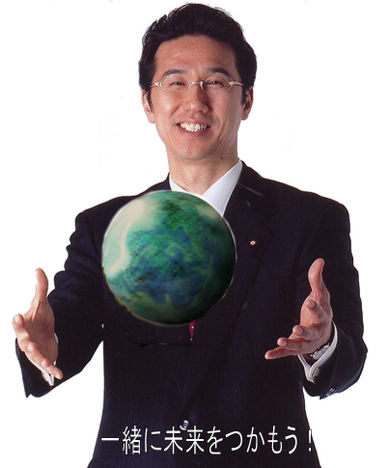
    Etsuji Nii.jpg

    Meet Etsuji Arai, LDP lower house member from Saitama’s 11th district. Doesn’t he look like a Japanese Napoleon Dynamite?

    His web site address is “My Dream” – one of those English phrases that every Japanese person knows, but in Japanese rather than sounding lame, it absolutely reeks of conviction and sincerity.

    As an LDP member, his basic stances should be pretty predictable, but he stands out in the following ways:

  • He remains one of the few LDP Diet members to have an official web site featuring an RSS feed (more on that later).
  • He’s a dentist.
  • He’s not the son of a former Diet member (but his older brother is “reformist” mayor of Fukaya City, Saitama, Iemitsu Arai.
  • He was elected to the Diet last year as one of the “Koizumi Children” to replace Dietman Ryuji Koizumi, who opposed the postal privatization bills.
  • Anyway, I just liked his picture really. He is apparently very active as a new Dietman, so let’s look forward to his continued success!

    Japan’s religious right part 1

    My post about popular right-wing blog mumur has stirred some interest on 2ch. That has led me to try and look into just what the mumur blog is about, which hasn’t been easy. Despite being the 19th most popular blog in Japan right now, there’s no wikipedia entry for it, and no real description of the author on the blog itself. That’s pretty typical of a lot of blogs (like Kikko’s), so that doesn’t surprise me. Anonymous message boards are so common in Japan that they are a main feature of one of the most popular manga/anime in Japan right now, Death Note (the movie version of which was terrible, btw).

    The content mainly consists of criticism of the media (Mainichi and Asahi, two left-leaning organizations, get the brunt of it) from a perspective similar to that of anti-American right wing manga artist Yoshinori Kobayashi (who actually has a pretty good English wiki article. Seemingly tied into the very concept of the blog, considering that it is subtitled “Site to support Tokyo Municipal Assemblyman Hiroaki Hatsushika” (in a reference to the campaign the blog led to harass the man), mumur regularly identifies people (usually public figures) whom he directs his readers to harass for their unacceptable actions. It’s reprehensible conduct that is sadly likely to go unpunished given that Japan’s remedies for libel are weak.

    But in my brief research, I came across a forum thread in which a number of people claimed that mumur was among Japan’s “religious right” and cited as “evidence” the observation that mumur observes some of their common traits:

    1. Writes frantic responses that would be inconceivable by common sense standards.
    2. Pretends to be multiple people using dial-up connections. Also there will be many posts from multiple sources but from the same area.
    3. As soon as the topic comes to religion the pace of posts drops.
    4. Frantically emphasizes the fact that “I’m an average person.” An average person wouldn’t write frantic responses.
    5. Hates deletions. It seems there is an order to post “a deletion means you lose” when that happens.
    6. It seems there is an order to post “people like you are just a small sample” to the object of their abuse.
    7. Hates Kobayashi, who betrayed right-wing religions and criticized the Iraq war.

    Now, among the attentive, Japan-focused English-speaking public there’s some recognition of Japan’s right wing and their belief in the holiness of the emperor, etc. Less well-known is the large number of right-aligned religious groups that form a major wing of the conservative elements in Japan. The issue is especially poignant now that news stories have broken indicating that Prime Minister Shinzo Abe is a follower of “Ekojuku.”

    Let me point out that I have no idea who writes for the mumur blog, so in no way do I wish to imply that this anonymous person is a member of any specific religious group. Quite the contrary, I often have no idea what to believe on the Japanese net since it’s so mired in conspiracy and backdoor manipulation. All I’m saying is that reading about mumur inspired me.

    For starters, let’s take a look at one of the main groups:

    Unification Church: The well-known group known as the Moonies is very active in Japan (perhaps the most followers of any country) and is subject to many conspiracy theories, including that the right wing textbook writing group “Tsukuru kai” is controlled by church founder Rev. Sun Myung Moon. A recent scandal hit PM Shinzo Abe after videos surfaced showing that Abe had sent a letter of congratulation to a mass wedding earlier this year. The discovery seemingly backs up rumors of continued close ties between the church and Japan’s elites (including Abe’s grandfather and several other former prime ministers) due to his contributions to the fight against Communism during the Cold War. The founder is well-known for his conservative beliefs and support of the Republican Party. The group is controversial in Japan for the fanatical devotion of its followers, its many dummy corporations, and its fraudulent sales of “spiritual goods” at inflated prices. The Japanese government began monitoring the church after Moon was known to have deepened ties with North Korea. (Source: incredibly long Japanese wikipedia article)

    OK, it’s getting late, so other groups will have to wait.

    PM Shinzo Abe a cult member?

    Last week’s issue of weekly news magazine Shukan Asahi contained a feature story claiming to have strange video footage of Shinzo Abe attending a party in Nov 2002. This was around the time of North Korean dictator Kim Jong Il’s admission of his country’s secret program to kidnap Japanese people. Abe, then Dep. Chief Cabinet Secretary, saw his star begin to rise as he received credit for pushing a strong protest of the program. At the party, for Ekojuku (Wisdom Light School), a “business consultancy” that uses fortunetelling and magic energies from the (now-deceased) founder’s hands to give business and career advice. The party was held to celebrate the birthday of the company’s founder, Hitoyoshi Mitsunaga.

    Abe’s speech to the crowd gathered was as follows, in translation:

    “Every November I attend Mr. Mitsunaga’s birthday party. We have a long relationship that goes back to the days of my father. Each and every day there are lots of hectic goings-on, but I am thankful, knowing that this is truly thanks to Mr. Mitsunaga. I would really like Mr. Mitsunaga to send his power to the diplomats in negotiations with North Korea now, and defeat North Korea. This is how I feel.”

    The article goes on to detail numerous meetings between the two (who hail from the same area of Yamaguchi prefecture), the fact that Abe was a board member on some of Mitsunaga’s companies, and some dealings that the Abe family had with Mitsunaga. Sure, the man’s beliefs are his own business I suppose, but it just irks me that crucial details like the man’s philosophy (i.e. magic hand energies can sway diplomatic negotiations) don’t make it into English-language media reporting on a major world leader. Somewhat less irksome is the absence of credit given to Abe for his 2002 best dresser award.

    I don’t feel like going into detail on this now, I just wanted it covered since I am working on a post about right wing religions in Japan.

    Aso in the mist

    So tonight I was at a huge party at the Imperial Hotel welcoming one of the international bigwigs of PricewaterhouseCoopers to town. It was a major affair. They booked an enormous banquet room, and provided foreign guests with earphones so they could listen to simultaneous translations of Japanese speeches from the major partners in the tax and advisory wings of PwC. Then the bigwig came up to speak, and he had a Japanese interpreter copying each sentence of his English speech. A slightly more stilted performance.

    Finally came the guest of honor: the Foreign Minister himself. He wandered out onto the podium, looking slightly drunk, and proceeded with his speech… in English. Now, Aso doesn’t exactly speak perfect English to begin with, and being red-faced didn’t help too much either. He stumbled around a talk about international business for a couple of minutes, then turned to the interpreter (who was still hanging around from the last speech) and shouted “All right, now translate it!”

    One of my companions looked down at his simultrans earpiece and said “I wonder if he’ll get the message if I put this on?”

    Right wing blog, 2-channel harassing Mainichi reporter of Korean ancestry for left-wing stances, speaking rudely about emperor

    Popular right wing nutjob blog murmur mumur, along with his buddies at 2ch, are furious over the behavior of a reporter for the Mainichi Shimbun, a third-generation zainichi (Japanese of Korean ancestry) named Park Chong Ju, at recent press conferences given by the Saga prefectural governor (UPDATE: For the record, murmur’s blog hasn’t commented on the emperor press conference specifically, but he probably will since Park is the subject of a “series” on the blog). In particular, people are angry over a 9/28 press conference given by the Saga prefectural governor announcing that the emperor would be attending a ocean-themed festival (that apparently already took place on 10/29) in the prefecture. Park was rude when questioning the necessity of spending millions of dollars to bring the emperor to the prefecture when govt finances are in trouble. He not only failed to use the proper honorifics when speaking of the emperor and his wife (calling the imperial couple “those two” rather than the formal 天皇皇后両陛下 “their majesties, the emperor and empress”), he questioned “the meaning” of an imperial visit, suggested that the money spent on the imperial visit could be used to help “the less fortunate,” and asked whether people would be forced to wave the Japanese flag, an act controversial among Japan’s left wing. Others were annoyed by his “interrogation” style of questioning, which is actually pretty common from what I’ve observed of reporters. It’s not pretty, but it’s also not something that’s usually publicized since press conferences like this have only recently been posted in full online and by their nature are not that popular to watch.

    You can watch the video on Youtube or take a look at the transcript. In Japanese only.

    To express his dissatisfaction with Park, Murmur mumurhas decided to use his favorite tactic and put up Park’s personal information, including mobile phone number, business card, and photographs, in an attempt to encourage readers to harass the man and contact his employers to complain about his performance. Consider it the online equivalent of black sound trucks outside a Communist Party picnic.

    Basically, Zainichi can do no good in the eyes of the Japanese right wing. Almost anything Koreans do sets them up for ridicule and scorn, or denouncements as spies in their midst. The mere knowledge that a well-known person has Korean blood makes them a member of the Korean conspiracy. Apparently this reporter has an activist streak who thinks of himself as a representative of the people (a more recent incident had the Saga governor informing Park “This isn’t a place for reporters to state their opinions!”). He’s written articles critical of revisionist textbooks and in favor of allowing more government participation for the zainichi population, in addition to his critical stance on using tax revenues on the emperor’s visit.

    As another commenter on 2ch pointed out, these stances make Park an easy straw man for those with a more conservative outlook (the majority of 2ch for starters). There have been several threads posted criticizing his manners, politics, and the definition of his own role as a reporter.

    I want to say stuff like this makes me feel good about the state of American political discourse, but of course we’re no better, what with our own countless examples of petty harassment.