A visit to Losheng

Update: Photo gallery added on 9.23.2008. The new Flicker flash gallery has a fullscreen mode which is excellent for photos like these. Also added some additional comments by Mr. Chang.

I had meant to write a few days ago about what I’ve been doing in Taiwan, but my friend’s house mate forgot to pay the DSL bill and so I haven’t been able to get online all that easily, so tonight I finally broke down and paid the NT$100 (about US$3) for a 24 hour WiFly (WiFi service in every Starbucks, McDonald’s, KFC, etc. in Taiwan) access card.

So, today I visited Taiwan’s famous Losheng Sanitarium (樂生療養院), a leper colony built by the Japanese colonial government in Xinzhuang City, Taipei County. As in leper colonies throughout the world, Taiwanese victims of Hansen’s Disease were forcibly imprisoned in Losheng by the government, as they were in Japan by the government there. Although the leper imprisonment order was lifted in Taiwan in the 1950s (I believe someone today told me 1957), they have for the most part remained. With modern medicine the patients are no longer inmates, and no longer contagious, but nothing can de-cripple them or regrow their missing fingers and stumpy limbs. And they have nowhere to go, and no way to survive except by public welfare of some sort.

I had first heard of Losheng perhaps a couple of years ago, due to the wave of protests to the government’s plan to demolish the entire complex to make way for a train depot, as part of Taipei metro’s never-ending expansion plan. Although there are naturally no opponents to MRT expansion itself, there have been severe doubts regarding the sense of building the depot in this particular location, which apparently requires the leveling of mountain to create flat ground which naturally occurs elsewhere and is widely suspected of having been chosen to satisfy local political interests before practical considerations of engineering.

Primary opposition to the plan however, is due to a desire to preserve Losheng. The adage goes something like, you never really appreciate something to it’s gone, and it is born out time and again in the history of urban preservation. New York City’s historical preservation regime was established in the wake of the foolhardy and abhorrent demolition of Penn Station in the 1960s, and throughout the world preservationist activity is often triggered by the threat of imminent loss. The government’s plan to demolish the place made people realize for the first time that it was worth preserving, and recent protests have spurred a surge of interest in the hospital site and its residents that has gone beyond simple preservationism to community organizing attempting to integrate Losheng, which for most of its existence was in principle as isolated as a prison, into the surrounding community. This has led to large numbers of non afiliated visitors spending time with the patients for probably the first time in many years, if not ever.

Since I cannot process the files from my digital camera until I get home to my desktop computer, words will have to suffice for now in describing Losheng. it turns out that from the articles I had read in The Taipei Times, not to mention the briefer pieces I saw in Japanese media I had no idea what it was like. When I read about a hospital/leper sanitarium being destroyed to make way for MRT construction I had for some reason imagined a cluster of shabby old buildings on a city street corner. But of course a leper colony could not be in such a place, and is in fact built on slightly elevated and up-sloping terrain on mountain foothills of a part of Taipei county that, at the time, was mostly farmland. Less a modern style hospital or a prison, Losheng is actually a sprawling and rather pleasant, almost collegiate-looking, campus with abundant greenery and attractive brick buildings. The main hospital building looks properly medical, and the general sense of design reflects its Japanese period origins, with semi-exposed corridors reminiscent of the older buildings on the Japanese Imperial Universities of the early 20th century, such as today’s National Taiwan University or Kyoto National University (the two examples whose architecture I am familiar with). Most other buildings are also in the pre-war Japanese style common in Taiwan, with a few notable exceptions. The least Japanese buildings in Losheng are probably the Buddhist temple, which is in standard Taiwanese style, and the now shuttered Catholic Church, which is perhaps the most spartan Catholic church building I have ever seen, with only a spare cross on the roof and no writing of any kind on the outside, but with a green Chinese roof, oddly complete with dragon tiles on the corners, and outer walls painted in the Chinese temple fashion. It reminds me of nothing so much as the far more elaborate Tainan Catholic cathedral, which is constructed and painted completely in the manner of a Chinese temple, if you do not look too close at the paintings. Of particular interest are the residence buildings for patients (originally, remember, inmates) from particular parts of Taiwan, such as Penghu or Tainan, donated by the governments of that region.

I mentioned above activity integrating the Losheng campus into the greater community. This consists of various activities, such as holding lectures and community meetings inside Losheng, or educational programs for children. As chance had it, I happened to go on a day which was particularly active. Community activists are currently running a summer camp for children from various elementary schools in the area, using various Losheng buildings for different activities. I was taken to see the room being used for a week-long Japanese language class run by a Japanese woman studying a PhD in Urban Planning at National Taiwan University, in the room of the hospital building where the sickest patients were brought, connected by a locked iron door to the much smaller room where they were taken to die. This is either morbidly incongruous beyond belief, or an excellent symbol of the way in which the space is being reclaimed and repurposed from its grim past. But little of that darkness remains. The staff (mostly Taiwanese college students) had cleaned the room fastidiously, and it was festooned with child drawings illustrating various basic Japanese words and phrases.

Then I went to a much larger room, a sort of meeting hall I suppose, where the kids were being led in Japanese songs by some of the old patients who remember their Japanese well. One played the keyboard-no easy task with hands ravaged by Hansen’s Disease, while another sat in front of the stage in his motor chair, leading the children in Furosato.

After the class was over, I spent some time speaking to the old men, who seemed both movingly thrilled and slightly amazed to have so many young people, children, teenagers and 20-somethings, having fun inside Losheng and spending time with the patients as human beings, and not afraid of their no longer contagious disease. As is the case with many elderly Taiwanese, their first language is Taiwanese (aka Minnan, Hoklo, Fukkianese, etc.) Their Mandarin is generally weak and heavily accented, and most of them also speak Japanese to some degree, having undergone elementary education during the colonial period. I spent the most time speaking with one old man, Chang Wen-pin 张文贫 (can’t figure out how to type pinyin with traditional characters on this thing…), whose fluent Japanese was easily the best out of the group.

Mr. Chang, now 81 if my calculations are correct, went to a Japanese colonial elementary school in Taiwan and worked as, I think, a locksmith both under the Japanese and in the early years of the KMT, before he was interned. He was around 20 years old at the time of the 228 incident, and considers Chiang Kai-shek to be the worst thing to have happened to Taiwan.

To paraphrase, translated and from memory:

Taiwan’s history is full of tragedy. After WW2 Taiwan shouldn’t have been given to Chiang Kai-shek, but instead the allies should have occupied it. America, England and Russia should have managed Taiwan and then organized it for independence. If they had done that then we would have avoided the 228 massacre and noone in Taiwan would be speaking Mandarin (lit: guoyu) today!

He went on to mention that he suspected a war between China and Taiwan would involve Japan and the U.S., and expand into not just a nuclear WW3, but literally “becoming the battle of Armageddon as described in the Bible.” He mentioned his strong distrust of Ma Ying-jiu, and his worry that Ma and the other KMT supporters of unification with China would lead to the destruction of Taiwan.

When we were done speaking and I was preparing to leave, Mr. Chang and the others made me promise to come back and visit next time I come to Taiwan, and before I left he made me wait while he went back to his room and brought a copy of the photo and essay book about Losheng assembled by the preservationist activists, which he signed and gave to me.

Countless speakers have said that “A society is ultimately judged by how it treats its weakest and most vulnerable members.” (Based on a quick search, the source of this quote seems obscure.) The leper has always been a symbol for the lowest in society, and despite having no use for religion myself, I think I can understand why Mr. Chang finds his solace in Christianity, a religion in which the leper is a symbol not of disgust, but of redemption. It says a lot of a society in which lepers are no longer lepers, but patients, and the resurrection of Losheng from a medical prison into a park where children play may be taken as a symbol for Taiwan’s transformation from colony and then military dictatorship into the relatively free and effectively independent country that it is today. But the current metro expansion plan still requires the demolition of something like 30-40% of Losheng’s territory, with some buildings kept in place, a few relocated, and many destroyed entirely. Even the preservationists have abandoned their attempts to save the entire site, with construction of the nearby depot building already well under way, and their best case plan today is the “90% plan.” There is still room for improvement.
We Fear Change

I haven’t been up to much in terms of writing these days, save for one exciting development: my first essay on Neojaponisme.com!

Follow the link to read what I have to say about the SMAPtastic Takuya Kimura’s latest attempt at acting.

Japan’s less-publicized “connection” with African commodities

The Japan-Africa thing might be last week’s news, but better late than never:

This Japan Times feature, ran to coincide with Japan’s hosting of the Tokyo International Conference on African Development did a good job of putting an identifiable and good-natured face on the conference’s goals, whatever they might have been. How better to bring the Japanese taxpayers around to supporting aid to Africa than to emphasize the “connections” between Africa’s sweet, sweet resources and Japanese daily life?

Few Japanese may be knowledgeable about far-away Africa, but the continent’s exports affect daily life here.

With the Wednesday start in Yokohama of the fourth Tokyo International Conference on African Development, one should pause and take a quick glance at facts and figures about the continent’s many valuable and necessary commodities.

Here in Japan, you might start the day with a cup of coffee from Ethiopia, the fifth-largest supplier of raw coffee beans to this nation, after Brazil, Columbia, Indonesia and Vietnam.


Uganda and Zambia meanwhile ship cobalt, essential for making batteries that go into computers, mobile telephones and digital cameras.

The off-hand mention of Ugandan cobalt reminded me of a recent NPR report on the world’s largest uranium mine, which is also a significant source of cobalt. The reporter breezily explains, “As mines go, it’s a honey. It has high-quality ore and a history of saving the Allies during World War II.”

Of course, the reporter is referring to the mother of all life-saving American freedom bombs — the two atomic bombs dropped on Hiroshima and Nagasaki. Perhaps that’s one connection to Africa the Japanese aren’t so keen on being reminded of.

Ma administration already beginning “rectification of names”?

Over a year ago I wrote two posts on pro-independence President Chen Shui Bian’s (陳水扁) campaign of “rectification of names (正名)”, in which various agencies, school texts, and other labels were renamed to suggest an affiliation with Taiwan rather than China.

Taiwan rectifies names in new history textbook: January 31, 2007

More on rectification of names in Taiwan: February 7, 2007

Where the now former president Chen is a member of the pro-localization Democratic Progressive Party (DPP-民進黨 ) and himself of the more radical localization/independence faction, the new president Ma Ying-jiu (馬英九) is a member of the Chinese Kuomintang (KMT-國民黨), and may make Chinese appeasement an aspect of his administration’s policy. This could easily include reversals of DPP iniatives such as the renaming of national corporations (post, oil, etc.) and the removal of former dictator Chaing Kai-shek’s (蔣介石) name from both the Taipei area airport which formerly bore his name, and to the grand Ming imperial tomb-inspired complex now currently knows as Democracy Memorial Hall (臺灣民主紀念館), but originally constructed as the Chiang Kai-shek Memorial Hall (蔣介石紀念館) following his death. While one can understand why Taiwanese democrats (small ‘d’) might object to the former dictator being memorialized in the style of the Ming Emperor’s (although his body is not buried there), it is also easy to see why some members of the KMT-Chiang’s political party-objected to the alteration, and why there is bound to be at least some amount of lobbying for a new executive order to change it back, now that their party has retaken the presidency.

One of the most notable of these renamings was the change of the national postal system from Chunghwa Post- which means China Post (中華郵政) to Taiwan Post (臺灣郵政). While this change has not (yet?) been reversed, it is possible that Taiwan may be in for a round of doubly confusing name flip-flops and reversals. As the Taipei Times reported on the day of Ma’s inauguration (yesterday, May 21)

Forty-year-old Mr Chen waited for two hours before he could put his hands on the sets he had ordered. He said he had purchased the stamps not only because Ma was president, but also because the Chinese characters for “Republic of China” were once again on the stamps.

Last year, the stamps issued by Taiwan Post Co only bore the name Taiwan.

Is this merely an example of the Taiwan Post Co honoring the new chief executive by printing his portrait next to the official name of the country he now leads, or a foreshadowing of a larger restoration of China -oriented names by the new administration? How deeply has Chen’s rectification of names really penetrated in Taiwan? Do most people prefer the localized names to the ones matching the country’s official name of Republic of China? How much has the necessity for campaigning in competitive elections with an electorate made up mostly of ethnic Taiwanese really changed the formerly mainlander-dominated KMT? And where does technically-mainlander but Taiwan-raised pragmatic Ma fit into this? Unfortunately, I have not been in Taiwan for over two years now and I really do not have a very solid sense of how most people have been reacting to these issues recently. It may be safe to predict that Ma will not be renaming any more “China” such-and-such to “Taiwan” such-and-such, but whether he will let all of the recent changes stand is another question entirely.

Taiwan’s Kung-fu politician

No, this isn’t a reference to some pathetic cheesy metaphor, but a quote from new Premiere Liu Chao-shiuan (劉兆玄).

After the ceremony, Liu escorted Chang on his way out of the Executive Yuan.

Liu tripped while walking down the stairs in the lobby of the Executive Yuan hall, nearly falling.

“I am fine. My kung fu is very good,” Liu, a martial arts fiction fan and author of more than 10 martial arts novels, joked in response to reporters’ questions. (Taipei Times)

I just hope that Liu hires this guy as his legislative assistant.

George Takei’s comments on gay marriage ruling in California

This isn’t normally the sort of thing we discuss on this blog, but in announcing his upcoming marriage with his partner of 21 years, the sci-fi actor makes an interesting comparison between discrimination involving his sexual orientation and Japanese descent. Here is Takei’s entire letter, with italics added for emphasis.

Our California dream is reality. Brad Altman and I can now marry. We are overjoyed! At long last, the barrier to full marriage rights for same-sex couples has been torn down. We are equal with all citizens of our state!

The California Supreme Court has ruled that all Californians have a fundamental right to marry the person he or she loves. Brad and I have shared our lives together for over 21 years. We’ve worked in partnership; he manages the business side of my career and I do the performing. We’ve traveled the world together from Europe to Asia to Australia. We’ve shared the good times as well as struggled through the bad. He helped me care for my ailing mother who lived with us for the last years of her life. He is my love and I can’t imagine life without him. Now, we can have the dignity, as well as all the responsibilities, of marriage. We embrace it all heartily.

The California Supreme Court further ruled that our Constitution provides for equal protection for all and that it cannot have marriage for one group and another form – domestic partnership – for another group. No more “separate but equal.” No more second-class citizenship. Brad and I are going to be married as full citizens of our state.

As a Japanese American, I am keenly mindful of the subtle and not so subtle discrimination that the law can impose. During World War II, I grew up imprisoned behind the barbed wire fences of U.S. internment camps. Pearl Harbor had been bombed and Japanese Americans were rounded up and incarcerated simply because we happened to look like the people who bombed Pearl Harbor. Fear and war hysteria swept the nation. A Presidential Executive Order directed the internment of Japanese Americans as a matter of national security. Now, with the passage of time, we look back and see it as a shameful chapter of American history. President Gerald Ford rescinded the Executive Order that imprisoned us. President Ronald Reagan formally apologized for the unjust imprisonment. President George H.W. Bush signed the redress payment checks to the survivors. It was a tragic and dark taint on American history.

With time, I know the opposition to same sex marriage, too, will be seen as an antique and discreditable part of our history. As U.S. Supreme Court Justice Anthony Kennedy remarked on same sex marriage, “Times can blind us to certain truths and later generations can see that laws once thought necessary and proper, in fact, serve only to oppress.”

For now, Brad and I are enjoying the delicious dilemma of deciding where, when, and how we will be married. Marriage equality took a long time, but, like fine wine, its bouquet is simply exquisite.

Much of the debate over the legitimacy of this court decision, and gay marriage in general, is based upon the question of whether sexual orientation as a basis for discrimination is on the same level as gender and race. Since the general scientific and societal consensus seems to be that sexuality is primarily an inherent characteristic (whether due to genetic or prenatal factors), rather than a matter of “choice” or “lifestyle” I personally cannot buy the argument that it is not a similarly invalid basis for discrimination. I imagine that the best route for success on the part of gay marriage equality advocates is to continue to press comparisons with the earlier generations’ fight for racial and gender equality, continue to conflate racial discrimination with homophobia, and remind people that “separate but equal” is a vicious lie. Most people will likely balk at highly technical debates of constitutionality and jurisprudence, but perhaps more of them will listen when an elderly Japanese-American homosexual tells them that being barred from marrying his fiance is equivalent to being locked in an internment camp in the 1940s.

Incidentally, my favorite potential remedy to the entire issue is the somewhat radical proposal to remove the term “marriage” from the law entirely, make the state responsible only for two-party “civil unions” to which gender is irrelevant, leaving marriage as a religious sacrament or label of self-identification.

Pacifist lawsuits: not just for Japan any more

It seems like every few months there’s yet another court ruling as to the constitutionality of Japan’s defense forces. Apparently, Americans are following suit with regard to the Iraq war.

New Jersey Peace Action et al. v. Bush, represented by the Constitutional Law Clinic at Rutgers University Law School-Newark, alleges that the war violates article I, section 8 of the U.S. Constitution, which assigns to Congress the authority to declare war.

Clinic director Frank Askin said the framers at the 1787 constitutional convention denied war-making powers to the president except in response to sudden attacks when Congress might not have time to react quickly.

“The founders were very clear that only Congress could make that awesome decision,” he said in a statement. “They [members of Congress] were not permitted to delegate that power to the president and thus be able later to disclaim responsibility for a decision gone bad.”

Interesting (but, I suspect, futile) arguments in the full article.

Surprise! you are now a part of the “Metabolic Syndrome Market”

Thomas Jefferson famously said, “The man who reads nothing at all is better educated than the man who reads nothing but newspapers.” As cliche as it’s become, the quote still rings very true to me as an avid newspaper and online news consumer.

Even today, it is very easy for those following the news to get caught up in the story of the day and completely miss the big picture. Part of the reason for this is that a news story is quite often the end result of months and months of researching, campaigning, planning, cost-benefit analyzing, focus grouping, intra-group wrangling, or any combination of the above. Therefore, when the average reader sees an announcement, whether it’s for a new hamburger at Wendy’s or the Barack Obama Speech About Race, we are forced to accept the basic premise and set of facts presented, and prevented by our own ignorance as outsiders, and the immediacy of reading information on the Internet, from seeing different parts of the story. The only possible response from the consumer is a sort of tit-for-tat reaction to the new information.

With that in mind, I want to talk about “Metabolic syndrome,” a set of symptoms, including overweight and high blood pressure, that puts one at risk of “lifestyle diseases” such as diabetes. In many cases it is indistinguishable from obesity (and in modern Japanese the terms are used somewhat interchangeably), but it is apparently useful as a medical definition.

The term became especially popular in Japan in 2007, as popular TV shows, infomercials, newspapers, and even the government played up the disease as a growing danger for Japanese people as they live increasingly sedentary lifestyles and consume ever-greater quantities of greasy Western snacks.

The English-language news media has noticed this phenomenon. The Japan Times, a local Japanese English-language newspaper aimed at the expat population, notes:

These days, not a single day goes by, it seems, without there being a fitness-club flier, a beverage ad or a new recipe that contains some mention of metabo, short for “metabolic syndrome.”

In contrast to the massive hype over the increasing problem of metabolic syndrome, the introduction of “specified medical examinations” at the beginning of this month has received much less fanfare. Under this system, all insured persons aged 40-74 will be required to undergo a yearly health check up, followed up by mandatory “guidance” if they are diagnosed with certain conditions. Metabolic syndrome is perhaps the most controversial, as people diagnosed with the condition may have to go through “active guidance” if they are particularly fat.

Coinciding with the introduction of this program is a series of article in the Nikkei Shimbun by a major corporate research group (I think Nomura) titled “the Emerging Metabolic Syndrome Market.” The series is ongoing, but some of its main points can be summed up as follows:

1) The specified examination system will result in thousands, if not millions, of people being officially diagnosed with “metabolic” syndrome.
2) The current medical establishment does not have the capacity to handle all these new “patients” so the mandatory follow-up care will be left in the hands of outsourcers.
3) The program, part of a Koizumi-era medical reform plan (also featuring increased premiums and patient contributions), is intended to make people healthier, which will reduce Japan’s total medical bill. However, actual cost savings will probably take at least 25 years to emerge, and in the short term the government will be dishing out massive largess to whoever can fill this current legally-mandated demand.

The Japan Development Bank has estimated that this metabolic syndrome market will grow to 280 billion yen, a “chance for medical institutions facing harsh business conditions [due to a drop in government payments in the national insurance scheme] to improve their revenue.” 45% of the 9.45 million targets of the system are expected to be judged as metabolic cases or in danger of becoming so, resulting in extra medical expenditures of 73-141 billion yen per year.

This specified exam system has been in the planning stages for years. In the meantime, the media has fanned popular worry over an obesity epidemic, couched in the convenient, one-word slogan “metabo.” And now doctors, or their counterparts in third-party examination centers, have the correct mindset and the legal authority to start diagnosing the problem and mandating treatment. The media, over the past two years or so, has featured the problem of metabolic syndrome in perhaps dozens of creative segments, ranging from features on anti-metabolic syndrome products, to informative explanations of the waist size/internal organ fat conditions for the diagnosis, to wackier efforts by Health Ministry officials to document their efforts to lose weight.

While the term metabolic syndrome is not new and is not a Japanese invention, the intense media campaign has injected the word “metabo” as synonymous with obesity in the Japanese language, with the added twist of hipness (new, trendy words are always a topic of small talk in Japan) and the specificity that comes with “metabolic syndrome” being the name of an actual disease rather than a mere physical attribute.

Without this propaganda campaign and the re-definition of the word obesity, it is unlikely that a vibrant market for anti-metabolic syndrome products would develop as effectively. But taken together, public awareness of the issue is so high that a diagnosis of metabolic syndrome will make much more sense to people and may make them more receptive to attempts to influence their behavior in a healthier direction.

I see two ways to view this major awareness campaign to alert everyday Japanese to the dangers of obesity – either Japan’s medical establishment has come up with an ingenious method for preventive care that will ensure that the life expectancy for Japanese people extends well into the 90s, or government, industry, and the media are conspiring once again to manufacture demand to solve a non-existent problem.

True, it seems like there is a real obesity problem here and a comprehensive plan focused on preventive care (i.e., fighting unhealthy habits will help prevent more serious ailments such as diabetes and heart disease) is a great idea. On the other hand, a massive, mandatory treatment program might be overdoing it, especially if it is taxpayer funded. The system does sound like it might be effective in addressing a real problem, to the extent that it encourages healthy behavior, and could lead to better quality of life for a lot of people. And as with the intention of many Koizumi-era reforms, the creation of new markets through smart regulation may be just what Japan needs to enliven its economy and, through the health benefits, help keep its working population on the job for the extra years that will be required in an aging society.

But my more cynical side tells me that the medical industry may not have Japan’s best interests at heart. If in fact, the expenses are not justified (and hundreds of millions of dollars in extra health burden with no promised overall benefits for a generation seems a little fishy to me) then the government could merely be entrapping its people into a handout scheme for the medical and health product industries.

Only 3% of Japan’s population is considered obese by body mass index standards, compared to ten times that ratio in the US. The figure has risen significantly for Japan over the past few decades, no doubt a result of the often mentioned higher living standards and Westernized diets. But as any prolonged contact with Japanese people will tell you, the demand for health supplements, beauty products, spa treatments, exercise machines, and all manner of health-related products is enormous. I wouldn’t be surprised if the market scale rivaled the US.

However, metabolic syndrome is a substantial redefinition of obesity (not that that is necessarily a bad thing — it seems to correspond much more closely to health problems than BMI, at least from a comparison of Wikipedia articles). Even if people are not fat in the traditional sense, they are much more likely to have the required body measurements for metabolic syndrome. And sure enough, media fanfare over this syndrome dovetails nicely with the ever-growing numbers of products offered to help fight it. And as any quick look at the Japanese mass media will tell you, there is no shortage of such products (today on NHK I saw a full-on infomercial for boxer briefs that force men to take larger strides when they walk, which will help them burn more calories during the day).

From my own observation of the Japanese user-generated media (which consists of a few favored blogs, a 2ch news aggregator, and the diary posting of my mixi friends), the reaction to the metabolic syndrome hype has been quite shallow, with perhaps zero discussion of this upcoming mandatory treatment system (until now, since it came into effect). Indeed, according to a survey translated at What Japan Thinks, almost two thirds of people are unaware that the specified examination system even exists. That, I think, is understandable since the coverage of this issue has tended to be in the form of corporate press releases quoted verbatim, statistics from medical establishment publications on the growing problem.

Honestly, I am no medical expert, and I do not intend to attempt a comprehensive assessment of the relative benefits of mandatory health exams for the middle aged, or of the real dangers of metabolic syndrome. But personally, I have been disappointed in myself for not giving this issue much thought until I ran across that series of articles in the Nikkei. Like many people, probably 75% of the reading I do in a given day consists of news articles, the paper newspaper, and blog posts. They are all quite entertaining to read and keep me informed of what’s going on in the world on a day to day basis, but the net effect of reading superficial day to day coverage is that I end up being completely in the dark about what sort of plans are being hatched behind the scenes.

The Japanese press has asked some of the right questions, and for someone more engaged the information is out there. A Yomiuri Shimbun report from last year cites experts who wonder why the waist size requirements are slimmer than those of other countries (a detail that can have massive implications on how many are singled out for mandatory “guidance” and whether that will affect people who are actually healthy), but in the end the hype has drowned out skepticism and a “metabolic syndrome market” is already fast being built without the knowledge of the vast majority of people. Residents of Japan may be getting fleeced in the deal in terms of increased insurance costs and dubious products intended to solve a problem that for many won’t really exist.

Who knew Bhutan could be so kinky?

While reading about Asia’s newest self-proclaimed democracy I did a double-take at the following factoid:

Bhutan’s first democratically elected prime minister will be Jigmi Thinlay, a charismatic politician who has portrayed the DPT as the party of ordinary Bhutanese. His rival, Sangay Ngedup, leader of the rival People’s Democratic Party (PDP), is the brother of the previous king’s four wives, all sisters.

(Note to readers: I know my last couple of posts have been frivolous. Many apologies. This stuff is just too amusing not to blog.)

Remembering the Railway of Death

About a week ago the New York Times had an article entitled “Seeking Recognition for a War’s Lost Laborers” on the lack of recognition for the Asian victims of Japanese forced labor in the construction of the famous “Railway of Death.” According to the article, the history of the 200,000-300,000 Asians who were employed, and often killed, in the construction of the railway, which was being constructed to link Bangkok and the Burmese (Myanmarese) capital of Rangoon (Yangon) to provide logistical support for Japan’s invasion of Southeast Asia, has been almost completely overshadowed by stories of the smaller number of Western POWs.

Between 200,000 and 300,000 Asian laborers — no one knows the exact number — were press-ganged by the Japanese and their surrogates to work on the rail line: Tamils, Chinese and Malays from colonial Malaya; Burmans and other ethnic groups from what is now Myanmar; and Javanese from what is now Indonesia.

“It is almost forgotten history,” said Sasidaran Sellappah, a retired plantation manager in Malaysia whose father was among 120 Tamil workers from a rubber estate forced to work on the railway. Only 47 survived.

[…]

By contrast, the travails of the 61,806 British, Australian, Dutch and American prisoners of war who worked on the railway, about 20 percent of whom died from starvation, disease and execution, have been recorded in at least a dozen memoirs, documented in the official histories of the governments involved and romanticized in the fictionalized “Bridge on the River Kwai,” the 1957 Hollywood classic inspired by a similarly named best-selling novel by Pierre Boulle.

One reason given for this inequality of historical memory are that virtually none of the Asian victims were from Thailand, giving the local government little incentive to commemorate them. Another is that, unlike the American and British POWs who wrote memoirs and gave countless interviews to journalists and historians, virtually none of the Asian laborers were literate, and they lacked ready access to mass media.

At this point, I would like to present some photos I took at a very peculiar museum that Adam, his (now) wife Shoko, and I visited when we were in Kanchanaburi, the location of the famous Bridge on the River Kwai.

The Jeath War Museum (JEATH is an acronym for Japan, English, American and THai) is a rather eccentric museum based on the collection of a wealthy Japanese history buff, who apparently purchased a building a number of years ago, stocked it haphazardly with local WW2 memorabilia of both great and small interest, and has not had arranged to have it cleaned since.

First, some photos from outside the museum itself.

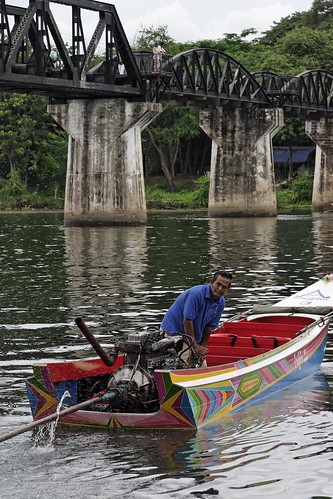
This is a picture of the famous Bridge which I quite like.

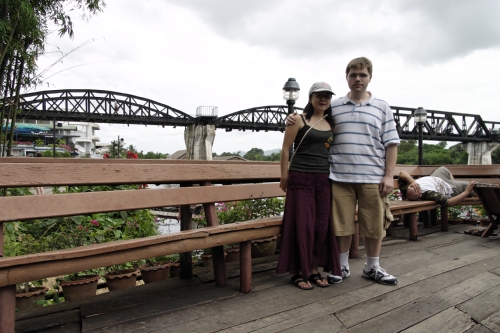
Here are Adam and Shoko posing with the bridge behind them. I do not know the sleeping man, but I have to assume that he is a war criminal of some kind.

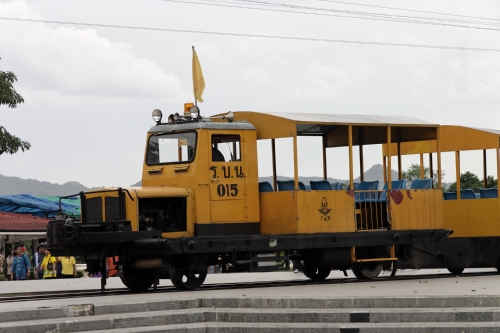
This is a silly little train which lets  tourists ride across the bridge and 1 or 2km into the jungle on the other side, and then ride backwards to the other side.

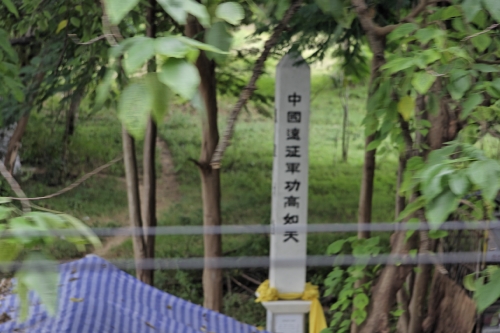
I blurrily snapped this memorial obelisk in the jungle across the river, from aforementioned silly train. It says something along the lines of “the remains of the Chinese army ascend into heaven.”

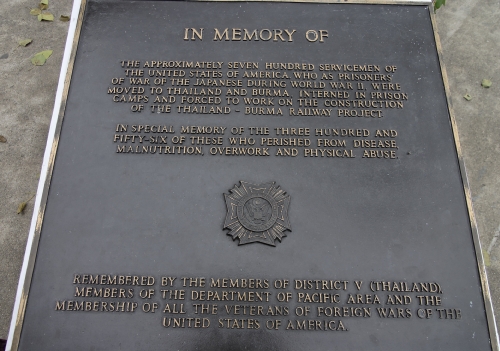
This plaque is location near the bridge. I did not, however, see one for the British POWs, although I certainly could have just missed it.

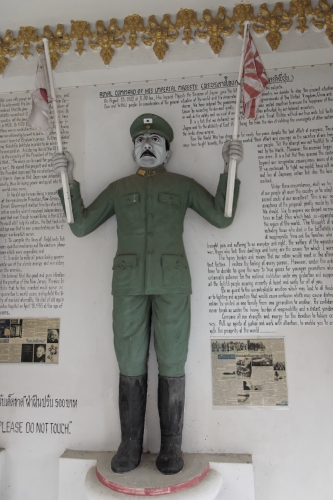
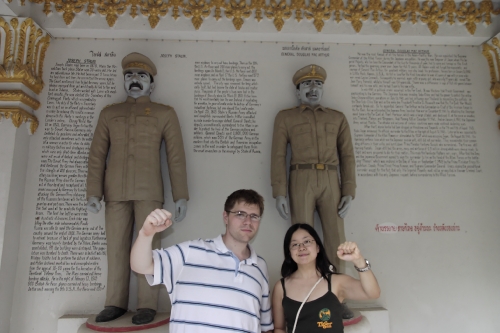
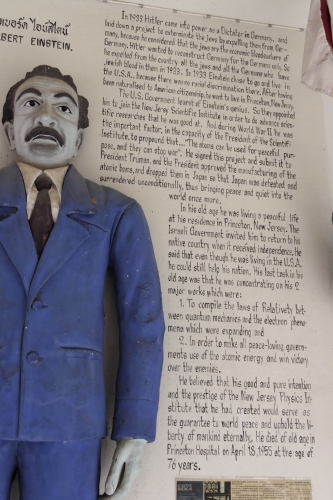
And now we reach the museum portion of our tour. I do not seem to have any photographs of the entrance area, but the first thing you see upon approaching the entrance to the museum proper are these statues of historical figures, with biography written on the wall behind them. I will transcribe the highly amusing text another time.

Here is Tojo.

Adam and Shoko again, with their good friends Josef Stalin and General Douglas MacArthur.

The lovable Albert Einstein gets a wall as well.

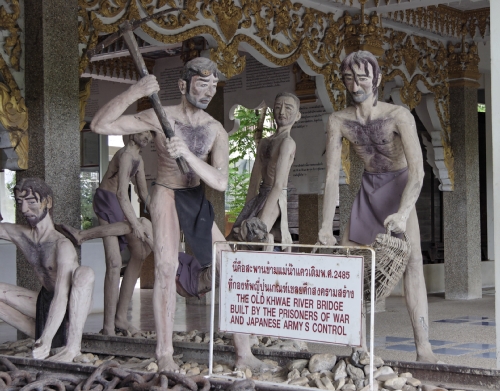
Inside the museum we are confronted with more dramatic statues, such as this tableau of POWs constructing the railway.

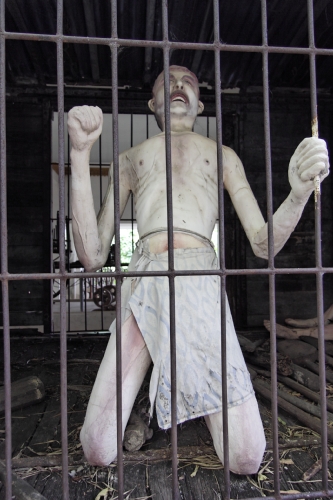
Here is one in a cage. Note the real straw.

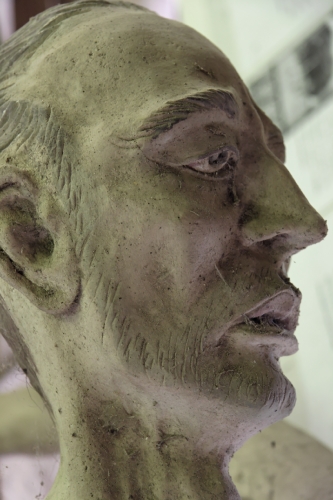
Eerie closeup of another caged POW statue’s face.

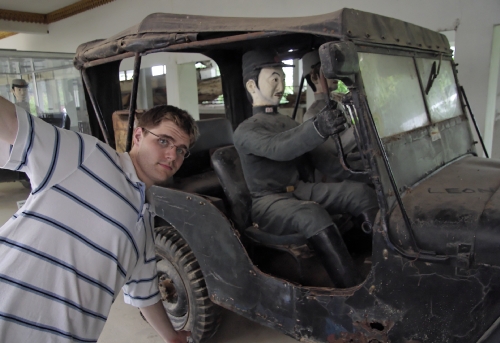
Adam and his new friend, the WW2-era Japanese soldier driving an old car.

The driver.

Another old car. I do not recognize the make, but it is covered in dust that may weigh as much as the steel.

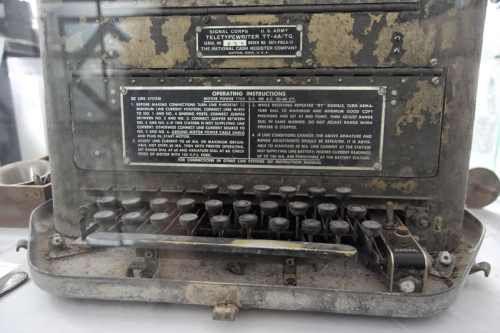
US Army signal core teletypewriter

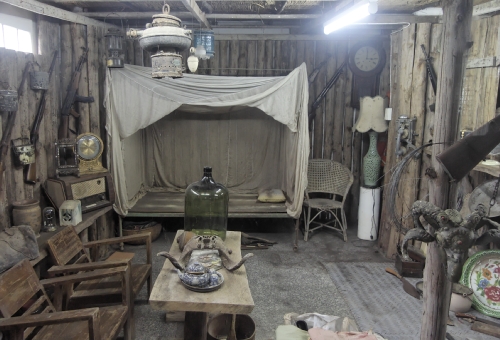
Recreation of Japanese army tent

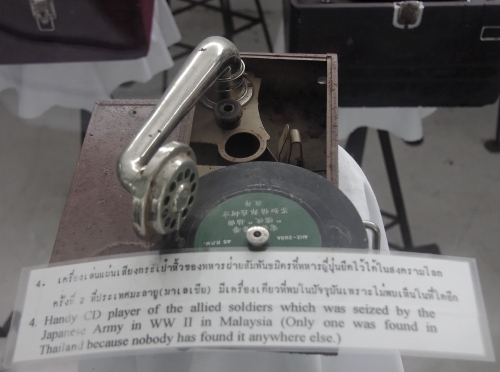
Read the text carefully. Do you know when the CD was invented?

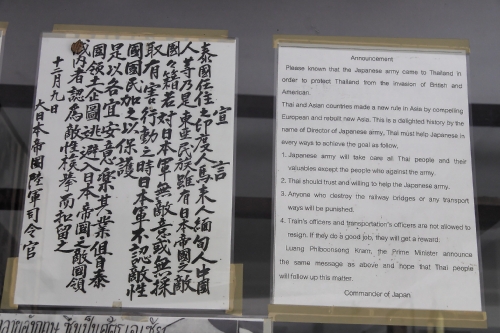
A message from Japan to the Thai people. It’s a bit hard to read, so if anyone wants I can transcribe it.

A British anti-Japan political cartoon

Overall, the museum is a complete shambles. While it has a huge array of cool stuff, it is strewn about almost at random, covered in dust, and sometimes behind other stuff. Not to mention placed in crowded and un-lit cases with poor labeling. Despite the numerous flaws, it is certainly worth a visit if you are in the area, but I can’t say that it will do much to provide any sort of historical narrative, and certainly does not even try to meet the standard hoped for by the Times article I began this post with.