New DPJ cabinet is NOT totally awesome–the counterview to “Change We Can Believe In” irrational exuberance

Adamu is totally pumped about the new DPJ cabinet. You won’t be surprised to hear that I’m underwhelmed by Hatoyama’s sausage fest of a government, full of elected politicians with precious little experience in government, and incorporating no experience from the private sector.

That being said, we agree on the basics. PM Hatoyama should be applauded for appointing Messrs. Fujii and Okada, respectively as Ministers of Finance and Foreign Affairs, making sure that adults are heading the most important positions. The appointment of social policy progressive Keiko Chiba as Minister of Justice is interesting and probably a positive move. I look forward to seeing how she fares in promoting her liberal policies noted in Adamu’s post, which would probably be for the better of the country, although realistically, I have low expectations on her accomplishing anything. Kamei Shizuka is just awful in the position of the Financial Services Agency, and we can only hope that he has some sort of Makiko Tanaka-esque failure.

But then let’s get to what we disagree on. Kan Naoto has fortunately been placed in a senior position where is only role is waffling about policy. The DPJ and Kan have tried to polish his reputation by endlessly unearthing the fact that he on breaking open the AIDS blood transfusion scandal. But a more objective view would note that he was at the helm of the Ministry of Welfare and Labor when the pension fiasco began, he tried to target LDP politicians for not paying into the national pension program with Gingrich-esque hubris when he himself wasn’t paying into the pension program himself.

Seiji Maehara, a hawkish DPJ faction leader who in some ways is philosophically closer to the LDP reform wing, has been appointed to lead the Ministry of Land, Infrastructure and Transport (and Tourism!) and has started out be reasserting the DPJ’s promise to cancel all dam projects, including the Yamba Dam project that has already gone through more than 300 billion yen of its 400 billion budget. The DPJ’s rejection of new projects is understandable; it’s refusal to approval the completion of projects that are done is just barmy — especially as the governors of Tokyo and Gunma, which have paid for part of the budget, are preparing litigation against the government to get back the money invested from their prefectural budgets, which they seem very likely to win.

Then there’s pension policy wonk Akira “Mister Nenkin” Nagatsuma (actually his real nickname) appointed as Minister of Health and Welfare. He was expected to be a vice minister for just pensions and yet has been appointed to run the whole ministry. The scene yesterday at his appointment was fascinating — outgoing LDP Minister Yoichiro Masuzoe gave his farewell address and was greeted by applause by the bureaucrats. Nagatsuma’s entrance was met with stony silence and shallow bows, which he answered by saying in his address that he was going to “purge the ministry of grime and pus.”

Nagatsuma’s post will probably be the ongoing test ground for the DPJ’s anti-bureaucrat stance: how can a minister who has spent the past years eviscerating the bureaucrats now effectively manage them? At least Tommy Carcetti understood the importance of co-opting people inside the institutions he had to change. The DPJ is going to need the help of the bureaucrats to effect the reforms they want to carry out.

The rest of the cabinet is hard to gauge because few have previous experience or much of a public reputation. The one other startling fact is the lack of private sector expertise. The Constitution of Japan only requires that a simply majority of the cabinet ministers be an elected member of either the upper or lower house. Koizumi was especially noticeable for bringing in private sector know-how to the cabinet. That is noticeably absent in the “mock-Westminster system” that the DPJ is advocating, for indiscernible reasons.

Hatoyama enters office with 75% approval ratings, numbers that are matched only by Koizumi in 2001. I would wager that they are at around 30% a year from now.
New DPJ cabinet is almost totally awesome

First, the bad news. Shizuka Kamei has been appointed minister of postal issues and financial services. The man is a fierce, fierce fighter who likes to dredge up personal scandals using his ties as a former police official. That’s probably how he got the job. Now he’s going to make sure Japan Post remains the world’s biggest and possibly worst-managed bank and he’s going to crush regional banks by allowing all the people they lended money to stop paying for three years. Great.

As I just commented over at Observing Japan’s assessment of the new lineup, I hope Kamei simply collapses under his own weight. He may well overreach in a position that gives him barely any authority at all. If any place should be safe from unwise political meddling, it’s the FSA which has SEC-like regulatory and law enforcement authority over all financial services institutions.

Otherwise, not a bad lineup. Though Time Magazine posits Ozawa as a “shadow shogun” (reflecting the “Ozawa is the real one in charge” theme trotted out by both Nikkei and Yomiuri, who are wary of a DPJ administration) the cabinet reflects a wide sampling from the party including people not so close to Ozawa, like finance minister Hirohisa Fujii who was an early voice calling for Ozawa to step down over the Nishimatsu political funds scandal.

Asahi had an interesting section listing some of the human side of each new minister. I reproduce some of it here:

Foreign Minister Katsuya Okada has a giant frog collection. I have heard it from an eyewitness that it’s really huge. Not sure if any of them are mutant.

The above-mentioned Kamei Shizuka is a sixth-degree black belt in aikido and has held exhibitions of his oil paintings.

Naoto Kan, head of the National Strategy Bureau, was DPJ president in 2004 when he was going after LDP politicians for failing to pay into the national pension system (a duty for all residents in Japan, including yours truly). When it was found that Kan himself failed to make his payments, he was forced to resign in shame. To get over the shock of the whole series of events, he decided to shave his head and make the traditional pilgrimage to 88 Buddhist temples in Shikoku.

Justice minister Keiko “Sonny” Chiba (not really her nickname) is a former Socialist Party member who’s against the death penalty, for dual citizenship, and pro letting women choose whether to take their husband’s names when they get married. The trifecta of policies I’ve been waiting for! There is no news that the DPJ plans to abolish the death penalty, but for the time being this election appears to have saved the life of Shoko Asahara, Tokyo subway sarin attack mastermind and Japan’s most famous blind cult leader/death row inmate (and my neighbor at nearby Tokyo Detention Center).

Social Democratic Party leader and consumer affairs, birthrate, and gender equality minister Mizuho Fukushima is not only a lawyer and former TV commentator, she is a huge Miyazaki fan and serves as a judge to select the Nikkan Sports film prizes, the top honors of which in 2007 went to “Even So, I Still Didn’t Do It” about a man wrongly accused of train groping.

Hirotaka Akamatsu, agricultural minister, was once a flight attendant in the 70s. One flight was hijacked by the PLO and he had to help negotiate with the terrorists in English.

Administrative reform minister Yoshito Sengoku had his stomach removed in 2002 due to cancer.

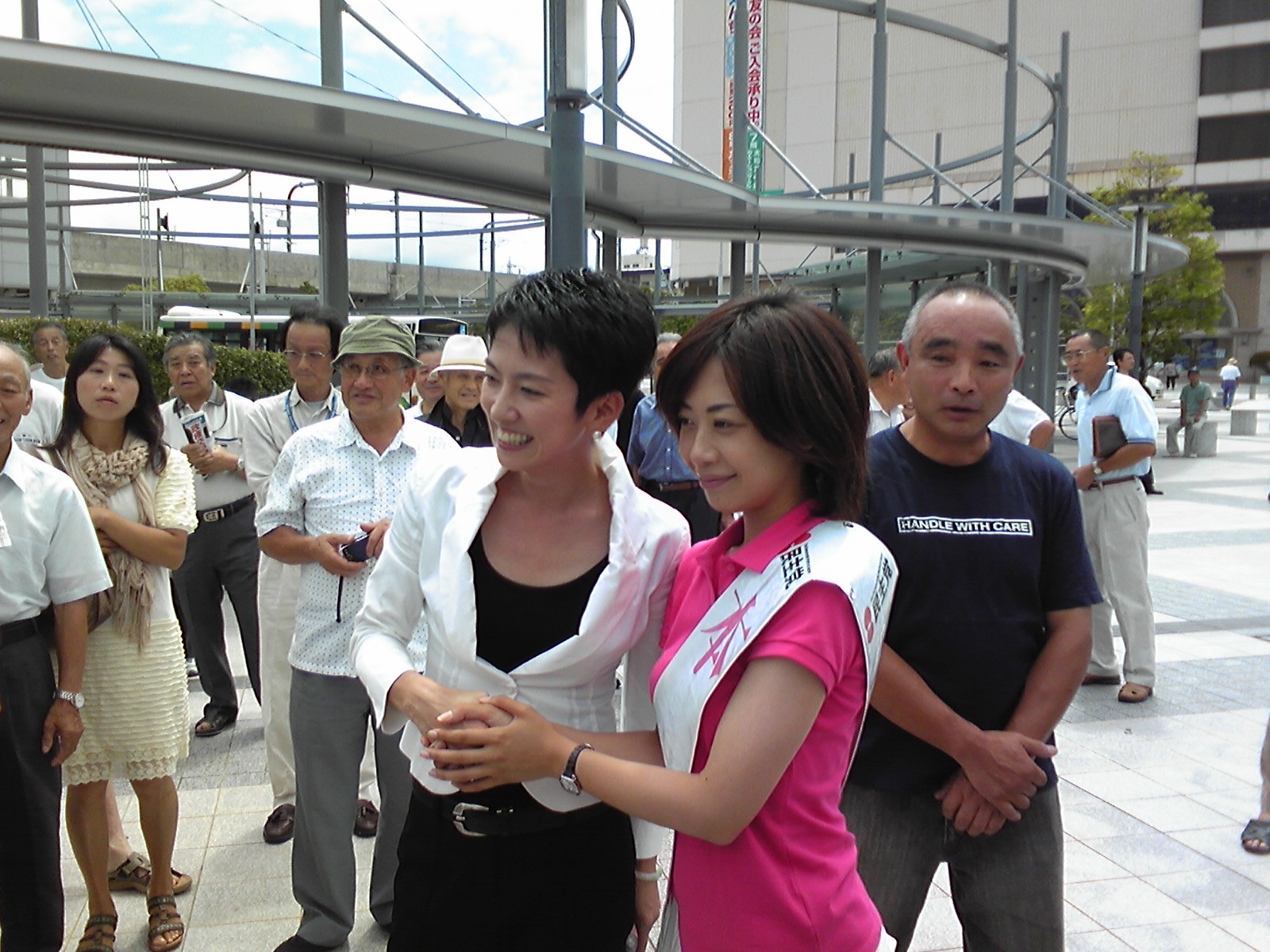
These two didn’t make it into the cabinet (this time), but I think it’s safe to say DPJ upper house member Ren Ho (who Ikeda Nobuo thinks would make a good press secretary) and “cosplay erotica writer” turned newly elected DPJ lower house member Mieko Tanaka are the two best-looking women in the Diet right now:

Ren Ho Tanaka 850745001

Handle with care, indeed.

Okada: No need for vice-minister press conferences; Nikkei: Take it back NOW

My new circumstances give me access to most of the daily papers, in real live dead tree format. So today I looked at the Nikkei and came away with some thoughts:

Nikkei has an editorial forcefully demanding that the DPJ scrap any plans it might have to eliminate press conferences for every ministry’s vice-minister (事務次官). The piece is a reaction to a recent comment from incoming foreign minister Katsuya Okada that they wouldn’t need to hold their own press  conferences because the traditional vice-minister inter-ministry meetings will be discontinued. Under LDP rule, the meetings had become a sort of shadow cabinet meeting and a manifestation of bureaucrat rule.

Calling the suggestion “rash,” the editorial writers lecture Okada that the people in power always try and reduce the number of press conferences as a way to escape scrutiny, and that it’s not up to those in power to decide what the public’s right to know is. One example of the benefits of these press conferences is that the agricultural vice-minister recently had to step down for making inappropriate comments at his press conference about a tainted rice scandal.

I checked, and none of the other major newspapers felt the need to devote an editorial to this issue (the Yomiuri for its part allotted its second editorial to lionizing Ichiro for his new hitting record). But I wouldn’t be surprised if some follow the Nikkei’s lead.

The incoming DPJ administration is expected to open up the press clubs in government institutions, which previously have been almost exclusively limited to domestic, mainstream newspapers and TV stations. Hence, the mainstream news media are on the watch for any signs they could lose their biggest asset – privileged access to those in power. The newspapers are more exposed to damage on this front than TV stations as the news is their only business, at least in their principal medium. The Nikkei in particular just got done posting its first loss since it started publishing figures, for the first half of 2009.

In principle, I agree with the Nikkei’s point that the powerful should be held up to scrutiny. But the Nikkei is changing the subject. Okada didn’t necessarily say he wanted to reduce the number of press conferences. As far as I can tell, Okada’s is merely saying that if the vice-ministers aren’t going to be in a position to speak for their ministries, of course they shouldn’t have press conferences. Maybe a political appointee would be the more appropriate person to put in front of the podium.

In fact, the DPJ’s plans to open up press clubs to independent media will open up government, so I would not be worried if the government stops holding press conference for people who are supposedly irrelevant anyway. The DPJ shouldn’t listen to the Nikkei. Remember, the media will try to portray itself as a defender of the public good, when in fact it’s an institution that’s exploited government secrecy for decades to its financial benefit. I would be happier if the Nikkei spent its vast resources not on acting as stenographers for the government and occasionally getting someone to say stupid things in public (as they did to make the vice minister resign), but instead on actual investigations.

Max Blumenthal at the 9-12 rally in DC

Just thought I’d pass this amazing video along.

Some of the interviews are unfair “gotcha” material, but it’s great to see people get confused when he asked them why they’re so opposed to health care reform and what exactly will happen when the “Obama revolution” goes down. These people really should stop and ask themselves what they’re getting so paranoid about.

Quick notes

Just a couple quick links related to the DPJ’s transition to power:

  • Nikkei reports that ministries are struggling to find enough individual offices for the more than 100 DPJ political appointees who will serve as their new midlevel bosses. The DPJ demands they don’t need their own offices – let the political appointees sit among the rest of the bureaucrats, the better to let them order them around. But the bureaucrats (unnamed as always) are saying unless the DPJ MPs are segregated into their own offices, this could result in a world of face-losing hurt if division directors and other higher ups have to be yelled at by politicians in front of their subordinates, particularly the political appointees’ assistants (actually very capable mid-level bureaucrats provided by the ministries).
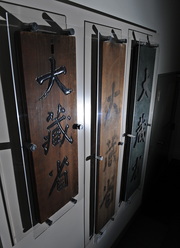
  • Great caption from the Nikkei.com English service: “Like these historic ministry nameplates, the Ministry of Finance has survived war and economic downturns with its powers intact.”

mof Nni20090907D07JFA08025040

  • Here’s a list of major political pressure groups in Japan and their vote-rallying power, again from Nikkei. Most of them are not hesitating to ditch their support for the LDP in favor of the new patron.

    Dentists’ association (日本歯科医協会) – 228,000 votes
    National construction industry association (全国建設業) – 227,000
    Medical association (日本医師会) – 186,000
    Pharmacists’ association (日本薬剤師協会) – 168,000
    Nursing association (日本看護協会) – 167,000

A Graphical History of the Democratic Party of Japan

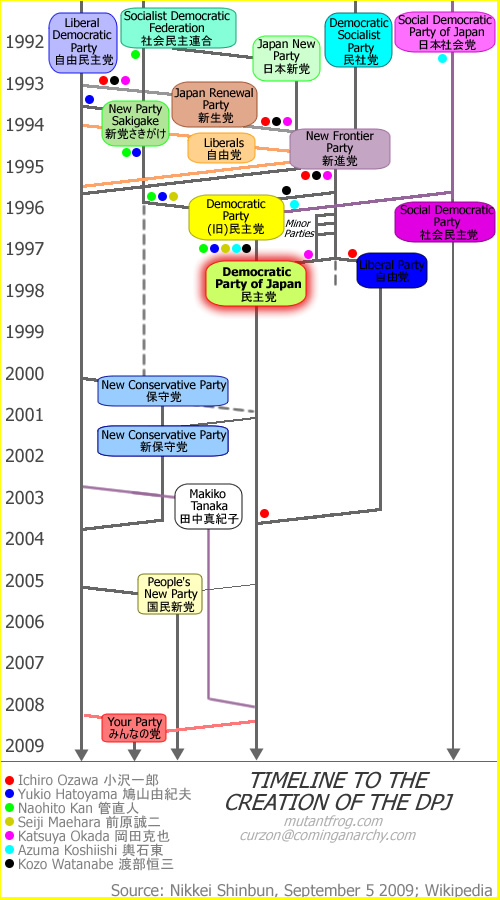
The Nikkei on Saturday had a chart of the history of the Democratic Party. I have translated, and substantiated, the graph and included it below here.

democrats

Thus did the party arrive at it’s coalition today of LDP defectors, socialists, and free market conservatives. After a decade of wondering what the DPJ would do in power, we finally get to see what happens. Let the party begin.

Change! ニッポンをカエル

Reports are out that Katsuya Okada will be the foreign minister in Hatoyama’s first cabinet, which is (unfortunately) not nearly as cool as the footnote to the AFP report:

One of [Okada’s] more peculiar hobbies is collecting items that depict frogs. But there is a serious political point — “frog” in Japanese is a homonym for “change” — the slogan used by the DPJ during last month’s election campaign.

This is a fairly popular pun in Japan. Last year I came across this banner at the Akasaka Sacas complex in Tokyo. It says “アカサカカエル、オイシサヲカエル” (Akasaka kaeru, oishisa wo kaeru) which could be read several ways, such as “The Akasaka Frog is changing tastiness,” or perhaps “Change Akasaka and frog the tastiness.”

Yay for kaeru puns

Check out Adamu pontificating on election matters

In case you didn’t catch it, you can watch me commenting on the other night’s election results with Ken and Garrett from Transpacific radio and special guest International Attorney Christopher Gunson.

The video is in three parts:

Part 1 / Part 2 / Part 3

Skip around a little because apparently there are parts where the sound didn’t quite work. All the same you can hear us cover:

  • Our election predictions, which are almost instantly shown to be way off
  • How the lower house members are chosen
  • Breakdowns of several races
  • What the religious parties New Komeito and Happiness Realization Party are all about
  • What kind of makeup politicians use to smooth out all their wrinkles to achieve the signature “Ichiro Ozawa as slimy salamander” look (thanks to viewer Kozo, we now know they use a kind of grease-based face makeup known as ドーラン in Japanese).
  • And much more!

Once again, thanks so much to TPR for putting everything together and making it a spectacular evening (and for all the pizza too). Also thanks to Marcus for going out of his way to do the sound and video (he even brought a TV light!)

Bad Analysis/Articles on Japan’s election

There’s a lot out there, but these two took the cake:

Next first lady feels affinity with Michelle Obama
Miyuki Hatoyama, who has a certain bug-eyed similarity to her alien-looking husband, has said she feels affinity with Michelle Obama. Next weird line: “He is blessed by his ancestors and his supporters and protected by their power, so whatever happens, he should be all right,” she said.” Man, I would have loved to see that in the original Japanese, if such an article exists perhaps some intrepid googler can track it down for me. She also wants their son, a shy engineer studying in Moscow, to run for office soon, a statement not exactly in line with the DPJ’s pledge to end hereditary politics.

Japan’s Underpopulation Crisis Led to Recent Election Upset Demographer Says
Lifenews.com, an anti-abortion news site based in the US, has said that Japan’s demographic crisis led to the DPJ win. Without explaining the logic behind that assertion, we heard that legalized abortion is the cause of the upheaval — which I declare to be complete nonsense considering the frequency of “dekichatta kekkon” in Japan, although I don’t have stats to back me up.

Tairo Hirayama to represent Tokyo 13th district

Amid all the excitement of last night’s live election coverage (DPJ won big, Hatoyama will be PM), I didn’t get a chance to check the results in my home district. So here goes.

In line with the overall nationwide trend, voters chose DPJ candidate (and ryokan heir) Tairo Hirayama to represent Tokyo’s 13th district (covering all but the western end of Adachi-ku). Hirayama beat LDP incumbent Ichiro Kamoshita by a small margin of 3,000 votes. Kamoshita will stay in the lower house as a proportional representation member, which will make things awkward if they ever run into each other in the halls of the Diet building.

In a statement on his website written last night, Hirayama adopted the same cautious tone as PM-to-be Hatoyama. He thanked supporters but said he considers the votes to be not for him personally but instead as votes for a change in government. Since he had already taken some painkillers to combat his lower back pain (ぎっくり腰 a new vocab word for me) he expected to stay up all night before heading to Kitasenju Station this morning to thank voters for their support.

At 62.82%, voter turnout in Tokyo’s 13th was lower than the 69% national average and not much higher than turnout in the July Tokyo assembly election.

***

Hirayama might want to shake hands with Kazumasa Fujiyama, his rival candidate from the Happiness Realization Party. Though Fujiyama received less than 3,000 votes or 1.1% of the total, that was just about in line with Hirayama’s margin of victory. Had those voters gone LDP the race would have been much closer. Even considering that the HRP voters were almost all Happy Science followers, Hirayama should thank his spirit guide that Okawa didn’t decide to throw his weight behind the LDP this time around.

Nationwide, the HRP failed to win a single seat or even surpass 1% of the popular vote in most districts. Without any significant voter support, the party stands to lose over 1 billion yen in security deposits for the more than 300 candidates it fielded.

Happy Science’s political movement, born of guru Ryuho Okawa’s vision of a nuclear holocaust, has failed. At one point it appears they considered giving up before the election, but in the end this was a bad idea that took on a life of its own. In a personality cult, once the leader sets his mind to something it can be very hard to stop. The leader himself may hesitate to admit to a mistake out of fear he’ll lose credibility, and of course his followers who think he’s a divine being would never go against his wishes.

I hope the authorities will keep a close eye on this group as it’s possible Okawa may still feel the urgent need to save Japan from certain doom by taking control of the government.

***

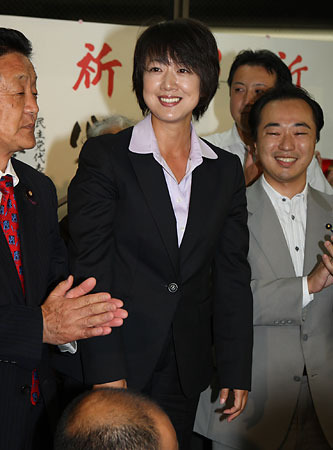
Perhaps the biggest national story set in Adachi-ku is the DPJ’s defeat of New Komeito President Akihiro Ota in Tokyo’s 12th district (covering Kita-ku and the western tip of Adachi-ku) was yet another humbling setback for the ruling coalition. Former DPJ President Ichiro Ozawa had considered running against him but decided to field a different challenger, singer and DPJ upper house member Ai Aoki (see photo above) instead. It ended up working, and Ota, who had not run in a PR spot, will have to turn in his MP badge (and of course resign as New Komeito leader).

In fact, nationally the New Komeito lost in every single-member district. The 21 members it will send to the next Diet session were all PR candidates.

Ai Aoki 20090831-00000014-jijp-pol-view-000

An ebullient Ai Aoki, winner in Tokyo’s 12th district (photo from Jiji Press)