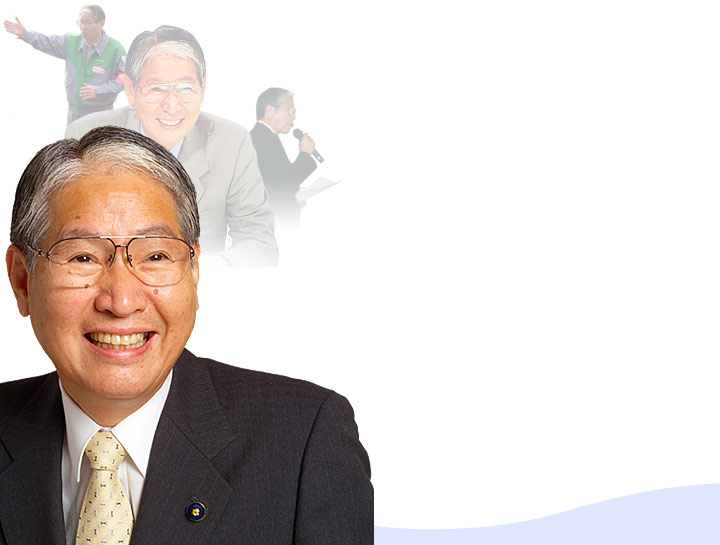
Japan Lower House election – Meet the candidates Part 3: Shuji Watanabe (69) JCP

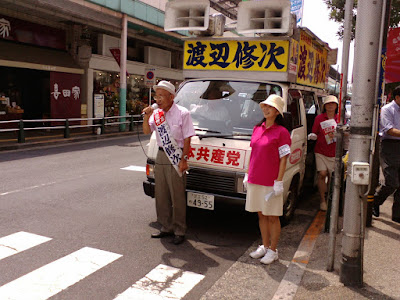
Profile: Watanabe is a former Adachi-ku assemblyman running on the JCP ticket. At 69, Watanabe is liver-spotted and somewhat frail-looking when campaigning. He is an old school communist – he never went to college but instead joined the party in 1960 after finishing technical school. Three years after graduation he began working as a sanitary inspector at a clinic for the poor, where he was an active unionist who pushed for improved benefits for workers. He entered electoral politics in 1971 and won a seat on the Adachi-ku assembly, where he has won re-election nine times (I assume consecutively). He has apparently retired from the assembly to run in this election.

Chances of winning: I don’t think he expects to win. True to the JCP’s commitment to being a vocal minority party, I think the point of him being there is to try and direct the debate in favor of the JCP’s policy platform. He doesn’t even have his own real website, so I kind of doubt the party’s commitment.

Policy: Watanabe is running on a typical JCP line of protecting employment. See my earlier post on the JCP to see why I find them unacceptable.

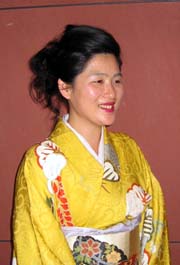
Something interesting: I can’t say for sure, but something tells me this guy is related to Yasunobu Watanabe, the Tokyo Prefectural Assemblyman who handed his seat to JCP candidate Yoshie Oshima in July.

Shuji:

Yasunobu:

Yasunobu Watanabe

Japan Lower House election – Meet the candidates Part 2: Tairo Hirayama (DPJ, age 37)

I am running out of time before the election (and have lots of research to do before my major live-streaming/blogging event tomorrow night), so I’ll be quickly running down the rest of the ticket in Tokyo’s 13th district:

Tairo Hirayama (DPJ, age 37) – This guy has been just about ubiquitous around Ayase recently, much more so than his LDP rival Ichiro Kamoshita.

fish img_profile

Profile: This first-time candidate was a guest lecturer at Akihabara’s Digital Hollywood University (a school specializing in IT and media) where he taught a class on e-commerce. His main occupation is running a non-profit organization that helps small companies set up e-commerce websites. While not as prolific as Kamoshita, Hirayama has authored several books including Net Shop Management Standard Guide – 37 Iron-clad Rules for Attracting Customers and Sales Promotions Known only to Top-selling Stores.

He is originally from Iki, a tiny island in Nagasaki prefecture between Kyushu and Tsushima where his parents run a ryokan (traditional Japanese inn). I assume he is running in Adachi-ku because that’s where the DPJ placed him. He does not claim any prior affiliation with the area.

A turning point in his life came in 1995 when as a student at Waseda University he volunteered for the rebuilding effort following the Great Hanshin earthquake that devastated the Kobe area. It was there that he learned how to lead people; it’s also where he met his wife Sachiko, with whom he now has three children.

Policy: His campaign vans and literature all feature a big sticker announcing his support for the DPJ’s childcare cash handout program. Under the program, most families with children will receive 26,000 yen a month until their kids finish middle school. He’s made that the centerpiece of his campaign. He’s also been emphasizing his youth – the masthead of his website contains a logo with the word “age 37” in flames.

In an Asahi policy questionnaire, he said he’d like Japan to be known as a nation of “peace and culture.”

Chances of winning: The Nikkei-Yomiuri joint poll showed Hirayama slightly ahead. I’d say he will probably win backed by the groundswell of support for a DPJ-led government. He has the backing of 80% of DPJ supporters.

Something interesting: Hirayama’s wife Sachiko (apparently in her early 30s), who worked at a local Kyushu TV station before getting married, is no slouch – she won a female entrepreneur award in 2007 (with a 3 million yen grand prize!) from FujiSankei and Daiwa Securities for her creative business plan to open a “next-generation store” in Tokyo based on her online business Ikimonoya, an online retailer of gourmet Japanese food. The site is run under the brand of the Hirayama Ryokan, the traditional Japanese inn located on Iki that has been in her husband’s family for three generations. She is president of the ryokan company and her husband Tairo is the Representative Director (some sources say Tairo’s mother is the okami-san, the Japanese term for lead hostess/general manager, while others say it’s Sachiko now). Unfortunately the site shows no indication that they actually opened a store since she won the award in March 2008.  She reportedly lives on Iki full time, so it must be very lonely for her husband in Tokyo.

hirayama sachiko 200806040011o1

Sachiko Hirayama

How Japan’s proportional representation voting system works, from Nikkei

Today’s Nikkei print edition has a great Q&A about Japan’s proportional representation system. Here is my explanation for how it works, borrowing from that Q&A and some Internet sources:

  • There are 180 seats (of the lower house’s 480) that are decided by PR. The country is divided into 11 regions, or “blocks”, which each receive some of the 180 seats. In addition to voting for a candidate in their single-member district, voters write in the name of the party they wish to receive their region’s PR seats. Votes remain valid if they are for an individual running on that party’s PR list, or if they are for the party leader.
  • Seats are awarded using the D’Hondt method. Though somewhat complicated, this is a fair system for allotting the seats as intended. Putting it in my own words would be tough, so I’ll just quote Wikipedia:

In a closed list system, each voter casts a single vote for the party of their choice. In an open list system (such as Japan’s), the voter votes for a candidate personally, but the vote is principally counted as a vote for the candidate’s party.

After all the votes have been tallied, successive quotients or ‘averages’ are calculated for each list. The formula for the quotient is \textstyle\frac{V}{s+1}, where:

  • V is the total number of votes that list received; and
  • s is the number of seats that party has been allocated so far (initially 0 for all parties in a list only ballot…)

Whichever list has the highest quotient or average gets the next seat allocated, and their quotient is recalculated given their new seat total. The process is repeated until all seats have been allocated.

If you don’t want to go through the calculation, you can use the following shorthand for your region – for example, for a party to win one of Tokyo’s 17 PR seats, it needs to garner 1/17 of the vote, or 5.9%. Every 5.9% of the vote after that gets it another seat. It’s not precise but it’s a rough indicator.

  • Parties are required to submit a list of PR candidates in advance, with candidates prioritized by region. For example, the LDP’s list prioritizes incumbents, many of whom are also running in single-member districts (see below).
  • Candidates are allowed to run both in a single-member district and one PR block. This means if the candidate loses in the single-member district, he or she can still be sent to the Diet if the party wins in the PR block.
  • It is possible to give two or more candidates the same level of priority if they are running in single-member districts (they then act like understudies for each other). A double-candidate who wins in the single-member district is automatically withdrawn from the PR list and the understudy takes his or her place. Note that in the LDP’s list, the first 22 candidates are all tied for first in priority. If only one wins in the PR block, then all 22 will get seats before the 23rd candidate.
  • PR candidates who were given equivalent priority who lose in the single-member districts are not given sub-ranks ahead of time. The seats will be alotted among them in order of who came closest to winning in their respective single-member districts. So if Yukari Sato loses in Tokyo’s 5th district by just 1,000 votes and Yuriko Koike loses in Tokyo’s 10th by 2,000 votes, then Sato would be given priority over Koike.
  • If a party wins in an unexpected landslide, there is a possibility they could fail to field enough PR candidates to satisfy the voters’ mandate. In that case, it sucks to be them because the seats go to the party who got the next greatest number of votes. This happened in 2005 when every candidate won on the LDP’s PR list in the South Kanto block, resulting in the election of 25-year-old Taizo Sugimura. They had enough votes to get at least one more seat but had to give it up to another party (story courtesy of Lord Curzon). This strikes me as a little undemocratic, since that means a party that the voters specifically voted against will win a seat.

Japan Lower House election – Meet the candidates Part 1 – Ichiro Kamoshita (LDP)

The August 30 general election will select all 480 members of Japan’s lower house of parliament. 300 of those seats are apportioned to 300 single-member districts, elected in first-past-the-post contests similar to the US House of Representatives. The other 180 are chosen by proportional representation among 11 regions, which means that in each region parties will receive seats in the proportion that their party receives votes.

My job for the next few days is to profile the candidates in my local district, Tokyo’s 13th.

***

First up is the incumbent LDP dietman and licensed psychiatrist Ichiro Kamoshita. He’s been re-elected five times and served as environment minister in the Yasuo Fukuda cabinet.

A native of Adachi-ku, Kamoshita spent his entire education in the district before entering the Nihon University’s medical school. He then worked as a psychiatrist until 1993, when he ran and won his first election under the ticket of the Japan New Party, a party that was formed during Japan’s period of political instability and now no longer exists.

Since joining the LDP in 1997, he has risen quickly, scoring a position in the second Abe cabinet in 2007 as environment minister.

Unfortunately for Kamoshita, his rise came at a time of turmoil for LDP governments. Abe’s cabinet reshuffle came soon after the LDP’s punishing defeat in upper house elections that resulted in the ruling coalition losing control of that house. Simultaneously, the media was unearthing scandal after scandal on cabinet ministers, which just months before resulted in the suicide of then-agriculture minister Toshikatsu Matsuoka. During his tenure as environment minister, Kamoshita became best known for becoming the focus of his own funding scandal as discrepancies were found in various official financial disclosures.

When Abe suddenly resigned in September and handed the prime ministership to Yasuo Fukuda, Kamoshita was kept on along with most of the rest of Abe’s second cabinet. He was spared further scrutiny of his political funding as similar discrepancies were found in the disclosures of high-level DPJ officials.

Kamoshita is a member of the LDP’s Tsushima faction, a group that traces its roots to the Takeshita faction of the 1980s. Known as “mainstream conservative,” the Tsushima-ha is led by former health and welfare minister Yuji Tsushima and has 68 members, notably current agriculture minister Shigeru Ishiba, gaffe-prone ex-defense minister Fumio Kyuma, and last but not least the flamboyant Japan Post-bashing Kunio Hatoyama, who was justice minister and then internal affairs and communication minister under Aso.

Policy: Aside from the official LDP platform of emphasizing economic recovery first and the LDP’s “power of responsibility” (責任力), Kamoshita has his own set of labor-related proposals that he’s outlined in the form of a Scientology-style stress test. They include encouraging telecommuting and helping people to have two homes (a small apt. near the office and a weekend home on the beach).

Kamoshita’s literature and website will not let you forget that this man is a real live doctor. It’s this personality-driven appeal that shines through more than his policies.

Here‘s his answer to a Mainichi questionnaire on his policies, though I doubt you’ll find much that’s surprising. He supports the Koizumi reforms “to a point,” supports a missile defense system, wouldn’t ban corporate political donations, supports temporary employment, opposes the recording of police interrogations, etc. etc.

Chances of winning: He might not make it. The Nikkei-Yomiuri poll gives the edge to his rival from the DPJ Tairo Hirayama, and he’s lost to the DPJ before in 2003 (but won election as a proportional representation candidate). A news report on one of his campaign speeches indicates a lack of enthusiasm. About 100 people watched him speak in front of Kitasenju Station, but apparently no one applauded or cheered. One observer noted, “I’ve never seen such a quiet campaign speech.”

Tell me something interesting: Ichiro Kamoshita is one of those rare Japanese politicians who actually has a life outside of politics. Soon after he was first elected in 1993, he began to write prolifically in the self-help genre, and to date has authored more than 90 books mostly on mental health, including such titles as Read This Book if You No Longer Feel Like Meeting People, A Book to Cure “Not Being a Morning Person,” Subtle Habits of “Women who Are Chosen [by Men]”, and Mother, Don’t “Love Your Kids Too Much.” Many of his books seem to apply the same basic approach to various problems. So if he loses this one, you can bet he can keep working as a writer.

He has also released three music-therapy CDs – one each for dieting, skin conditions, and constipation.

Kamoshita visited the potentially sinking nation of Tuvalu in his capacity as Minister of Environment to initiate an effort by JICA, Japan’s aid implementation agency, to assess local conditions for future support from the Japanese government to mitigate the effects of climate change.

Take the LDP stress test, courtesy Ichiro Kamoshita

My current lower house representative in Tokyo’s 13th district is Ichiro Kamoshita, an LDP man who is now seeking his sixth term in office in the August 30 general election. He’s also a licensed psychiatrist who’s written more than 90 self-help books.

Early polls show him facing an uphill battle against DPJ challenger as anger at LDP rule rises, but that doesn’t mean he’ll go down without a fight.

To help promote some of his policy ideas as he seeks re-election, Kamoshita has borrowed a fun idea from the Scientologist playbook: stress tests! Those who visit his website or receive one of his pamphlets can take a test entitled “Working 2.0” (働き方 2.0).

The test asks, “Is your mind stressed out?” (心のストレス、たまってませんか?). To answer, the reader must go through a list of symptoms and check all that apply. Here is the full list:

  • I feel like meetings and discussions are actually meaningless
  • I keep working hard but I remain poor as ever
  • I have at some point felt like throwing it all away
  • I sometimes feel like I want a life where I can spend all day looking at the ocean
  • I sometimes feel like I want to liquidate the past and start over from scratch
  • I can more or less predict what my life will be like in 20 years
  • I have been doing the same exact job ever since joining my company
  • I have recently stopped chatting with family and coworkers
  • I have at times felt suddenly lonely in closed-in spaces such as the subway or elevators
  • I have called someone just to hear their voice, only to hang up after the second or third ring
  • It has become painful to go back and forth between home and work
  • It makes me jealous to see the empty trains heading the opposite way during rush hour.

Results

Here is my paraphrase translation of the results

If you checked 0-3 items: You’re the type who is good at dealing with stress. As someone with the capacity to process pent-up emotions, you realize it’s not worth it to get mad at your idiot boss. You know you can either take action or ignore it.

4-7: You need a mental detox. Just as removing toxins makes your skin look healthier, removing stress will make each day brighter and help you become better at many things. Why don’t you try and talk with friends or those around you about the things that worry you? Talking to someone will help you sort out the things that have been going back and forth in your head when you were thinking about them all by yourself.

8-10: Try and improve your lifestyle. Stress is the worst when you cannot escape it. You might need to switch jobs, take a vacation, or do something to get out of the group of people you are having problems with and break with the status quo. You might benefit from vegging out in the bathroom for 30 minutes or skipping a day of work sometime.

How did you do on the test? You can take it in Japanese here. I think I got around 4, but then the test seems designed to put everyone in that range. Who hasn’t thought about living at the beach?

Kamoshita’s plans for you

After the results, the next page is a list of labor-related policy proposals (note that at this point the reader still doesn’t know this is a political pamphlet, let alone from LDP man Kamoshita). They are:

Telecommuting – With almost 70% of workers in the services sector, it is possible for more and more people to work using technology instead of commuting to an office.

Working closer to home – Under this proposal, people would have two homes – a small room in the city close enough to their office to let them get their by bicycle, and a larger weekend house in the country where they’d rest on holidays and retire in old age. This would eliminate the issue of packed commuter trains.

More flexible working hours – By allowing flextime and diverse employment schemes such as temp work, people would be able to choose their working style while being eligible for the same social programs.

Kamoshita understands

In the final two pages Kamoshita reveals himself, tells of his own experience, and pledges to fight for the hard-working salarypersons of Japan.

You see, until age 44 Kamoshita also had to ride crowded trains to work. He even occasionally had to get off midway due to the stress (thankfully he got elected in 1993 and has probably never ridden a commuter train since).

***

According to the Yomiuri, Kamoshita wrote this pamphlet himself and is immensely proud of it, noting that this original pamphlet might be the first of its kind in Japan.

For a politician, maybe. But unfortunately the Japanese Scientologists have beat him to it!

Japan Lower House election – Meet the candidates Part 0.2 – Scenarios of potential results

Who is likely to win?

No one can say for sure, but so far polls consistently favor the DPJ to pick up a large number of seats. Tobias Harris at the Observing Japan blog sees DPJ advantage wherever he looks, and so do the major weekly magazines. As I see it, there are three realistic scenarios, in order of likelihood:

1) The DPJ picks up a large number of seats but not enough to form a government alone or with its current opposition partners.

For the DPJ to win 241 seats, the number required to form a government without any help from coalition partners, it will have to expand its current standings from 112 seats by 129. Alternately, to form a coalition government with current opposition forces, the DPJ would need to pick up 98 seats (assuming all other parties stay the same).

Either result would be a true blowout. I haven’t checked, but one expert on the subject has told me that a gain of 129 seats would be the biggest win under the current constitution. However, that’s the result that most in-depth analysis is predicting.

But what if it doesn’t happen? It’s entirely possible that the DPJ could pick up just 90 seats, eight seats short of a clear win. In that case, as yesterday’s Nikkei notes, immediately after the election the parties would have 30 days to negotiate a government coalition before the extraordinary Diet session must be held to choose a prime minister. In that case, minority parties such as Your Party could end up being the deciding factor – they could go either way. The Nikkei predicts this could lead to some party defections as various groups jockey for position.

A DPJ loss would be an enormous shock considering the momentum and expectations for a DPJ win. For some it would be a relief, while others (including many in the foreign press, apparently) would be sorely disappointed.

2) The DPJ picks up a historically unprecedented number of seats and can form a government either on its own or in a coalition with the current opposition.

This is the easiest scenario to envision and it’s the one most widely reported. If the DPJ can pick up at least 98 seats, assuming other opposition parties stay the same, it wins. It can form a government headed by DPJ President Yukio Hatoyama.

3) The LDP pulls off an upset and manages to stay in power somehow.

Expectations for the LDP seem next to non-existent. While the mainstream domestic media are maintaining a more or less neutral tone, polls consistent show a clear advantage to the DPJ. The foreign media seems to discount the possibility of an LDP win (in at least one case conducting a pre-emptive post-mortem), opting instead to play up the historic nature of the election. But it’s not at all an impossible scenario. If all of Aso’s political gambles, his smears of the DPJ, and his insistence that the LDP is the most responsible party to lead Japan end up paying off somehow, he will have pulled off a major achievement that could lead to his own long term in office.

This scenario does seem unlikely, however. As Hiroshi Yamaguchi and Tobias Harris have been showing, election predictions by people who have analyzed each district are all showing major DPJ gains.

***

And so ends my introduction to the lower house election. From here on in, I’ll be focusing on my local race in Tokyo’s 13th district.

Japan Lower House election – Meet the candidates Part 0.1 – Issues and parties

Moving forward with my series on this upcoming election, today I would like to talk about the main issues at stake and outline the main parties in the race.

What are some of the issues in this election, and where do the main parties stand?

Bureaucratic control – As I mentioned in the last post, Japan’s bureaucracy has maintained control of the ship of state for most of the postwar period. The DPJ wants to fix that and create a system more like the British executive branch, while the LDP pledges to do some trimming around the edges.

Pensions – With the aging of Japan’s population, there is a widespread concern that the country’s pension system won’t be able to keep up. These concerns are no doubt bolstered when the government acts to limit benefits, as it has several times in recent history, or is caught losing records and misappropriating large chunks of the pension fund. As a result, the pensions issue turns up as the top priority for voters in most polls. A general consensus seems to have formed that the only way to fund the pension liabilities is to raise consumption taxes, but that remains a political third rail.

Depopulation – As mentioned above, the issue of population decline is a major source for concern, as the entire model for economic growth more or less hinges on a growing population. The prospect of relative economic decline has many Japanese putting off childbirth until later in life and settling in for a long-term period of mediocre lifestyles. To help assuage these concerns all parties have pledged one form or another of childcare support – The LDP pledges to make school affordable, while the DPJ has promised to give cash handouts to couples with children while levying tax penalties on single-income families with no children.No party is talking about expanding immigration as a way to stem depopulation, a move that would be controversial but has been widely argued for.

Economic turmoil/unemployment – The LDP has made the current economic downturn its top priority. Aso has repeated that it will take three years for Japan’s economy to fully recover (though it’s odd that he started saying that more than six months ago and he’s still saying “three years” in TV ads. Shouldn’t it be 2.5 years by now?) and will continue efforts to combat the short-term deficit.

Structural reform – Though the 2005 election was fought on the merits of privatizing the postal service, both parties appear set to revise the terms of privatization if they win this time around. Aso’s LDP pledges to “say goodbye to excessive market fundamentalism” while the DPJ has pledged to freeze the planned stock offerings of Japan Post’s banking and insurance arms. On other fronts, however, the DPJ seems to be more active in pursuing some structural reforms – namely, eliminating “special accounts” that are managed by various ministries, and taking on bureaucratic rule as a whole.

One area of policy where the DPJ and LDP differ very little is support of less central government control over Japan’s local administration (which is incidentally a long-term goal of the Ministry of Internal Affairs and Communication).

Both the LDP and DPJ have also proposed reforming the legislative branch of government. The LDP wants to reduce the size of both houses by 30%, while the DPJ has only proposed eliminating 80 of the 180 lower house proportional representation seats.

Foreign policy – Though it might not decide the election, the parties have real differences when it comes to foreign policy. The LDP is seen as willing to maintain the status quo of the US-Japan alliance, while the DPJ has made it clear they would seek some more fundamental renegotiation. Meanwhile, the DPJ is viewed as more willing to build close relations with China, as evidenced by DPJ president Yukio Hatoyama’s pledge not to visit Yasukuni Shrine as prime minister. The prevailing view of US Japan-watchers seems to be that if the DPJ takes power, these differences would mean real but manageable change, as outlined in this WSJ op-ed by Dan Blumenthal and Gary Schmitt.

What are the main parties and what are their platforms?

Liberal Democratic Party – This is the party that’s been in power for almost all of Japan’s post-war history. There’s some truth to the cliche that the LDP is “neither liberal nor democratic… nor a party” – the members tend to be more right-wing (closer to the European definition of “liberal”) though the internal factions have widely disparate policy objectives. Their campaign centers on positioning themselves as the more responsible party versus a spendthrift DPJ that can’t be trusted with power.

(You can take a look at an English-language policy brochure here (PDF))

Democratic Party of Japan – The current main opposition party was formed in 1998 and took its current form in 2003 from an merger of several smaller parties that had either formed or evolved from the messy political reorganization of the 1990s. The LDP was removed from power in 1993 only to take back the premiership in various convoluted coalition governments until things stabilized in 1998, when the New Komeito and the LDP solidified an alliance that continues to this day. The DPJ, therefore, is a wide mix of former socialists, moderates, and conservatives united principally in their desire to gain power (this is very similar to the LDP’s uniting factor).

People’s New Party (Kokumin Shinto in Japanese) – A breakoff of the LDP, Kokumin Shinto is the party I like to call the anti-postal privatization party. This party was formed in 2005 when Koizumi ousted dozens of his own party for voting against his bill to privatize Japan Post, an effort aimed at helping restore Japan’s financial soundness while cutting off the political base of some of his political rivals. These included some long-time political heavyweights such as Tamisuke Watanuki of Toyama and Shizuka Kamei of Hiroshima, who now lead Kokumin Shinto. Their entire platform boils down to opposition to postal privatization, as the postal interests have long been the members’ source of support and funding. They are allied with the DPJ on the condition that the DPJ support the bill to freeze the impending IPOs of the Japan Post Bank and Japan Post Insurance.

While Kokumin Shinto is somewhat single-minded, they have at times proven an adept opposition party, thanks to Shizuka Kamei, who is a foremost Soka Gakkai hater and opposition researcher.

New Party Nippon – This is another party formed in the wake of the LDP’s “postal rebellion” in 2005. It’s led by Yasuo Tanaka an author-turned-politician who led the fight against wasteful spending during his term as Nagano governor. This party remains tiny and in this election they are only fielding a few candidates.

Your Party – This is yet another party formed due a split in the LDP split, only this time the defectors are pro-structural reform elements. This party is led by Yoshimi Watanabe, a Tochigi Prefecture politician and former administrative reform minister who left the LDP after the party refused to implement his policy initiatives. His small party is also not expected to make much of an impact in this election, though if the results are close all small parties could become critical to forming a government.

New Komeito – This is the populist/pacifist party that serves as the political arm of lay Buddhist movement Soka Gakkai. With the third largest number of seats in the lower house, they are the LDP’s coalition partner and have pledged to stick with the LDP win or lose (yeah, right). They have a fairly stable voter base of Soka Gakkai believers, and so are expected to keep their current standing. They are campaigning on promises of administrative reform and enhanced social spending.

Japan Communist Party – The communist party in Japan has essentially renounced revolution as a means to achieve socialism and instead campaigns on labor and other populist issues. This election, as in 2005, they are emphasizing their role as a check on the conservative tendencies of the other parties. For instance, they devote the back page of their manifesto to criticizing some of the DPJ’s policies, though they are expected to enter into a coalition with them should the DPJ win. The DPJ’s success is likely to come at the expense of some of the JCP’s seats, especially in the proportional representation voting. Though the revival of 1920s communist propaganda The Crab Canning Ship has renewed interest in the JCP, it’s unclear whether that will help the party in this election. In last month’s Tokyo assembly election, the JCP actually lost seats. In my district the JCP is fielding a candidate against the LDP and DPJ.

Social Democratic Party – This center-left party is what remains of the Japan Socialist Party, the longtime permanent opposition under the 1955 system of semi-permanent LDP control. Since the 1990s their numbers have dwindled and they are struggling to remain relevant. They are also considered likely to coalition with the DPJ if they take the reins of government.

Happiness Realization Party – The sudden decision of new religion Happy Science, a personality cult of guru Ryuho Okawa, to form the Happiness Realization Party and run in the general election has raised eyebrows in Japan but not garnered much local press coverage. As I noted in my posts on the Tokyo assembly election, their campaign pledges make promises that don’t even seem physically possible – they want to eliminate most taxes, invade North Korea, and build a massive bullet train system all over the world. What does this have to do with reality? Not a whole lot, but the party seems to be betting that people are stupid enough to vote for “no consumption taxes.”

There are a couple other parties running, including Muneo Suzuki’s Shinto Daichi, a Hokkaido-specific party designed primarily to keep Suzuki in office. But they are too minor for me to bother with at this point.

***

In my next post, I will discuss the three likely post-election scenarios: Will the LDP stay on top, will the DPJ score a landslide and take over, or will the DPJ gains not be enough to form a government with the current opposition parties?

Howard Dean: Health care debate in the Senate “kabuki” as the Japanese would say

Note Howard Dean’s statement toward the end of this video:

BTW, the Talking Points Memo blog’s “Day in 100 Seconds” and “Sunday Show Roundup” are great. This way I don’t have to actually watch those painful news shows.

Japan Lower House election – Meet the candidates Part 0 – What voting means and how it works

On Tuesday, parts of Japan’s political net-osphere will go dark as the official campaigning period begins for the August 30 general election to select members of the nation’s lower house of parliament. Considering that this election has the potential to take government control away from the ruling Liberal Democratic Party for the first time in 13 years, national and international attention on this race is high.

So what can I add to the conversation? My interest in Japanese politics and other current events is fairly intense, so I plan to follow this story with the same rigor I apply to my other favorite topics.

Mainly,  I plan to profile the candidates up for election in my district (Tokyo’s 13th) to give a worm’s-eye-view of the election from my perch in Adachi-ku, Tokyo. Some readers will recall my series of candidate profiles leading up to last month’s Tokyo prefectural assembly elections.

But first, some opening remarks:

What will this election decide?

On Sunday, August 30, Japanese voters will go to the polls to elect all 480 members of the House of Representatives, the more powerful house of the country’s bicameral legislative branch of government. After the election, the Diet (Japan’s word for its parliament) will be convened to choose a prime minister, who will then form a cabinet. The upper and lower house will each conduct a vote, but if the upper house vote differs from the lower house’s, the lower house’s choice will prevail. If one party has won an outright majority of seats in the lower house, it can elect a prime minister without the aid of any other party, but if not various parties will have to negotiate and form a coalition government.

The lower house is where most substantive legislative business is done. It controls the passage of the national budget, can override an upper house veto with a two-thirds vote, and most importantly decides the appointment of the prime minister. The DPJ currently controls the upper house, which is a less powerful but still significant part of the legislative process.

The party (or coalition of parties) that wins this election will ostensibly gain control over essentially the entire country — if the DPJ gains control it will preside over the executive branch, dominate both houses of the legislature, and possess the power to appoint Supreme Court and lower court justices.

In practice, however, the prime minister and cabinet’s power has been limited – to give a very broad outline, powerful ministries set the agenda on most important national issues, the legislature exists mainly to ratify that agenda and distract the public with loud but ineffectual drama and scandal (in exchange for funneling money back to their districts), and the judicial nominees are almost never decided by the elected officials themselves.

The opposition Democratic Party of Japan are on track to make significant gains in this election, though it will be a tall order to increase their current standings (110) to exceed the LDP’s total of 303. The DPJ are campaigning on many issues, but perhaps first and foremost on a revolutionary vision of administrative reform. They believe that the bureaucrats in the country maintain power based on, in Secretary General Acting President Naoto Kan’s words, a “mistaken interpretation of the Constitution” that bureaucracy has the inherent right to control government administration, while it’s the job of the cabinet and legislature concentrate on passing laws. The DPJ would like to wrest control away from the “iron triangle” of unelected bureaucrats, powerful business interests, and their cronies in the Diet and place power squarely in the politicians’ hands. But more on that later.

How are members selected?

Since the law was changed in 1993 following a major LDP electoral defeat, members of Japan’s lower house have been chosen using two parallel systems – 300 are selected through single-member districts nationwide similar to the US House of Representatives, while the remaining 180 seats are allotted through a proportional representation system (or PR for short).

Under Japan’s PR system, the parties running in the election field candidates in each of 11 regions. On election day, voters write down two votes for the lower house – one for their preferred individual in their district, and the other to choose a party they’d like to receive the PR seats in their region. In the interest of counting as many votes as possible, votes will still count if a voter writes in the name of an individual running in the region or the party leader’s name instead of the party name.

For example of how this works, in 2005 the Tokyo PR district had 17 available seats. To win a seat, a party would have had to earn at least 5.88% of the vote, or 389,682 votes. Only one party that ran (Shinto Nippon with 290,027 votes) failed to gain a seat in this district.

The fact that relatively fewer votes are needed to win a PR seat has convinced smaller parties to try their luck. Most recently, the Happiness Realization Party, a newly formed political wing of new religion Happy Science, has decided to field more than 300 candidates in all single-member and PR districts (though as of this writing it is unclear whether they will actually go through with it). The religion’s leader Ryuho Okawa has announced his intention to run in the Kinki PR district with the top position. To do so he will need 3.45% of the vote, which would have been around 375,000 votes in 2005. His party would have to seriously improve its performance after winning a dismal 0.682% (13,401 votes in 10 districts) of votes in the Tokyo prefectural elections. Okawa had originally planned to run in Tokyo, but Tokyo has a higher 5.88% hurdle to overcome.

How does voting work in practice?

After entering the polling station, voters will be handed a paper ballot and a pencil (yes, a pencil, not a pen). They will be directed to a table with a list of candidates and instructions on how to vote. There they will write in the name of their preferred candidate along with their PR vote. To make it easier for voters to remember, many candidates spell their names using phonetic hiragana instead of kanji, which can be harder to write and have many different readings.

Since this election will also include a people’s review of nine of Japan’s 15 Supreme Court justices, voters will be required to mark an X next to the names of justices they would like to see dismissed. Blank votes will be counted as in favor of keeping them on.

In my next post, I’ll talk about the issues and outlook for this specific election before getting into the more provincial task of profiling my local candidates.

In conjunction with general election, Japan’s supreme court justices are up for “re-election” August 30

(Updated with correction, thanks to Curzon)

shinsa_img01

Everyone knows that Japan’s lower house of parliament is up for re-election on Sunday, August 30.

But what you may not have heard is that some Supreme Court justices are also up for a “people’s review” (国民審査) at the same time.

Thanks to a banner on the sidebar of Yahoo Japan’s politics site, I now know how this works:

On paper, Supreme Court justices are “appointed by the emperor” based on the cabinet’s nomination and thus the Chief Justice serves as a minister of the emperor on the same level as the prime minister. However, the Japanese emperor has no real power, so in fact this means the justices are appointed by cabinet decision.

As a means of providing a democratic check over the judicial process, each justice is subject under the constitution to a people’s review at the general election immediately following their appointment, and then again every decade thereafter. In the upcoming election nine of the fifteen justices are up for review, including Chief Justice Hironobu Takesaki who was appointed by the Aso cabinet in November 2008.

At the polls, voters will be presented with a ballot listing the name of each justice with a box next to each name. The voter must place an X in the box to affirmatively vote to dismiss each judge. Blank votes are counted as votes in favor.

As far as I can tell, this system is all but window-dressing. So far, no judge has ever been dismissed in this manner, and among current justices who have undergone review, the justice with the highest ratio of votes against him is Yuki Furuta at 8.2%.

This appears to be the only way for the electorate (or their representatives) to dismiss Supreme Court justices, though there is The other ways that justices can be dismissed are the age requirement (they must retire by their 70th birthday) and a law that judges can be tried for dereliction of duties or other misconduct in the Court of Impeachment, consisting of 14 lower and upper house  MPs (no Supreme Court justice has ever been impeached).

The Supreme Court‘s English-language page has a very brief mention of this system toward the bottom:

The appointment of Justices of the Supreme Court is reviewed by the people at the first general election of members of the House of Representatives following their appointment. The review continues to be held every ten years at general elections.
A Justice will be dismissed if the majority of the voters favors his/her dismissal. So far, however, no Justice has ever been dismissed by the review.
Justices of the Supreme Court must retire at the age of 70.

The Japan Times had a good Q&A about the Supreme Court back in September 2008.