N95 masks could help prevent you from spreading H1N1, but won’t prevent it

Again, masks are just about unnecessary for average people during this outbreak:

They think wearing a mask protects them from swine flu. The mainstream media perpetuates the myth, broadcasting images of people wearing the masks, all while talking about people “protecting themselves” from swine flu. If it wasn’t a potentially life-and-death situation, it would all be quite hilarious.

But let me ask you a question: Have you ever had surgery or visited a surgery room? Did you ever notice that the surgeons and medical staff are all wearing surgical masks that are very similar to the N95 face masks being used by people afraid of swine flu?

Did you ever wonder WHY they are wearing those masks? Here’s the question: Are they wearing those masks to protect themselves from the patient’s germs? Of course not! They’re wearing those masks to prevent their own germs from infecting the patient!

N95 masks, you see, have but one purpose: To prevent the wearer from infecting others. To use blunt medical terminology, they work by preventing snot, spit or other virus-carrying particles from becoming airborne. Thus, if the wearer sneezes, coughs, drools, spits or talks excitedly, his or her infected fluids will be trapped in the mask and will not infect others.

The writer goes on to try and sell you an audio seminar and seriously suggest people invest in gas masks, but hey, at least the first half of the article made sense.

(via @Matt_Alt)

Nine Days Left…

Curzon is pumped for the 2016 Olympics — I really hope Tokyo wins the big to host the Olympics, and the decision is to come out on October 2, just nine days away.

I gave an overview of the four candidate cities at ComingAnarchy more than a year ago, and I might as well share the background with MF readers as the date of decision approaches.

In June 2008, four candidate cities were chosen for the shortlist on when a complete “bid score” was issued to aid the decision-making process. The finalists: Tokyo, Madrid, Chicago, and Rio de Janeiro.

olympics-2016.jpg

Shortlist:
+ Tokyo — score 8.3
+ Madrid — score 8.1
+ Chicago —score 7.0
+ Rio de Janeiro — score 6.4

Elminated Candidates:
+ Baku — score 4.3
+ Doha — score 6.9
+ Prague — score 5.3
(Doha received a higher score than Rio de Janeiro but was eliminated because it wanted to hold the games in October, not August.)

Here’s a brief overview, with more details from Wikipedia here.

Chicago
The last summer Olympic games to be hosted by the Americas was the 1996 Games in Atlanta, and Chicago has an extensive public transit system, a wide range of venues, and a strong sports culture. Five new venues and eleven temporary venues will be built for the games. Chicago is reported to be the strongest contender in terms of infrastructure, public support, and money, but is still deemed to be behind Tokyo and Madrid in the technical aspect.

Madrid
Madrid benefits from its strong reputation from the 2012 bid as well as having 85% of venues already in place and experience in hosting Olympic qualifying events. One potential problem is that no continent has hosted successive Summer Games since 1952, when Helsinki followed London as host city, and London is hosting the 2012 Summer Olympics and Sochi, Russia is hosting the 2014 Winter Olympics.

Rio de Janeiro
Rio de Janeiro boasts natural beauty and recently hosted the XV Pan American Games. International Olympic Committee head Jacques Rogge expressed eagerness to have either South America or Africa host the Games, as neither have ever served as hosts. However, it has a weak bid because of poor infrastructure and high crime rate.

Tokyo
Tokyo is touting “the most compact and efficient Olympic Games ever” with a setting on the shores of Tokyo Bay, refurbishing a run-down industrial area and reclaiming land from the bay, and stressing its “green” approach to plans. Tokyo boasts the highest technical score and has great infrastructure, but has the weakest public support of all candidates. Also, like Madrid, its bid is weakened by the recent regional hosting by Beijing.

Will Tokyo win because of its high score? Chicago because it’s “America’s turn”? Madrid because of its existing infrastructure? Or Rio de Janeiro because of continental favoritism/OIC “Affirmative Action”? Stay tuned, the decision is just nine days away.

Reminder: the US has yet to make a profit on its bailout investments

Just wanted to pass on this very salient point from Bloomberg columnist Jonathan Weil:

President Barack Obama did Americans a great service yesterday. He boiled down what’s wrong with his administration’s approach to the financial crisis into a single, symbolic statistic.

Striking a hopeful tone during a speech on the first anniversary of Lehman Brothers Holdings Inc.’s collapse, the president said banks have repaid more than $70 billion of taxpayer money that they had accepted from the government. “And in those cases where the government stakes have been sold completely,” he said, “taxpayers have actually earned a 17 percent return on their investment.”

This is the kind of math that helped get Lehman into so much trouble. It’s called cherry-picking.

Let’s be clear: Taxpayers have not earned a 17 percent return on their investment in companies that have accepted federal bailout money. Real-life investors don’t count only their winners. They count their losers, too, including investments that have declined in value and remain unsold.

A few minutes after that bit of bravado, the president identified the “simple principle” in which all his proposed reforms of the financial regulatory system are rooted: “We ought to set clear rules of the road that promote transparency and accountability.” He’s right. We should. A good place to start would be with the people who crunch numbers for the president’s speeches.

Trumpeting the 17% gain on bailout funds returned so far is like saying I invested 90% of my money into a company that’s probably bankrupt, but I must be doing OK because I made a 17% return on the remaining 10%.

Shizuka “Crusher” Kamei

Adamu from last week:

Shizuka Kamei has been appointed minister of postal issues and financial services. The man is a fierce, fierce fighter who likes to dredge up personal scandals using his ties as a former police official. That’s probably how he got the job. Now he’s going to make sure Japan Post remains the world’s biggest and possibly worst-managed bank and he’s going to crush regional banks by allowing all the people they lended money to stop paying for three years. Great.

Adamu didn’t elaborate at the time, this is what he was talking about: Kamei is pushing for a moratorium on loan repayments for small and medium-sized companies, and says this moratorium should last for three years. This would mean that small businesses with loans or credit lines from banks which cannot be repaid can avoid being pushed into bankruptcy by their creditors and basically demand a stay as a right. And -if- when banks have problems because they can’t collect the money that they loaned, Kamei thinks the government should step in with capital infusions to the banks. And on it goes, this thing of ours.

Let’s be clear that this is not the US cash infusion into/takeover of major institutions such as Citibank, AIG, and GM. The US directly acted on the belief that these companies were vital spokes to the superstructure of the economy, and their failure would be a disaster. (Exhibit A: “Lehman Shock.”) And Washington gained an enormous level of control in these takeovers that, while controversial, do give it a major say in how macro-management operates.

Kamei’s efforts to keep small companies afloat may look noble from the little guy’s perspective. But it’s woefully short-sighted. Small companies across Japan’s countryside that are having trouble making repayments should either restructure themselves, or fail and be restructured by creditors or new management. Many have antiquated management with regards to accounting, employment rosters, operational efficiency, supply chains, etc. Companies that can’t adapt to changed economic environments are supposed to fail. Yes, some good companies caught in unlucky times are destined to be caught in the current credit crunch as they are unable to repay loans and go bankrupt. But bankruptcy is a good thing! It is the engine of economic development that allows bad companies to fail, stifled talent to move elsewhere, assets to be sold at whatever price the market will bear, and bad management to be replaced. Yes, it sucks that people lose jobs and shareholders forfeit their investments, but that’s life! Letting this happen is a necessity for economic growth.

And on top of this, the poor local banks, only barely functioning after 15 years of treading water with the bad loan crisis, will now inevitably reduce their limited lending activities to nothing. There will be no money to lend, thus no local business growth or economic development, and thus no entrepreneurial activity. A short-term benefit for stabilized employment rates means the countryside gets screwed in the long term.

Adamu said that he hopes Kamei “simply collapses under his own weight. He may well overreach in a position that gives him barely any authority at all.” Indeed — Minister of Finance Fujii opposes the moratorium plan, saying that now is not the right time, to which Kamei responded “The Minister of Finance should stick to his own job.” And while the official party line is that the moratorium is an item of discussion, Kamei has said that the “three party union” is agreed on this issue. Also, legal jurisdiction over postal privatization resides with Minister of Internal Affairs Haraguchi, who said at a press conference on the 18th “I want to work together with Minister Kamei [on the postal privatization issue].” Kamei said in an interview afterwards, “I will handle post office privatization on my responsibility as we discuss going forward. I have no intention of including Minister Haraguchi on this.”

(Oh, and an endnote to point out how much of an idiot Kamei is, in waffling over his opposition to foreigners voting in local elections, he had this to say: “The ratio of resident foreigners differs by region. It would be unacceptable if worry and dissatisfaction arose in certain areas where Japanese are the minority and their personal will is not reflected in local politics.” The town with the largest percentage of foreign residents is Oizumi-machi in Gunma prefecture, with a 10% population of foreign nationals. If I reverse engineer his point to its logical conclusion, we should implement voting for foreigners in local elections immediately and reconsider it in a few decades when there is finally a town large enough to put Japanese people in the minority.)

Showdown at Narita: JAL vs. Ugly Americans vs. the DPJ

Various media sources have been reporting that JAL is now the subject of a tug-of-war between Delta and American Airlines, both of whom are interested in taking a large minority stake in Japan’s largest airline. (Korean Air and Air France have also popped up as “angel investors” in some reports.)

Let’s start with some background.
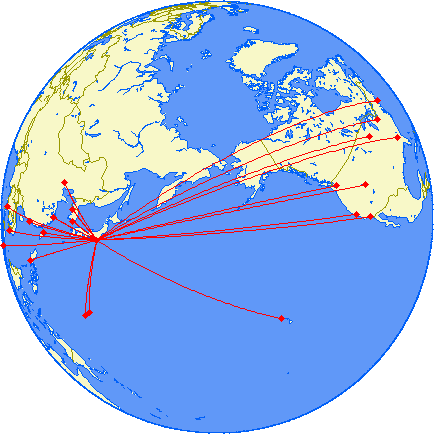
This is the ex-Narita route map of Delta Air Lines following its acquisition of Northwest. Delta is the #3 carrier at Narita with about 330 flights/week, compared to JAL’s 870 and ANA’s 500.

Northwest, whose operations account for the vast majority of Delta’s combined total, was the first airline to serve Japan following World War II. It provided the technical assistance which was necessary for JAL to start up in the early 1950s, and it has maintained an Asian mini-hub in Tokyo since the immediate postwar era. Delta came into the picture much later: they flew a very odd Portland-Nagoya route for a while in the 1980s, then pulled out of Japan completely, then came back in the 90s with a daily Atlanta flight. While Northwest was well-entrenched with travel agents and corporate travel desks, Delta relied more on feed from its US and Latin American route network out of Atlanta.

Now that Delta has absorbed Northwest, American is the small fry among US carriers at Narita, with just 70 weekly flights in comparison to Delta’s 330, United’s 150 and Continental’s 80. Despite this, AA has great marketing in Japan and their brand is fairly well-known here. Their saving grace is an extensive partnership with JAL through the oneworld airline alliance: JAL sells tickets on AA transpacific and US domestic flights, while AA sells tickets on JAL transpacific, Asian and Japan domestic flights. The carriers also cooperate with each other’s mileage programs, so that one can get JAL miles by flying AA, and vice versa.

AA has been doing fairly well lately, at least as far as US “legacy” airlines go. It just raised a cool billion dollars by selling frequent flyer miles to Citibank, which will, in turn, be dishing out more and more AA miles to credit card holders in the future. It also has more efficient planes trickling in to replace older MD-80 models in its US domestic fleet, which will improve its overall fuel efficiency and make it more competitive with the likes of Southwest and JetBlue.

JAL, on the other hand, is a financial disaster. Its “equal merger” with Japan Air System, which was supposed to make it more competitive in the domestic market, ended up creating two tracks of unionized employees, aircraft and operational infrastructure within the company, and this dichotomy has still not been sorted out. JAL still has a smattering of international routes that it doesn’t really need, most of which date back to the postwar economic explosion when the government basically tried to get JAL to fly everywhere in the world, on top of the extensive ex-JAS network within Japan that generally doesn’t mesh with the international network at all. On top of that, it has a huge, disorganized and fuel-hungry fleet of planes, and no money to swap them all out for a more streamlined fleet. JAL today looks a lot like Pan Am did in the 80s, and we all know what happened to Pan Am.

The Ministry of Land, Infrastructure and Transport has been pressing JAL to tie up with Delta for a few months now, according to media reports. Its reasoning is that the two carriers can code share, fill each other’s empty seats and tacitly cede certain markets to each other’s flight operations, much as JAL and American do now. Since Delta has many more routes from Narita, and significant overlap with JAL’s route network, turning the two competitors into allies would help JAL’s finances and justify some level of public funding to keep them afloat. Or at least, that was MLIT’s reasoning as of Taro Aso’s last day in power: New Transport Minister Seiji Maehara is being mum about the situation and implying that the Development Bank of Japan and private financial institutions may be on their own in financing a turnaround plan.

Delta has its own initiative to throw money on the table, and Delta’s interest basically explains American’s interest. I’ll let Cranky Flier, one of my favorite aviation bloggers, explain:

My guess is that [Delta’s Asian routes out of Narita] absolutely suck wind right now. If Delta is really losing a ton of money as I suspect, they could eliminate all those routes and either use the slots to fly to the US or transfer them to JAL. The additional connectivity in Tokyo that they could gain from this link-up would add a bunch more traffic to feed all that US-Tokyo flying Delta does now. (You people in Portland could breathe a sigh of relief, because this could probably help that flight come off the edge of the cliff.)

This move could make a big, immediate difference on the bottom line. If Delta can pour some money in but get it back out very quickly in the form of improved profits, then it’s a no-brainer. …

Of course, if JAL leaves, oneworld loses, so American has now come back with its plan to invest in JAL.

To this, I would only add that although Delta has inherited Northwest’s excellent sales and operational staff in Tokyo, Delta has not been making much effort to publicize its acquisition of Northwest here, except through a few ads here and there that are apparently direct translations of the ads they use in the US. This indicates to me that they are not particularly interested in developing their brand in Japan, despite the fact that it is now their most important overseas market. It’s much easier, from Delta’s perspective, to let JAL sell seats out of Japan under its own brand.

Some analysts and reporters have also raised the topic of Haneda slots, with very little clarification as to why Delta would care about Tokyo’s downtown, mostly-domestic airport. As many MFT readers know already, the Japanese government is slowly making Haneda more international. They are building a new international terminal and have started the legal documentation necessary to allow nonstop service from Haneda to Southeast Asia, Europe and other new destinations, primarily during late-night and early-morning hours when Narita is closed. The United States is not on the table yet, but many observers believe that an “open skies” treaty to open the aviation market between Japan and the US is long overdue, and with that treaty would come the ability to serve Haneda from the US. The most interesting aspect of Haneda for trans-pac flyers is that it will be open 24 hours, potentially allowing early morning or late-night flights between Tokyo and the West Coast that wouldn’t eat up a working day on either side of the ocean. Delta and American should both have an interest in such a service, especially if they can be assured of good domestic feed within Japan out of Haneda, which JAL is best positioned to provide.

It won’t be an easy ride, though. Whoever bails out JAL will have to sort through their mess of operational issues in order to get some return on the investment.

New DPJ cabinet is NOT totally awesome–the counterview to “Change We Can Believe In” irrational exuberance

Adamu is totally pumped about the new DPJ cabinet. You won’t be surprised to hear that I’m underwhelmed by Hatoyama’s sausage fest of a government, full of elected politicians with precious little experience in government, and incorporating no experience from the private sector.

That being said, we agree on the basics. PM Hatoyama should be applauded for appointing Messrs. Fujii and Okada, respectively as Ministers of Finance and Foreign Affairs, making sure that adults are heading the most important positions. The appointment of social policy progressive Keiko Chiba as Minister of Justice is interesting and probably a positive move. I look forward to seeing how she fares in promoting her liberal policies noted in Adamu’s post, which would probably be for the better of the country, although realistically, I have low expectations on her accomplishing anything. Kamei Shizuka is just awful in the position of the Financial Services Agency, and we can only hope that he has some sort of Makiko Tanaka-esque failure.

But then let’s get to what we disagree on. Kan Naoto has fortunately been placed in a senior position where is only role is waffling about policy. The DPJ and Kan have tried to polish his reputation by endlessly unearthing the fact that he on breaking open the AIDS blood transfusion scandal. But a more objective view would note that he was at the helm of the Ministry of Welfare and Labor when the pension fiasco began, he tried to target LDP politicians for not paying into the national pension program with Gingrich-esque hubris when he himself wasn’t paying into the pension program himself.

Seiji Maehara, a hawkish DPJ faction leader who in some ways is philosophically closer to the LDP reform wing, has been appointed to lead the Ministry of Land, Infrastructure and Transport (and Tourism!) and has started out be reasserting the DPJ’s promise to cancel all dam projects, including the Yamba Dam project that has already gone through more than 300 billion yen of its 400 billion budget. The DPJ’s rejection of new projects is understandable; it’s refusal to approval the completion of projects that are done is just barmy — especially as the governors of Tokyo and Gunma, which have paid for part of the budget, are preparing litigation against the government to get back the money invested from their prefectural budgets, which they seem very likely to win.

Then there’s pension policy wonk Akira “Mister Nenkin” Nagatsuma (actually his real nickname) appointed as Minister of Health and Welfare. He was expected to be a vice minister for just pensions and yet has been appointed to run the whole ministry. The scene yesterday at his appointment was fascinating — outgoing LDP Minister Yoichiro Masuzoe gave his farewell address and was greeted by applause by the bureaucrats. Nagatsuma’s entrance was met with stony silence and shallow bows, which he answered by saying in his address that he was going to “purge the ministry of grime and pus.”

Nagatsuma’s post will probably be the ongoing test ground for the DPJ’s anti-bureaucrat stance: how can a minister who has spent the past years eviscerating the bureaucrats now effectively manage them? At least Tommy Carcetti understood the importance of co-opting people inside the institutions he had to change. The DPJ is going to need the help of the bureaucrats to effect the reforms they want to carry out.

The rest of the cabinet is hard to gauge because few have previous experience or much of a public reputation. The one other startling fact is the lack of private sector expertise. The Constitution of Japan only requires that a simply majority of the cabinet ministers be an elected member of either the upper or lower house. Koizumi was especially noticeable for bringing in private sector know-how to the cabinet. That is noticeably absent in the “mock-Westminster system” that the DPJ is advocating, for indiscernible reasons.

Hatoyama enters office with 75% approval ratings, numbers that are matched only by Koizumi in 2001. I would wager that they are at around 30% a year from now.

New DPJ cabinet is almost totally awesome

First, the bad news. Shizuka Kamei has been appointed minister of postal issues and financial services. The man is a fierce, fierce fighter who likes to dredge up personal scandals using his ties as a former police official. That’s probably how he got the job. Now he’s going to make sure Japan Post remains the world’s biggest and possibly worst-managed bank and he’s going to crush regional banks by allowing all the people they lended money to stop paying for three years. Great.

As I just commented over at Observing Japan’s assessment of the new lineup, I hope Kamei simply collapses under his own weight. He may well overreach in a position that gives him barely any authority at all. If any place should be safe from unwise political meddling, it’s the FSA which has SEC-like regulatory and law enforcement authority over all financial services institutions.

Otherwise, not a bad lineup. Though Time Magazine posits Ozawa as a “shadow shogun” (reflecting the “Ozawa is the real one in charge” theme trotted out by both Nikkei and Yomiuri, who are wary of a DPJ administration) the cabinet reflects a wide sampling from the party including people not so close to Ozawa, like finance minister Hirohisa Fujii who was an early voice calling for Ozawa to step down over the Nishimatsu political funds scandal.

Asahi had an interesting section listing some of the human side of each new minister. I reproduce some of it here:

Foreign Minister Katsuya Okada has a giant frog collection. I have heard it from an eyewitness that it’s really huge. Not sure if any of them are mutant.

The above-mentioned Kamei Shizuka is a sixth-degree black belt in aikido and has held exhibitions of his oil paintings.

Naoto Kan, head of the National Strategy Bureau, was DPJ president in 2004 when he was going after LDP politicians for failing to pay into the national pension system (a duty for all residents in Japan, including yours truly). When it was found that Kan himself failed to make his payments, he was forced to resign in shame. To get over the shock of the whole series of events, he decided to shave his head and make the traditional pilgrimage to 88 Buddhist temples in Shikoku.

Justice minister Keiko “Sonny” Chiba (not really her nickname) is a former Socialist Party member who’s against the death penalty, for dual citizenship, and pro letting women choose whether to take their husband’s names when they get married. The trifecta of policies I’ve been waiting for! There is no news that the DPJ plans to abolish the death penalty, but for the time being this election appears to have saved the life of Shoko Asahara, Tokyo subway sarin attack mastermind and Japan’s most famous blind cult leader/death row inmate (and my neighbor at nearby Tokyo Detention Center).

Social Democratic Party leader and consumer affairs, birthrate, and gender equality minister Mizuho Fukushima is not only a lawyer and former TV commentator, she is a huge Miyazaki fan and serves as a judge to select the Nikkan Sports film prizes, the top honors of which in 2007 went to “Even So, I Still Didn’t Do It” about a man wrongly accused of train groping.

Hirotaka Akamatsu, agricultural minister, was once a flight attendant in the 70s. One flight was hijacked by the PLO and he had to help negotiate with the terrorists in English.

Administrative reform minister Yoshito Sengoku had his stomach removed in 2002 due to cancer.

These two didn’t make it into the cabinet (this time), but I think it’s safe to say DPJ upper house member Ren Ho (who Ikeda Nobuo thinks would make a good press secretary) and “cosplay erotica writer” turned newly elected DPJ lower house member Mieko Tanaka are the two best-looking women in the Diet right now:

Ren Ho Tanaka 850745001

Handle with care, indeed.

Okada: No need for vice-minister press conferences; Nikkei: Take it back NOW

My new circumstances give me access to most of the daily papers, in real live dead tree format. So today I looked at the Nikkei and came away with some thoughts:

Nikkei has an editorial forcefully demanding that the DPJ scrap any plans it might have to eliminate press conferences for every ministry’s vice-minister (事務次官). The piece is a reaction to a recent comment from incoming foreign minister Katsuya Okada that they wouldn’t need to hold their own press  conferences because the traditional vice-minister inter-ministry meetings will be discontinued. Under LDP rule, the meetings had become a sort of shadow cabinet meeting and a manifestation of bureaucrat rule.

Calling the suggestion “rash,” the editorial writers lecture Okada that the people in power always try and reduce the number of press conferences as a way to escape scrutiny, and that it’s not up to those in power to decide what the public’s right to know is. One example of the benefits of these press conferences is that the agricultural vice-minister recently had to step down for making inappropriate comments at his press conference about a tainted rice scandal.

I checked, and none of the other major newspapers felt the need to devote an editorial to this issue (the Yomiuri for its part allotted its second editorial to lionizing Ichiro for his new hitting record). But I wouldn’t be surprised if some follow the Nikkei’s lead.

The incoming DPJ administration is expected to open up the press clubs in government institutions, which previously have been almost exclusively limited to domestic, mainstream newspapers and TV stations. Hence, the mainstream news media are on the watch for any signs they could lose their biggest asset – privileged access to those in power. The newspapers are more exposed to damage on this front than TV stations as the news is their only business, at least in their principal medium. The Nikkei in particular just got done posting its first loss since it started publishing figures, for the first half of 2009.

In principle, I agree with the Nikkei’s point that the powerful should be held up to scrutiny. But the Nikkei is changing the subject. Okada didn’t necessarily say he wanted to reduce the number of press conferences. As far as I can tell, Okada’s is merely saying that if the vice-ministers aren’t going to be in a position to speak for their ministries, of course they shouldn’t have press conferences. Maybe a political appointee would be the more appropriate person to put in front of the podium.

In fact, the DPJ’s plans to open up press clubs to independent media will open up government, so I would not be worried if the government stops holding press conference for people who are supposedly irrelevant anyway. The DPJ shouldn’t listen to the Nikkei. Remember, the media will try to portray itself as a defender of the public good, when in fact it’s an institution that’s exploited government secrecy for decades to its financial benefit. I would be happier if the Nikkei spent its vast resources not on acting as stenographers for the government and occasionally getting someone to say stupid things in public (as they did to make the vice minister resign), but instead on actual investigations.

Max Blumenthal at the 9-12 rally in DC

Just thought I’d pass this amazing video along.

Some of the interviews are unfair “gotcha” material, but it’s great to see people get confused when he asked them why they’re so opposed to health care reform and what exactly will happen when the “Obama revolution” goes down. These people really should stop and ask themselves what they’re getting so paranoid about.

Ayase crime update: Possible foreigner robs sushi restaurant… across the street from my apartment

While making breakfast this morning, I noticed a couple of news trucks around the sushi restaurant across the street, which is the first thing I see when leaving my apartment in the morning. I figured that Gal Sone was probably eating a metric ton of kohada or something, but the truth was far darker. Kyodo reports:

Robbery at Choshimaru kaitenzushi: 720,000 yen seized

Around 6:30 AM on the 13th, a man entered from the back door of the Ayase Sushi Choshimaru kaitenzushi restaurant in Yanaka 1-chome, Adachi-ku, Tokyo, held a knife to the clerk (26) opening the restaurant, said “Give me your money,” seized 720,000 yen in sale receipts from the safe and fled. The clerk was unharmed.

The Metropolitan Police Ayase Station are searching for the man as a robbery suspect.

According to the Ayase Station, the man is around 30 and about 160-170 cm tall. He was wearing sunglasses, a black short-sleeved shirt and jeans. The clerk claims that “he threatened me in broken Japanese.” (Kyodo)

The Jiji report uses a fascinating phrase to describe the perp: “アジア系外国人風,” which means something like “looks Asian, seems foreign.” Fortunately, I only fit half of those criteria.