
When I hear about the death of James Brown I can only think of this:
And when I hear about the death of Gerald Ford I can only think of this:
When I hear about the death of James Brown I can only think of this:
And when I hear about the death of Gerald Ford I can only think of this:
Q: At what time does the average (employed) Japanese person wake up?
The answer comes after the jump.
Continue reading Quiz time! At what time does the average Japanese person wake up?
Japanese weekly business magazine Shukan Toyo Keizai (Weekly Oriental Economy) has given me a very nice Xmas present: They finally post some free content online! I was even more delighted to discover that one featured article discusses a topic that’s come up in a recent post: the “decline” of Japan’s animation industry. According to animation critic Ryota Fujitsu (who incidentally also is on the selection committee for the Nippon Otaku Awards) argues that rather than declining per se it’s “hollowing out” due to outsourcing of animators. I decided to translate it in full since it brings up some interesting issues. Let’s have a look:
The Hollowing Out of Japan’s Animation Industry Continues
(2006/12/19)
Currently, Japan’s animation industry wouldn’t be viable without the presence of Korean and Chinese subcontracting companies. Why must the industry rely on foreign outsourcing? If you trace the causes of this dependence, you’ll find the answer lies in the low production costs. Normally, production costs of a 30-minute program amount to around 10 million yen apiece. However, it costs even more than that for a more elaborate project, and there are also many works that are produced for prices lower than 1 million yen. This situation has been going on for years, and you could say it has become entrenched. So as a result, the issue of low wages for animation staff, chiefly represented by the animators, has been repeated in the media. This is despite the facts that dozens of animated programs are shown every week, and animation has been proclaimed as “a subculture representative of Japan” by the media.
One third of animators make less than 1 million yen annually
The typical lifestyle of a contemporary animator was detailed in the 2005 study “Status of Activities and Lifestyles of Performing Artists” conducted by the Japan Council of Performers’ Organizations (tr: report available here in Japanese only).
According to this source, animators work an average of 10.2 hours a day, an estimated 250 hours per month. Despite this, 26.8% of the make less than 1 million yen per year, 38.2% earn an average annual income of between 1 million and 3 million yen annually. Meanwhile, 80% of in-between (douga) animators are paid by quantity, with per-cel prices averaging 186.9 yen. 73.7% had annual incomes of less than 1 million yen.
Continue reading Japan’s animation industry hollowing out?
As a total atheist and a Jew, Christmas means absolutely nothing to me except for school vacation, annoying music, and an annual party at my friend Alistair’s house, but for some reason it has made a huge impression throughout the world, even in many countries like Japan where Christianity is virtually nonexistent. I’m not going to try and do any boring analysis about why, but I want to show two different news stories that discuss Christmas in Japan.
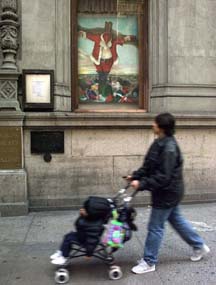 First, we have this really boring article about Santa Claus, written for Slate by David Plotz.
In Japan, a department store recently stumbled into the yuletide spirit by displaying Santa Claus–nailed to a crucifix.
This would be a pretty funny mistake if it were true, but it only took me ten seconds of fact checking (typing “Japan crucifix santa” into Google and finding a thorough Snopes.com article debunking this story) to find that it never actually happened.
Then we have this “foreigners eat weird food”Reuters article from Reuters, which tells us the incredible truth that people living in countries without Turkey don’t eat Turkey on Christmas! (I thought Christmas was ham or goose anyway? Aren’t most Americans still sick of turkey from Thanksgiving?) Anyway, here are the Japan bits:
In Japan, many people head to Kentucky on Christmas — Kentucky Fried Chicken, that is.
The fast food joints do a roaring trade over the Christmas period, with restaurants turning away customers on December 24 if they haven’t booked their chicken in advance.
“Over the period from 23rd to 25th December, sales can be as high as ten times normal levels,” said Sumeo Yokokawa, of the public relations department at Kentucky Fried Chicken Japan.
The Kentucky Christmas habit started in 1974, after a foreign customer mentioned to a store manager that he had come to buy fried chicken because he was unable to find turkey in Japan. His words inspired a sales campaign that paid off.
“The fashion at the time was to have a nice American-style Christmas,” said Yokokawa. “So we offered the chicken as a set with a bottle of wine and it was very popular.”
[…]
In Japan, many families opt for a plain sponge cake topped with whipped cream and strawberries. As delicious as it sounds, the term “Christmas cake” was long used to refer to unmarried women over the age of 25, who were said to be past their best, like cakes after December 25.
All of this is actually totally true. Not just KFC, but also Lotteria (crappy McDonald’s knockoff, apparently soon to be replaced by its parent company with a Burger King franchise) offer Christmas promotions on fried chicken, as do supermarkets, and even the small but excellent fried chicken takeaway I found in the Demachi area shoutengai this past Sunday. I would also like to congratulate the reporter for indicating that the totally old fashioned and no longer used “Christmas cake” expression for unmarried women is in fact no longer used. I’ve seen Western media touting that expression as recently as a year or two ago, and it’s nice to see that news of its demise is filtering abroad.
You may have noticed that Prime Minister Shinzo Abe isn’t all that popular these days despite only having been in office for 2 months. The newspapers are reporting a 20% dip in support, and he has been mired in scandals, the most recent of which surrounds Tax Commission Chairman Masaaki Honma, who was forced to step down for living in subsidized housing with his mistress. This is the first change to Abe’s appointed team since taking office and a major development that could lead to further loss in confidence.
Compared to Koizumi’s first 2 months in office back in 2001, when the lion-maned PR darling was a veritable rockstar with his own hit photobook, Abe isn’t getting a break. And this despite the nuclear missile test in NK, which would presumably inspire a nation to rally around its leader.
While the substance of Abe’s policy agenda got its share of attention, the media has seemed to go out of its way to focus on Abe’s missteps, in particular the town meeting scandal (Abe knew!), the readmittance of the postal rebels (the LDP is cynical!), and his supposed lack of resolve in pursuing economic reform and budget discipline (he’s giving power back to the evil bureaucrats!).
Why? One reason is the Ozawa-led DPJ. They have so far done a good job of relentlessly pushing the first two issues in the spotlight, in particular the town meeting scandal, which was embarrassing since the LDP government was caught red-handed. There’s an upper house election in 7 months, and it comes at a time when LDP is vulnerable (the LDP member who won seats in 2001 on the Koizumi popularity wave must now stand for reelection) that also happens to be a traditionally unlucky year for the LDP. While some reports claim the DPJ is being needlessly uncooperative, the numbers show that these scandals are taking their toll on Abe’s popularity rating, and that makes them effective. Without public support Abe loses quite a bit of leverage if he’s to lead policymaking and stay in power for his full term.
But another, more likely, explanation is that Abe is having a tough time dealing with the media. For one thing, he isn’t playing ball with the press gaggle.
I noted back in October that Abe decided to cut in half his daily press availabilities from 2 to 1. The reports offered no real explanation for the change, but it was significant enough to get reported in the first place. Instead, he is relying on his PR double team of Chief Cabinet Secretary Yasuhisa Shiozaki and Special Advisor Hiroshige Seko to deal with the press while he does the awesome prime minister stuff like eat school lunches.
But it hasn’t taken very long for the media to complain that they aren’t getting enough face time. Abe got in trouble just yesterday when he talked way too long during his press conference announcing achievements upon the end of the recent extraordinary Diet session. He used up 19 minutes of a 20 minute press conference to blab on listlessly about the legislative achievements of passing patriotism-instilling education reform and the promotion of defense agency to ministry status.
The media was livid and ran stories announcing that only 2 questions could be asked, and later reports announcing the forthcoming apologies from both Shiozaki and Abe himself. Abe pledged that it someone made a “clerical error” by giving him a long speech at a press conference. How convenient just a day before you have to fire someone!
Now, I don’t want to go and accuse the major media of manufacturing any of his scandals, or blowing things out of proportion (though they may be doing the latter). It’s just that they haven’t been very sympathetic, either. The Honma scandal came out of a muckraking piece by a less-prestigious weekly. Many reports by the weeklies (such as Abe’s ties to shady cults) are ignored by the larger newspapers, but this time they picked up the story, making the problem much larger than it normally would have been.
It’s strange to see this change in the relationship, since as far as I know, Abe has so far had a rather amiable relationship with the press, who helped raise his image as the hero working to rescue kidnapping victims from North Korea. Now it’s like they’re setting him up for a fall just because it would be a good story.
But rather than being angry, the media could simply be getting bored with a prime minister whose hair is far too normal. One anonymous insider quoted in a Reuters story was sympathetic with Abe’s situation, noting that Abe is in part simply dealing with the Koizumi legacy of staged appearances and neverending soundbites: “Abe is doing what he can, but to the public who’s used to theater-style politics it just looks normal.” Replace the word “public” with “media” and you’ll get the idea.
Phenomenal talent but unrelenting freakshow Michael Jackson saw himself back in the news this week when he cancelled a Xmas party that was to be held in Japan. ZAKZAK takes a closer look at what happened:
The truth behind the sudden cancelleation of Michael’s Xmas party
Confusion over hiring Dave Specter as host
Fans of American singer Michael Jackson (age 48) were peeved at the sudden cancellation of the planned “Premium Christmas Party” to be held at Studio Coast event hall in Shinkiba, Tokyo on December 19. A spokesperson for Michael explained that the reason behind the postponement was “to engage with as many fans as possible” and rescheduled the event for March 8-9 of next year. The postponement is enshrouded in mystery, and claims have been made of Michael’s poor health and poor sales of the most expensive Platinum Tickets, priced at 400,000 yen apiece.
According to sources close to the issue, the party originally planned for 200 Platinum Tickets (priced at 400,000 yen each that would have included a photo and handshake with Michael), and 1400 Golden Tickets (just a handshake for 200,000 yen). Jackson himself was not scheduled to perform, but spokespeople explained that “Michael was to watch a show, consisting of gospel and band performances, along with his guests from a VIP area on the 2nd floor.”
Planners began additionally selling 50,000 yen tickets from December 5. Event planners repeated boastful explanations that “Sales of Platinum and Golden Tickets have only amounted to a few buyers, but we have filled the hall.”
At the “do-over” party to be held in March, a “Premium VIP Party” will be held on March 8 with tickets selling for 400,000 yen apiece, and on March 9 ticket prices will be lowered to 15,000 yen for a fan appreciation event.
Michael fan sites have recently expressed mixed opinions, from hopeful (“No matter how expensive it is, there is a corresponding value to Michael in the flesh”) to opposed (“This is a simple ploy to make money and will tarnish Michael’s image”).
The confusion continues, with episodes such as when television producer Dave Specter, approached by event planners to host the March party, declined the offer after protests from Jackson fans.
Dave commented, “Since I have before now made many (critical) statements about Michael as a journalist (tr: He hosted the Japanese version of that interview from a few years ago when Michael insisted that sleeping in the same bed with young boys is all right), I had no choice (but to decline the hosting gig). There are many excitable fans who worship Michael as if he were a god.” He also noted that for the March party “He will probably come on the scheduled date and time since there is a proper contract. The tickets are certainly expensive, but I have heard that inquiries from abroad have been impressive.”
There have been reports that Michael’s health is in bad condition, such as when US tabloid Globe has reported: “He is addicted to painkillers and wine.” However, it looks like Michael will continue to make his fans inpatient right up until the March party.
Comment:It looks like Michael sees Japan as the only place where he can make profitable public appearances these days. What I don’t get is why won’t he perform? If he wants to make money that seems like the most logical way to do it.
At lunch today I heard that a guy working in another department put in a request for an impressive 45 hours of overtime payment. However, while he did do the extra time on the clock, he actually spent most of it just surfing the net. The boss is naturally angry, but since they both live in the same neighborhood, the boss doesn’t want to get in an argument over and cause trouble.
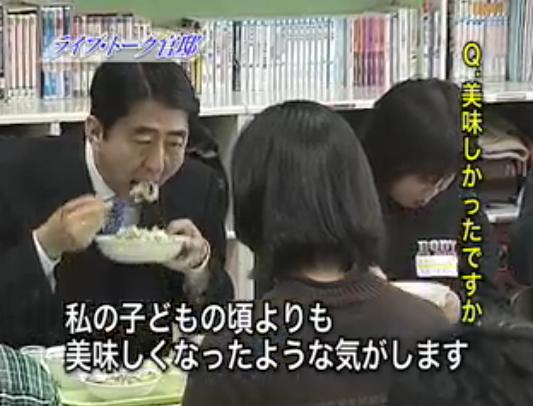
Last week, Prime Minister Shinzo Abe took a trip to some random elementary school where he made a point to eat one of the nationally subsidized school lunches (“kyushoku”) with students. He ate a salmon steak, some wakame miso soup, rice mixed with some kind of seaweed, and washed it all down with a frosty mini-bottle of milk (salmon and milk? Ick!). He remarked it was even more delicious than his old school lunches (which likely included a bit of whale meat) despite having “some difficulty” finishing the whole thing. Here’s what it looked like:
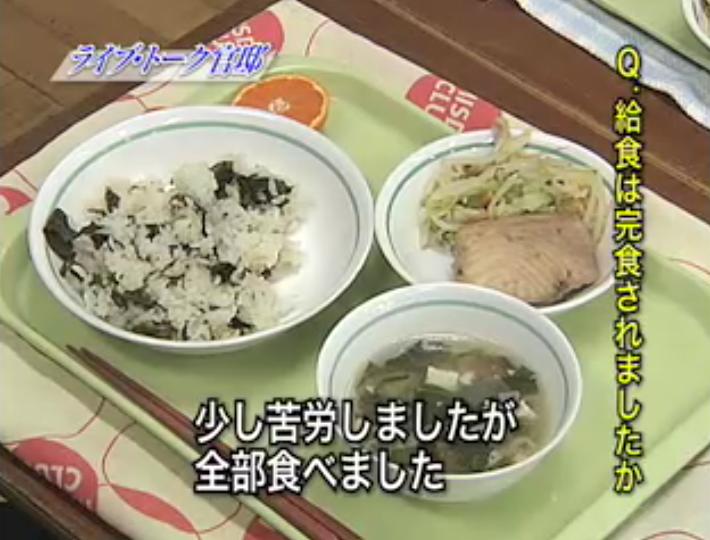
And here’s what Abe had to say about the visit in his latest e-mail magazine:
I visited an elementary school in Tokyo last week in hopes of getting a feel for the educational environment children are in today and talking to them in person.
It was my first visit to an elementary school in the 40 years since I graduated from my own. Over lunch, I had a chance to hear, in their own words, what children are really thinking. Many shared with me that they enjoy extracurricular activities and sports. They also asked me unpretentious questions, such as, “As a child, did you have a goal in life?” These questions reassured me that children have hopes and dreams for what they want to pursue in the future.
I was a bit worried that the children would tense up with the press crew in their classroom, but the close bond the class shared and the warm smiles they gave me as we talked impressed me strongly.
I have kept in close touch with my elementary school friends, meeting with them frequently even now after 40 years. Exciting
times spent together with friends, even if you occasionally argue, will become a precious memory later in life. It is my hope that
children will possess the kindness to go over and talk to another child they see all alone. I was able to convey this message during
my visit to the school.
While he also added some token call to action against evil bullying activities, I couldn’t help but focus on and feel jealous of the delicious-looking lunches these kids get to eat. I never once got a taste of salmon during my US education, though perhaps it’s all the better since I wouldn’t have trusted my lunch ladies to prepare fish anyway. Still, it’s no wonder Japanese kids are so much healthier. Well, that and the constant endurance tests that they call phys ed class and extracurricular sports.
The Dragon Quest/Dragon Warrior series (one of my favorites) has made the move back to Nintendo from Sony, starting with Dragon Quest 9 on the DS. Why?
According to ZAKZAK, an industry insider explains: “The key can be found in the DS’s surprisingly strong sales. Currently, the cost of developing a game ranges from 300-500 million yen, but that will jump to 800 million – 1 billion yen with next-generation systems such as the PS3. Most developers who got a look at the PS3 when it made its first appearance as a demontration system at the Tokyo Game Show were intrigued by the clear images but did not get it in their heads to go that far themselves in game design. It would just cost too much.”
Games on portable systems cost much less to develop. And the DS is already a monster product, clocking 12 million units in sales since its release in December 2004. And of course games for that system have been hits as well, such as the “New Super Mario Brothers” and “DS Brain Training.” Add the latest installment of Dragon Quest, one of the top console series ever, to that lineup would be tantamount to “arming an ogre with an iron staff” in ZAKZAK’s vernacular (an analogy akin to “pouring gasoline on a fire”). Future DQ games will be released on the Nintendo Wii.
However, DQ series developer SquareEnix is not putting all its eggs in the Nintendo basket. The new Final Fantasy games will continue to be released on the Playstation as the company announced in May. SCE is also a major shareholder in SquareEnix.
From the people who brought you Krispy Kreme Japan (which opens today) comes another wonderful fast food innovation: Burger King will be coming back to Japan! Unfortunately, they’re aiming to be a Mos Burger-style “high class” fast food chain and are thus charging a “whopping” 700 yen for a value meal.
Still, BK in Japan will help alleviate some homesickness as it does here in Thailand. What could be next, a cheap, delicious bagel outlet? One can only hope.
Given my elated gratitude at such news, I am more than happy to reprint the company’s press release on the matter, which ran as a story in Friday’s Nikkei:
Burger King To Return To Japan With Help From Lotte, Revamp
TOKYO (Nikkei)–Lotte Co. and turnaround firm Revamp Corp. have entered a franchise agreement with Burger King Corp. of the U.S. and will start opening stores of the hamburger chain in Japan next summer, The Nihon Keizai Shimbun learned Thursday.
Lotte and Revamp have set up a company for the operations, with Lotte kicking in the bulk of the funds.
The partners hope to have eight directly run stores by March 2008. They plan to expand the chain to 50 locations, mainly in the Tokyo area, by March 2010 and to 100 by 2012.
This marks a comeback for Burger King, which entered the Japanese market in the 1990s in cooperation with the Seibu Railway Co. group and Japan Tobacco Inc. but withdrew in 2001 in the face of poor results.
Burger King will promote its burgers in Japan by stressing the fact that it flame-broils its patties rather than heating them on a grill.
A set of a burger and a drink is expected to cost around 700 yen — 30-40% more than is charged by the Lotteria chain, which is run by Lotte. McDonald’s Co. (Japan) charges around 500 yen for a similar meal, while Mos Food Services Inc. and Freshness charge about 700-800 yen.
Lotte plans to turn its Lotteria chain, Krispy Kreme Doughnuts stores, which will begin opening in Japan this month, and Burger King restaurants into three main pillars of its restaurant operations.